
What Automobile Emissions Are and How Much Cars Actually Pollute
A typical gasoline passenger vehicle puts out about 4.6 metric tons of CO2 every year, or about a few hundred grams per mile, based on EPA’s assumptions of typical annual mileage and fuel economy assumptions. That’s the headline number, but it’s not the whole story. Automobile emissions break into two buckets that matter for different reasons: greenhouse gases that warm the climate, and criteria pollutants that dirty the air you breathe right now.
The pollutants worth knowing:
- CO2 — the main greenhouse gas, tied directly to how much fuel you burn.
- NOx (nitrogen oxides) — reacts with sunlight to form smog
- CO (carbon monoxide) — a toxic gas from incomplete combustion
- Hydrocarbons/VOCs — unburned fuel that also feeds smog formation
- Particulate matter (PM2.5/PM10) — soot-sized particles linked to lung and heart damage
- Evaporative emissions — fuel vapor that escapes through a leaky EVAP system, not the tailpipe
If you’re a driver trying to prioritize, it comes down to three things: keep your emissions control systems maintained, drive efficiently, and factor lifecycle impact into your next vehicle purchase.
Key Takeaways
Automobile emissions come down to two categories, greenhouse gases that warm the climate and criteria pollutants that affect local air quality, and reducing both starts with keeping exhaust and evaporative control systems in working order.
| Point | Details |
|---|---|
| Know your baseline | A typical gas vehicle emits about 4.6 metric tons of CO2 per year, or 400 g per mile, under EPA assumptions. |
| Two failure points dominate | Most test failures trace back to a degraded catalytic converter or an EVAP system leak. |
| Rules are tightening in stages | Standards for MY2023 to 2026 are active now, with EPA’s multi-pollutant rule phasing in for MY2027 to 2032. |
| Vehicle choice depends on the grid | EV lifecycle emissions advantage over gasoline varies with local electricity mix, per Argonne’s GREET model. |
| Local repair support matters | Tom’s B & M Auto diagnoses and repairs catalytic converter, EVAP, and other emissions-related issues for Lynnwood drivers. |
Table of Contents
- How Do States Test a Car’s Emissions?
- Who Regulates Car Emissions in the United States?
- How Vehicle Emissions Affect Air Quality and Health
- What Can Drivers Do to Cut Vehicle Emissions?
- Where Do the Emissions Numbers in This Article Come From?
- A Repair Shop’s View on Emissions Failures
- Why the “Just Buy an EV” Answer Oversimplifies Emissions
- Get Your Vehicle’s Emissions Systems Checked at Tom’s B & M Auto
- Frequently Asked Questions
- Sources
How Do States Test a Car’s Emissions?
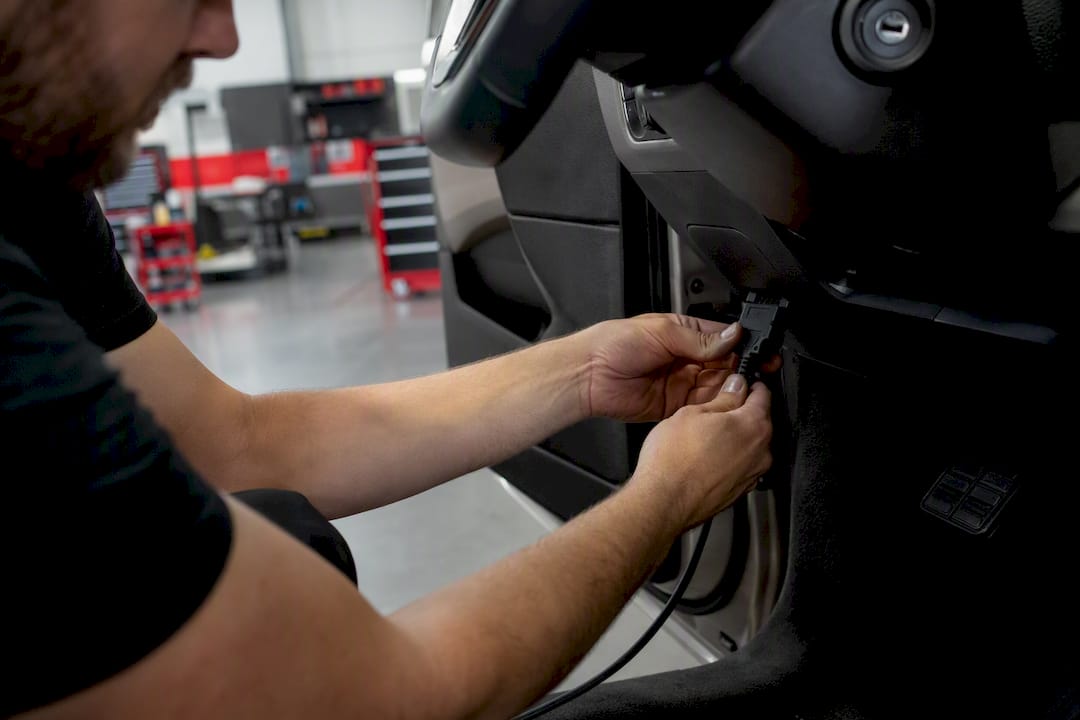
Emissions testing splits into two main approaches, and which one applies to you depends entirely on where you live and how old your car is. Older vehicles sometimes still go through a tailpipe test, where a probe measures actual exhaust gases while the car runs on a dynamometer. Most modern vehicles, though, get an OBD-II check, where a technician plugs into the car’s onboard computer and reads stored diagnostic codes and monitor status instead of measuring gas directly.
Testing programs also examine both sides of the equation. As ACEA explains, inspections generally check CO2 for fuel-consumption compliance and separately test CO, hydrocarbons, NOx, and particulates for pollutant limits. Real-world driving conditions can produce different results than lab-style tests, which is why some programs now supplement fixed-station checks with real-driving-emissions monitoring.
Pro Tip: If your check-engine light is on, don’t bother scheduling a smog test yet. Most state programs will fail you automatically for an illuminated light, or an OBD system that isn’t “ready,” regardless of what’s actually causing it.
A typical state workflow looks like this:
- Vehicle owner receives a renewal notice or registration reminder
- Car goes to a certified testing station for tailpipe or OBD-II inspection
- Pass results in a certificate; fail triggers a required repair
- Owner gets the issue fixed and returns for a free or discounted re-test
- Many states exempt new vehicles (often the first several model years) and very old vehicles
Fees for a standard test typically run in the $20 to $40 range, and the whole process, from initial test to repair to re-test, usually takes anywhere from a few days to a couple of weeks depending on parts availability. Rules vary widely by state, so check your own program’s page for exact fees and exemptions. The Illinois EPA’s vehicle testing page is a good example of how a state lays out its specific workflow and exemption list.
Who Regulates Car Emissions in the United States?
Three agencies split the regulatory work, and understanding who does what clears up a lot of confusion about why standards change and who enforces them. The EPA sets emissions standards and enforces the Clean Air Act. The NHTSA regulates fuel economy standards, which run parallel to and interact with EPA’s GHG rules. CARB, California’s own regulator, sets its own stricter emissions standards that other states can choose to adopt instead of the federal baseline.
The current regulatory picture layers two waves of rulemaking. Standards for model years 2023 through 2026 are already locked in and phasing through production now. On top of that, EPA finalized a multi-pollutant emissions rule in 2024 that sets new standards for model years 2027 through 2032, covering both greenhouse gases and criteria pollutants for light and medium-duty vehicles. The full regulatory text and technical justification sit in the Federal Register entry for anyone who wants to read the agency’s reasoning directly rather than take a summary at face value.
The transportation sector accounts for the largest share of U.S. greenhouse gas emissions of any sector, and light-duty vehicles, the cars and light trucks most people actually drive, make up the majority of that transportation total. That’s why passenger vehicle standards get so much regulatory attention compared to, say, freight rail or aviation.
What this means for drivers day to day:
- New vehicles sold in coming model years will carry tighter tailpipe standards, which usually pushes manufacturers toward more efficient engines or electrification
- Existing vehicles aren’t retroactively subject to new rules. Your 2019 sedan is graded against 2019 standards, not 2032 ones
- State testing requirements are separate from federal manufacturing standards. Even if your car met the manufacturing standard when new, it still needs functioning emissions equipment to pass a state test years later
How Vehicle Emissions Affect Air Quality and Health
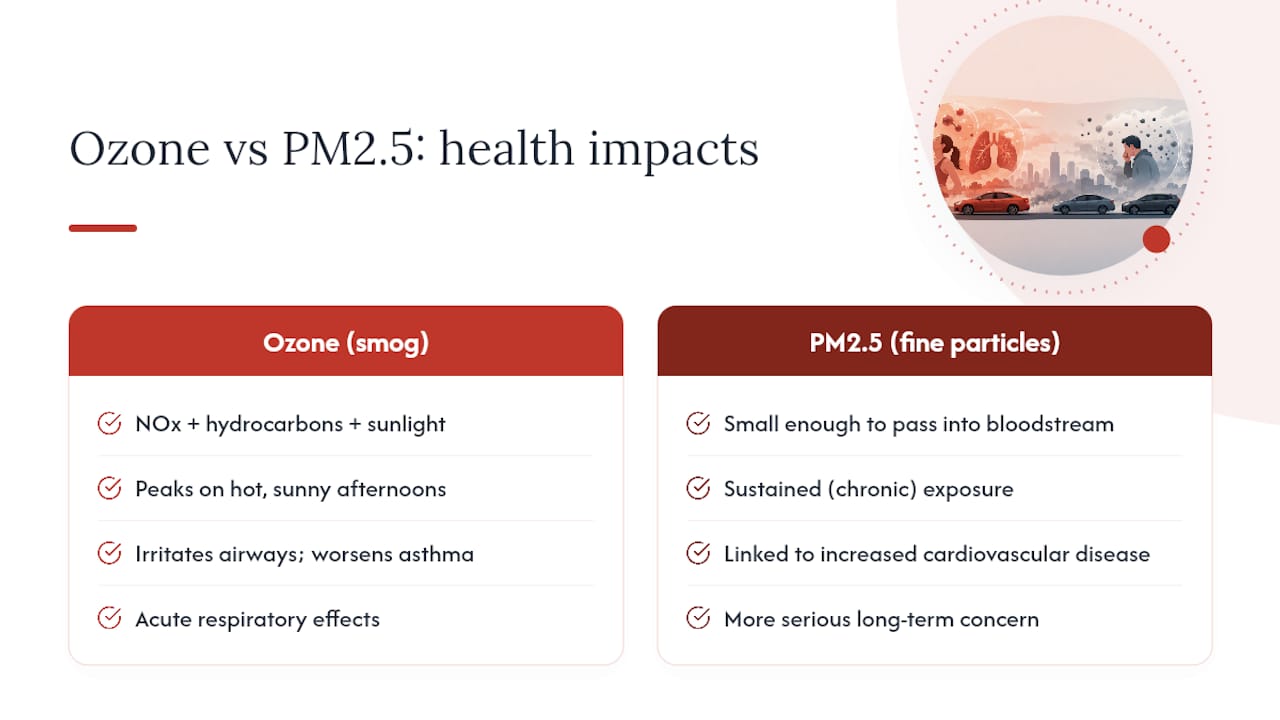
Smog doesn’t come out of a tailpipe as smog. It forms afterward, when NOx and hydrocarbons react in sunlight to create ground-level ozone. That’s why smog tends to peak on hot, sunny afternoons rather than during a cold morning commute, even if traffic volume is identical.
The health consequences split roughly along two lines: acute respiratory effects and longer-term cardiovascular risk. Ozone exposure irritates airways and worsens asthma, particularly in children and people who already have respiratory conditions. Fine particulate matter is arguably the more serious long-term concern. PM2.5 particles are small enough to pass through lung tissue into the bloodstream, and sustained exposure is linked to increased cardiovascular disease risk.
Vehicles remain one of the largest single contributors to smog-forming pollutants in most American cities, which is exactly why urban areas with heavy traffic density see disproportionately worse air-quality days compared with rural regions. People living near major highways and dense urban corridors, often lower-income communities and communities of color due to historical zoning patterns, tend to bear a heavier share of this exposure. That’s the environmental justice dimension regulators increasingly factor into where they concentrate testing enforcement and infrastructure investment.
On the climate side, the math is more straightforward: every gallon of gasoline burned releases a fixed and unavoidable amount of CO2, roughly 8,887 grams per gallon. Multiply that across the hundreds of millions of vehicles on U.S. roads and it’s easy to see why light-duty transportation carries so much weight in national climate accounting.
What Can Drivers Do to Cut Vehicle Emissions?
Not every emissions-reduction tactic delivers the same payoff, so it helps to rank them by actual impact rather than tackle them in random order.
- Keep emissions control systems maintained. A failing catalytic converter or a leaking EVAP canister will spike your pollutant output far more than a slightly under-inflated tire. Regular tune-ups, prompt attention to check-engine lights, and addressing misfires quickly all keep those systems working as designed.
- Adopt smoother driving habits. Hard acceleration and unnecessary idling both burn more fuel per mile than steady, moderate driving. Cutting excess cargo weight helps too, especially on vehicles that regularly haul unneeded gear.
- Think about your next vehicle’s full lifecycle, not just its tailpipe. This is where it gets more nuanced than “electric is always better.”
Argonne National Laboratory’s GREET model, which tracks emissions across vehicle production, fuel or electricity production, and actual driving, found that a representative 2024 EV produces significantly fewer lifecycle greenhouse gases than a comparable gasoline vehicle. That gap depends heavily on the local electricity grid; a coal-heavy grid narrows the advantage, while a cleaner grid widens it.
| Vehicle type | Relative lifecycle GHG advantage |
|---|---|
| Gasoline (ICE) | Baseline |
| Hybrid | Moderate reduction, no grid dependency |
| Battery electric | Largest reduction, but depends on local grid mix |
Whatever you’re driving now, regular preventive maintenance and prompt diagnostic work make the biggest near-term dent in what actually comes out of your car.
Where Do the Emissions Numbers in This Article Come From?
The EPA’s ~4.6 metric ton figure isn’t a mystery. It’s a straightforward calculation: 11,500 miles driven per year divided by 22.2 mpg equals roughly 518 gallons burned, and each gallon produces about 8,887 grams of CO2. Multiply those together and you land right around 4.6 metric tons.
Lifecycle comparisons work differently. Rather than measuring tailpipe output alone, GREET accounts for vehicle manufacturing, battery or fuel production, the actual driving phase, and end-of-life disposal. That full-picture approach is why an EV’s lifecycle number looks different from its “zero tailpipe emissions” marketing claim.
The primary sources behind this article’s figures:
- EPA’s greenhouse gas emissions baseline page
- EPA’s multi-pollutant final rule
- Argonne’s R&D GREET fact sheet
A Repair Shop’s View on Emissions Failures
Most emissions test failures we see at the shop trace back to two things: a degraded catalytic converter or an EVAP leak, not some mysterious engine problem. Our ASE-certified technicians run professional-grade OBD-II diagnostics on every make, and catching a failing catalyst early is almost always cheaper than waiting for a full test failure and a scramble to fix it before a deadline.
If your check-engine light is on or you’re staring down a smog-check deadline, get a free digital vehicle inspection before you assume the worst.
Why the “Just Buy an EV” Answer Oversimplifies Emissions
The conventional wisdom treats vehicle emissions as a simple binary: electric good, gasoline bad. That framing skips over the parts that actually matter for someone deciding what to do with the car they already own.
Here’s what gets lost. The GREET data shows a real and meaningful lifecycle advantage for EVs, but that advantage assumes the buyer is in the market for a new vehicle in the first place. Manufacturing a new car, electric or gasoline, carries a substantial upfront emissions cost from materials extraction and battery or engine production. If your current gasoline vehicle is running well and passing emissions tests, replacing it early doesn’t automatically produce a net environmental win once you account for the manufacturing footprint of the replacement.
The more overlooked lever is maintenance discipline. A neglected catalytic converter or a leaking EVAP system can push a single vehicle’s pollutant output well past what regulators intended for that model year, and that’s true whether the car is five years old or fifteen. Multiply that across a fleet of poorly maintained cars in a city, and you get a bigger real-world air-quality problem than the marginal difference between a well-maintained sedan and a hybrid. The unglamorous answer, fixing what’s broken and keeping systems working as designed, does more for near-term air quality than most people assume. Vehicle choice matters for the long run. Maintenance is what controls what’s happening on the road today.
Get Your Vehicle’s Emissions Systems Checked at Tom’s B & M Auto
If a check-engine light, a failed smog test, or an aging catalytic converter is what brought you here, Tom’s B & M Auto has handled exactly this kind of repair for Lynnwood drivers since 1985.
We’re a full-service shop for all makes, including Toyota, Honda, Subaru, domestic vehicles, and European and hybrid models that many general shops turn away. Our ASE-certified technicians run professional-grade OBD-II diagnostics to pinpoint the actual cause of an emissions failure instead of guessing, whether that’s a failing catalytic converter, an EVAP leak, or a misfire throwing off your readings. Same-day appointments are often available, pricing is upfront before any work starts, and every repair carries a 24 month/24,000 mile warranty. If a catalytic converter replacement or another emissions-related repair comes with a bigger price tag than expected, financing options can help spread out the cost. Start with a free check-engine light review to find out exactly what’s triggering the light before your next test deadline.
Frequently Asked Questions
How much CO2 does the average car emit per year?
About 4.6 metric tons annually for a typical gasoline passenger vehicle, based on EPA’s assumption of 11,500 miles driven per year at 22.2 mpg.
What’s the difference between a criteria pollutant and a greenhouse gas?
Criteria pollutants like NOx, CO, and particulate matter cause immediate local air-quality and health problems, while greenhouse gases like CO2 accumulate in the atmosphere and drive long-term climate warming. A car emits both simultaneously through different mechanisms.
Why did my car fail an emissions test with no check-engine light on?
OBD-II systems sometimes flag a “not ready” monitor status after a battery disconnect or recent repair, which can cause an automatic fail even without an active warning light. Driving the vehicle through a normal drive cycle usually resets the monitors.
Are electric vehicles really zero-emissions?
They produce zero tailpipe emissions, but lifecycle analysis from Argonne’s GREET model accounts for manufacturing and electricity generation too. A 2024 EV averaged about 52% fewer lifecycle greenhouse gases than a comparable gasoline vehicle, with the exact gap depending on the local power grid.
How often should I get my car tested for emissions?
It depends on your state program. Many require testing every one to two years at vehicle registration renewal, though new vehicles are often exempt for their first several model years. Check your state’s testing program page for specifics.
Sources
Every car produces emissions through three distinct pathways, and mixing them up is where a lot of confusion starts. Exhaust emissions come out the tailpipe after combustion. Evaporative emissions escape from the fuel system, often through a cracked hose or a loose gas cap, without ever touching the engine. Non-exhaust emissions include things like AC refrigerant leaks and brake or tire wear particles, which don’t show up on a standard smog test but still affect air quality.
Each pollutant has its own origin story and its own consequence:
- Greenhouse Gas Emissions from a Typical Passenger Vehicle — U.S. EPA
- Final Rule: Multi-Pollutant Emissions Standards for Model Years 2027 and Later Light-Duty and Medium-Duty Vehicles — U.S. EPA
- R&D GREET fact sheet — U.S. Department of Energy / Argonne National Laboratory
- Emissions testing — ACEA
- Vehicle Emissions Testing Program — Illinois EPA
Two systems do most of the heavy lifting to control this. The catalytic converter chemically transforms CO, NOx, and hydrocarbons into less harmful gases before they exit the tailpipe. The EVAP system captures fuel vapor in a charcoal canister instead of letting it vent into the atmosphere. When either system degrades, whether it’s a clogged catalyst or a cracked EVAP hose, that’s usually what triggers a check-engine light and a failed test.
Recommended
- Engine Smells: What Every Driver Needs to Know – Tom’s B & M Auto Blog
- What Your Car’s Exhaust Smoke Color Is Telling You – Tom’s B & M Auto Blog
- Car AC Heater: How They Work and When to Run Both – Tom’s B & M Auto Blog
- What’s Causing Your Check Engine Light to Come On? – Tom’s B & M Auto Blog
Leave a Reply