

The Role of Brake Force Vectoring in Vehicle Safety
Brake force vectoring is defined as a vehicle control technique that applies selective braking pressure to individual wheels during cornering to improve stability, steering response, and traction. The industry standard term is cornering brake control (CBC), and it operates as a software layer within Electronic Stability Control (ESC) systems. Modern implementations use Model Predictive Control algorithms to anticipate handling deviations before a driver notices them. The result is a car that corners more confidently, resists understeer, and stays planted through emergency maneuvers. Understanding the role of brake force vectoring helps drivers make smarter choices about vehicle maintenance and safety.
How does brake force vectoring work in modern vehicles?
Brake vectoring technology reads multiple sensor streams simultaneously. Every modern system monitors wheel speed, yaw rate, steering angle, and lateral acceleration. These inputs feed a control unit that builds a real-time model of driver intent and vehicle behavior.
The control loop runs hundreds of times per second, cross-referencing yaw rate, steering angle, throttle position, and wheel speed simultaneously. That speed means the system acts before a driver’s hands or feet can respond. The adjustments are invisible to the driver under normal conditions.
The core mechanism works through a simple physics principle. Braking the inside wheel during a corner transfers effective torque to the outside wheel, pulling the car through the turn more effectively. This is the opposite of what happens during a traditional ESC intervention, which cuts engine power and brakes multiple wheels to slow the car down.
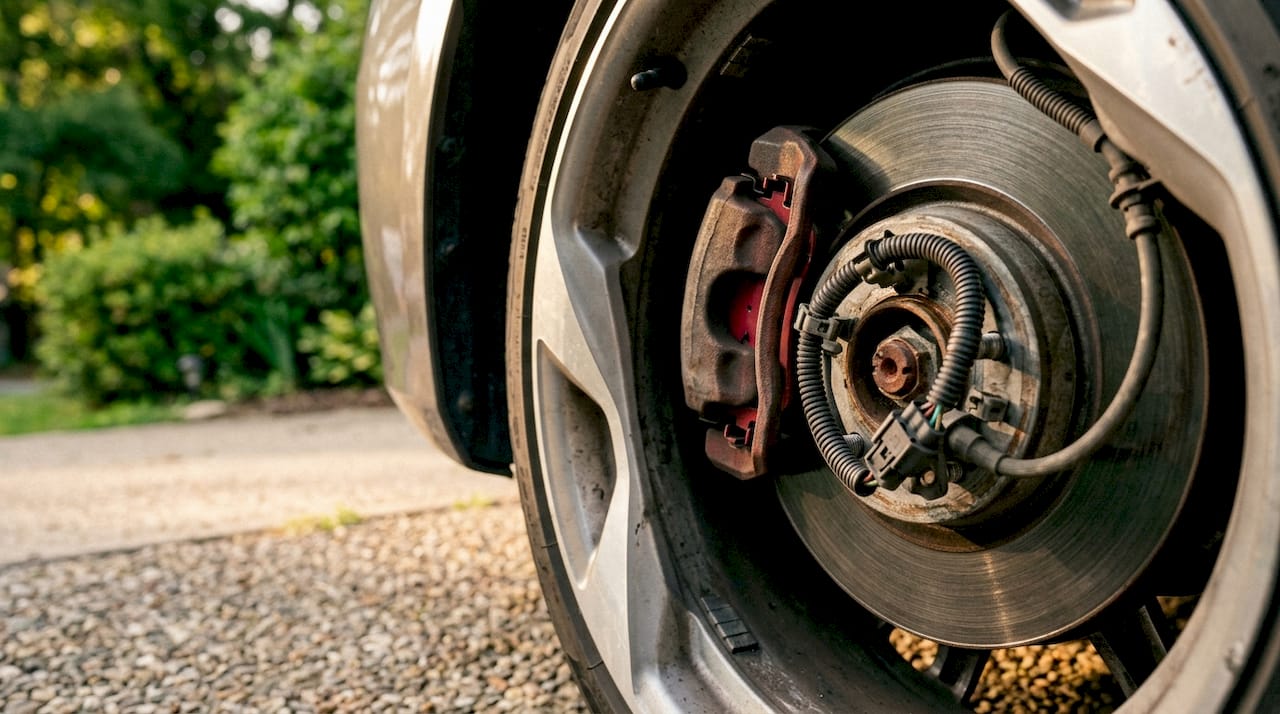
Cornering brake control also adjusts brake pressure based on curve position and vehicle speed to prevent wheel locking and reduce brake steer torque. The system does not wait for a skid to start. It acts proactively, nudging the yaw moment in the correct direction before the car drifts off the intended line.
Pro Tip: If your ABS warning light activates, your brake vectoring system loses a critical data input. Get the ABS sensor diagnosed immediately, not at your next scheduled service.
The numbered sequence below shows how a single cornering event triggers the system:
- Driver turns the steering wheel and applies light throttle entering a curve.
- Sensors detect a yaw rate mismatch between driver input and actual vehicle rotation.
- The control unit calculates the required correction within milliseconds.
- Brief braking pressure applies to the inside front wheel.
- Torque shifts to the outside wheel, tightening the vehicle’s line through the corner.
- The driver feels nothing unusual. The car simply goes where they pointed it.
What are the advantages of brake vectoring technology vs. mechanical systems?
The biggest advantage of brake-based torque vectoring is cost. Brake-based systems use existing ESP/ESC hardware without adding mechanical differentials, clutch packs, or hydraulic actuators. That keeps manufacturing costs low and makes the technology available across a wide range of vehicles, not just performance cars.
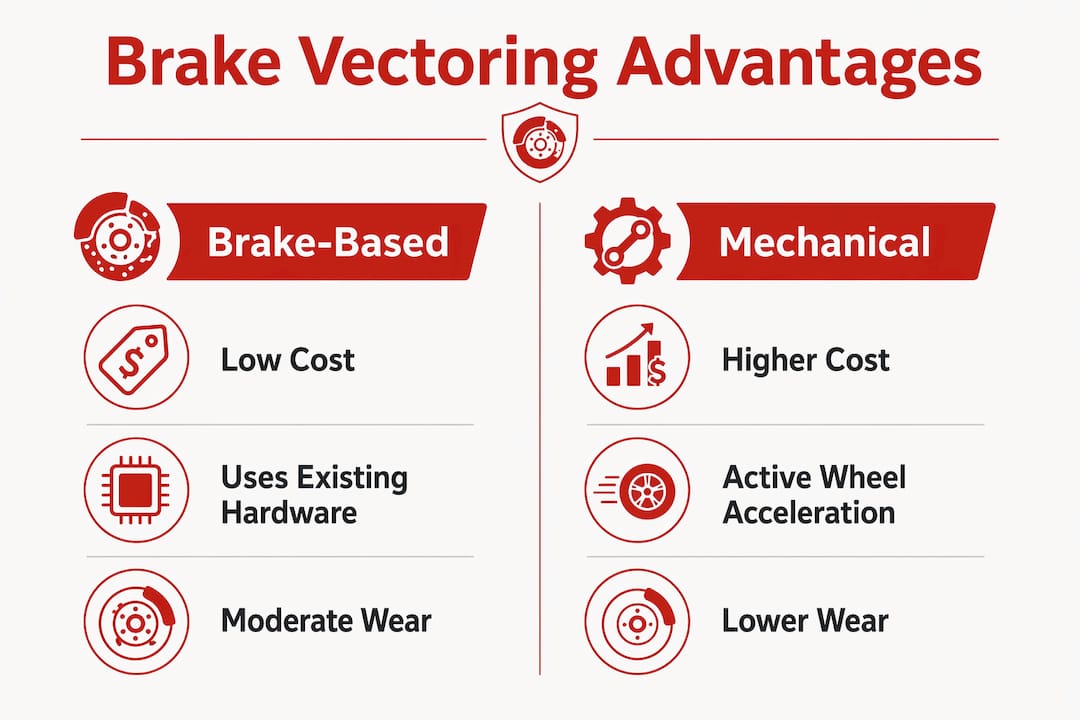
Mechanical torque vectoring systems actively accelerate the outside wheel using a dedicated gearset or clutch pack. They add torque rather than subtract it. This produces a more aggressive cornering response and is favored in track-focused vehicles where brake wear is less of a concern.
The trade-off for brake-based systems is wear. Brake-based systems improve handling by reducing wheel speed, and aggressive or repeated use accelerates brake pad and rotor wear. Drivers who use their vehicles on track days or in mountainous terrain will notice this faster than typical commuters. Understanding brake rotor wear patterns becomes more relevant when a vehicle uses brake vectoring frequently.
Electric vehicles benefit from a third option: regenerative braking vectoring. Because electric motors can apply negative torque to individual wheels almost instantly, the system can vector force without touching the hydraulic brakes at all. Integrated braking and torque vectoring strategies in electric and hybrid vehicles achieve over 85% correlation in predicting vehicle dynamic behavior, reducing torque fluctuation and jerks during cornering. That level of accuracy is difficult to match with hydraulic systems alone.
Pro Tip: When buying a used vehicle with brake vectoring, ask specifically whether the ESC system has ever thrown fault codes. A history of ESC faults often signals sensor degradation that compromises the entire vectoring function.
| Feature | Brake-based vectoring | Mechanical torque vectoring |
|---|---|---|
| Hardware cost | Low, uses existing ABS/ESC | High, requires added gearsets |
| Cornering method | Brakes inside wheel | Accelerates outside wheel |
| Brake wear impact | Moderate to high under aggressive use | Minimal |
| Best use case | Daily driving, safety focus | Track performance |
| EV compatibility | High, pairs with regenerative braking | Limited integration |
How does brake vectoring improve safety in real driving scenarios?
The practical safety benefits of brake force distribution are measurable. A hierarchical braking force allocation strategy reduces emergency braking-in-turn distances by 1.4 to 2.56 meters while improving lateral stability significantly. In a real emergency, that distance is the difference between stopping before an obstacle and hitting it.
The system addresses two of the most common handling failures drivers experience:
- Understeer: The front wheels lose grip and the car pushes wide. Brake vectoring applies brief pressure to the inside front wheel, which tightens the yaw moment and pulls the nose back toward the intended line.
- Oversteer: The rear steps out. The system brakes the outside front wheel to counteract the rotation, stabilizing the car without requiring a driver to catch the slide manually.
- Braking mid-corner: Traditional braking during a turn shifts weight forward and unloads the rear, creating instability. Cornering brake control distributes brake pressure to reduce brake steer torque and prevent wheel locking, keeping the car stable through the entire braking arc.
- Wet and low-grip surfaces: Brake vectoring responds faster than any driver can on slippery roads. The system detects grip loss through yaw rate deviation and corrects before the car begins to slide.
- Emergency lane changes: The rapid yaw corrections during a sudden swerve are where brake vectoring earns its keep. The car follows the steering input more faithfully, reducing the risk of overcorrection.
Brake vectoring acts proactively to pull the vehicle through corners rather than only reacting to a developing skid like traditional ESC. This distinction matters because reactive systems always lag behind the physics. Proactive systems stay ahead of them. For drivers of Toyota, Honda, and Subaru vehicles, which have integrated ESC with cornering brake control as standard equipment for years, this technology is already working on every drive.
What maintenance keeps a brake vectoring system working correctly?
Brake vectoring depends entirely on the accuracy of its sensor inputs and the uniformity of its braking hardware. A single faulty wheel speed sensor can corrupt the data the control unit uses to make decisions. The system may still function, but its corrections will be less accurate and potentially delayed.
Uneven brake pad or rotor wear creates asymmetric braking force. The control unit assumes each wheel can deliver a specific amount of braking torque. When one corner is worn significantly more than another, the system’s calculations are off. This is why brake force distribution depends on consistent hardware condition across all four corners.
Key maintenance checks for brake vectoring systems:
- Wheel speed sensors: Inspect for damage, corrosion, and secure mounting at every brake service.
- Brake pad thickness: Replace pads as a full axle set, never one side only, to maintain balanced braking force.
- Brake rotors: Check for warping and uneven wear. A warped rotor causes pulsating brake force that confuses the control unit.
- Brake fluid condition: Degraded fluid reduces hydraulic response speed, slowing the system’s ability to apply precise pressure. Brake bleeding at manufacturer-recommended intervals keeps the hydraulic circuit responsive.
- Software calibration: Some manufacturers issue ESC and ABS software updates that refine vectoring algorithms. Check with your service provider whether your vehicle has pending calibration updates.
Pre-purchase inspections of vehicles with brake vectoring should include a scan for stored ESC and ABS fault codes. A clean scan history is a strong indicator that the system has functioned correctly throughout the vehicle’s life.
Key Takeaways
Brake force vectoring is the most cost-effective method available for improving cornering stability, and its performance depends directly on the condition of ABS sensors, brake pads, and rotors across all four wheels.
| Point | Details |
|---|---|
| Core mechanism | Braking the inside wheel transfers torque to the outside wheel, tightening cornering line. |
| Safety impact | Hierarchical brake allocation reduces emergency braking distances by 1.4 to 2.56 meters. |
| Cost advantage | Brake-based systems use existing ABS/ESC hardware with no added mechanical components. |
| EV integration | Regenerative braking vectoring achieves over 85% accuracy in predicting vehicle dynamics. |
| Maintenance priority | Uneven pad wear and faulty wheel speed sensors degrade vectoring accuracy and handling safety. |
Why software is now the most important part of your brakes
The shift from mechanical to software-driven torque management is the most underappreciated development in chassis engineering over the past decade. Enthusiasts spend hours debating suspension geometry and tire compounds, but the software running on the ABS/ESC control unit now does more for cornering behavior than either of those variables in most street driving situations.
What I find genuinely interesting is how brake vectoring exposes a maintenance gap. Drivers who would never ignore a worn tire will run brake pads down to metal on one corner and wonder why their car feels vague through turns. The vectoring system is trying to compensate for hardware that can no longer deliver what the software expects. The car feels “off” but no warning light appears. That mismatch between software expectation and hardware reality is where handling problems quietly develop.
Electric drivetrains are making this technology significantly more capable. When regenerative braking can vector torque at the motor level, the hydraulic brakes become a backup layer rather than the primary tool. The integration of both systems, as simulation research on electric and hybrid vehicles confirms, produces vehicle dynamic behavior that hydraulic-only systems cannot replicate. For enthusiasts watching where the technology goes next, the answer is motor-level vectoring with hydraulic braking as a precision supplement, not the other way around.
My practical advice: treat your brake system as a sensor network, not just a stopping mechanism. Every component that touches brake force, from the wheel speed sensor to the rotor surface, feeds data or delivers force to a system that is actively managing your vehicle’s handling. Maintain it with that in mind.
— Shingi
Brake system service at Tom’s B & M Auto
Tom’s B & M Auto has served Lynnwood drivers since 1985, and brake system integrity is one of the most common reasons customers come through the door. ASE-certified technicians use professional-grade OBD-II diagnostics to read ABS and ESC fault codes, inspect wheel speed sensors, and assess brake pad and rotor condition across all four corners.
A brake system that supports vectoring needs uniform hardware and clean sensor data. Tom’s B & M Auto offers a free visual brake inspection to identify wear imbalances and sensor issues before they compromise your vehicle’s handling. For larger repairs, financing options are available. Same-day appointments are often available, and all work carries a 24-month / 24,000-mile warranty.
FAQ
What is the role of brake force vectoring?
Brake force vectoring improves cornering stability and steering response by applying selective braking pressure to individual wheels. It transfers effective torque to the outside wheel during a corner, pulling the vehicle through the turn more accurately.
How does brake force vectoring differ from Electronic Stability Control?
ESC reacts to a developing skid by braking multiple wheels and cutting engine power. Brake vectoring acts proactively during normal cornering to optimize yaw moment before any instability develops.
Does brake vectoring increase brake wear?
Yes, brake-based torque vectoring applies brief braking pulses to specific wheels during cornering, which adds wear beyond normal stopping use. Aggressive driving amplifies this effect, making regular brake inspections more important.
Can electric vehicles use brake force vectoring?
Electric vehicles use regenerative braking vectoring at the motor level, which delivers near-instantaneous torque adjustment without relying solely on hydraulic brakes. Simulation studies show over 85% accuracy in predicting vehicle dynamics with integrated systems.
What symptoms suggest a brake vectoring system problem?
Unexpected understeer, a car that pulls during braking, or an illuminated ABS or ESC warning light all indicate potential issues with the sensors or hardware that brake vectoring depends on. A diagnostic scan will identify the specific fault.
Recommended
- The Role of Brake Caliper in Vehicle Safety – Tom’s B & M Auto Blog
- What Is Electronic Brake Distribution? A Car Owner’s Guide – Tom’s B & M Auto Blog
- What Is a Brake Rotor? Function, Wear, and Care – Tom’s B & M Auto Blog
- What Is Brake Bleeding? A Car Owner’s Guide – Tom’s B & M Auto Blog
Leave a Reply