
Why Your Car Pulls to One Side: Causes and Fixes
A car pulling to one side is defined as a condition where uneven forces on one or more wheels cause the vehicle to drift left or right without any steering input from you. The four primary causes are uneven tire pressure, wheel misalignment, a seized brake caliper, and worn suspension components. Each cause produces a distinct symptom pattern, and knowing which one you are dealing with cuts diagnosis time in half. This guide walks you through every cause, how to spot it, and what to do next.
Why does my car pull to one side?
Uneven tire pressure is the single most common reason a car drifts toward one side. A tire with low pressure has a smaller rolling radius than a properly inflated tire. That smaller radius creates more drag on that side, and the car steers itself toward it.
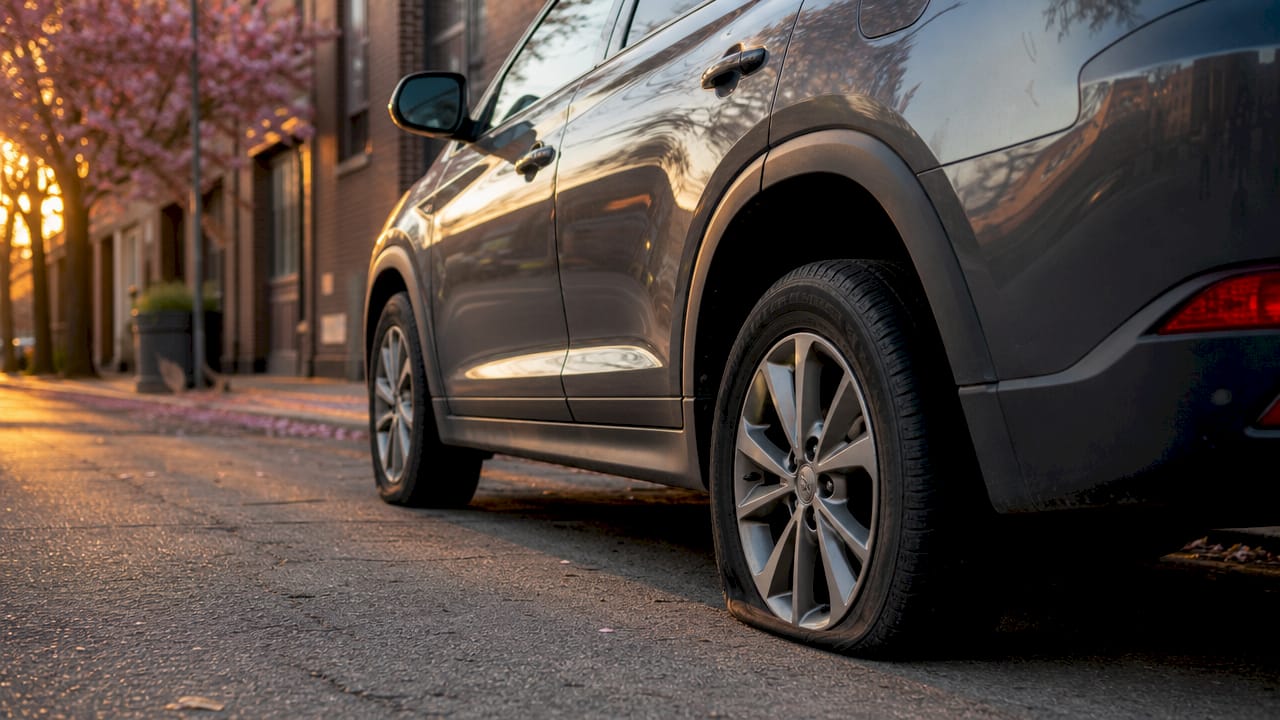
The gap does not need to be large. A 5 PSI difference between the left and right front tires is enough to produce a noticeable pull. That is a difference most drivers never notice until they feel the car drifting.
Checking tire pressure is free and takes under two minutes with a gauge. Pull out a quality digital gauge, check all four tires cold (before driving), and compare readings against the sticker inside your driver’s door jamb. Do not use the number printed on the tire sidewall. That number is the maximum pressure the tire can hold, not the recommended operating pressure.
Beyond pressure, tire condition matters. A tire with uneven tread wear, a bulge, or internal damage from a pothole hit can also pull the car. Rotate your tires every 5,000–7,500 miles to catch wear patterns early.
- Check all four tires, not just the front two
- Use a digital gauge for accuracy
- Inflate to the door jamb spec, not the sidewall max
- Look for visible damage, bulges, or cupping on the tread surface
- If pressure is correct and pull persists, move to alignment
Pro Tip: Tire pressure drops roughly 1 PSI for every 10°F drop in temperature. If your car starts pulling after a cold snap in Lynnwood, check your tires before booking any repair.
How does wheel alignment cause pulling?
Wheel alignment issues cause a pull in about 9 out of 10 cases where no worn components are present. Alignment refers to three angles: camber, caster, and toe. Each one affects how your tires contact the road, and each one affects vehicle behavior differently.
Camber is the vertical tilt of the tire when viewed from the front. A tire tilted inward or outward creates uneven contact with the road. When camber differs side to side, the car pulls toward the side with more positive camber. This is a direct, steady pull you feel at all speeds.
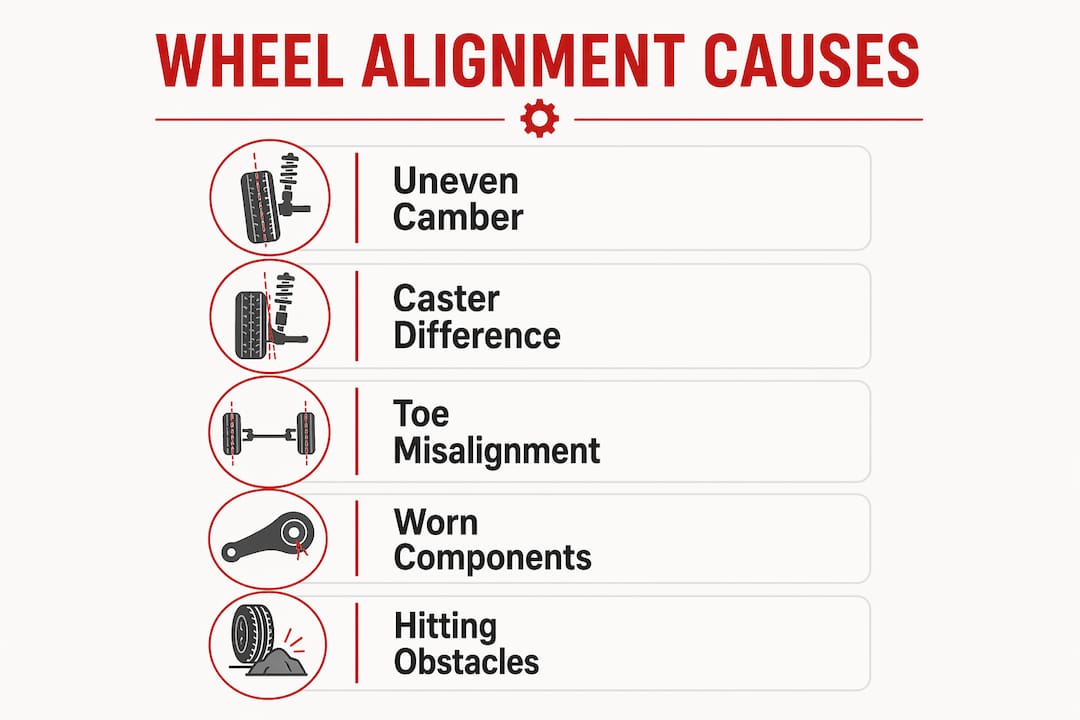
Caster is the angle of the steering axis when viewed from the side. A caster difference side to side does not cause a steady pull the way camber does. Instead, it makes the car more sensitive to road crown and crosswinds, producing a mild drift rather than a firm tug.
Toe is how much the tires point inward or outward when viewed from above. Toe misalignment does not cause pulling. It causes an off-center steering wheel and rapid, feathered tire wear. If your car pulls, toe is not the culprit. Focus on camber and caster first.
| Alignment angle | Effect on pulling | Other symptoms |
|---|---|---|
| Camber (uneven) | Direct, steady pull toward higher camber side | Uneven tire wear on inner or outer edge |
| Caster (uneven) | Mild drift, road crown sensitivity | Steering feels light or heavy on one side |
| Toe (misaligned) | No pull | Off-center steering wheel, feathered tire wear |
Misalignment happens gradually through normal driving. Hitting a curb, dropping into a deep pothole, or even accumulated road wear shifts these angles away from factory spec. A professional four-wheel alignment resets all three angles to manufacturer specifications using a laser or camera-based alignment rack.
Pro Tip: Always have worn ball joints, tie rods, and control arm bushings replaced before an alignment. Aligning a car with worn suspension parts is like straightening a picture frame on a crooked wall. The alignment will shift again the moment you drive.
Can brakes or suspension cause a car to drift?
A seized brake caliper causes continuous drag on one wheel, pulling the car firmly toward that side. The caliper holds the brake pads against the rotor. When it seizes, the pads never fully release, creating constant friction and heat. The symptom is a pull that feels strong and consistent, often accompanied by a burning smell after driving.
The simplest field test: drive a few miles at normal speed, park, and carefully hold your hand near each wheel without touching it. A seized caliper produces noticeably more heat on that wheel than the others. A brake caliper seizure is frequently mistaken for an alignment problem, which is why a proper inspection covers both systems.
Worn suspension components like ball joints, tie rods, and control arm bushings allow the wheel to shift position under load. The pull from worn suspension is inconsistent. It changes with speed, road surface, and cornering. That variability is the key diagnostic clue. Technicians check for suspension wear by grabbing the wheel and testing for movement. Up-and-down movement points to ball joint or control arm wear. Side-to-side movement points to tie rod end wear.
Common symptoms of brake or suspension-related pulling:
- Pull that appears or worsens under braking
- Clunking or knocking sounds over bumps
- Steering wheel vibration at highway speeds
- Car that wanders rather than pulling firmly in one direction
- One wheel visibly hotter than the others after a drive
Pro Tip: If your car pulls only when braking, suspect the brakes before alignment. Brake-related pulls are a safety issue and need attention before any other diagnosis.
What else makes a car drift? Torque steer, road crown, and tire conicity
Torque steer is a pull that occurs only during hard acceleration in powerful front-wheel-drive vehicles. It happens because the two front driveshafts are different lengths. The unequal lengths create unequal torque delivery to each front wheel, steering the car to one side under power. Torque steer is a design characteristic of many FWD cars, not a fault. Worn CV joints worsen the effect and do require inspection.
Road crown is the slight outward slope built into most roads for water drainage. This slope causes a mild rightward drift on most American roads, and that is completely normal. Some manufacturers align vehicles with a slight leftward bias to compensate. If your car drifts gently right on a crowned road but tracks straight on a flat surface, the road is the cause, not the car.
Tire conicity is a manufacturing defect where the internal belts of a tire are slightly off-center, giving the tire a cone shape instead of a cylinder. A conical tire rolls in a circle rather than a straight line. The pull from tire conicity disappears when you swap the front tires side to side. If the pull switches direction after the swap, you have a defective tire.
- Torque steer: pull only under hard acceleration in FWD cars
- Road crown: mild rightward drift on normal roads, disappears on flat surfaces
- Tire conicity: pull that switches sides when front tires are swapped
How to diagnose a pulling car step by step
Diagnosing a pull correctly saves you money and avoids unnecessary repairs. Work through these steps in order before calling a shop.
- Check tire pressure first. Inflate all four tires to the door jamb spec. Drive the car and note whether the pull is gone, reduced, or unchanged.
- Observe the pull behavior. A pull that is firm and constant at all speeds points to alignment or tires. A pull only under braking points to brakes. A pull only under acceleration in a FWD car points to torque steer. A pull that varies with speed or road surface points to suspension.
- Rotate the tires. Move the front tires to the rear and vice versa. If the pull changes direction or intensity, a tire is the cause. If it stays the same, look elsewhere.
- Test on a flat road. Find a flat, straight, empty road. Drive at 30 mph and briefly release the steering wheel. A car with alignment issues will drift steadily. A car with a brake issue may pull more when you apply the brakes.
- Check wheel heat after driving. Park after a normal drive and compare wheel heat by holding your hand near each wheel. Unequal heat signals a brake problem.
- Book a professional inspection. If steps 1 through 5 do not isolate the cause, a shop with an alignment rack and lift can check camber, caster, toe, and suspension play in under an hour. Differentiating between a firm pull and wandering helps the technician narrow down the cause before the car even goes on the lift.
Ignoring a pull accelerates tire wear, increases fuel costs, and creates a genuine safety risk. A small alignment fix today prevents a tire replacement and a brake job tomorrow.
Key takeaways
A car that pulls to one side is almost always caused by uneven tire pressure, misaligned wheels, a seized brake caliper, or worn suspension parts, and each cause has a distinct symptom pattern that points directly to the fix.
| Point | Details |
|---|---|
| Check tire pressure first | A 5 PSI difference between sides causes noticeable pull and costs nothing to fix. |
| Camber causes pulling, toe does not | Uneven camber pulls the car; toe misalignment causes off-center steering and tire wear. |
| Brake calipers can mimic alignment | A seized caliper creates a firm, constant pull and a hot wheel after driving. |
| Suspension wear produces variable pull | Ball joint and tie rod wear cause inconsistent pulling that changes with speed and load. |
| Fix pulls early | Ignoring a pull accelerates tire wear, raises fuel costs, and creates safety risks. |
What I have learned after years of seeing these repairs
The most common mistake I see car owners make is booking an alignment before checking anything else. Alignment is the right fix maybe half the time. The other half, the pull comes from a low tire, a sticky caliper, or a worn tie rod end that will knock the alignment out again within weeks.
The second mistake is treating a pull as a minor annoyance. A car that drifts left or right is working against you every mile. Your tires wear faster on one edge. Your fuel economy drops. Your steering components take extra stress. And if that pull comes from a brake caliper, you are driving with compromised stopping power.
My advice: start with the free stuff. Check your tire pressure. Rotate your tires if they are due. Then observe exactly when and how the car pulls. That information tells a technician more than any scan tool. A pull only under braking is a brake job. A pull only under hard acceleration in your Honda Civic is torque steer. A steady pull at all speeds on a flat road is alignment or a bad tire.
The suspension components are the part most owners underestimate. Ball joints and tie rod ends wear slowly and quietly. By the time you feel the pull, the wear is often significant. Regular inspections catch these parts before they cause a safety issue, not after.
— Shingi
Tom’s B & M Auto can find and fix what is pulling your car
If you have worked through the basics and your car still pulls, the problem needs a lift, an alignment rack, and a trained set of eyes.
Tom’s B & M Auto has served Lynnwood, WA drivers since 1985. ASE-certified technicians use professional-grade alignment equipment and a thorough inspection process to identify whether the pull comes from alignment, brakes, suspension, or tires. All makes are welcome, including Toyota, Honda, Subaru, and European vehicles. A free digital vehicle inspection is available to get a clear picture of what needs attention before any work begins. Repairs come with a 24-month / 24,000-mile warranty, and financing options are available if the repair cost is more than you planned for. Same-day appointments are often available.
FAQ
What is the most common reason a car pulls to one side?
Uneven tire pressure is the most common cause. A difference of just 5 PSI between the left and right front tires creates enough drag to pull the car toward the lower-pressure side.
Does wheel alignment fix a car that pulls left or right?
Alignment fixes a pull caused by misaligned camber or caster angles. It does not fix pulls caused by low tire pressure, a seized brake caliper, or worn suspension parts. Those issues need to be addressed first.
How do I know if my brakes are causing the pull?
A brake-related pull gets stronger when you apply the brakes and is often accompanied by a burning smell or one wheel that is noticeably hotter than the others after driving.
Can worn suspension parts cause a car to drift?
Yes. Worn ball joints, tie rods, and control arm bushings allow the wheel to shift under load, producing an inconsistent pull that changes with speed and road conditions. Suspension parts must be replaced before an alignment will hold.
Is it safe to drive a car that pulls to one side?
A mild pull from low tire pressure is low risk if corrected quickly. A pull from a seized brake caliper or severely worn suspension is a safety hazard and should be inspected immediately.
Recommended
- Why Transmission Slips: Causes, Symptoms, and Fixes – Tom’s B & M Auto Blog
- What Is Engine Misfiring? Causes, Signs, and Fixes – Tom’s B & M Auto Blog
- Why Brakes Squeak: Causes, Fixes, and Warning Signs – Tom’s B & M Auto Blog
- European Car Repair Challenges: What Owners Must Know – Tom’s B & M Auto Blog
Leave a Reply