A car that stalls at idle is telling you something specific: the engine can’t maintain the minimum RPM needed to keep combustion cycling, typically around 600 to 800 RPM in most modern vehicles, and it shuts off. The most common reasons this happens are a faulty idle air control valve, vacuum leaks, a dirty throttle body, or a failing Mass Airflow (MAF) sensor. Sensor trouble codes like P0120–P0124 (throttle position) and P0401–P0402 (EGR) frequently accompany these failures.
At idle, the engine operates with almost no margin for error. Airflow is minimal, fuel delivery is precise, and the ECU relies on a tight network of sensors to hold everything in balance. At highway speeds, small disruptions get masked. At idle, even a slight drop in airflow or a momentary sensor hiccup can kill the engine. Vehicles with higher mileage are especially vulnerable, since aging rubber hoses and carbon buildup compound every other weakness.
Common scenarios when idle stalling occurs:
- Engine dies at red lights or in stop-and-go traffic
- RPM drops suddenly during deceleration or braking
- Stalling happens more often with the AC running
- Engine restarts immediately after dying
- Rough or bouncing RPM needle at idle
- Hissing sound near the intake (vacuum leak)
- Check engine light on, with pending or active codes
Why car stalls at idle: the most common causes
The causes of engine stalling when idling almost always trace back to one of three systems: airflow, fuel delivery, or ignition. Here is where to look first.
- Faulty Idle Air Control (IAC) valve. The IAC regulates how much air bypasses the throttle plate when your foot is off the gas. When it sticks or clogs, the engine simply doesn’t get enough air to stay running. This is the most frequent cause of idle stalling, especially on higher-mileage vehicles.
- Vacuum leaks. Unmetered air sneaking past the MAF sensor leans out the fuel mixture. At idle, engine vacuum peaks at a high level, so even a pinhole crack in a rubber hose draws in enough air to destabilize combustion.
- Dirty throttle body. Carbon deposits on the throttle plate reduce airflow when the plate is nearly closed. Drive-by-wire systems struggle to compensate for this.
- Failing MAF sensor. A contaminated MAF under-reports incoming air, so the ECU delivers too little fuel. The engine runs unstably and stalls. A quick test: unplug the MAF while idling. If idle smooths out, the sensor is likely the problem.
- Faulty Throttle Position Sensor (TPS). The TPS tells the ECU where the throttle plate is at every moment. Erratic voltage signals during deceleration cause the ECU to miscalculate fuel trim, leading to stalls. Codes P0121–P0124 are the giveaway.
- Fuel system problems. A weak pump, clogged filter, or dirty injectors can starve the engine at idle. Low fuel pressure becomes impossible to compensate for when engine demand drops to minimum.
- Worn spark plugs or failing ignition coils. A misfiring cylinder drags down idle RPM in a way the ECU can only partially offset. At a marginal idle, one dead cylinder is enough to kill the engine.
- Stuck EGR valve. When the EGR valve sticks open at idle, it dumps inert exhaust gas into the intake. The engine chokes on it almost immediately.
- Weak alternator or battery. Low voltage causes erratic sensor readings and unstable idle. This gets worse when the AC, headlights, and blower motor all run at once.
Signs and scenarios that point to idle stalling problems
Recognizing the pattern of your stall narrows the diagnosis considerably. Most idle stalling problems share a recognizable set of symptoms.
- Engine dies specifically at red lights or when coasting to a stop, not during highway driving
- RPM needle drops suddenly to zero during deceleration
- Engine restarts immediately after stalling, which indicates the mechanical and fuel systems are intact but idle control is compromised
- Stalling occurs more often with the AC engaged, pointing to a marginal idle control system that can’t handle the added compressor load
- Rough, bouncing, or surging idle RPM even when the car doesn’t fully stall
- Audible hissing near the intake manifold or brake booster line
- Check engine light on, or pending codes that don’t illuminate the light but still affect performance
- Stalling only when the engine is fully warm, which suggests a heat-sensitive component like the IAC valve or fuel pressure regulator
- No stalling at higher speeds or under load, only at idle
That last pattern is one of the most useful clues. An engine that runs fine at 2,000 RPM but dies at 700 RPM almost certainly has an airflow or idle control problem, not a catastrophic mechanical failure.
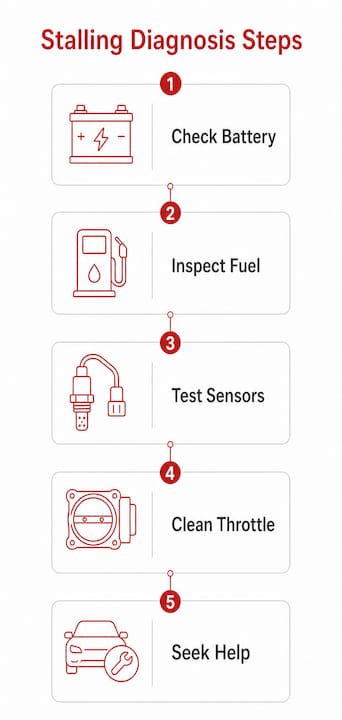
How to diagnose engine stalling at idle step by step
Start with the cheapest and fastest checks before touching any parts. A systematic approach saves money and correctly identifies the small percentage of cases that turn out to be transmission-side problems.
- Scan for trouble codes first. Pull codes even if the check engine light is off. Pending codes like P0505 (IAC circuit), P0171/P0174 (lean condition), and P0102 (MAF low input) won’t always trigger the light but will point you in the right direction. The check engine light guide at Tom’s B & M Auto covers what these codes mean in plain language.
- Listen for vacuum leaks. With the engine running, listen along the intake for a hiss. A Long-Term Fuel Trim above +8% at idle is a strong indicator of a vacuum leak.
- Spray carb cleaner on vacuum lines. With the engine idling, carefully spray around hose connections and intake fittings. If RPM changes, you’ve found the leak. Keep the spray away from hot surfaces.
- Clean the IAC valve and throttle body. On most vehicles, these are the cheapest fixes with the highest success rate. Use throttle body cleaner and a rag. Some manufacturers, including certain Toyota and BMW models, require a throttle body relearn procedure after cleaning.
- Test the MAF sensor. Clean it with MAF-specific cleaner only. Never use carb cleaner on a MAF wire element. If cleaning doesn’t help, unplug it while idling. An idle that smooths out after unplugging points to replacement.
- Check throttle position sensor voltage. The TPS should produce a smooth voltage sweep from idle to wide-open throttle. Erratic or flat spots in the signal confirm a failing sensor.
- Inspect fuel pressure. A Schrader valve on the fuel rail lets you check pressure directly. Low pressure at idle, especially on a hot restart, points to a weak pump or failing regulator.
- Assess ignition components. Pull spark plugs and look for fouling, erosion, or oil contamination. Check for misfire-related codes in the P0300–P0308 range.
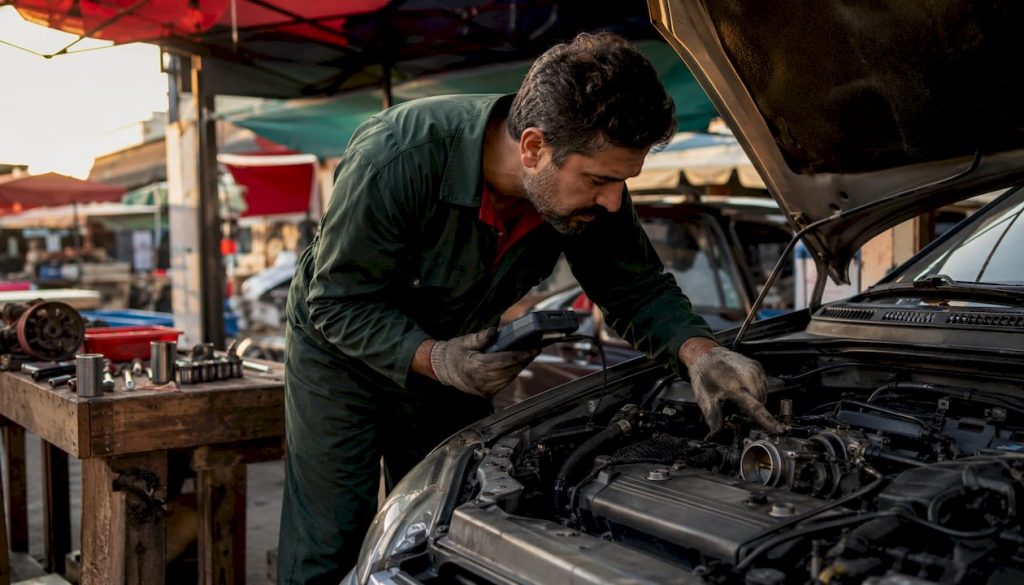
- Monitor live data. Use an OBD-II scanner with live data capability. Watch idle air flow percentage, short-term and long-term fuel trims, and IAC position. If IAC position reads at maximum and the engine still stalls, you have either a large vacuum leak or a throttle body that needs cleaning.
- Test AC load impact. Turn the AC on and off while watching RPM. If the engine stalls only with AC engaged, the idle compensation circuit is marginal, not failed.
Pro Tip: If your car stalls only when fully warm but runs fine cold, check the IAC valve and fuel pressure regulator first. Both are temperature-sensitive and fail more predictably under heat.
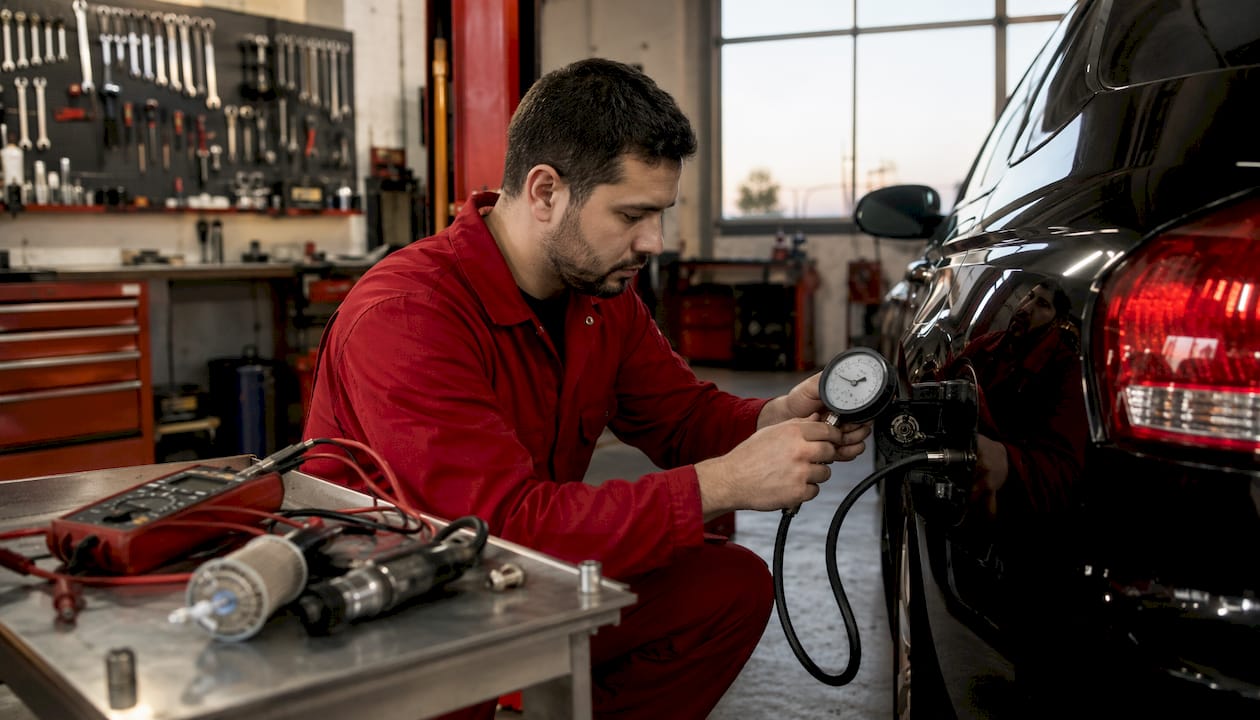
How to fix or reduce car stalling at idle
Many idle stalling fixes are within reach of a motivated car owner with basic tools. Start with the low-cost steps before moving to parts replacement.
- Clean or replace the IAC valve and throttle body. This resolves the majority of idle stalling complaints on vehicles with over 80,000 miles.
- Fix vacuum leaks by replacing cracked hoses, tightening loose intake boots, or replacing a deteriorated brake booster line. Rubber hoses age faster in temperature extremes.
- Clean the MAF sensor with MAF-specific cleaner. If cleaning doesn’t hold, replace it.
- Replace worn spark plugs and ignition coils if misfire codes are present. For engine misfires that accompany idle stalling, address ignition first before chasing sensor faults.
- Replace the fuel filter if it hasn’t been serviced recently, and test fuel pump pressure if the filter is clean.
- Perform a throttle body relearn after cleaning on vehicles that require it. Skipping this step can cause a new set of idle complaints.
- Avoid running the tank consistently below a quarter full. Fuel pumps are cooled by the fuel surrounding them, and low-fuel driving accelerates pump wear.
- Use quality fuel and avoid prolonged idling with heavy electrical loads running simultaneously.
- Stay current on high-mileage maintenance to prevent carbon buildup before it becomes a stalling problem.
When to get professional help and what repairs cost
Some stalling problems genuinely require professional tools and expertise. Knowing when to stop DIYing saves time and prevents misdiagnosis.
Seek a mechanic promptly if the check engine light is flashing (not just on), if you smell fuel near the engine, or if the stalling is frequent and getting worse. A flashing check engine light indicates an active misfire severe enough to damage the catalytic converter.
Repair costs vary considerably by cause:
- Throttle body cleaning: moderate cost at a shop, or inexpensive in parts if you do it yourself
- Vacuum hose replacement: cost varies depending on location and labor
- IAC valve replacement: moderate cost for parts and labor
- MAF sensor replacement: moderate to higher cost
- TPS replacement: moderate cost for parts and labor
- Fuel pump replacement: higher cost depending on vehicle
- Ignition coil replacement: moderate to higher cost
Complex electrical faults, transmission-related stalling (torque converter solenoid issues), or low compression from internal engine wear require professional diagnosis. An OBD-II live data scan catches problems that code-only readers miss entirely. ASE-certified technicians can distinguish between a marginal IAC valve and a failing torque converter clutch solenoid, two problems that feel identical to the driver but require completely different repairs.
What ASE-certified mechanics know about idle stalling
Carbon buildup in the IAC passage is a real and underappreciated problem on high-mileage engines. The load sensitivity test is one of the most useful quick checks: if the engine stalls only when the AC compressor engages, the idle control system is borderline, not failed. That distinction changes the repair path entirely. Mechanical issues like low compression from worn rings can also mimic sensor faults, which is why a compression test belongs in any diagnosis that doesn’t respond to the usual fixes.
Tom’s B & M Auto has been diagnosing these problems since 1985, using professional-grade OBD-II equipment and ASE-certified technicians who read live data, not just stored codes.
How temperature and humidity affect idle stability
Cold weather thickens engine oil, stiffens rubber hoses, and makes the IAC valve work harder to maintain idle RPM during warm-up. A car that stalls only on cold mornings often has a sticky IAC or a weak ignition coil that can’t fire reliably until the engine warms up. For more on cold-start stalling, the cold weather starting guide covers the overlap between cold-start failures and idle instability.
Heat creates a different set of problems. Rubber vacuum hoses that seal fine when cold can open up as they expand under heat, creating leaks that only appear after 20–30 minutes of driving. IAC valves that operate normally when cold may stick when hot due to carbon binding on the valve stem. Fuel pumps in early failure almost always perform worse when heat-soaked.
Humidity adds another variable. Moisture can compromise ignition coil insulation and spark plug boots, causing misfires that are worse on damp mornings or after rain. If your idle stalling is seasonal or weather-dependent, ignition components and vacuum hoses are the first places to look.
How fuel quality and fuel system condition affect idle stalling
Low-grade fuel with inconsistent detergent packages accelerates carbon buildup on intake valves, throttle bodies, and fuel injectors. Direct-injection engines are especially vulnerable because fuel never washes the intake valves directly. Running consistently on low fuel damages the pump by reducing the cooling effect of the surrounding gasoline.
A clogged fuel filter starves the engine at idle when demand drops to minimum and pressure can’t recover fast enough. Dirty injectors spray fuel in an uneven pattern instead of a fine mist, producing rough idle and stalling, particularly when the engine is cold. A failing fuel pressure regulator causes pressure to drop at idle even when the pump is healthy.
The fix sequence for fuel system stalling: replace the filter first (cheapest), then test fuel pressure at idle and on hot restart, then evaluate injectors and pump. Don’t assume the pump is fine just because the car starts.
How battery and electrical system health affect engine stalling
A weak battery or failing alternator affects far more than just starting. When alternator output drops or battery voltage sags under load, the ECU and fuel pump receive insufficient voltage. Fuel pump output drops, sensors send voltage-dependent signals that read incorrectly, and the engine stalls. This gets worse when the AC, headlights, and blower motor all run simultaneously.
The connection between electrical faults and idle stalling is frequently overlooked because drivers associate battery problems with a car that won’t start, not one that dies at a red light. A battery that starts the car fine in the morning can still sag enough under load to destabilize idle. Test alternator output voltage at idle with the AC on. A healthy alternator holds 13.5–14.5 volts. Anything below 13 volts under load is a problem worth addressing before chasing sensor faults.
Tom’s B & M Auto: professional idle stalling diagnosis in the Lynnwood area
Idle stalling is one of those problems where guessing costs more than diagnosing. A throttle body cleaning that doesn’t fix a vacuum leak, or a new IAC valve installed over a failing alternator, just adds to the bill without solving anything.
Tom’s B & M Auto has handled idle stalling on every make and model since 1985, from Toyota Camrys to European imports. ASE-certified technicians run professional-grade OBD-II live data scans, not just code pulls, to see exactly what the engine is experiencing at idle before recommending any repair. Upfront pricing means no surprises, and every job carries a 24-month / 24,000-mile warranty.
If you’re in the Lynnwood, Kenmore, or Mountlake Terrace area, engine repair in Kenmore and Mountlake Terrace are available with same-day appointments often open. Start with a free digital vehicle inspection to get a clear picture of what’s causing the stall before spending a dollar on parts.
Key Takeaways
A car that stalls at idle almost always has an airflow, sensor, or fuel delivery problem, not internal engine damage, and most fixes cost under $300 when diagnosed correctly.
| Point | Details |
|---|---|
| Top cause of idle stalling | A faulty or clogged IAC valve is the most frequent culprit, especially on vehicles past 80,000 miles. |
| Vacuum leaks are sneaky | Engine vacuum peaks at idle, making even a pinhole crack enough to stall the engine. |
| Electrical system matters | A weak alternator or battery causes erratic sensor readings and unstable idle, not just hard starts. |
| Diagnose before replacing parts | Live OBD-II data reveals what the engine actually sees at idle; code-only scans miss intermittent faults. |
| Tom’s B & M Auto | ASE-certified technicians in Lynnwood use professional OBD-II diagnostics and back every repair with a 24-month / 24,000-mile warranty. |