
Avoid Dealer Upsells at 30K: Lynnwood Toyota VIN Aware Checklist
The Toyota 30,000-mile service is mostly preventive: an oil and filter change plus a thorough round of inspections on your tires, brakes, fluids, and filters. It’s not a major overhaul. Exact line items shift by model, VIN, and driving conditions, so check your owner’s manual and book the service within about 500 miles of the 30,000 mark. An ASE-certified shop can confirm exactly what your Toyota needs and skip what it doesn’t.
TL;DR:
- The 30,000-mile service for Toyota mostly involves preventive checks and routine replacements, with specific items depending on model and driving conditions.
- Key tasks include oil and filter changes, air filter inspections, tire rotations, fluid top-offs, and brake and suspension inspections; hybrid models require extra checks for the battery and regenerative brakes.
- Proper documentation of all services, including date, mileage, and detailed inspection results, is essential to maintain warranty coverage and resale value.
- Cost typically ranges from $120 to $300, depending on parts needed and optional add-ons like fluid flushes or cabin sanitizing, with independent shops often charging less than dealers.
- Choosing a qualified, ASE-certified shop that provides transparent estimates, quality diagnostics, and warranty-backed work ensures proper maintenance without unnecessary upsells.
Table of Contents
- What’s Actually Included in a Toyota 30,000-Mile Service?
- Why Warranty Coverage Depends on This Service
- How Much Does a Toyota 30K Service Cost?
- Dealer or Independent Shop for Your 30K Service?
- How to Prepare for Your 30K Appointment
- What Makes a Shop Qualified to Handle Your 30K Service
- What Most Owners Get Wrong About the 30K Mark
- Book Your Toyota 30K Service in Lynnwood
- Sources
What’s Actually Included in a Toyota 30,000-Mile Service?
Toyota’s maintenance schedule breaks routine care into checkpoints roughly every 5,000 to 7,500 miles, and 30,000 miles lands on one of the bigger ones. It pulls together several smaller services into one visit, so it’s a good time for a technician to look at things that don’t get checked at every oil change.
Here’s what a shop should be doing, item by item:
- Oil and oil filter change. Toyota vehicles run on synthetic oil, and most models stretch to a 10,000 mile interval between changes, so this is likely your third or fourth oil change since new, not your first.
- Engine air filter check. A dirty air filter chokes airflow to the engine and can hurt fuel economy. If it’s gray and clogged rather than tan and dusty, it gets replaced.
- Cabin air filter check. Weak AC airflow or a musty smell inside the car usually means this filter needs swapping. It’s cheap, and it’s often skipped by owners who don’t know it exists.
- Tire rotation and pressure check. Front and rear tires wear differently depending on your drivetrain, so rotating them at regular mileage intervals extends tread life across the set.
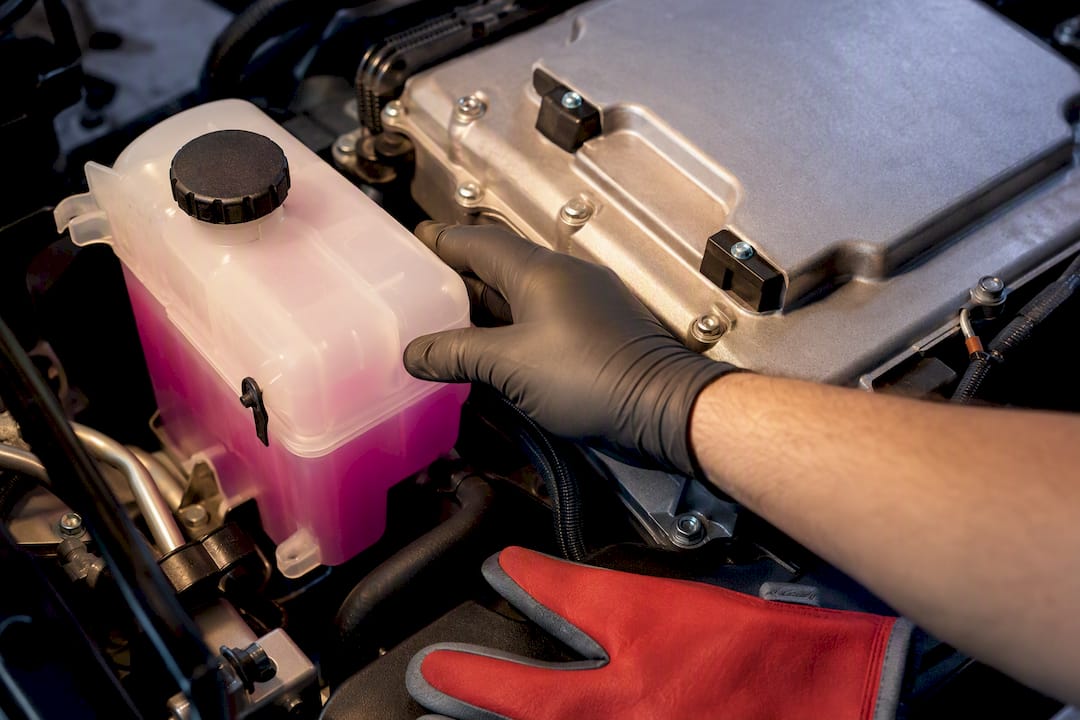
- Fluid checks and top offs. Coolant, brake fluid, and transmission or power steering fluid (where applicable) get checked for level and condition, not necessarily replaced.
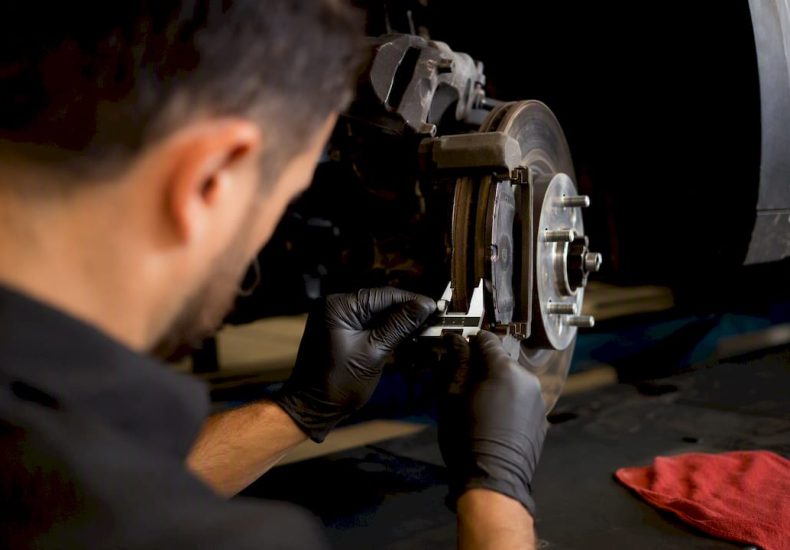
- Brake inspection. Pad thickness, rotor wear, and brake fluid condition all get a look. Nothing gets replaced unless it’s actually worn.
- Suspension and steering inspection. Ball joints, tie rod ends, and the rubber boots covering CV joints and the differential get checked for cracking, wear, or leaks.
- Belts, hoses, exhaust, wipers, lights, and battery. A visual pass catches cracked belts, soft hoses, exhaust leaks, worn wiper blades, and a battery that’s starting to weaken before it leaves you stranded.
Kelley Blue Book’s maintenance schedule overview lists this same core group, plus an EFI additive treatment on some models and a transmission leak check, which lines up closely with what most independent shops and dealers actually perform.
If you drive a hybrid, the 30K visit adds a couple of items that gas only owners don’t need to think about. Technicians should inspect the regenerative braking system, since hybrids rely on it more heavily than standard hydraulic brakes and it wears differently. The cooling system for the hybrid battery and inverter also deserves a check, particularly if you drive in stop and go traffic where those components run hotter. Hybrid batteries and their support systems have their own quirks worth understanding before you sit down with a service advisor.
Pro Tip: Ask the shop to hand you the actual inspection sheet, not just a summary. If a line item like “brake pads: 6mm remaining” doesn’t show up anywhere in writing, you have no way to verify the recommendation later.
One caveat that trips up a lot of owners: Toyota’s own guidance notes that “special operating conditions” like frequent short trips, dusty roads, or towing shorten these intervals. If that describes your driving, some of the 30K items may already be due sooner than the mileage suggests.
Why Warranty Coverage Depends on This Service
Toyota’s maintenance booklet is direct about this: damage caused by lack of proper maintenance isn’t covered under warranty. If a transmission fails and there’s no record you ever had the fluid checked, Toyota can point to that gap when reviewing a claim.
You don’t have to use a dealer to protect that coverage. Toyota’s own guidance confirms maintenance can be performed at any qualified facility, not just a franchise dealership. What matters is that the work happened, on schedule, and that you can prove it.
The recordkeeping habit that actually protects you: keep a simple log with the date, mileage, and description of every service, along with the invoice or receipt. Toyota’s booklet language for its owners specifically calls out date, mileage, and description as the fields that matter most for a warranty claim.

A folder of paper receipts works. A shared note on your phone works too. What doesn’t work is trusting your memory, or trusting that a shop’s internal system will still have your records if you switch shops in three years. For a step by step approach to organizing this, documenting your repair history properly also pays off at resale, since a buyer or dealer trade-in appraiser will pay more for a car with a clean, documented history than one where you’re just telling them it was well maintained.
Owners who drive fewer than 5,000 miles a year shouldn’t assume they’re off the hook either. Toyota treats the time-based interval (roughly every six to seven and a half months) as equivalent to the mileage-based one for warranty purposes, provided it’s performed and logged.
How Much Does a Toyota 30K Service Cost?
Expect a dealer package for the 30K interval to run somewhere between roughly $120 and $300, depending on what’s bundled in and your region. Independent shops often land near the lower end of that range, or below it, for equivalent inspection work.
A few things push the price up or down:
- Filter replacements. If both the engine air filter and cabin air filter genuinely need swapping, that adds parts cost on top of the base inspection fee.
- Fluid flushes. A coolant or transmission fluid flush is a different job than a level check, and shops price them separately.
- Cabin sanitizing or “deodorizing” add-ons. These are almost always optional upsells, not required maintenance.
- Hybrid-specific labor. Inspecting the hybrid cooling system or regenerative brakes can add time to the visit compared to a standard gas model.
Before you approve anything, ask for a written, itemized estimate that separates “included in this service” from “recommended, but optional.” A single lump sum labeled “30K Service Package” tells you nothing about what you’re actually paying for, and it’s the easiest way for a shop to slide in items your car doesn’t need yet.
Dealer or Independent Shop for Your 30K Service?
Both can do this job correctly. The right choice depends on what you’re solving for.
A dealer makes sense when a recall or technical service bulletin is open on your VIN, since dealers have direct access to Toyota’s warranty systems and software updates that independent shops can’t always pull. Genuine Toyota parts and online scheduling through the My Toyota portal are also dealer advantages.
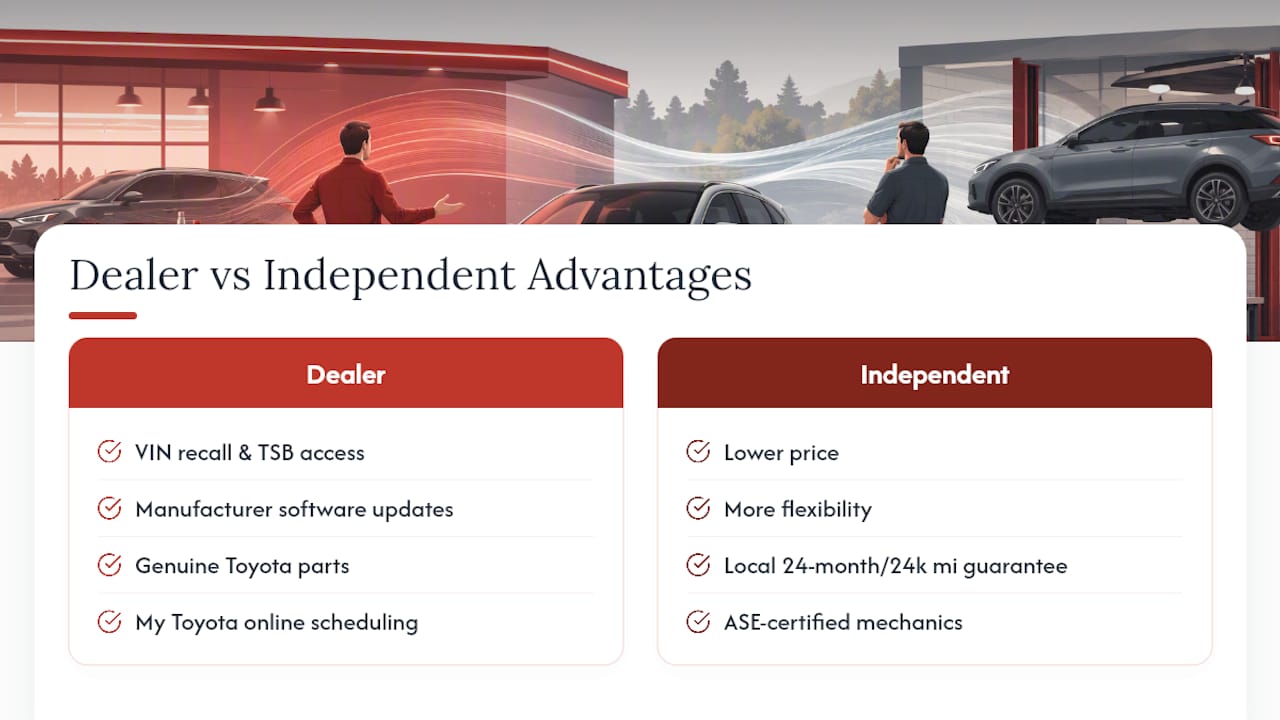
Independent shops tend to win on price and flexibility, and a good one backs its own work with a local guarantee, similar to a 24-month, 24,000-mile warranty. For routine maintenance like a 30K checkpoint with no open recalls, an ASE-certified independent shop typically matches dealer quality at a lower rate.
How to Prepare for Your 30K Appointment
Walking in prepared is the single best defense against paying for work you don’t need.
- Bring your owner’s manual, maintenance log, and VIN. These let the advisor confirm exactly which service checkpoint applies to your specific model and mileage.
- Note your driving conditions and any symptoms. Mention short commutes, towing, dusty roads, or anything odd you’ve noticed, like a pulling sensation when braking.
- Ask the shop to map each proposed line item to your owner’s manual schedule. If an item isn’t in the manual for your mileage, ask why it’s being recommended anyway.
- Request to see the actual inspection results, not a verbal summary, before agreeing to any repair beyond the standard checklist.
- Ask directly: “Is this required for warranty, or just recommended?” That single question separates genuine maintenance from a discretionary upsell.
Pro Tip: Some shops sell a bundled “30K Major Service” package that includes items your specific VIN doesn’t need yet. If an advisor can’t point to the exact line in your maintenance schedule that calls for it, that’s your cue to decline until it’s actually due.
If a service advisor gets defensive or vague when you ask for the inspection sheet, treat that as a signal to get a second opinion rather than sign off on the spot.
What Makes a Shop Qualified to Handle Your 30K Service
Not every shop applies the same rigor to a 30K checkpoint, and the gap shows up in details owners don’t always notice until something goes wrong later.
- ASE-certified technicians matter because the 30K checklist depends on judgment calls, like whether a brake pad has 4mm or 6mm left, not just a checkbox exercise.
- Professional-grade OBD-II diagnostics catch issues a basic code reader misses, which matters when a fault is intermittent or hides behind a generic code.
- A 24-month, 24,000-mile warranty on completed work gives you a real backstop if a part fails after the visit, on top of whatever coverage Toyota itself provides.
- Upfront, itemized pricing means you see the estimate broken down by task before anything gets approved, not after.
Tom’s B & M Auto has served Lynnwood’s Toyota owners for over 40 years, and that stretch of time means a lot of 30K checkpoints have come through the shop on nearly every Toyota model on the road. If you want to see what a transparent checklist looks like at the next major interval, the shop’s own 60K service breakdown shows how each line item ties back to the manufacturer schedule.
What Most Owners Get Wrong About the 30K Mark
The biggest misconception about this service is that it’s a “major” milestone requiring major money. It isn’t. The research backing Toyota’s own maintenance schedule treats 30,000 miles as a checkpoint for catching small problems early, not a threshold where your car suddenly needs a stack of expensive replacements.
Where conventional advice falls short is in treating every dealer estimate as gospel. A worn brake pad at 5mm doesn’t need replacing yet. A cabin filter that still looks clean doesn’t need swapping just because it’s on a package list. The gap between what gets recommended and what your specific VIN actually requires is often wider than owners assume, and closing that gap takes about thirty seconds: ask the advisor to point to the exact line in your owner’s manual.
Prioritize documentation over anxiety. A car with a clean, logged maintenance history protects your warranty and your resale value far more than any single service visit does. Get the oil changed, get the inspections done, keep the paperwork, and treat every add on as optional until someone shows you otherwise in writing.
— Shingi
Book Your Toyota 30K Service in Lynnwood
Some shops give you a straight answer instead of a bundled package: ASE-certified technicians check every item against your Toyota’s actual maintenance schedule, so you pay for what your VIN needs at 30,000 miles, not a generic upsell menu.
That means professional-grade OBD-II diagnostics if something’s flagged, upfront written estimates before any work starts, and a 24-month, 24,000-mile warranty backing everything we touch. Same-day appointments are often available, which matters when you’re trying to get this done before a road trip or before mileage creeps past that 500-mile window. If a coolant or transmission flush turns out to be part of your visit, we also offer financing options for the larger jobs. Ready to get it scheduled? Check availability for 30K, 60K, and 90K service in Edmonds or reach out to book your Toyota’s next checkpoint.
Sources
- Toyota Maintenance & Warranty brochure (2025)
- Toyota service schedules & maintenance pricing | Kelley Blue Book
Leave a Reply