Most brake jobs take between 30 minutes and 4 hours at a professional shop, depending on what the car actually needs. Pad-only swaps on a straightforward vehicle can be done in under an hour per axle. A full four-wheel pads-and-rotors job on a rusted Pacific Northwest car can push past three hours before the tech even touches the test drive.
Here are the realistic time ranges to plan around:
- Brake inspection only: 15–30 minutes (billed or scheduled separately from repair)
- Pad replacement, one axle: 30–60 minutes
- Pads + rotors, one axle: 1–1.5 hours
- Pads + rotors, all four wheels: 2–4 hours
- Caliper replacement (one corner): 45–90 minutes
- Full brake system overhaul: roughly 4–6 hours
Three things commonly push those numbers up: rotors that measure below spec (add 30–60 minutes per rotor for machining or sourcing a replacement), seized hardware from road salt exposure, and parts that have to be ordered rather than pulled from the shop’s shelf.
Key Takeaways
A professional brake job takes 30 minutes to 4 hours depending on service type, vehicle design, and hardware condition, with rust and parts availability the most common causes of overruns.
| Point | Details |
|---|---|
| Pad-only time per axle | 30–60 minutes at a professional shop; plan for a longer slot with scheduling padding. |
| Pads + rotors, all four wheels | Typically 2–4 hours; rotors below spec add 30–60 minutes per rotor for machining or replacement. |
| Inspection is a separate step | A brake evaluation takes 15–30 minutes and should be completed before any repair is authorized. |
| Rust doubles book time | Seized hardware on salt-exposed vehicles commonly doubles the estimated labor time. |
| Tom’s B & M Auto | ASE-certified brake service with upfront pricing, a 24-month / 24,000-mile warranty, and free visual inspections in Lynnwood, WA. |
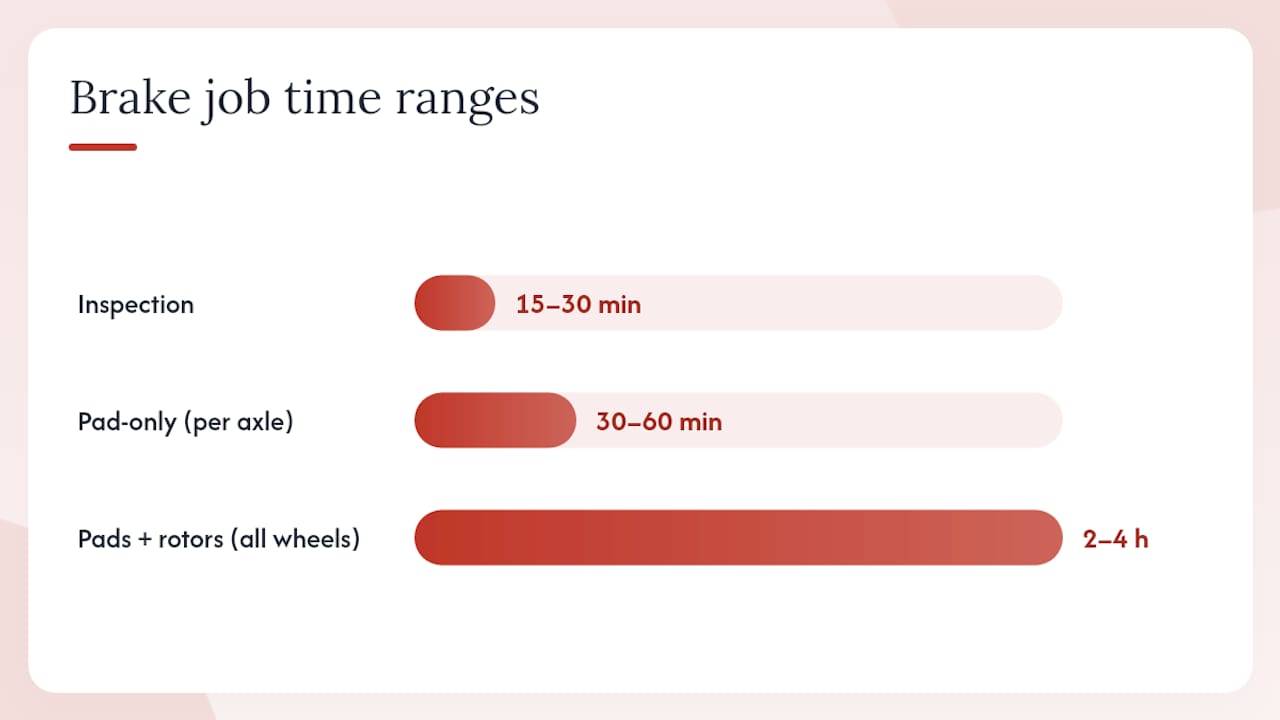
Table of Contents
- How long does a brake job take, job by job?
- What makes the same brake job take very different amounts of time?
- What does a shop actually do during a brake repair?
- How to prepare for your appointment and what to ask the shop
- What commonly causes a brake job to run longer than expected?
- How long do brake pads and rotors actually last?
- Why Tom’s B & M Auto handles brake jobs the way we do
- What the shop’s perspective on timing actually means for you
- Schedule your brake service at Tom’s B & M Auto
- Sources
How long does a brake job take, job by job?
The table below reflects professional shop labor times. These are pure wrench-on-car estimates; most shops schedule a longer window to account for intake, parts staging, and a final quality check.
Professional pad replacement runs 30–60 minutes per axle; add rotors and that climbs to 1–1.5 hours per axle, or 2–4 hours for all four corners. A complete overhaul that covers the full system lands in the 4–6 hour range.
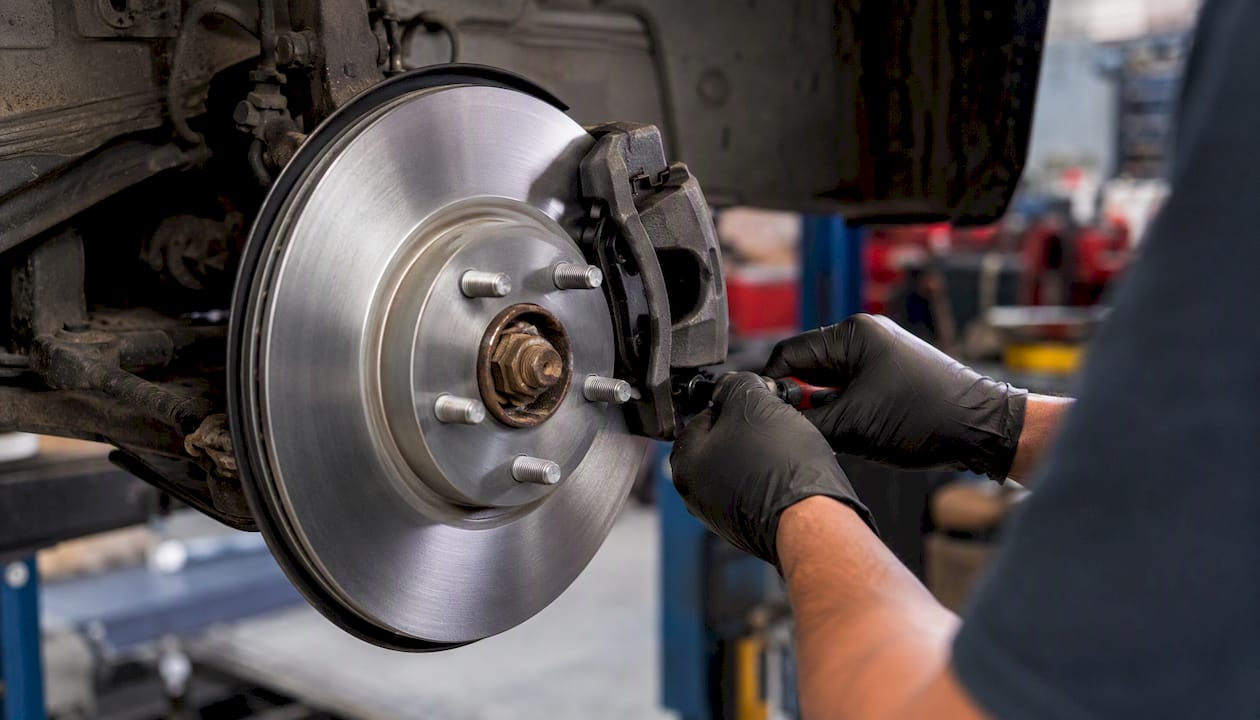
Shop scheduling padding is a real factor. Many shops add 30–60 minutes beyond pure labor time for intake paperwork, parts staging, and a post-service QA check. A job with 90 minutes of actual labor may be booked into a 2.5-hour slot. That is not padding in the dishonest sense; it is how shops avoid running late on every car behind yours.
Pro Tip: Ask the shop to separate the inspection from the repair estimate. A proper brake evaluation takes 15–30 minutes and is often billed or scheduled as its own step. Skipping it and going straight to parts replacement is how unnecessary work gets done.
What makes the same brake job take very different amounts of time?
Vehicle design is the first dividing line. A standard front-disc setup on a Toyota Camry or Honda Accord is about as straightforward as brake work gets. Rear drum brakes add complexity. Electronic parking brakes (common on newer European models and many late-model domestics) require a scan tool to retract the caliper piston before the pads can be changed, which adds time and specialized equipment. Multi-piston calipers on performance vehicles are slower to service than single-piston units. European and luxury vehicle brake systems often use proprietary hardware that takes longer to source and longer to torque correctly.
Environmental factors hit harder than most drivers expect:
- Rust and corrosion: Seized caliper slide pins, corroded rotor hat areas, and stuck lug nuts all add labor. On a car that has lived through multiple Pacific Northwest winters, what looks like a 90-minute job can easily become a three-hour one.
- Stuck bolts: Caliper bracket bolts that won’t break loose require penetrating oil, heat, or extraction tools. Each stuck bolt can add 20–40 minutes on its own.
- Rotor condition: Rotors are the single biggest timing variable. A tech who measures a rotor below minimum thickness has to either machine it (30–60 minutes per rotor) or order a replacement, which may push the job to the next day.
Shop-side factors matter too. Parts availability is the biggest one. A common Toyota or Honda rotor is usually on the shelf. A rear rotor for a 2019 Audi Q5 may need to be ordered, which turns a same-day job into a next-day or next-week appointment. Technician experience also plays a role; a tech who has done the same job fifty times moves faster than one encountering an unfamiliar platform for the first time.
Variation in brake job time comes down to vehicle design and environmental factors more than anything else. Imports, luxury cars, trucks, and performance models typically require more labor. Salted-road vehicles frequently need rust-removal work that simply cannot be rushed.
What does a shop actually do during a brake repair?
Knowing where the time goes helps you understand why a shop’s estimate is what it is.
- Intake and inspection (15–30 min): The tech drives the car briefly, then lifts it and pulls the wheels. They measure pad thickness, rotor thickness, and check caliper condition. This step determines what actually needs to be done and protects you from paying for parts you don’t need. See the brake system components checklist for a full picture of what gets evaluated.
- Wheel removal (5–10 min per corner): Straightforward on a clean car; corroded lug nuts or a stuck wheel can add time.
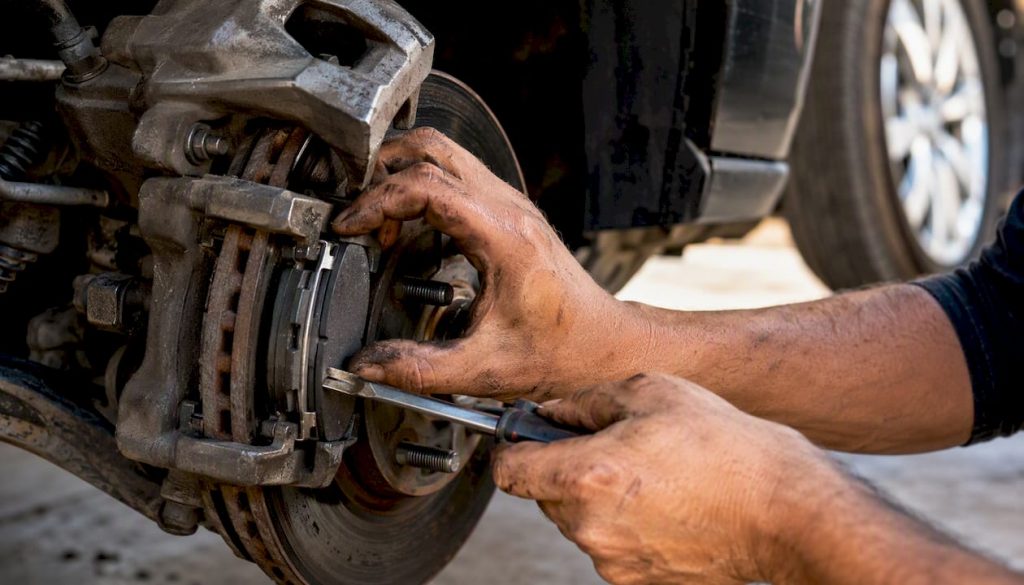
- Caliper removal and hardware inspection (10–20 min per corner): The caliper comes off, slide pins get cleaned and lubricated, and the bracket is inspected for damage.
- Rotor removal and evaluation (10–30 min per corner): If the rotor is above spec, it stays. If it’s below spec, it goes to the lathe for resurfacing or gets swapped for a new one. Rotor resurfacing adds roughly 30–60 minutes per rotor; replacement time depends on parts availability.
- Pad installation and caliper reassembly (10–20 min per corner): New pads go in, the caliper piston gets compressed (or retracted electronically), and everything is torqued to spec.
- Brake fluid check and bleeding (15–30 min): If the fluid is dark or moisture-contaminated, a flush is recommended. Bleeding the system after caliper work is standard.
- QA road test and bed-in (15–20 min): The tech drives the car to verify pedal feel and confirm no noise or pull. Bed-in involves a series of moderate stops from 30–35 mph to seat the pads against the rotors.
The bed-in procedure is not optional. Skipping it can cause uneven pad deposits on the rotor surface, which shows up later as vibration under braking.
How to prepare for your appointment and what to ask the shop
A little prep before you call cuts the chance of surprises on the day.
Tell the shop when booking:
- Your symptoms (squealing, grinding, soft pedal, pulling to one side, vibration)
- When brakes were last serviced and what was done
- Whether the car has spent time in a salted-road climate
- Any aftermarket parts or recent suspension work
Questions worth asking before you hand over the keys:
- Do you have my rotors and pads in stock, or will you need to order them?
- Will you measure the rotors before recommending replacement?
- What is the labor time estimate per axle, and does that include the inspection?
- What warranty do you offer on parts and labor?
Logistics to plan:
- Book an appointment rather than walking in for anything beyond a simple pad swap. Walk-ins for brake work often wait hours for a bay.
- Arrange a ride or plan to wait. Even a 90-minute job can run longer if the tech finds seized hardware.
- Tom’s B & M Auto offers a free visual brake inspection so you can get a real diagnosis before committing to repair costs.
Pro Tip: Mention upfront if your car has an electronic parking brake. The shop needs a compatible scan tool to service it, and knowing ahead of time prevents a wasted trip.
What commonly causes a brake job to run longer than expected?
Rust and corrosion are the top culprits. Seized hardware can easily double the estimated book time on salt-exposed vehicles. Lynnwood and the broader Puget Sound area see enough wet winters that corrosion is a real factor even without road salt, though cars that have been driven in snowier inland regions or brought from the Midwest carry heavier rust loads.
Common delay sources and rough time additions:
- Seized caliper slide pins: 20–45 minutes per corner to clean, free, or replace
- Stuck caliper bracket bolts: 20–40 minutes per bolt for penetrating oil soak, heat, or extraction
- Corroded rotor hat (where the rotor meets the hub): 15–30 minutes per corner to clean and separate
- Parts backorder: Hours to days depending on vehicle and part; performance or import-specific rotors and calipers are the most common offenders
Regional note: if your car has spent winters in Montana, Idaho, or anywhere with heavy road salt use, tell the shop before they quote you. A tech who knows that upfront can build the extra time into the estimate rather than calling you mid-job with a revised number.
How long do brake pads and rotors actually last?
Brake pad lifespan varies widely: most drivers see 30,000–40,000 miles under normal conditions, but pads can reach 60,000 miles with gentle highway driving or wear out before 20,000 miles in heavy city stop-and-go. Rotors typically outlast one or two sets of pads before they need attention.
Key lifespan factors:
- Driving style: Hard, late braking wears pads two to three times faster than smooth, progressive stops.
- Vehicle weight: Heavier trucks and SUVs put more load on brake components at every stop.
- Rotor condition: A warped or scored rotor accelerates pad wear even on a fresh set.
Rotors can often be resurfaced once before replacement becomes necessary, but only if they are still above the manufacturer’s minimum thickness after machining. Once they hit that floor, replacement is the only safe option.
For maintenance planning, a brake inspection every 15,000 miles or once a year is a reasonable cadence. Come in sooner if you notice squealing (worn pad indicators), grinding (metal-on-metal contact), a soft or spongy pedal, or the car pulling to one side under braking. You can also inspect brake pads at home between shop visits to catch wear early.
Why Tom’s B & M Auto handles brake jobs the way we do
Tom’s B & M Auto has been servicing brakes for Lynnwood-area drivers since 1985. Every brake job starts with a proper inspection, not an assumption about what needs to be replaced.
- ASE-certified technicians on every brake job, including rear drum, electronic parking brake, and multi-piston caliper systems
- OBD-II diagnostics available for vehicles where the parking brake or ABS system requires a scan tool during service
- Experience with all makes: Toyota, Honda, Subaru, domestic trucks, European vehicles, and hybrids
- 24-month / 24,000-mile warranty on all parts and labor, covering both the components installed and the work performed
- Upfront pricing: you get a written estimate after inspection, before any work begins
At Tom’s B & M Auto, we do not start replacing parts until we know what is actually wrong. The inspection is not a formality. It is the step that keeps you from paying for rotors you do not need.
What to expect at intake: a tech will ask about your symptoms, pull the vehicle into a bay, and complete a full brake evaluation before writing an estimate. If parts need to be ordered, you will know before you wait.
What the shop’s perspective on timing actually means for you
The single most useful thing a driver can do before a brake appointment is be honest about the car’s history. A vehicle that has been driven hard, lived in a wet climate, or has not had brake service in five years is going to take longer than a well-maintained daily driver. That is not a problem; it is just reality, and a shop that knows it upfront can give you an accurate estimate instead of a low number that doubles once the wheels come off.
Surprises mid-job are frustrating for everyone. The best way to avoid them is a real inspection before repair authorization, full disclosure of the car’s history, and a shop that communicates clearly when something unexpected turns up. That is the standard at Tom’s B & M Auto, and it is why realistic timing matters more than a fast quote.
Schedule your brake service at Tom’s B & M Auto
Tom’s B & M Auto gives Lynnwood-area drivers a clear alternative to guessing at brake repair costs and timelines. You get a written estimate after a real inspection, ASE-certified labor, and a 24-month / 24,000-mile warranty on every brake job.
Start with a free visual brake inspection to find out exactly what your brakes need before you commit to any repair cost. Current offers include up to $120 off brake service for qualifying work. For larger brake overhauls, financing is available so the cost does not have to come out of pocket all at once.
Call or book online. Have your vehicle year, make, model, and a description of your symptoms ready, and mention any previous brake work or recalls. Same-day appointments are often available.
Sources
- Brake Labor Times: A Shop Owner’s Guide to Accurate Estimates
- Howlongfor
- How Long Does Brake Service Take in 2026? Real Timing by Scenario
- How Long Do Brakes Last?
- Carparts