Catalytic Converter Theft in Lynnwood: Risk, Law and Repair
Catalytic converter theft has not gone away in the Puget Sound area. It rises and falls with the price of the metals inside the part. If yours is stolen, you need a documented police report, a shop that can inspect the whole exhaust system, and a replacement that is installed correctly and warrantied. We replace converters on all makes at our Lynnwood shop, and we back the work with a 24-month/24,000-mile warranty.
This guide covers what is happening locally, why thieves want the part, which vehicles they pick, what Washington law now says, how to make your car a harder target, and what to do the day you find it gone.
TL;DR
- Thefts around the Eastside and Snohomish County have flared up again in 2026 as precious metal prices rose, so the risk is current.
- Hybrids, trucks and SUVs with high ground clearance are the usual targets, but any car with a converter can be hit.
- A Washington law in effect since April 1, 2025 requires VIN marking and cuts off the easy cash market for stolen converters.
- A shield, VIN etching and smart parking cost far less than a replacement, which commonly runs into the thousands.
- If it is gone: don’t drive it, photograph the damage, file a police report, call your insurer, then have the full exhaust inspected.
Table of Contents
- Is catalytic converter theft still happening around Lynnwood?
- Why thieves want your converter
- Which vehicles get targeted
- What Washington law now says
- How to make your car a harder target
- Signs your converter is gone
- What to do the day you find it stolen
- What replacement involves and what it costs
- Where we do this near Lynnwood
- Replacing a stolen converter in Lynnwood
- Our view
- FAQ
- Sources
Is catalytic converter theft still happening around Lynnwood?
Yes, and the pattern is uneven. Bellevue Police counted 16 thefts in the first five months of 2026, already more than the 14 reported in all of 2025, with most clustered in the Eastgate neighborhood and at park-and-ride lots. That is a long way below the 452 thefts Bellevue reported in 2021, but the direction changed.
Closer to us, Mukilteo Police handled two cases in a single week in March 2026 after thefts had declined. An officer there said precious metal prices tend to rise during global instability, which may be why thieves go back to converters for quick cash.
Nationally, CARFAX estimated that more than 137,000 converters were stolen in the U.S. in 2025. The practical takeaway for a Lynnwood driver: theft comes in waves, and park-and-ride lots, apartment complexes and long-term street parking are where waves land.
One caution on the trend. A King County prosecutor told MyNorthwest that some thieves have moved on to copper communication lines as copper prices climb. That is a shift in some cases, not a reason to stop protecting your car.
Why thieves want your converter
A catalytic converter contains platinum, palladium and rhodium, metals that clean exhaust gases. CARFAX reported that rhodium reached about $11,000 per ounce in March 2026, more than double a year earlier, though well under its roughly $30,000 peak in 2021. Metal prices move daily, so check a live market quote if you want today’s number.
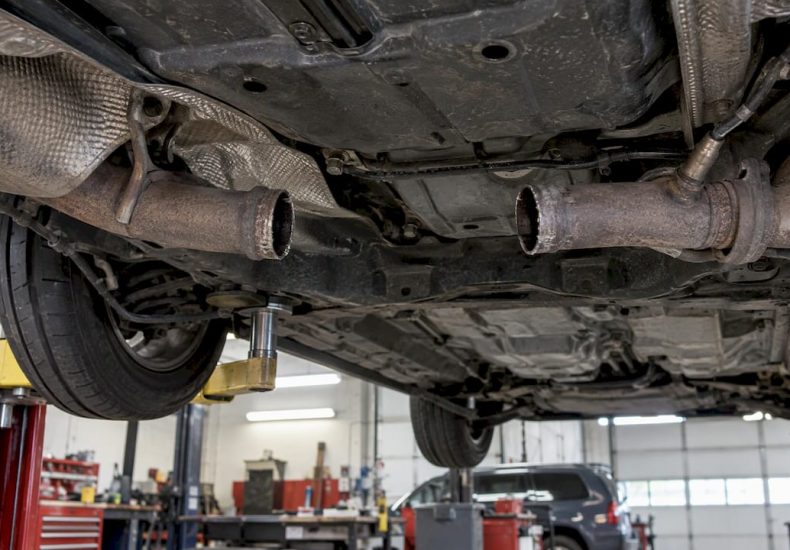
The theft itself is fast: a thief slides under the car, cuts the pipe on both sides of the converter and leaves. Federal investigators explained why it pays. Converters carry no unique serial number or VIN marking, so stolen parts are hard to trace. They are sold intact to extraction operations that crush the honeycomb core, and the resulting powders go to refineries. Black market prices ran over $1,000 per converter depending on the vehicle.
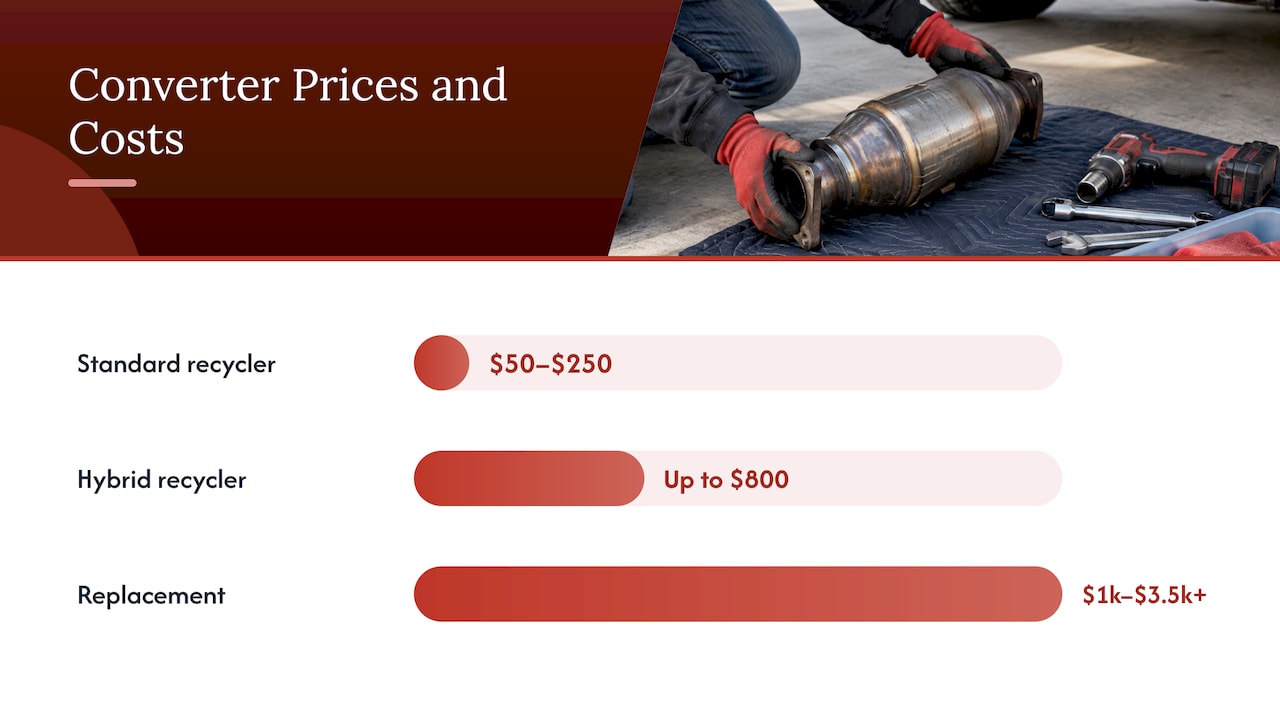
The thief gets a fraction of that, and you get the bill. The National Insurance Crime Bureau, as reported by The Seattle Times, said recyclers pay $50 to $250 for a standard converter and up to $800 for a hybrid one, while replacement costs the owner $1,000 to $3,500 or more. Insurance claims for these thefts rose from 16,660 in 2020 to 64,701 in 2022, according to the same report.
Which vehicles get targeted
Thieves pick vehicles that are easy to get under and carry valuable metal. CARFAX’s most recent list of the ten most targeted vehicles is:
- Ford F-150
- Hyundai Tucson
- Ford Explorer
- Ram 2500
- Chevrolet Silverado
- Chevrolet Traverse
- Ram 3500
- Ford EcoSport
- Ford Expedition
- Chevrolet Trax
That comes from CARFAX’s June 2026 data. Washington agencies add their own warnings. The City of Everett’s prevention guide names the Toyota Prius and Ford E-250/F-250 and larger V10 trucks as popular targets, and Bellevue Police say hybrids and trucks are hit because they contain high-value metals and are easy to steal and sell for fast cash.
In a Toyota, Honda and Subaru market like ours, that matters: hybrid owners in particular should treat protection as routine. Does your car have a converter at all? Every gasoline car built for the U.S. market in the last several decades does, and so do hybrids. Fully electric vehicles do not.
What Washington law now says
Washington changed the rules so that stolen converters are harder to sell. House Bill 2153 took effect April 1, 2025, and its main points are:
- VIN marking. Under RCW 9A.82.180, a converter removed for any reason other than maintenance, repair or demolition must be permanently marked with the last eight digits of the originating vehicle’s VIN within 24 hours and before it is moved off site.
- Seizure and penalties. Unmarked detached converters can be immediately seized and forfeited. An unlicensed person who knowingly possesses or sells six or fewer commits a gross misdemeanor, and seven or more is a Class C felony.
- No cash payouts. Under RCW 46.79.150, licensed scrap processors cannot pay individual sellers in cash or on the spot. Payment goes by nontransferable check mailed no earlier than three days later, and records, including a photo showing the VIN marking, are kept for three years.
- Limits on de-canning. Only licensed scrap processors may break open converters to extract metals, and they must wait 30 days after purchase unless they own the originating vehicle.
- Funding enforcement. The Department of Revenue’s summary says the bill adds a $500 inspection fee to scrap processor and wrecker licenses to pay for Washington State Patrol inspections of converter purchases.
The Seattle Times also reported that the law directs car dealers to offer customers the option of marking converters with partial VINs. King County prosecutors said unregulated online buyers were absorbing stolen converters, which is the gap the licensing and record-keeping rules aim at.
What this means for you: a VIN-marked converter is traceable, and a thief who cannot sell it for cash has less reason to take it. Marking is a deterrent, not a guarantee.
How to make your car a harder target
The City of Everett’s guide says prevention may cost several hundred dollars, while replacement costs several thousand and can take weeks. Its recommendations, echoed by Bellevue Police, are:
- Mark the converter with your VIN. Some Washington police departments run free etching events. Ask your local department, since schedules change.
- Install an undercarriage shield or cage. It makes the cut slower and noisier.
- Weld the flange bolts or the converter to the frame. This removes the quick unbolt option.
- Add a tilt or vibration alarm. It sounds when the car is jacked or cut.
- Park smart. Use a garage when you can, or a well-lit, busy spot. Avoid dark corners of park-and-ride lots and long stretches in the same street space.
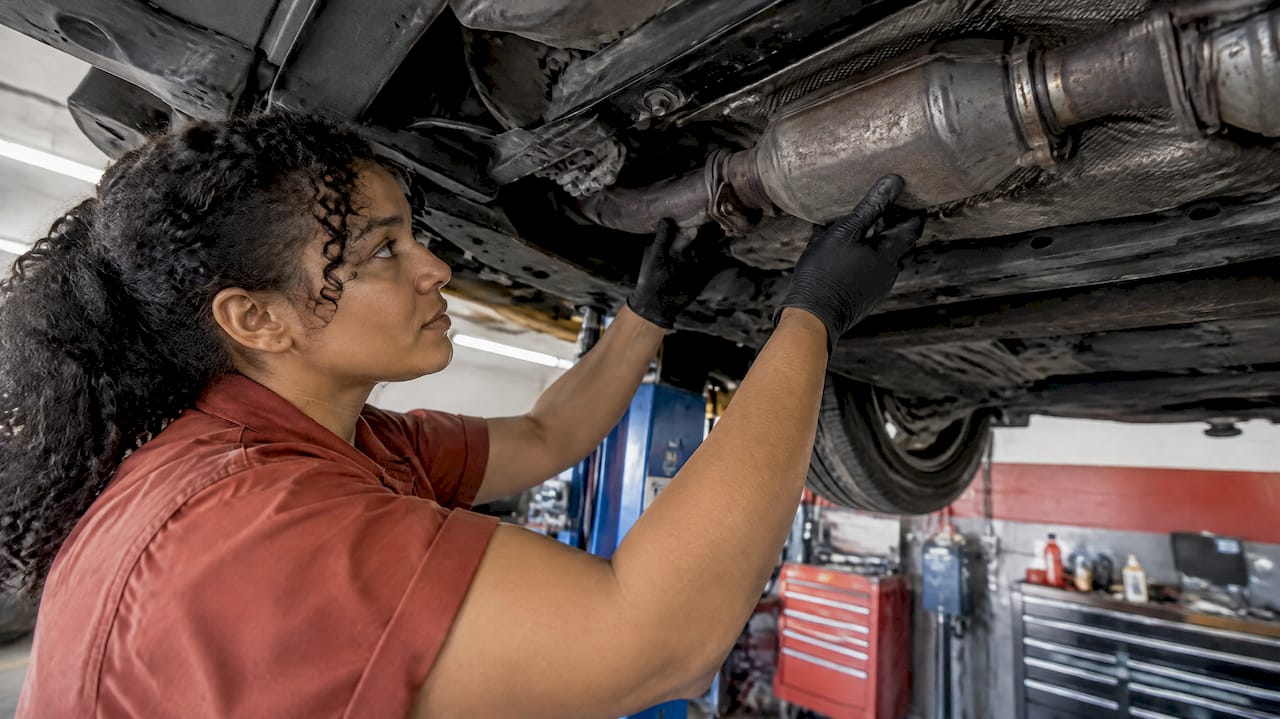
A few practical points from the shop floor. A shield only helps if it is bolted to solid points and fits your exhaust layout, which differs between a Prius, a Tacoma and a Silverado. Welding has to be done where it will not damage the converter or nearby oxygen sensors. Because we work on Toyota, Honda, Subaru, domestic and hybrid vehicles every day, we can tell you what fits your car before anyone starts cutting or welding. Our own theft prevention guide for Washington drivers goes deeper on what works.
If you drive a hybrid or a tall truck, do this before you need the repair, not after.
Signs your converter is gone
You will usually know within seconds of starting the engine:
- A sudden, loud roar from under the car, often worse when you accelerate, sometimes with rattling or sputtering.
- A check engine light, often with emissions-related codes (P0420 and P0430 are common examples).
- Visible cut pipe ends with fresh, bright metal, or a gap where the converter sat.
- Exhaust smell inside the cabin.
Exhaust fumes in the cabin are a safety issue. Carbon monoxide is odorless and dangerous, so if you smell exhaust inside the car, stop driving it and get it towed.
A loud exhaust and a check engine light do not always mean theft. A P0420 code can also come from a failing oxygen sensor, an exhaust leak or an engine misfire. A proper diagnosis finds out which, so you don’t pay for a converter the car did not need. Our shop lists check engine light diagnostics among its services, and the same inspection looks at the sensors and pipes around the converter.
What to do the day you find it stolen
- Don’t drive it. Driving risks fumes in the cabin and can damage the engine, sensors and wiring.
- Photograph everything. Take pictures of the cut pipes, the empty space and the car’s location before it is moved.
- File a police report. Call the department for the city where the car was parked, such as Lynnwood Police, and keep the report number. Your insurer will want it, and reports help police see patterns.
- Call your insurer. Theft of a converter is generally handled under comprehensive coverage, not collision. Ask about your deductible and whether a rental is covered.
- Get a tow to a shop that can do the full job. The cut often damages more than the converter itself.
Our step-by-step guide on what to do after a converter is stolen lays this out with the photos and paperwork you need.
What replacement involves and what it costs
We don’t quote a converter price here because it depends on your vehicle, the part and the damage. What the evidence says about the range: NICB figures reported by The Seattle Times put replacement at $1,000 to $3,500 or more. Hybrids and trucks sit at the upper end because the parts are larger or more metal-rich.
Three things move the price:
- The part. Hybrids and larger-engined trucks use converters with more precious metal, and the price follows the metals.
- Collateral damage. Thieves often cut flanges, oxygen sensor connections and pipe sections. All of that is part of the repair and of your insurance claim, so make sure the estimate lists it.
- Protection added. Many owners choose a shield at the same visit so the car is not hit twice.
Because the repair is a full exhaust job, ask for an itemized written estimate. We give upfront pricing, and our technicians are ASE-certified and use digital inspections to document what was damaged, which also helps with your insurer’s paperwork. We use OEM-quality parts, and the repair carries our 24-month/24,000-mile warranty.
A converter replacement is also where emissions rules matter. A part that does not match your vehicle can trigger a check engine light, so the right converter for your exact make, model and engine is the point of doing it properly.
Where we do this near Lynnwood
We replace converters at our Lynnwood shop, and we also have pages for nearby communities: Edmonds, Mukilteo, Shoreline, Mountlake Terrace and Kenmore. If you drive a hybrid or European vehicle, we service those as well.
Replacing a stolen converter in Lynnwood
If your converter has been stolen, or you want it protected before it is, start with our catalytic converter replacement service in Lynnwood. Same-day appointments are often available. Military members, seniors and first responders qualify for discounts. You can also see everything else we do on our main site, from check engine light diagnostics to exhaust system repair.
Bring the police report number and your insurance details, and we will give you an upfront price in writing.
Our view
Most people come to us after the theft, and the first thing they ask is why nobody warned them. The honest answer is that the risk is not constant. It follows metal prices, and when prices climb, converters on hybrids and trucks go first.
What we have found at our shop is that the repair is rarely just a converter. Cut pipes, damaged sensor connections and a stressed exhaust all need to be looked at together. That is why we do a digital inspection before quoting, and why we state the price upfront.
If you drive a Prius, a Tacoma or a full-size truck, we would rather fit protection with you now than replace the part later. And if it has already happened, we will get you back on the road with a repair backed for 24 months or 24,000 miles.
Shingi
FAQ
Is catalytic converter theft still a thing?
Yes. Bellevue’s 2026 count had already passed its full 2025 total by May, and Mukilteo had a cluster of cases in March 2026. Thefts rise when metal prices rise, so the risk can return quickly.
Can I drive with a stolen catalytic converter?
It is not a good idea. The exhaust is loud, fumes can enter the cabin, and the engine and sensors can be damaged. Have the car towed and inspected instead.
Does insurance cover a stolen catalytic converter?
Usually it falls under comprehensive coverage, subject to your deductible, and your insurer will ask for a police report number. Ask whether the claim includes damage to sensors and pipes, not only the converter.
Is it illegal to sell a catalytic converter in Washington?
Not if you are selling your own part legally, but since April 1, 2025, converters removed for reasons other than repair or demolition must carry the last eight VIN digits. Licensed scrap processors cannot pay sellers in cash. Unlicensed people who knowingly possess or sell unmarked converters face gross misdemeanor or felony charges depending on the number.
How do I protect my converter?
Mark it with your VIN, add a shield or cage, have the flange bolts or converter welded, consider a tilt alarm, and park in a garage or a well-lit, busy spot.
Sources
- Bellevue has already seen more catalytic converter thefts than all of last year (MyNorthwest, May 2026)
- Mukilteo Police on rising precious metal prices (MyNorthwest, March 2026)
- CARFAX top 10 vehicles targeted by converter thieves (June 2026)
- ICE: national catalytic converter theft ring takedown (November 2022)
- The Seattle Times: New WA law on stolen catalytic converters (April 2024)
- RCW 9A.82.180
- Chapter 46.79 RCW: Hulk haulers and scrap processors
- Washington Department of Revenue: 2024 summary of legislation
- City of Everett: catalytic converter theft prevention
Recommended
- Catalytic Converter Theft Prevention: What Works in Washington
- Catalytic Converter Stolen? Get a Police Report, Photos, and a Tow Today
- Catalytic Converter Replacement in Lynnwood, WA
Leave a Reply