

Toyota Hybrid eCVT Fluid: Type, Interval and Service
Toyota’s hybrid transaxle is not a belt-and-pulley CVT, and it does not take universal CVT fluid. Most Toyota hybrids from the last decade use Toyota Genuine ATF WS, and newer designs such as the 2023 and later Prius call for e-Transaxle Fluid TE. Toyota’s normal schedule asks for inspection rather than replacement, but heavy use, age and fluid condition are good reasons to change it sooner. At Tom’s B & M Auto in Lynnwood, WA, our ASE-certified technicians service Toyota hybrids, and transmission service is one of the jobs we do.
TL;DR
- The right fluid depends on the model year: ATF WS on many earlier and current hybrids, e-Transaxle Fluid TE on newer designs. Never substitute a generic CVT fluid.
- Toyota’s published schedules inspect the hybrid transaxle for leaks on the normal schedule. They call for replacement at 60,000 and 120,000 miles under severe use.
- Towing, a roof carrier, heavy loads, lots of idling or stop-and-go driving all count as severe use.
- A proper service is a drain and refill, with a new drain-plug gasket, correct torque and a level check to a tight window, not a pressure flush.
- Capacity differs by model, from roughly 3.3 L on a Prius c to 4.4 L on a Grand Highlander, and the rear motor on AWD models has its own fluid.
Table of Contents
- What an eCVT is, and why its fluid is different
- Which fluid your Toyota hybrid takes
- What Toyota’s schedule says about changing it
- When a preventive change makes sense
- What a proper eCVT fluid service involves
- Why have a hybrid specialist do it
- Book your Toyota hybrid transmission service in Lynnwood
- FAQ
- Sources
What an eCVT is, and why its fluid is different
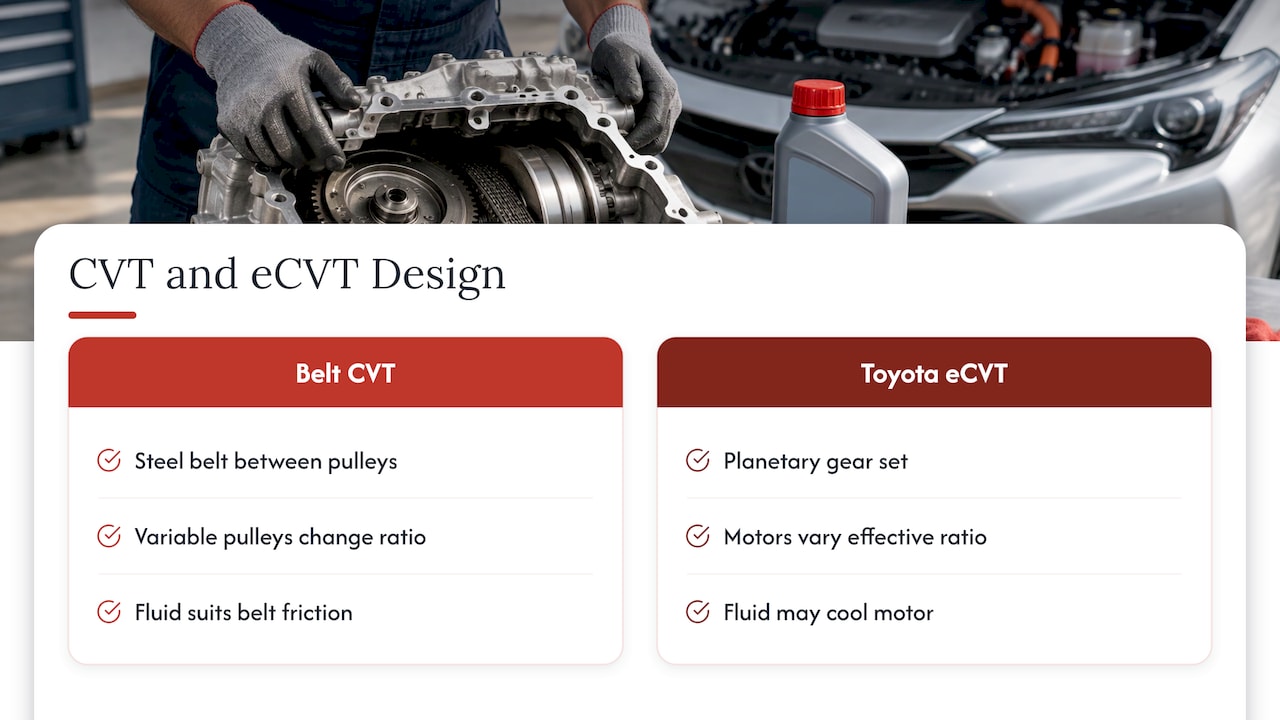
A conventional CVT moves power through a steel belt running between two variable pulleys. Toyota’s hybrid transaxle has no belt. It uses a planetary gear set that splits engine power between the wheels and electric motor-generators. The “eCVT” name comes from the way the motors vary the effective ratio.
That design changes what the fluid has to do. In a Prius-style layout, the electric motor sits inside the transmission housing, so the fluid can touch it. Industry analysis notes that additives that suit a normal gearbox can raise electrical-compatibility problems when the fluid also has to cool the motor. This is why a bottle labeled “CVT fluid” is not a safe stand-in. Belt CVT fluids are built for friction between a belt and pulleys. Your eCVT has no such need.
Toyota’s own service procedure for the 2020 RAV4 Hybrid requires Toyota Genuine ATF WS and warns that other fluid may cause abnormal noise, vibration or transmission damage.
Which fluid your Toyota hybrid takes
There are two fluids to know. ATF WS (World Standard) is the long-running choice. e-Transaxle Fluid TE appears on newer designs. They are not interchangeable, and the year and drivetrain decide which applies.
| Vehicle | Fluid | Reference capacity |
|---|---|---|
| 2013 Prius c | ATF WS | 3.3 L (3.5 US qt) |
| 2009 to 2015 Prius | ATF WS | 3.4 L |
| 2015 to 2018 Prius | ATF WS | 3.6 L |
| 2023 to 2024 Prius and Prius Prime | e-Transaxle Fluid TE | See the Toyota procedure for your model |
| 2018 to 2025 RAV4 Hybrid | ATF WS | 3.9 L front, 1.7 L rear motor |
| 2023 and later Grand Highlander Hybrid | ATF WS (A25A-FXS), TE on the T24A-FTS rear unit | 4.4 L front, 1.7 L or 3.0 L rear |
Two details matter in practice. First, a Camry Hybrid can shift from one fluid to the other between model years: a schedule for the 2022 Camry lists ATF WS, while one for the 2025 Camry says to use e-Transaxle Fluid TE rather than WS, including for the AWD rear differential. Second, AWD hybrids have a separate rear motor unit with its own fluid and its own capacity. Servicing only the front unit leaves part of the job undone.
The capacities above are reference figures. The real amount depends on how much comes out, and the level check at the fill opening has the final say.
What Toyota’s schedule says about changing it
This is where owners get conflicting answers. Some dealers describe the fluid as lifetime. The published maintenance schedules are more specific.
On the normal schedule, the hybrid transaxle is inspected for leakage, not replaced. A summary of the 2022 Camry schedule shows an inspection every 30,000 miles or 36 months. Under severe use (towing, a car-top carrier, heavy loading), it shows replacement at 60,000 and 120,000 miles. A RAV4 schedule summary also lists replacement at 60,000 and 120,000 miles for towing, roof carriers or heavy loads, and for the rear motor fluid too.
So “lifetime” really means “inspect, and replace if your use is demanding.” Your owner’s manual and warranty booklet for your exact year are the authority. Check them before you decide, and note that intervals differ by model.
When a preventive change makes sense
The schedule’s severe-use list is a reasonable starting point, but real driving is rarely so tidy. Here are the situations where we would look at the fluid earlier than the normal schedule suggests.
Severe use
Towing a trailer, hauling a loaded roof box, carrying heavy loads, long idling and low-speed stop-and-go traffic all raise the heat and wear on the fluid. Puget Sound commuting often includes hilly stop-and-go traffic on I-5 and 405, and a hybrid used for short trips in that traffic can fit the pattern. If that sounds like your week, the 60,000-mile severe-use point is your reference, not the 120,000-mile normal one.
A used hybrid with no records
If you buy a Toyota hybrid at 80,000 or 100,000 miles and the history is blank, you do not know whether the fluid was ever touched. Changing it gives you a known starting point. Our buyer inspection can include a look at the transaxle for leaks before you commit to the car.
Fluid condition
Fresh WS fluid is a clean, translucent color. Dark fluid, a burnt smell or visible metal debris on the drain plug magnet are all reasons to act. A technician can see this when the plug comes out, which is another reason a drain-and-refill beats guessing from mileage alone.
Symptoms
New whine, a shudder on takeoff, vibration at steady speed or a leak at the transaxle seam should be looked at promptly, whatever the mileage. A check engine light on a hybrid also deserves a proper scan, and our check engine light diagnostics use professional-grade OBD-II tools.
What a proper eCVT fluid service involves
This is a drain and refill with a defined procedure, not a quick top-up. Toyota’s service documents show how exacting it is.
For the 2020 RAV4 Hybrid, the vehicle must be level and lifted. The technician removes the filler plug and the drain plug, then refits the drain plug with a new gasket at 50 N·m (37 ft·lbf). New fluid goes in slowly until it sits within 0 to 5 mm of the filler opening’s lower edge. After a 30-second wait, the level is re-checked, the fluid is inspected and the unit is checked for leaks.
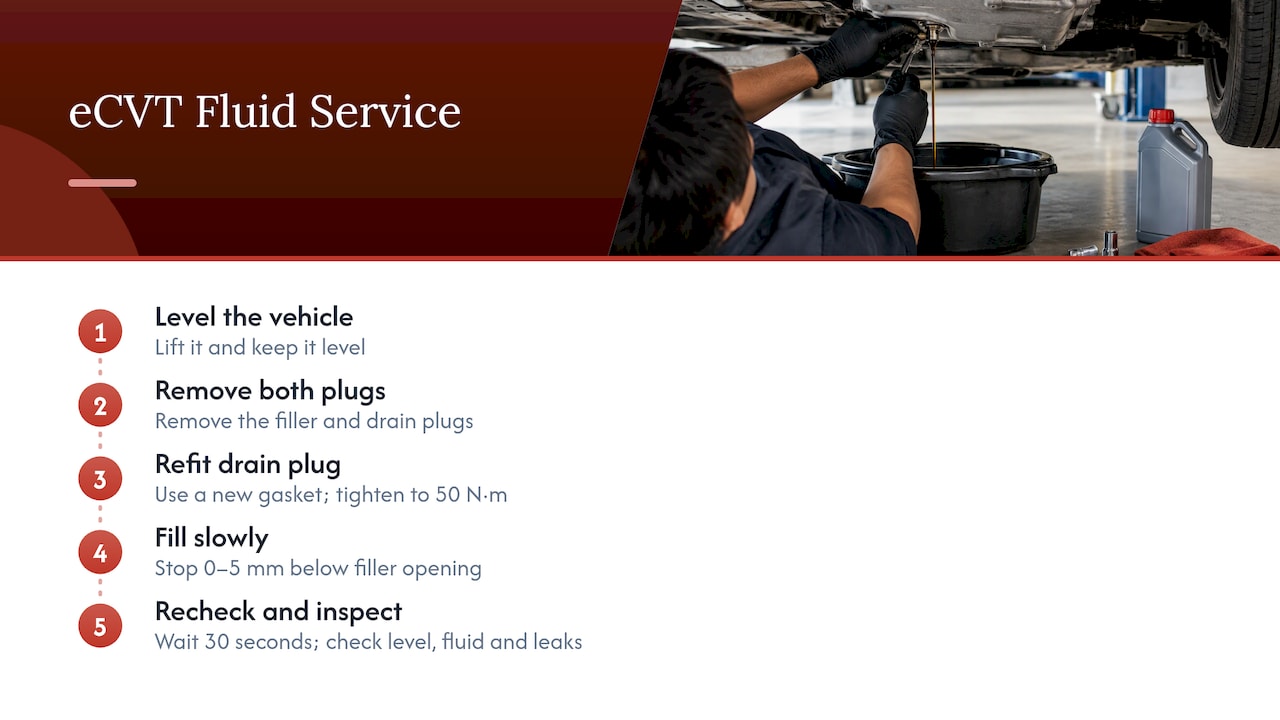
The level window varies by vehicle. Toyota’s Prius c procedure allows 0 to 8 mm, and the 2023 to 2024 Prius family uses 0 to 6 mm for the PA10. Some older models, like the 2012 Camry Hybrid, also use diagnostic software to cycle the system during the refill and set the level.
A few millimeters sounds trivial, but over- or under-filling a transaxle changes how it lubricates and cools. That precision is why this job belongs on a lift with the right tools and the right fluid for the exact vehicle.
High-voltage safety
A hybrid’s orange cables carry high voltage. Toyota’s owner’s manuals warn that the high-voltage system can cause severe burns, shock or fatal injury, and that orange wiring, connectors and the service plug should not be touched. Fluid service happens near the drivetrain, not the battery, but it is one more reason to leave hybrid work to trained technicians.
Why have a hybrid specialist do it
The job is simple to describe and easy to get wrong. The wrong fluid, a skipped rear unit, a missing gasket or a bad level reading can each cause trouble, and the trouble may not show for months.
When you bring a Toyota hybrid to us, here is what we can say about how we work:
- Our technicians are ASE-certified, and we service hybrid and European vehicles as well as Toyota, Honda, Subaru and domestic makes.
- We use OEM-quality parts and give upfront pricing.
- Our digital inspections let you see what we see.
- Every repair carries a 24-month/24,000-mile warranty.
A wider look at hybrid maintenance, including what else comes due, is in our hybrid service guide. The inverter has its own cooling loop with its own fluid, covered in hybrid inverter coolant. For general intervals across transmission types, see our transmission fluid change interval guide.
Our view from the shop
Lifetime fluid is a phrase, not a service plan. Toyota’s own schedules separate normal and severe use, and plenty of Lynnwood driving falls into the second group: short trips, hills, stop-and-go traffic, a roof box in summer.
We would rather look at your fluid than guess. Drain it, check what comes out, refill with the fluid Toyota specifies for your exact model, set the level correctly and check for leaks. That is a small job compared with a transaxle repair.
Toyota hybrids are some of the most reliable cars we see, and this one habit helps keep them that way. If you are around 60,000 miles, or past it with no record, it is a good time to have it looked at.
Shingi
Book your Toyota hybrid transmission service in Lynnwood
We handle transmission service for Toyota hybrids and other makes at our Lynnwood shop. Same-day appointments are often available, and we offer discounts for military, seniors and first responders. If your mileage is due for a 30k, 60k or 90k service, we can look at the transaxle at the same visit. To get started, request a quote for transmission service in Lynnwood.

FAQ
Can I use regular CVT fluid in my Toyota hybrid?
No. The eCVT is a planetary gear set with electric motors, not a belt-and-pulley unit. Toyota’s procedure for the RAV4 Hybrid requires ATF WS and warns that other fluids may cause noise, vibration or damage. Newer models may specify e-Transaxle Fluid TE instead.
How often should I change the transmission fluid in a Toyota hybrid?
The normal schedule inspects the transaxle, and replacement at 60,000 and 120,000 miles applies to severe use such as towing or heavy loads. Many owners choose a preventive change somewhere around 60,000 miles, especially with stop-and-go driving or an unknown history. Check your owner’s manual for your model year.
How much fluid does a Toyota hybrid transaxle hold?
It depends on the model. A Prius c holds about 3.3 L, and a 2018 to 2025 RAV4 Hybrid lists 3.9 L plus 1.7 L for the rear motor. The level check, not the number, sets the final fill.
Does the AWD rear motor need fluid service too?
Yes, on models that have one. The RAV4 Hybrid’s rear motor unit takes its own 1.7 L of ATF WS, and some newer models use TE there. Ask for the front and rear units to be covered in the same visit.
Sources
- Hybrid E-motor Positions, Lubes’N’Greases
- Toyota RAV4 HV hybrid transaxle fluid procedure (Mitchell)
- Toyota Prius c fluid adjustment procedure, 2013 model year
- Toyota Gen 5 Prius and Prius Prime transaxle fluid replacement
- Toyota Prius transmission fluid specifications by chassis, CarFactBook
- RAV4 fluids and capacities, Toyota-Club.net
- Grand Highlander fluids and capacities, Toyota-Club.net
- 2022 Toyota Camry maintenance schedule, GarageHub
- Toyota RAV4 maintenance schedule 2019 to 2025, GarageHub
- 2025 Toyota Camry maintenance schedule
- 2012 Camry Hybrid transaxle service procedure
- 2019 Highlander Hybrid owner’s manual safety section
Recommended
- Common Hybrid Vehicle Service Needs: 2026 Owner’s Guide
- Hybrid Inverter Coolant: What It Is and When to Change It
Leave a Reply