
Rough Idle After Refueling: Causes, Checks and Fixes
If your engine shudders at a stoplight or cranks longer than usual right after you fill the tank, the most likely culprit is the evaporative emission (EVAP) system, usually a purge valve that is sticking open or a charcoal canister that got soaked with liquid fuel. It is rarely an emergency, but it is worth diagnosing, because the same fault can set a Check Engine light, hurt fuel economy and fail an emissions test. Below is what causes it, what you can check in five minutes at the pump, and what a shop does to confirm it.
TL;DR
- A rough idle or hard start right after a fill-up most often points to the EVAP system, especially a stuck-open purge valve letting too much fuel vapor into the engine.
- Topping off the tank (squeezing in extra fuel after the nozzle clicks off) can push liquid gasoline into the vapor lines and canister and damage the purge components.
- A loose gas cap usually triggers an EVAP code and a Check Engine light, but it rarely causes a severe shake on its own.
- If you smell strong raw fuel or see a leak, shut the engine off and have it inspected before driving further.
- A scan of stored codes and live fuel trim data is the fastest way to tell a purge valve from other causes.
Table of Contents
- What happens inside the car when you refuel
- The most common causes, from likeliest to least likely
- Why your car may be hard to start after fueling
- What you can safely check yourself
- How a shop diagnoses it
- What the repair usually looks like
- Our perspective
- Get it checked in Lynnwood
- When not to wait
- FAQ
- Sources
What happens inside the car when you refuel
Your gas tank is not just a bucket. Gasoline gives off vapor, and a modern car is not allowed to vent that vapor into the air. The EVAP system captures it in a charcoal canister, then, when the engine is running and conditions are right, the engine computer opens a purge valve and draws the stored vapor into the intake to be burned. Snap-on’s technical guide describes the pieces: the gas cap seals the system, the control module monitors it, and a detected leak can set a code and the Check Engine light.
When you refuel, the tank pushes a burst of vapor toward the canister. If the purge valve does not seal when it is supposed to be closed, or the canister is already loaded with fuel, that vapor can flow straight into the intake manifold. The engine suddenly gets more fuel than the computer planned for. The mixture goes rich, the idle hunts or stumbles, and the computer needs a few seconds or minutes to trim it back.
That is why the symptom shows up right after the pump and often fades as you drive. It also explains why it can be intermittent: some fill-ups produce more vapor than others, especially on a warm day or after a full tank.
The most common causes, from likeliest to least likely
A purge valve stuck open
This is the leading suspect. A purge valve that sticks open lets vapor into the engine when it should not. A repair-oriented explainer says that a stuck-open valve can flood the intake with trapped fuel vapor and create a rich mixture the engine cannot instantly correct. Typical signs of a sticking purge valve include:
- Rough or erratic idle, sometimes with a stall at low speed
- Extended cranking, especially just after fueling
- A fuel odor from the exhaust or near the engine bay
- A Check Engine light
The Check Engine light is the most common sign of purge valve failure, and the stored OBD-II codes give the first clue. A diagnostic reference for code P0496, high purge flow, lists rough idle, stalling, occasional hard starting right after refueling, a fuel smell near the valve or canister, and emissions-test failure among the possible symptoms.
This is not limited to one brand or age of car. BMW, for example, published service bulletins on the topic. One covers the G30 with the B48 engine, where an EVAP purge (vent) valve issue can cause hard starting and rough idling. Another, for the i3 REx, describes a faulty purge valve causing hard starting, rough running especially at idle, a metallic noise, a lit warning light and stored fault codes. Those bulletins apply to specific eligible vehicles, but they show that automakers treat this as a real, repeatable failure and not a driver myth.
Overfilling the tank
Most of us have squeezed in another dollar of gas after the pump clicks off. The nozzle shuts off for a reason: the tank needs air space for vapor. Topping off can force liquid gasoline into the vapor lines and the canister, which was designed to hold vapor, not liquid. Autotrader reported that overfilling can saturate the charcoal canister with liquid gasoline, cause difficult starting or a Check Engine light, and promote purge valve or solenoid damage.
A saturated canister can then feed raw fuel into the intake on the next drive, producing symptoms that look just like a bad purge valve. If your rough idle began after a few habitual top-offs, this is a strong lead. The fix starts with stopping the habit: one click, then stop.
A vent valve or restricted vent path
The EVAP system also has a vent side that lets fresh air in as the engine draws vapor out. A blocked vent or a restricted hose can upset pressure in the tank. One repair guide lists an EVAP vent problem, restricted hoses or an inaccurate fuel tank pressure sensor among the other causes of a rough idle after refueling. A telltale sign is a pump nozzle that keeps clicking off before the tank is full. A vapor canister supplier notes that a clogged canister or restricted vent path can make the nozzle shut off repeatedly.
A loose or worn gas cap
A cap that is not clicked tight, or a cracked seal, creates an EVAP leak. That usually stores a leak code and turns on the Check Engine light, but it typically does not cause a severe shake on its own. If your engine is clearly stumbling, do not stop at the cap. Still, it is the cheapest thing to rule out. Our guide to EVAP leak symptoms and shop steps covers what a cap-related code looks like and what is worth trying first, and our EVAP smoke test explainer shows how a shop finds leaks that a new cap does not fix.
Bad gas
People often suspect a bad batch of fuel. It is possible, and contaminated fuel can cause cranking no-start, hard starting, stalling, loss of power and poor fuel economy, often right after refueling. But the typical pattern differs. Bad fuel tends to cause trouble that persists while you drive and for the rest of the tank. An idle that stumbles right after the fill-up and then smooths out within minutes is much more typical of EVAP-system behavior. If the problem lingers, gets worse as the tank empties, or began after you filled at an unusual station, mention that to your technician.
Why your car may be hard to start after fueling
Hard starting after a fill-up follows the same logic as the rough idle, except it happens at the key turn. Fuel vapor from a leaking purge valve or an overloaded canister can reach the intake while the engine is off. When you try to start, the cylinders get a mixture that is too rich, so the engine cranks longer, catches unevenly, or runs lumpy for a few seconds. A canister supplier’s symptom guide describes this: excess vapor drawn into the intake at the wrong time can make the engine crank longer, stumble or briefly run rough.
A few patterns help narrow it down:
| What you notice | What it points to |
|---|---|
| Long crank only after fueling, normal otherwise | Purge valve leaking, or canister soaked with fuel |
| Rough idle after fueling, smooths out while driving | Rich mixture from excess vapor, trims recovering |
| Nozzle clicks off repeatedly while filling | Restricted vent path or canister |
| Light on after fueling, no driveability issue | Loose cap or small EVAP leak |
| Rough running that never improves | Not EVAP alone: ignition, vacuum leak, sensors, fuel quality |
A fuel pump problem is a different animal. It usually shows up as loss of power under load, sputtering at highway speed or a no-start that has nothing to do with when you last fueled. If your symptoms follow the pump visit like clockwork, look at EVAP first.
What you can safely check yourself
You do not need tools for the first round, and none of it should involve working around fuel vapor with sparks or open flame.
- Check the gas cap. Tighten until it clicks. Look at the rubber seal for cracks or flattening. If your car has a capless filler, make sure the flap closes fully and the opening is clean.
- Think about your fueling habits. Do you top off after the first click? If yes, stop for a few tanks and see whether the symptom fades. Damage that has already been done will not reverse, but a wet canister can dry out over time.
- Note exactly when it happens. Right after fueling only? With a full tank only? On hot days? That timeline is gold for a technician.
- Look for the dashboard light. A steady Check Engine light means codes are stored. A flashing one signals an active misfire and means you should avoid hard driving. Our Check Engine light guide explains the difference, and our piece on pending versus stored codes explains why a light may not show up the first time.
- Use your nose. A faint fuel smell right at the filler door is normal. A strong raw-fuel odor in the cabin or under the hood is not.
If there is a strong raw-fuel smell or a visible leak, shut the engine off and deal with the safety hazard before anything else. Do not keep driving to see if it clears. Our guide to gas smell in your car explains when to stop and what a mechanic will test.
How a shop diagnoses it
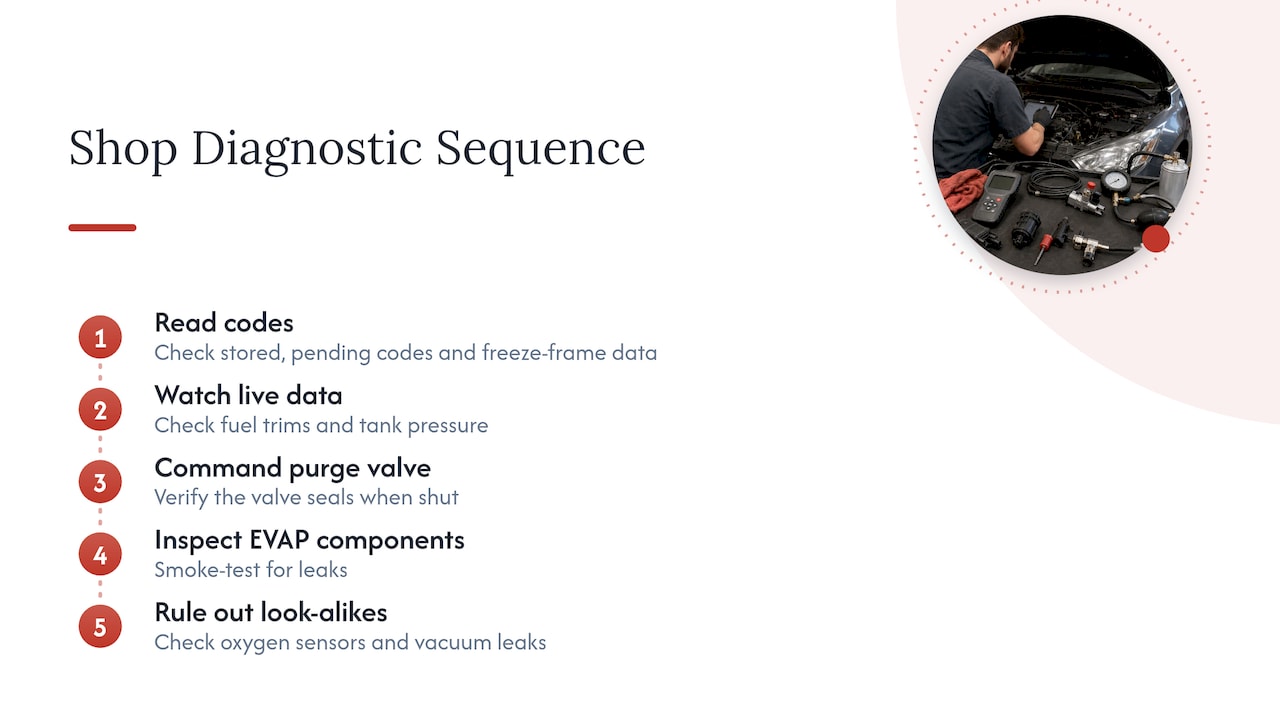
Guesswork gets expensive here, because purge valves, canisters and hoses can all look similar from the outside. A sound diagnosis follows a sequence.
Step 1: Read the codes. The scan tool shows stored and pending codes, and freeze-frame data showing the conditions when a fault was recorded. EVAP codes fall into groups: component and circuit faults, purge flow problems, and leak detection. A Maryland Department of the Environment guide notes that the code type determines the diagnostic path.
Step 2: Watch live data. Fuel trims tell the story. Long-term fuel trims that run high and positive at idle and improve as engine speed rises are a classic indicator of a vacuum-leak-like condition caused by a stuck-open purge valve. If the fuel tank pressure and trims behave oddly with purge commanded closed, suspect a purge leak or a stuck-open valve.
Step 3: Command the component. A bidirectional scan tool can open and close the purge valve on command. A valve that passes vapor when it is commanded shut has failed. The same diagnostic walkthrough recommends retrieving codes, analyzing live data, and then running component tests.
Step 4: Check the rest of the system. The control module, gas cap, valves, canister, pressure sensor and vapor lines all play a part. Snap-on recommends scan-tool tests and manufacturer-specific information for this work, which matters because EVAP layouts differ a lot between a Toyota, a Subaru and a European model. A smoke test finds leaking hoses and seals.
Step 5: Rule out look-alikes. A rich or lean condition can also come from a failing oxygen sensor or a vacuum leak. If trims and sensor readings do not match the purge theory, we check those next. See our notes on O2 sensor symptoms and, if the engine actually dies, our guide on a car that stalls at idle.
What the repair usually looks like
The fix follows the finding:
- Purge valve: Replace it. On many vehicles it is a small solenoid in the engine bay, though some sit near the tank or under the vehicle and take more time to reach.
- Soaked canister: If the canister has taken on liquid fuel, it may need replacement, along with a purge valve that was damaged in the process.
- Vent valve or hoses: Replace cracked or blocked parts after the smoke test shows where the problem is.
- Gas cap: A new cap is the cheap end of the range. Our EVAP leak guide lists small fixes that cost a few dollars as well as the signs that mean it is time for a shop.
Once the repair is done, the codes are cleared and the car is driven through the monitor cycles, so we can confirm the EVAP system passes its own self-tests. Skipping that last step is how a problem reappears two weeks later.
A caution on parts-swapping: replacing a purge valve because a website said so, without checking fuel trims or commanding the valve, can leave the real cause in place. With a saturated canister, a fresh valve can be damaged again.
Our perspective
We have worked on cars in Lynnwood since 1985, and this complaint has a familiar shape. A customer says the car shook after gas, then drove fine, and the light may or may not be on. The temptation is to shrug it off, and sometimes a loose cap really is the whole story. But when the idle stumbles or the engine cranks long on a regular basis, we treat it as a diagnosis and not a guess.
Our ASE-certified technicians start with the scan tool and the data, not a parts cart. We look at codes, fuel trims and what the purge valve does when we command it. Our digital inspections let us show you what we found, and you get upfront pricing before work begins. Repairs carry our 24-month / 24,000-mile warranty. We service all makes, including European and hybrid models, and EVAP layouts differ enough between them that we check model-specific information before we condemn a part.
Our most useful advice costs nothing: when the pump clicks, stop. Habitual top-offs are one of the avoidable ways owners wear out purge valves and soak canisters.
— Shingi
Get it checked in Lynnwood
If your car shakes at idle or cranks long after fueling, a code scan and live-data check is the quickest way to find out whether you need a gas cap, a purge valve or something else. Our technicians run professional-grade OBD-II diagnostics on all makes, and same-day appointments are often available. Describe the symptom when you call, and tell us whether the light is on and whether you tend to top off the tank.
Book a Check Engine light diagnosis through our Lynnwood auto repair page. We also offer discounts for military members, seniors and first responders. If the diagnosis shows a bigger engine problem, our engine repair team in Lynnwood can take it from there. For more on symptoms and repairs, browse the Tom’s B & M Auto blog.
When not to wait
Most post-fill-up roughness is a nuisance, not an emergency. A few situations change that:
- Flashing Check Engine light: This usually means an active misfire. Reduce speed and get the car to a shop promptly.
- Strong fuel odor or visible dripping: Shut off the engine and avoid sparks or flames near the car.
- Stalling in traffic: Even if it restarts, an engine that dies at low speed is a safety problem.
- The problem is growing: Longer cranking, more frequent stumbles or a worsening smell mean the damage is progressing.
If you live in a state with emissions testing, remember that unresolved EVAP codes can cause a failed test. The P0496 reference above lists emissions-inspection failure among its possible symptoms.
FAQ
Why does my car idle rough right after I fill up with gas?
Usually because extra fuel vapor is entering the engine through the EVAP system, often through a purge valve that is stuck open or a canister soaked with liquid fuel. The engine gets a richer mixture than the computer expects, so the idle stumbles until the fuel trims catch up. If it smooths out within minutes, EVAP is the leading suspect.
Can a loose gas cap cause a rough idle?
A loose cap more commonly causes an EVAP leak code and a Check Engine light than a severe rough idle. It is still the first thing to check because it costs nothing. If the idle is clearly rough, expect the cause to lie deeper in the system.
Can bad gas cause a rough idle or jerking after filling up?
It can, but the pattern differs. Contaminated fuel tends to cause stalling, power loss and poor economy that persist while you drive. A stumble that appears right after fueling and then fades is more typical of a purge valve or canister problem.
Is it safe to keep driving with this problem?
If the car only idles a little rough for a moment and there is no strong fuel smell, short-term driving is usually fine until you can book a scan. A flashing Check Engine light, stalling or a strong raw-fuel odor means you should stop driving and have the car inspected promptly.
Sources
- Why Does My Car Idle Rough After Refueling?
- BMW service bulletin, G30 B48 EVAP purge valve
- BMW service bulletin, i3 REx EVAP purge valve
- Signs of a Bad Purge Valve, AutoZone
- P0496 Evaporative Emission System High Purge Flow
- What Happens if You Overfill Your Gas Tank?, Autotrader
- Technical Focus: Evaporative Emission Control System, Snap-on
- Contaminated Fuel Can Wreck Havoc On Fuel Delivery Systems
- Vapor Canister Symptoms
- Purge Valve: Symptoms, Testing, Live Data Analysis
- Purge Valve vs Vent Valve Failure Signs
- REPAIRCARE, Maryland Department of the Environment
Recommended
- Engine Surging at Idle in Lynnwood? Diagnose Before Buying Parts
- Car Stalls at Idle: Causes, Diagnosis, and Fixes
- Ten Minute Pressure Test: Fuel Pump Failure Symptoms to Check First
- Fix Engine Misfires Step by Step: A Car Owner’s Guide
Leave a Reply