
6 Checks to Document a Steering Rack Leak Before You Visit a Shop
If you notice fluid stains under the front of your car, a whining or whirring noise when you turn the wheel, heavier steering at low speed or on a cold start, and a reservoir that keeps dropping, you’re likely looking at a steering rack or power-steering fluid leak. Sudden loss of steering assist or fluid dripping onto a belt or the exhaust needs attention right away.
TL;DR:
- Fluid leaks from the power-steering reservoir or hoses are common causes of steering issues, with external leaks often visible as wet, oily residue.
- Whining or groaning noises when turning and stiff steering at cold start are key signs of internal rack wear or fluid level problems.
- Pinch test of the bellows can help differentiate between external seal leaks and internal rack damage, with significant fluid inside indicating a worse internal leak.
- Replacing hoses or fittings is usually straightforward, but internal leaks or grooving in the spool valve often require full rack replacement or sleeving.
- Safe DIY checks include reservoir level monitoring, inspecting hoses and boots, and recording symptoms to assist accurate diagnosis and repair planning.
Table of Contents
- Common symptoms of a steering rack or power-steering fluid leak
- Where leaks come from and what each source usually indicates
- How to check for a leak safely at home
- Internal leaks and ‘morning sickness’: when seals aren’t enough
- Repair options, urgency, and what repairs typically cost
- Shop perspective: what our ASE-certified team does when you bring a steering-leak concern
- Tom’s B & M Auto: steering diagnostics done right
- FAQ
- Sources
Common symptoms of a steering rack or power-steering fluid leak
A leak usually announces itself in more than one way, and the combination tells you more than any single clue. Fluid on the garage floor is the most obvious sign: power-steering fluid typically runs reddish, pink, or brown, has a thin oily feel, and sometimes carries a faint burnt smell when it’s been overheated, according to AAA’s guide to automotive leaks.
Noise is the second big tell. A whining or groaning sound when you turn, especially at startup, often points to the pump or a fluid level problem, while a high-pitched squeal can mean a slipping belt rather than the rack itself. Stiffness at low speeds, particularly right after starting the car, is another common complaint, along with a reservoir that needs topping off again and again even though you can’t find an obvious puddle.
Watch for these secondary signs as well:
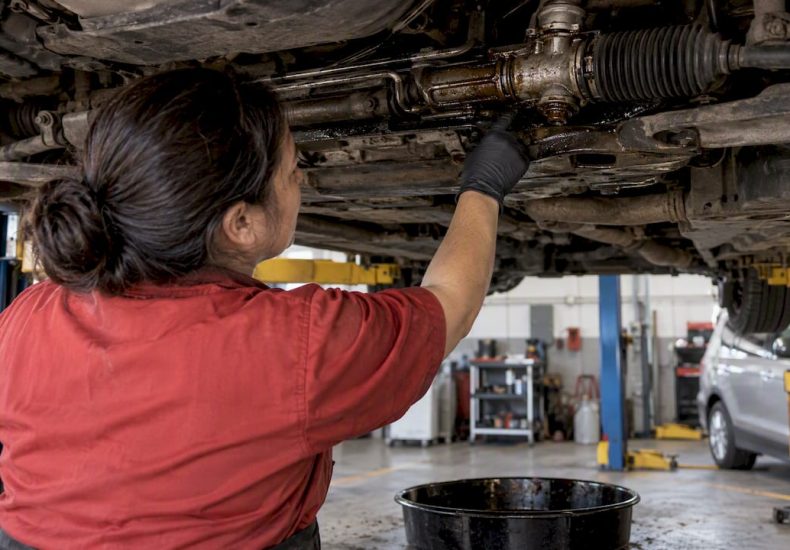
- Wet or oily rubber bellows (the boots at each end of the rack)
- Vibration felt through the steering wheel
- The wheel not returning to center smoothly after a turn
- Wandering or vague steering feel at highway speed
Taken together, stiff steering, whining or grinding noises when turning, visible fluid under the front of the car, and a low reservoir are the symptoms most commonly cited as primary indicators of a fluid leak, according to AAA’s guide to how car steering works.
Where leaks come from and what each source usually indicates
Knowing where the fluid is coming from narrows down the repair before you even call a shop.
- End-seal (bellows) leaks: a small amount of oily residue inside the rubber boot can be normal on a high-mileage car, but a boot that’s visibly wet or dripping points to a failing seal or worse.
- Pinion input-shaft seal: oil pooling near the steering column or lower pinion area, paired with ongoing reservoir loss, often signals an internal rack leak rather than a simple external seal failure.
- High-pressure hoses and fittings: spray or drips near the pump or along the chassis are frequently fixed by replacing the hose or line itself, since leaking hoses and fittings are a well-documented cause of external drips and whining, and hose replacement is typically the only lasting cure.
- Power-steering pump seals: whining combined with contaminated or discolored fluid often means the pump’s own seals have failed, which can call for a pump rebuild or replacement.
- Internal spool-valve leaks: stiff steering that only shows up when the engine is cold, sometimes called “morning sickness,” rarely responds to a simple reseal because the wear usually runs deeper than the seal itself.
Pro Tip: Before assuming the worst, pinch the bellows gently at the lowest point. If fluid runs out freely rather than just coating the rubber, that’s a stronger sign of an internal leak than surface dampness alone.
Bellows should hold little or no fluid under normal conditions; a large volume inside the boot is a strong indicator the rack is leaking internally and will likely need replacement rather than a reseal, according to Brake & Front End’s diagnosis guide.
How to check for a leak safely at home
A careful walk-around before your appointment gives a shop a head start and can save you a diagnostic fee.
- Park on level ground, shut off the engine, and put on gloves before touching anything underneath.
- Check the power-steering reservoir, note the fluid color and level, then check again after a short drive to see if it drops.
- Look for puddles under the car and note whether they sit closer to the engine, the transmission, or the front axle.
- Inspect each rack bellows by gently pinching or sliding it to see if wetness is trapped inside, and look for cracks or tears in the rubber.
- Follow the hoses from the pump to the rack, feeling for dampness at the fittings, and check the serpentine belt for oil contamination.
- Take the car for a short drive: test low-speed turns and note any whining, then try a cold start the next morning to see if steering feels stiff before it warms up, and take photos or video of anything unusual for the shop.
Avoid crawling fully under the vehicle unless you’re experienced with jack stands and know how to support the car safely.
Internal leaks and ‘morning sickness’: when seals aren’t enough
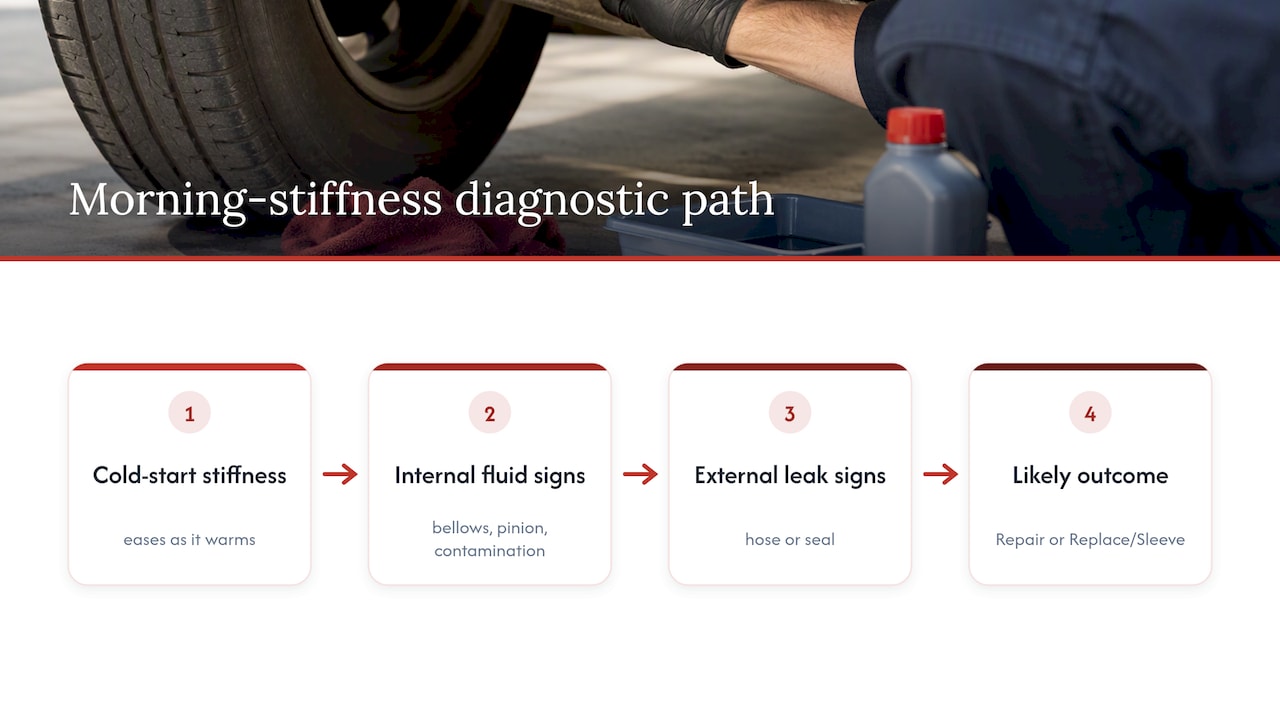
“Morning sickness” describes steering that feels stiff or heavy on a cold start and loosens up as the car warms, and it’s usually a sign of internal wear in the spool-valve housing rather than a simple seal failure. The housing itself, often made of aluminum, can develop grooves over time, and new seals can’t seat properly against a worn, grooved bore, so a reseal alone tends not to fix the problem.
Technicians typically confirm internal failure by combining a few clues: significant fluid inside the bellows, seepage near the pinion seal, and fluid that looks contaminated or discolored. A hose leak or a worn external seal is reasonable to repair on its own. A cold-start stiffness that improves with engine heat, paired with internal fluid signs, usually points toward a full rack replacement or a sleeved valve housing instead.
Repair options, urgency, and what repairs typically cost
Stop driving if you lose power assist entirely or see fluid dripping onto a belt or the exhaust, both of which can create a fire or control hazard. Topping off fluid buys you a little time, but stop-leak additives are a short-term patch at best: they can swell or soften seals and contaminate fluid in ways that complicate a later repair, according to AA1Car’s diagnostic guide.
Repair scope depends on where the leak lives:
- A leaking hose or fitting usually means hose or line replacement.
- A noisy, contaminated pump often calls for a rebuild or full replacement.
- A worn pinion seal may be replaceable on its own if the rack’s internals are otherwise sound.
- Confirmed internal leaks or morning sickness typically point to a reman or new rack.
Operating pressure in a power-steering system commonly exceeds 150 psi while driving straight and can climb into the hundreds of psi during tight turns, which explains why hoses and fittings fail so often and why labor time adds up quickly on these repairs, according to AA1Car. Cost depends heavily on labor versus parts, whether you choose a remanufactured or new rack, and your vehicle’s make and model, so treat any number you hear as a starting point rather than a quote. For a closer look at typical cost ranges and how electric versus hydraulic systems get checked, our guide to power-steering fluid leak costs walks through the comparison. Bring photos, your reservoir readings, and a timeline of when symptoms started when you call a shop.
Shop perspective: what our ASE-certified team does when you bring a steering-leak concern
When a steering-leak concern comes through our bay doors, our ASE-certified technicians start with a visual inspection, check the reservoir, and take the car on a test drive before touching anything. A digital inspection with OBD-II scanning, where relevant, helps us confirm whether the issue is external or internal before recommending a repair. That sequence matters because an accurate diagnosis avoids replacing a rack that only needed a hose or a seal. Bring whatever photos or notes you’ve gathered, and we’ll walk you through what we find in plain terms.
— Shingi
Tom’s B & M Auto: steering diagnostics done right
A whining noise or a wet patch under your car doesn’t automatically mean a new rack. We run a full diagnostic inspection, including a reservoir check and a test drive, before recommending anything, and every job comes with a written estimate and a warranty so you know what you’re paying for up front.
If you’re also due for routine upkeep, our 30k 60k 90k service includes a multi-point inspection that can catch a developing leak before it becomes a bigger repair. For a steering concern specifically, book a diagnostic appointment through our engine repair and diagnostics page and we’ll get you a clear answer and a same-day appointment when one’s available.
FAQ
Is replacing a steering rack a big job?
Replacing a steering rack is a mid-to-large repair that involves removing the old unit, reconnecting hoses and linkage, and bleeding air from the system afterward. Labor time and total cost vary by vehicle, so it’s worth getting a written estimate rather than assuming a flat price.
What causes power steering failure?
Power-steering failure usually traces back to a fluid leak that starves the pump, worn pump seals, a failing hose or fitting, or internal wear in the rack’s spool-valve housing. Low fluid caused by any of these can let air into the pump, which leads to noise and a sudden loss of assist, according to Brake & Front End.
How do I repair a power steering hose?
A damaged power-steering hose is typically replaced rather than patched, since the system runs at high pressure and a repaired hose is unlikely to hold. If you’re sourcing replacement boots or related steering parts yourself, suppliers like Standard Diesel Direct’s steering rack boots carry aftermarket options, though a shop should confirm fitment and pressure rating for your vehicle.
How do I stop a power steering leak?
Topping off fluid is a short-term fix, and stop-leak additives can mask a leak temporarily but risk swelling seals or contaminating the fluid, making a later repair more complicated. The reliable fix depends on the source: a hose gets replaced, a seal gets replaced, and an internal leak generally points to a rack replacement.
What does a failing steering rack sound like?
A failing rack often produces a whining or groaning noise when turning, sometimes paired with stiffness that’s worse on a cold start and eases as the engine warms. If the noise comes with a wet bellows or a steadily dropping reservoir, that combination points more toward the rack than the pump alone.
Sources
- Power Steering Racks: Fluid Leaks & Repairs for Cars
- How To Diagnose Rack & Pinion Steering
- What causes a steering fluid leak?
Recommended
- Power Steering Fluid Leak: EPS vs Hydraulic Checks and $15–$200 Costs
- Avoid a $150–$400 Repair: 5 DIY Checks for Wheel Bearing Noise
- 55–75 mph Shake? Diagnose Steering Wheel Vibration in 10 Minutes
- How to Diagnose Suspension Noise Before It Gets Worse
Leave a Reply