
Airbag Light On? ASE Certified Shop: Get a Same Day SRS Scan
The airbag light on your dashboard means the Supplemental Restraint System (SRS) found a fault serious enough that your airbags and seat belt pretensioners may not fire in a crash. Stop treating it as background noise. Skip long trips, avoid the highway if you can, and get an SRS-capable diagnostic scan from ASE-certified technicians as soon as possible. If the light showed up alongside a brake or battery warning, or right after a collision, have the car towed instead of driven.
TL;DR:
- Most airbag lights are caused by faulty clock springs, seat sensors, corroded connectors, or recent battery work, not just the airbag system itself.
- Driving with a lit airbag light is risky because airbags and pretensioners may not deploy correctly, and immediate towing is recommended if combined with other warning lights or right after a collision.
- Standard home OBD-II scanners cannot read SRS-specific codes; a professional diagnostic scan is necessary to identify and confirm the fault accurately.
- Repairs involve replacing or fixing specific components like connectors, clock springs, or sensors, with costs varying based on parts and vehicle make.
- Clearing the airbag light without repairing the underlying fault almost guarantees the problem will recur, so proper diagnosis and part replacement are essential for safety.
Table of Contents
- Why Is My Airbag Light On? Common Causes Explained
- Is It Safe to Drive With the Airbag Light On?
- What You Can Check Before Visiting a Shop
- What a Repair Actually Costs
- Why This Isn’t a DIY Fix
- How the System Behaves Once It Detects a Fault
- How SRS Codes Get Read and Cleared
- Resetting the Airbag Light the Right Way
- Airbag Light and Vehicle Inspections: What You Need to Know
- Do All Airbag Warning Lights Mean the Same Thing?
- Airbag Light On: What Owners Get Wrong
- Get Your Airbag Light Diagnosed Right the First Time
- Sources
- FAQ
Why Is My Airbag Light On? Common Causes Explained
Most airbag light triggers trace back to one of a handful of repeat offenders, and the symptoms usually give you a clue before a scan tool ever confirms it.
- Clock spring (spiral cable) failure. This coiled ribbon of wiring sits behind your steering wheel and carries signal to the horn, cruise controls, and driver’s airbag. When it cracks or frays from years of turning the wheel, you’ll often notice the horn cutting out or steering wheel buttons acting flaky right before the airbag light appears.
- Seat-occupancy sensor problems. The mat or weight sensor under the passenger seat tells the SRS module whether to arm that airbag. A failing sensor can flip the passenger airbag indicator on and off depending on how someone sits, or ignore a passenger entirely.
- Seat belt buckle or pretensioner faults. A worn buckle switch or a pretensioner with a logged deployment event will throw a code even if the belt still latches normally.
- Crash sensors and stored crash data. If the SRS module has crash data logged from a prior impact, some cars will keep the light on until that data is properly cleared through a manufacturer procedure.
- Corroded or loose connectors under the seats. Water intrusion, road salt, and years of seat-track adjustment loosen these plugs. It’s one of the cheapest fixes and one of the most overlooked, according to The Motor Guy’s breakdown of common airbag light causes.
- Low battery voltage or a recent jump start. A weak battery or a botched jump can confuse the SRS module enough to log a fault, according to Safety Restore’s analysis of airbag light triggers.
- Incomplete prior collision repairs or open recalls. If a fender bender was patched up without full SRS service, the fault can resurface months later.
Spiral cables, occupancy mats, and bad connectors account for the bulk of these cases, according to Airbag24’s guide to airbag light causes.
Is It Safe to Drive With the Airbag Light On?
Short answer: not for long, and not far. A lit SRS light means your airbags and pretensioners might not deploy correctly, or might not deploy at all, in a real crash. That’s a gap in your car’s most basic crash protection, not a comfort feature.
- Get the car to a shop instead of running errands across town for a week.
- Tow it immediately if the airbag light appears with a brake or battery warning, or right after any collision, however minor.
- Keep loose or heavy items off the passenger seat in the meantime; they can confuse occupancy sensors and add another variable to diagnosis.
- Make sure every occupant buckles up normally, since a compromised pretensioner still needs a properly worn belt to do what it can.
Pro Tip: Don’t file the airbag light next to your oil-change reminder. It’s a safety-critical alert about crash protection, not routine wear and tear.
What You Can Check Before Visiting a Shop
A little detective work before you call around saves time and money once you’re in the bay. None of it involves touching the airbags themselves.
- Note the timing. Did the light come on right after a battery replacement, a jump start, or disconnecting the battery for other work? If so, drive a few cycles first. Sometimes the module resets itself; often it doesn’t, according to Safety Restore.
- Do a visual connector check under the seats. Look for a loose plug or corrosion. Never unplug an airbag connector yourself.
- Watch for related symptoms. A dead horn, unresponsive steering wheel buttons, or a passenger airbag indicator that flickers with seat weight all point toward specific culprits.
- Decide tow versus drive. If nothing else is wrong and the light is steady, driving carefully to a shop is usually fine. If other warnings joined the party, tow it.
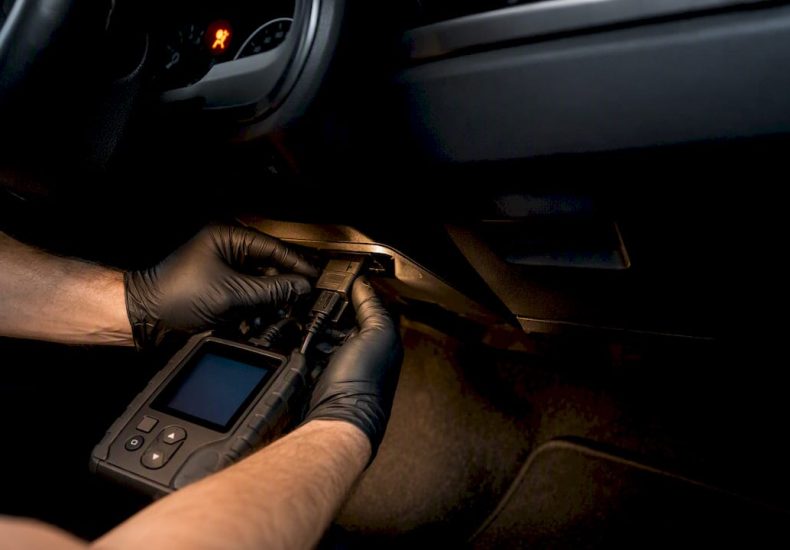
Here’s the catch most DIYers hit: standard OBD-II code readers, the ten-dollar kind you plug in at home, generally can’t pull SRS-specific fault codes at all. That’s not a settings issue. It’s a hardware limitation, and it’s why a clean reading on a generic scanner doesn’t mean the system is fine. Reading the airbag control module correctly requires an SRS-capable tool, which is exactly the gap a proper diagnostic scan is built to close.
What a Repair Actually Costs
A professional SRS diagnosis follows a specific sequence: connect an SRS-capable scanner, pull the stored fault codes, cross-reference them against wiring diagrams and known failure points for that make and model, then inspect the flagged component before touching anything.
- Connector repair or cleaning: often the least expensive fix, sometimes resolved in under an hour of labor.
- Clock spring replacement: a mid-range repair, since the steering wheel and airbag have to come off and go back on correctly.
- Occupancy sensor replacement: varies by whether it’s a simple mat or an integrated weight sensor system.
- Pretensioner or airbag module replacement: the priciest end of the spectrum, especially after a deployment, since these are single-use safety parts that must be replaced rather than reused.
Costs swing widely depending on the vehicle and whether OEM parts or dealer-level programming are required, according to The Motor Guy’s cost breakdown. Be wary of anyone offering to simply “reset” the airbag light without diagnosing the fault first. That clears the symptom, not the problem, and it can leave your restraint system compromised while looking fixed on the dash.
Why This Isn’t a DIY Fix
An experienced auto repair shop has worked on Toyota, Honda, Subaru, and domestic vehicles for many years, including European and hybrid models where SRS wiring gets even more particular.
- Technicians run professional-grade diagnostics, not generic code readers.
- Pricing is provided upfront so you know the cost before work starts.
- Same-day appointments can be available for urgent warning lights.
- Repairs are backed by a warranty.
The workflow for an SRS fault starts with a safe battery disconnect to prevent accidental deployment during inspection, followed by an SRS-specific scan at a professional auto service, then a targeted repair of the identified part, code clearing through the correct module procedure, and a verification test drive before the car goes back to you.
A code reader that can’t talk to the SRS module will show a clean bill of health on a car that still can’t protect its occupants. That mismatch is exactly why airbag diagnostics belong with a shop that has the right tools, not a five-minute parts-store scan.
How the System Behaves Once It Detects a Fault
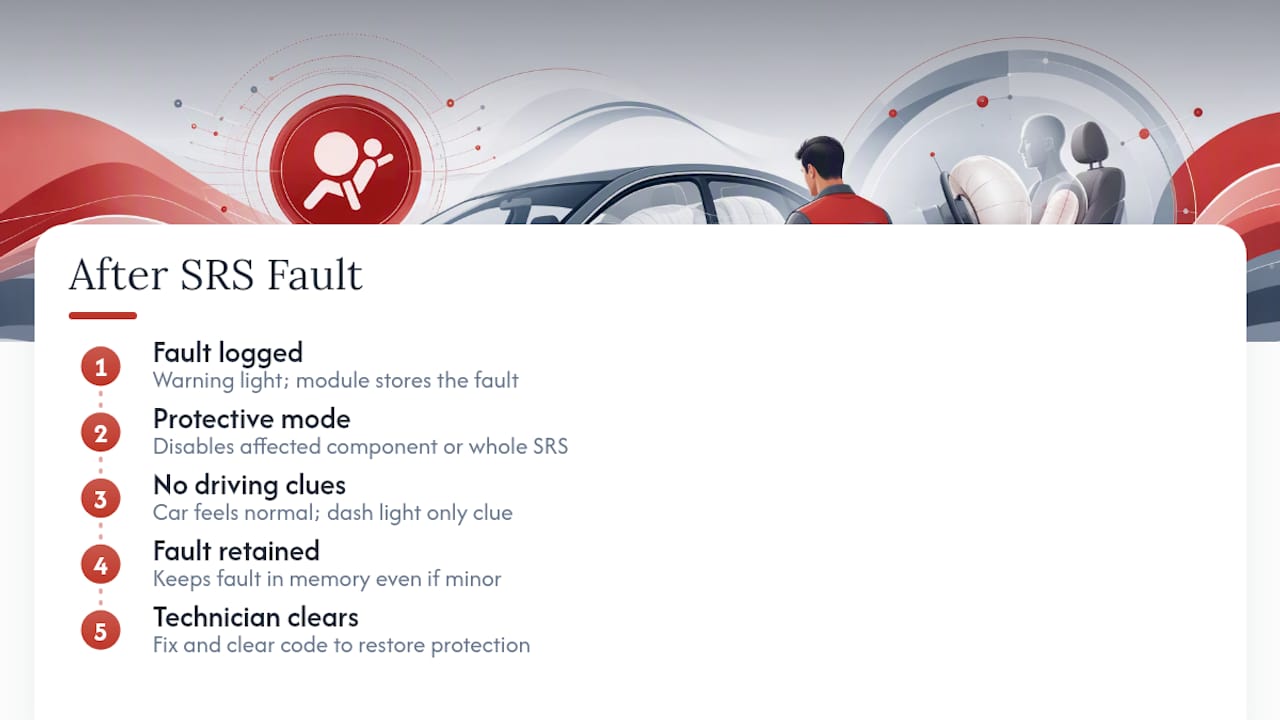
Once the SRS module logs a fault, it doesn’t just light a warning icon and carry on as usual. Most systems shift into a protective mode that disables deployment for the affected component, sometimes the whole system, to avoid an airbag or pretensioner firing unpredictably or partially during a crash.
That’s actually the sane engineering choice. An airbag deploying at the wrong angle or wrong force can cause its own injuries, so manufacturers design the module to err toward “do nothing” rather than “do something unreliable” once it can’t confirm the sensor network is trustworthy. The tradeoff is that you lose crash protection you’re used to having, without any change in how the car drives or feels day to day. Nothing about acceleration, braking, or handling tips you off. The dash light is the only clue.
This is also why the light sometimes stays on even after what seems like a minor issue, say, a loose connector under the passenger seat. The module doesn’t know it’s minor. It only knows a signal it expects isn’t arriving correctly, and it holds that fault in memory until a technician reads it, fixes the actual cause, and clears it through the proper procedure. Driving around hoping it resolves itself skips the one step that actually restores protection.
How SRS Codes Get Read and Cleared
Reading an airbag fault starts at the SRS module itself, not the general engine computer most drivers picture when they hear “check engine light.” A technician connects an SRS-capable scan tool, which is different from the basic OBD-II reader sold at most auto parts counters, and pulls whatever fault codes the module has stored.
Some of those codes are soft codes: they reflect a current, live problem and often clear on their own once the underlying issue, like a loose connector, gets fixed. Others are hard codes, and those are a different animal entirely. Hard codes typically come from a genuine crash event or airbag deployment, and the module locks them in as a permanent record. Clearing a hard code usually requires manufacturer-specific programming, sometimes a dealer reflash, because the system is designed to prevent someone from simply erasing evidence of a deployment without actually replacing the deployed parts.
That distinction matters for repair planning. A soft code from a bad connector might be a same-day fix. A hard code from a prior collision means the shop needs to confirm every single-use component tied to that deployment (airbags, pretensioners, sometimes the module itself) has actually been replaced, not just electrically cleared.
Resetting the Airbag Light the Right Way
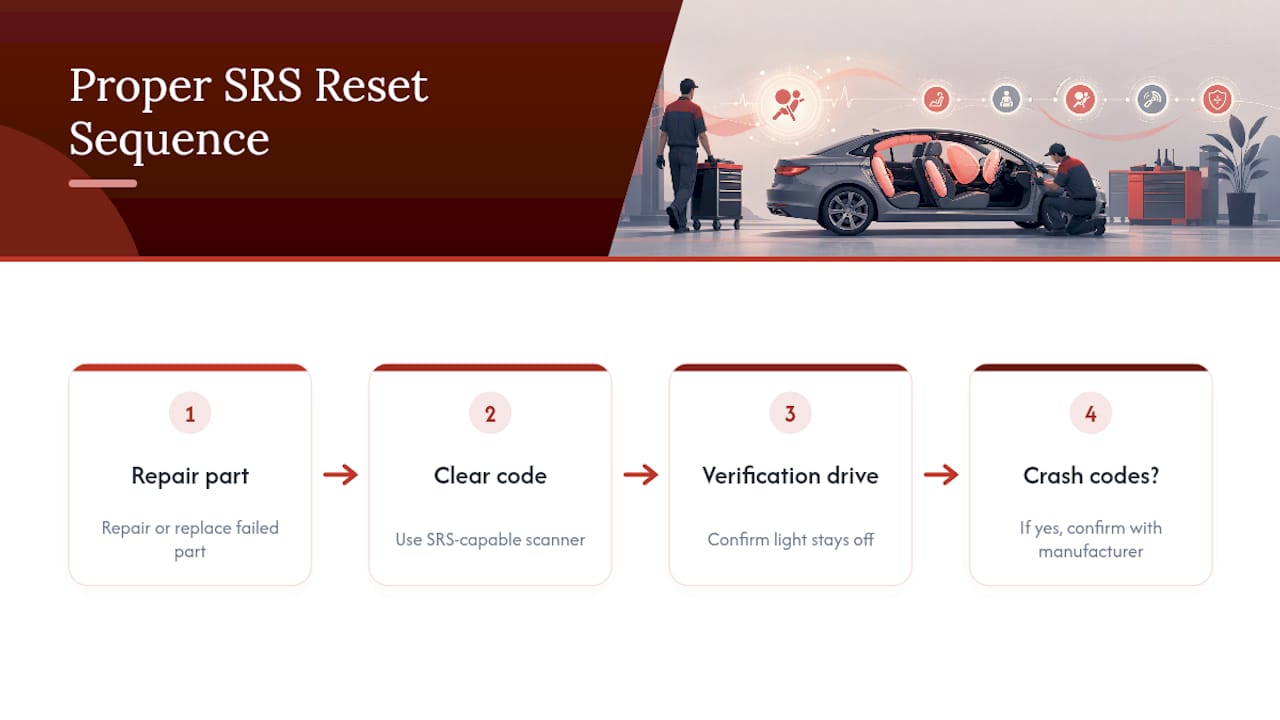
Clearing the airbag light after repair is the easy part, and also the part where shortcuts do the most damage. The code only gets cleared once the actual fault, the failed clock spring, the corroded connector, the bad occupancy sensor, has been repaired or replaced. Clear the code first and skip the repair, and the light will almost always come back within a few drive cycles, because the module is simply detecting the same problem again.
A proper reset happens as the last step of a repair, not the first. After the technician replaces or repairs the failed part, they use the SRS-capable scanner to clear the stored code, then run a verification test drive to confirm the light stays off and no new codes appear. For vehicles carrying hard codes from a prior crash, this step may also involve confirming with the manufacturer’s system that all deployment-related parts have been properly logged as replaced.
Skipping straight to a reset without the repair is the single most common mistake owners make, usually because a quick clear is cheaper than diagnosing the real problem. It isn’t a fix. It’s a way to make the dashboard quiet while the actual risk stays exactly where it was.
Airbag Light and Vehicle Inspections: What You Need to Know
A persistent airbag light isn’t just a personal safety concern. In many states, an active SRS warning is treated as a safety-critical defect during vehicle inspection or registration renewal, and it can be enough on its own to fail the inspection, according to Airbag24.
The logic mirrors how inspectors treat brake warnings: a restraint system that might not work is a genuine safety failure, not a cosmetic one. If you’re due for inspection or trying to sell a car, an unresolved airbag light can stall the process, and disclosing a known SRS fault to a buyer is generally expected practice, since it directly affects crash protection. Getting it diagnosed and repaired before your inspection date saves you a second trip and, more importantly, closes the actual safety gap rather than just the paperwork gap.
Do All Airbag Warning Lights Mean the Same Thing?
The underlying message is consistent across brands: a fault was detected in the restraint system. How that message gets displayed varies more than most drivers expect.
Some manufacturers use a simple airbag icon that stays solid when there’s a fault. Others use a flashing pattern to distinguish between a stored fault and an active, ongoing one, similar to how a flashing check engine light signals urgency differently than a steady one. A few brands pair the airbag icon with a separate passenger-airbag indicator that shows “on” or “off” status independent of the main SRS light, which can confuse owners into thinking a second problem exists when it’s really a normal status readout. European makes in particular sometimes route SRS alerts through the same information cluster used for seat belt reminders, so a flashing seat belt icon and a solid airbag light together usually point to a pretensioner fault rather than two unrelated issues.
The takeaway is the same regardless of badge on the hood: any airbag light, flashing or steady, warrants an SRS-capable scan rather than a guess based on the icon’s behavior.
Airbag Light On: What Owners Get Wrong
Most advice about the airbag light treats it like a mystery to be solved with patience and a cheap code reader. That framing undersells the problem. The real issue isn’t figuring out what triggered the fault. It’s that generic tools genuinely can’t see SRS codes, so a driver checking their own car with a parts-store scanner often gets a false all-clear and drives around for months with a restraint system that’s quietly disabled.
The conventional wisdom to “just clear the code and see if it comes back” is backwards advice dressed up as caution. Clearing without repairing doesn’t test anything; it just hides the symptom until the module logs the same fault again, usually at a worse time.
What actually matters is sequencing: note when the light appeared, check the obvious stuff (connectors, recent battery work) without touching airbag wiring, then get an SRS-capable scan before deciding anything else. Skip the middle step and you’re guessing. Skip the last step and you’re driving on hope. The fix is rarely dramatic, most cases trace back to a connector, a clock spring, or a sensor, but finding out which one requires the right tool, not a longer wait-and-see period.
— Shingi
Get Your Airbag Light Diagnosed Right the First Time
An auto repair shop runs SRS-capable diagnostics that a basic parts-store scanner simply can’t perform, so you get an answer instead of a guess. The shop has serviced a variety of vehicles for many years, including hybrid and European models, with ASE-certified technicians and upfront pricing.
If cost is the thing holding you back from getting the light checked, financing options can spread out a larger repair like a clock spring or pretensioner replacement. For a low-pressure first step, book a free digital vehicle inspection and let a technician pull the actual SRS codes before you commit to anything. Same-day appointments are often available, and every repair comes with a 24-month/24,000-mile warranty. Call or book online today to get the airbag light looked at before it becomes a bigger problem, or an inspection failure.
Sources
- Airbag Light On: Causes & Solutions | Airbag24
- Airbag Light On? Causes, Fixes, and Costs — Safety Restore
- Airbag Light On? Every Common Cause Explained and When to Act Fast — The Motor Guy
FAQ
What causes an airbag light to come on?
The most common triggers are a failing clock spring, a seat-occupancy sensor fault, corroded connectors under the seats, low battery voltage or recent battery work, and stored crash data from a prior collision.
How do you fix the airbag light?
A technician uses an SRS-capable scan tool to read the stored fault code, repairs or replaces the specific failed part, then clears the code and verifies the fix with a test drive; simply resetting the light without repairing the cause usually makes it return.
Can I still drive if my airbag light is on?
You can typically drive carefully to a repair shop, but avoid long trips, and tow the vehicle instead if the light appeared alongside a brake or battery warning or right after a collision.
Is an airbag light expensive to fix?
Costs vary widely: a loose connector repair can be inexpensive, while clock spring, pretensioner, or airbag module replacement costs more, depending on your vehicle’s make and model.
Do I need a professional to fix an airbag light?
Yes, in almost every case, because most basic OBD-II scanners can’t read SRS-specific codes, and professional repair shops use diagnostics designed specifically for the restraint system.
Leave a Reply