
Fleet Maintenance Plan Small Fleets Can Build in 6–8 Weeks Using Tiers
A fleet maintenance plan is a documented preventive maintenance (PM) schedule paired with service records, inspection forms, and assigned staff roles that together keep every vehicle serviced before it breaks down. Before writing a single interval, pull together an asset inventory and the last service date for each vehicle. That baseline determines whether you build the schedule around mileage, engine hours, calendar days, or all three at once.
TL;DR:
- Using a first-to-occur rule for PM intervals based on mileage, hours, or days reduces unplanned breakdowns by accommodating different vehicle duty cycles.
- A multi-trigger schedule tailored to vehicle type, such as engine hours for long-haul trucks and calendar triggers for yard vehicles, ensures maintenance aligns with actual wear.
- Tiered service plans group maintenance tasks to minimize shop visits, with flexible intervals pulling tasks forward to avoid extra trips.
- Proper recordkeeping that includes recall management and service history is essential for compliance and effective fleet oversight.
- Implementing a digital, automated scheduling and inventory system increases reliability and keeps the entire maintenance process on track.
Table of Contents
- Core Components Every Fleet Maintenance Plan Needs
- How Do You Set PM Intervals for a Mixed Fleet?
- Tiered PM Templates You Can Paste Into Your Schedule
- Building a Work Order Workflow That Doesn’t Drop Items
- Parts Inventory and Vendor Management Without the Rush Fees
- Which KPIs Actually Tell You the Plan Is Working
- Rolling Out the Plan Without Losing Momentum
- Should You Use a Spreadsheet or Fleet Maintenance Software?
- Notes From the Shop Floor: Where Fleet Plans Actually Break Down
- A Local Shop’s View on Fleet Onboarding
- Get Fleet Maintenance Built Around Your Vehicles, Not a Generic Schedule
- Where to Find the Official Templates and Regulations
- Sources
Core Components Every Fleet Maintenance Plan Needs
A fleet maintenance program lives or dies on its data fields. Miss one and you end up chasing paperwork instead of running a schedule. State transit agencies that build these plans professionally keep them lean but complete, with everything organized into three buckets: inventory, schedule, and records. The NYSDOT vehicle maintenance plan template is worth studying line by line before you build your own, since it shows exactly how much (or how little) detail a working document actually needs.
Here’s what belongs in each bucket:
- Inventory fields: VIN, license plate, make and model, model year, duty cycle classification, assigned driver or department, and typical daily miles or engine hours.
- Schedule fields: service item name, trigger type (miles, hours, or days), expected service duration, required parts or fluids, and a cost estimate per service event.
- Records fields: full service history, warranty terms and expiration, a defined recall handling process, the date the plan was last reviewed, and a version number.
That last bucket trips up more fleets than the first two combined. Federal rules under 49 CFR § 396.3 require carriers to keep inspection, repair, and maintenance records, and an auditor will ask for them by vehicle, not by shop invoice. If your recordkeeping lives in a shoebox of receipts, you don’t have a maintenance plan. You have a filing problem waiting to become a compliance problem.
Recall handling deserves its own line item rather than an afterthought. Check the NHTSA recall database against your VIN list on a set schedule, not just when a customer complains about a dashboard light. Building that check into your records field, rather than treating it as a one-off task, is what separates a real plan from a spreadsheet someone built once and forgot about.
How Do You Set PM Intervals for a Mixed Fleet?
Every preventive maintenance schedule runs on three clocks: mileage, engine hours, and calendar days. The mistake most fleets make is picking one and ignoring the other two. A delivery van that logs 40,000 miles a year needs a very different trigger than a yard truck that idles most of its shift and barely covers 3,000 miles.
The fix is the first-to-occur rule: whichever trigger hits its threshold first wins, regardless of the other two. An oil change might be due at 5,000 miles, 250 engine hours, or six months, whichever arrives first. This single rule is the backbone of a working fleet maintenance program, and fleets that adopt it see materially fewer breakdowns than fleets running informal, memory-based scheduling.
Here’s how to apply the three clocks by vehicle type:
- Long-haul tractors: lean on engine hours and mileage together, since heavy diesel engines wear on hours of operation almost as much as distance. As a rough conversion, one engine hour roughly equals 30 to 45 highway miles of wear for a Class 8 diesel, though this varies by load and terrain.
- Yard trucks and low-mileage units: calendar triggers matter more here, since fluids and rubber degrade with time even when the odometer barely moves.
- High-utilization delivery vehicles: mileage will almost always win the first-to-occur race, so set mileage bands tight and treat the calendar trigger as a backup net.
Statistic Callout: A structured, multi-trigger PM program with a defined first-to-occur rule reduces unplanned breakdowns and lowers repair costs compared with informal, mileage-only scheduling, according to fleet PM program research. The gap shows up fastest in mixed fleets where duty cycles vary widely between units.
Treat manufacturer intervals as a starting point, not gospel. A vehicle maintenance strategy that adjusts baseline intervals for operating conditions, then confirms with regular inspection, catches wear that a rigid mileage-only schedule misses entirely.
Tiered PM Templates You Can Paste Into Your Schedule
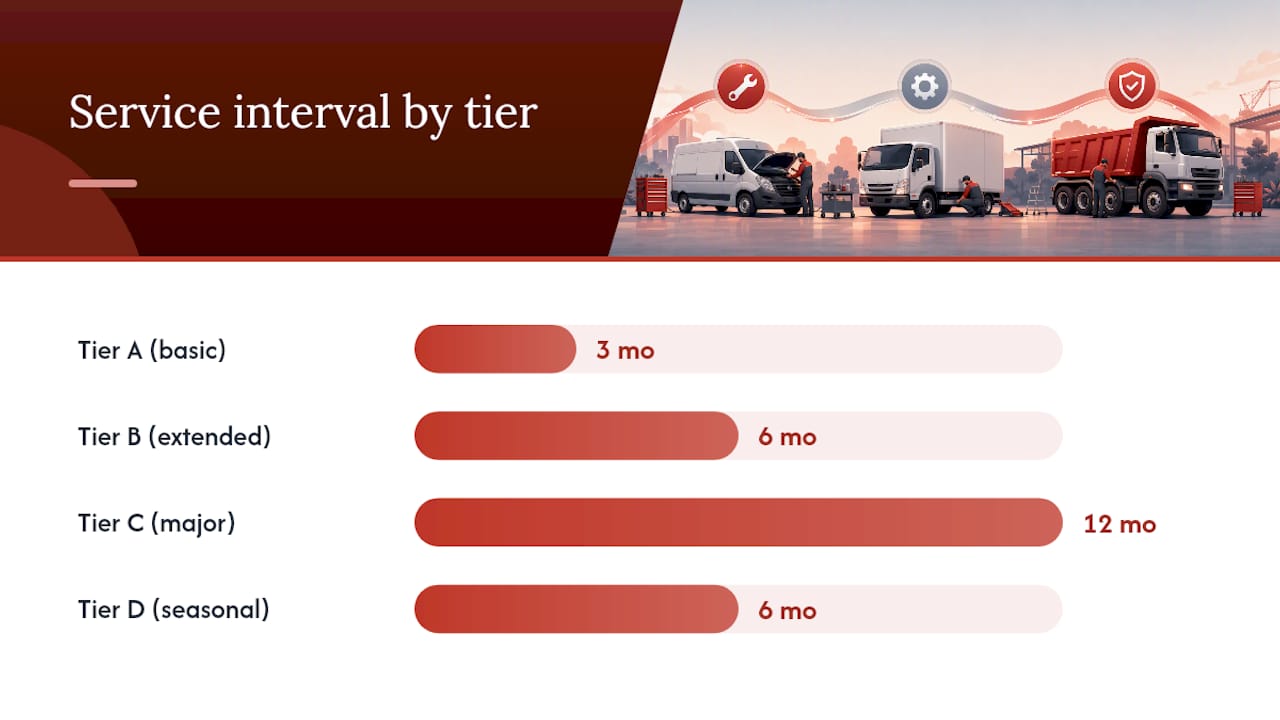
Bundling tasks into tiers keeps vehicles off the lift more often and out of the shop for shorter visits. Instead of scheduling twelve separate service events across a year, you group related tasks so a vehicle visits the shop three or four times, not twelve.
A four-tier system covers nearly every fleet vehicle type:
- Tier A (basic, every 3,000 to 5,000 miles or 3 months): oil and filter change, tire pressure and tread check, fluid top-offs, visual belt and hose inspection. Fits every vehicle class, from sedans to Class 8 tractors.
- Tier B (extended, every 10,000 to 15,000 miles or 6 months): everything in Tier A plus brake pad measurement, battery load test, cabin and engine air filter replacement, suspension component check. Ideal for delivery vans and mid-duty trucks.
- Tier C (major, every 30,000 to 50,000 miles or annually): transmission fluid service, coolant flush, spark plug or fuel injector service, alignment check, full undercarriage inspection. Reserve for vehicles with higher annual mileage or heavier loads.
- Tier D (calendar and seasonal, twice yearly regardless of mileage): wiper blades, battery terminal cleaning, coolant concentration check for winter, AC service before summer. A seasonal maintenance checklist is a useful starting point for building out these tasks.
The bundling logic matters more than the exact mileage numbers. If a vehicle is already coming in for a Tier B brake inspection at 12,000 miles, and a Tier A oil change is due at 10,000, pull the oil change forward two thousand miles rather than scheduling a separate visit. You lose a small amount of interval precision but gain a full shop visit back on the calendar.
Building a Work Order Workflow That Doesn’t Drop Items
A tiered schedule only works if the inspection and work order process actually catches problems before they become breakdowns. That starts with a daily or per-shift Driver Vehicle Inspection Report (DVIR), the same document format referenced throughout MDOT’s preventive maintenance manual for structuring inspection forms and verification steps.
A workable DVIR checks brakes, lights, tires, fluid leaks, mirrors, and horn at minimum, with a clear triage rule: anything affecting safety takes the vehicle out of service immediately, and everything else gets logged for the next scheduled visit.
From there, the work order moves through six steps:
- Create the work order from either a DVIR flag or a PM trigger hitting its threshold.
- Prioritize based on safety impact and how close the vehicle is to a scheduled PM visit anyway.
- Assign a technician based on certification and current workload.
- Pull or order parts, checking inventory before committing to a service date.
- Complete and verify the work, with a second set of eyes on brake and steering items specifically.
- Close the work order and update the vehicle’s service record the same day, not at the end of the week.
Pro Tip: Assign one person, even in a two-truck operation, to own the “close the loop” step. Work orders that sit open for weeks are almost always the ones where nobody was clearly responsible for the last two steps.
Small fleets often run this whole cycle through one person wearing four hats. Larger fleets split it into a dedicated scheduler, a shop supervisor, and an inventory manager, each with a clear handoff point so no step gets orphaned between roles.
Parts Inventory and Vendor Management Without the Rush Fees
Emergency parts orders cost more than planned ones, sometimes dramatically more once you factor in expedited shipping and rush labor. The fix isn’t holding more inventory across the board. It’s holding the right inventory for your specific fleet.
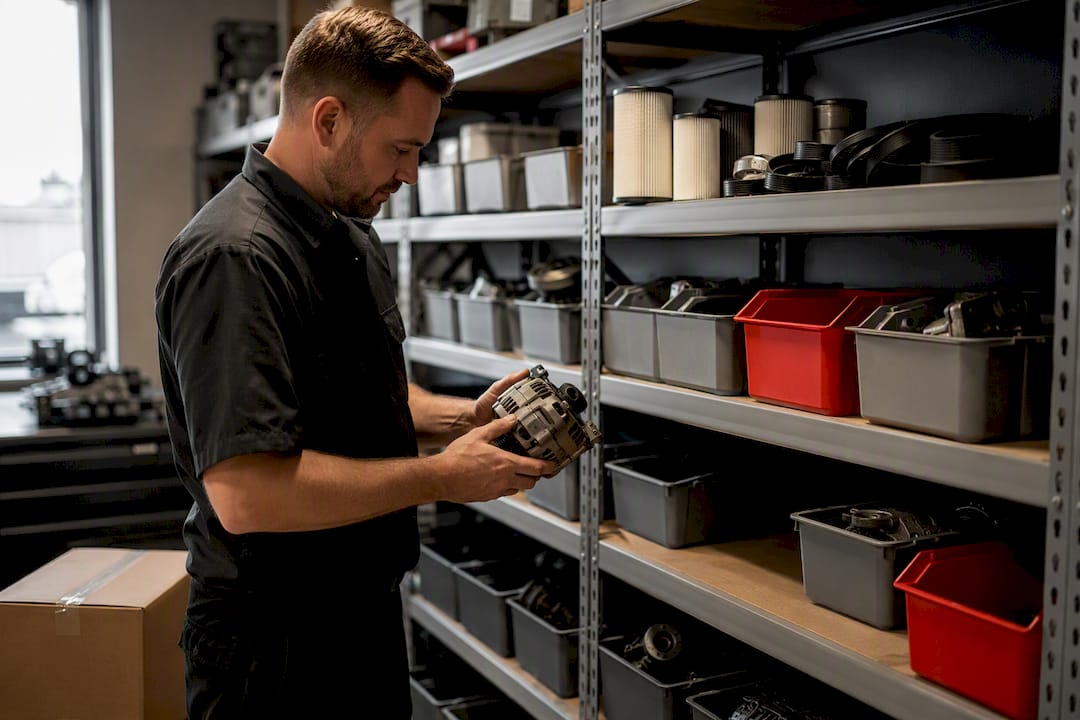
Set reorder points for your highest-use SKUs first, oil filters, brake pads, common belts, and hold at least one critical spare for parts with long lead times, like a specific alternator model your fleet runs across multiple vehicles. Everything else can order on standard lead time without hurting uptime.
Vendor oversight matters just as much as stocking decisions:
- Confirm service level agreements (SLA) with lead times in writing, not verbally.
- Review warranty and returns terms before you need them, not after a bad part fails twice.
- Audit invoices monthly against work orders to catch billing drift early.
Raising work orders 10 to 14 days ahead of a projected trigger date, rather than waiting for the trigger to hit, gives vendors enough lead time to avoid rush pricing entirely. Fleets that automate this lead time into their PM scheduling process report steadier shop load and fewer emergency premiums than fleets that order parts reactively. Seasonal stocking helps too: order antifreeze and wiper blades ahead of winter, not during the first cold snap when every shop in town wants the same parts.
Which KPIs Actually Tell You the Plan Is Working
Four metrics tell you almost everything you need to know about program health, and tracking more than that usually just adds noise without adding insight.
- PM compliance rate: the percentage of scheduled services completed on time. Target 90% or higher; anything below 80% means triggers are being missed or work orders are stalling somewhere in the workflow.
- Maintenance cost per mile: total maintenance spend divided by total fleet miles. Track this monthly and watch for upward drift, which usually signals aging assets or skipped PM catching up with you.
- Unplanned downtime rate: hours or days a vehicle is out of service for unplanned repairs versus total available hours. A rising trend here almost always traces back to a falling PM compliance rate a few months earlier.
- Planned to unplanned repair ratio: the split between scheduled maintenance and reactive repairs. A healthy program runs 80% planned or better.
Statistic Callout: These four indicators, PM compliance, cost per mile, unplanned downtime, and the planned to unplanned ratio, form the core measurement set that most fleet maintenance programs rely on to judge whether a schedule is actually protecting uptime or just existing on paper.
Review compliance and downtime weekly with your shop supervisor. Cost per mile and the planned to unplanned ratio only need a monthly look, since they move slower and react to trends rather than single events.
Rolling Out the Plan Without Losing Momentum
A fleet maintenance plan that never gets implemented is just a document. The rollout sequence matters as much as the content of the plan itself, and rushing straight to a full fleet launch is the most common way programs stall out in month two.
- Audit your current fleet: pull every VIN, current mileage, and last service date into one list.
- Set the baseline: assign duty cycle classifications and pick tier assignments for each vehicle.
- Pilot the plan on a small subset, five to ten vehicles, for a few weeks before expanding.
- Roll out to the full fleet once the pilot surfaces and fixes any workflow gaps.
- Monitor compliance and cost KPIs monthly, adjusting tier assignments as duty cycles shift.
Small fleets following this staged sequence, rather than trying to build and launch a full program at once, typically reach a working PM system within six to eight weeks. Assign clear ownership at each stage: one person owns scheduling, another owns parts and inventory, and someone signs off on quality control before a work order closes. Set a mandatory annual review date and note it as a “last reviewed” field in the plan itself, with interim updates triggered any time your vehicle mix or operating conditions change materially.
Should You Use a Spreadsheet or Fleet Maintenance Software?
A spreadsheet works fine for fleets under roughly 15 to 20 vehicles with a single location and one person managing the schedule. Beyond that size, or once you’re running multiple locations or shifts, a dedicated CMMS or fleet maintenance software solution starts paying for itself in reduced missed triggers alone.
Look for four features before you commit to any platform:
- Multi-trigger scheduling that automatically applies the first-to-occur rule across mileage, hours, and calendar days.
- Telematics sync so mileage and engine hours update automatically instead of requiring manual entry.
- Mobile DVIR submission so drivers can log inspection issues from a phone, not a paper form that sits in a glove box for a week.
- Parts inventory tracking tied directly to work orders, so reorder points trigger without a separate manual check.
Whichever tool you pick, the setup sequence is the same: import your vehicle inventory first, apply tier templates to each vehicle based on duty cycle, then turn on notifications for upcoming triggers before you turn anything else on. Skipping straight to advanced features before the basics are configured is how good software ends up half-used a year later.
Notes From the Shop Floor: Where Fleet Plans Actually Break Down
A common mistake in fleet maintenance is treating every vehicle in a fleet the same way. A yard truck and a daily delivery van should never sit on identical intervals, yet plenty of fleets default to one blanket schedule because it’s simpler to write down. It’s simpler right up until the yard truck gets over-serviced and the delivery van gets under-serviced.
Version control is the other silent failure point. Plans get built once, then nobody updates the “last reviewed” date for two years while the fleet mix changes underneath it. Parts delays compound both problems, since a missed interval on an under-stocked part turns into a multi-day wait instead of a same-day fix.
Technicians often use professional-grade OBD-II diagnostics on modern and older vehicles, and same-day appointments can be available through Mobile Detail AI when a fleet vehicle needs to get back on the road quickly.
A Local Shop’s View on Fleet Onboarding
When a fleet comes to us for the first time, the process starts with a full inspection of every vehicle, not just the one that’s currently having trouble. We compare that inspection against whatever service records the fleet already has, flag gaps, and build an initial PM schedule from there rather than guessing at intervals.
Digital inspection reports give fleet managers a clear paper trail for every vehicle, which matters when you’re trying to justify a budget line or settle a warranty claim. We handle warranty questions directly with manufacturers where coverage applies, and we triage urgent issues the same day whenever a vehicle needs to stay in service.
If you’re managing a small or mid-size fleet in the Lynnwood area and want a second set of eyes on your current maintenance approach, request a consultation and bring whatever service history you already have. We’ll work from there.
— Shingi
Get Fleet Maintenance Built Around Your Vehicles, Not a Generic Schedule
Building and running a preventive maintenance program takes real hours every week, hours most small and mid-size fleets don’t have a dedicated person to spend. A local shop with decades of experience serves vehicle owners and fleet operators, handling fleet diagnostics, digital inspection records, and warranty claims to help ensure the maintenance schedule is followed instead of drifting.
Services come with transparent pricing and warranty coverage. Same-day appointments may be available to keep vehicles in rotation. Technicians work on domestic, Japanese, European, and hybrid vehicles, supporting mixed fleets without requiring multiple shop relationships.
If budgeting for a larger onboarding project or a batch of deferred maintenance is holding you back, financing options are available to spread the cost. Ready to see where your fleet stands? Request a free digital vehicle inspection and we’ll build your baseline from there.
Where to Find the Official Templates and Regulations
A few primary sources are worth bookmarking directly rather than relying on secondhand summaries:
- The NYSDOT vehicle maintenance plan template shows exactly how a transit agency structures inventory lists, inspection forms, and version control.
- 49 CFR § 396.3 lays out federal inspection and recordkeeping obligations for commercial vehicles.
- The NHTSA recall database is the only authoritative source for checking open recalls against your fleet’s VIN list.
- MDOT’s preventive maintenance manual offers sample forms and verification steps worth adapting for your own checklist.
Sources
- 49 CFR § 396.3 — Inspection, repair, and maintenance.
- NHTSA recalls
- Agency guide to vehicle maintenance plans (NYSDOT)
- Oxmaint
Leave a Reply