
What Does a Suspension Clunking Noise Mean?
A clunking suspension almost always means a component has worn past its normal tolerance and is now hitting metal against metal or shifting where it shouldn’t. The usual suspects:
- Sway bar links or bushings
- Ball joints
- Control arm bushings
- Strut mounts or worn shocks
If the clunk shows up when you turn or hit a bump and you suspect a ball joint or control arm, get it inspected soon. Don’t put off a hoist check, and avoid long highway drives until someone’s looked underneath the car.
Key Takeaways
A suspension clunk almost always signals worn hardware, a failing joint, or a loose connection that a hoist inspection with manual levering can pinpoint accurately.
| Point | Details |
|---|---|
| Identify the sound type | A rattle usually means sway bar links; a pop suggests a ball joint; a thud points to struts or bushings. |
| Note timing and location | Track whether the clunk happens over bumps, on turns, or under braking, and which side it favors. |
| Don’t delay ball joint checks | Worn ball joints carry real safety risk and deserve prompt inspection rather than a wait-and-see approach. |
| Do safe DIY checks only | Bounce tests and wheel wiggles help, but never go under a car supported only by a jack. |
| Choose hoist-based diagnosis | Tom’s B & M Auto uses hoist inspection and joint levering to confirm the actual cause before recommending repairs. |
Table of Contents
- What Does a Suspension Clunking Noise Actually Sound Like?
- What Are the Most Common Causes of Front End Clunking?
- How Do Mechanics Diagnose a Suspension Clunk?
- What Can You Check Yourself Before a Repair Visit?
- How Much Does It Cost to Fix a Suspension Clunk?
- How Can You Prevent Suspension Clunks From Coming Back?
- What Should You Expect From a Trusted Repair Shop?
- Why the “Just Replace It” Approach to Suspension Repair Fails Owners
- Get Your Suspension Checked Before a Small Clunk Becomes a Bigger Bill
- Sources
What Does a Suspension Clunking Noise Actually Sound Like?
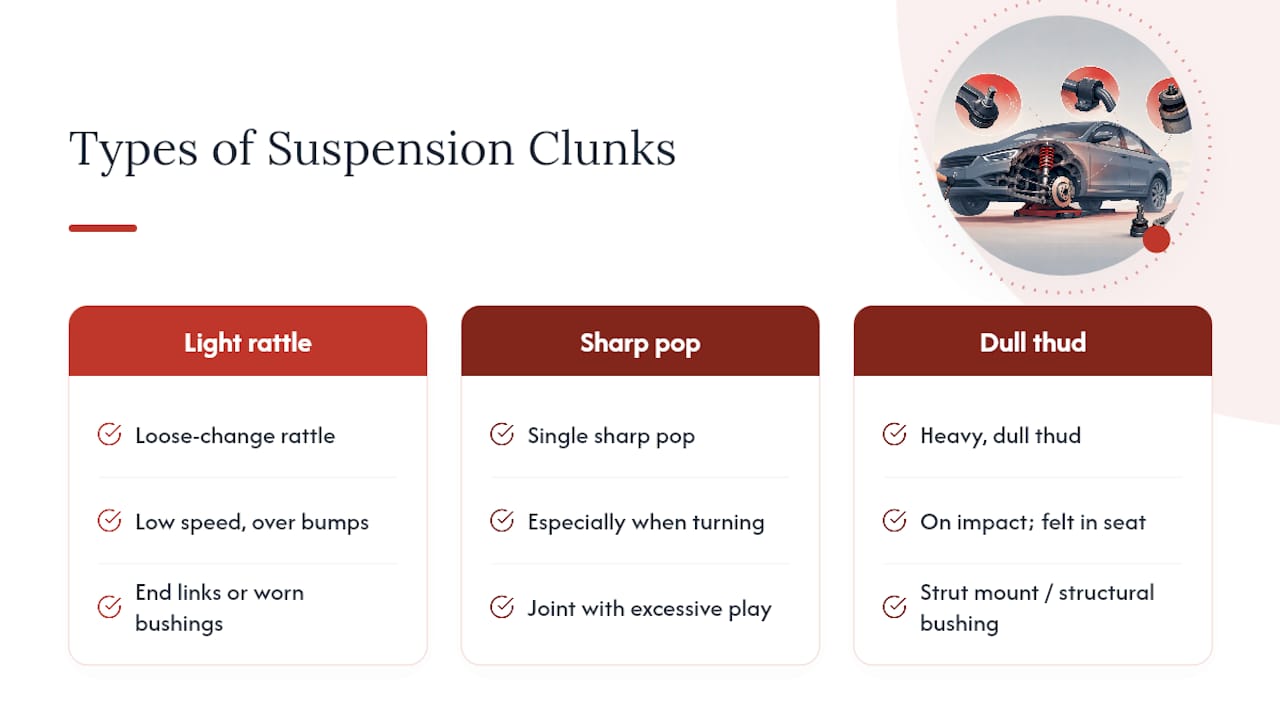
Not all clunks are the same clunk, and the difference tells you a lot before a mechanic ever touches a wrench. A light rattle, almost like loose change shaking in a cup holder, usually points to something small and cheap: end links or worn bushings knocking around at low speed. A sharp, single pop, especially when you turn the wheel, often means a joint has more play than it should. A dull, heavy thud on impact, the kind you feel through the seat, tends to come from something structural like a strut mount or a bushing under real load.
Timing matters too. Note whether the noise happens over every bump, only when turning, only under braking, or just at parking-lot speeds. Pay attention to which side it comes from, and whether it tracks with the car leaning or twisting.
Pro Tip: Roll your windows down and drive the same stretch of rough road twice, once turning left and once right. Which side gets louder tells a mechanic more than you’d think.
What Are the Most Common Causes of Front End Clunking?
Most suspension clunks trace back to one of five parts, and each one has its own signature.
- Sway bar links and end links. These small linkages connect the sway bar to the suspension, and their bushings wear out faster than almost anything else in the system. A worn link produces that classic “marbles in a can” rattle, most noticeable at low speed over uneven pavement. Sway bar end link failures often show up as light, repeated clunks around town and are relatively cheap to fix compared to strut or ball joint work.
- Ball joints. A failing ball joint tends to produce a sharp pop, especially when turning at low speed, and this is the one to take seriously. Left unchecked, a worn ball joint can eventually let the wheel fold under the car, so prompt inspection is the right call, not an overreaction.
- Control arm bushings. These produce a duller, more muffled clunk as the arm shifts under load, often during braking or acceleration. Worn bushings can also throw off your alignment over time, which shows up as uneven tire wear.
- Strut mounts and shocks. A heavier thud, sometimes paired with extra bounce after a bump, points here. Look for oil residue on the strut body or the shock leaking. Sway bar link problems and strut mount failure are the two ends of the noise spectrum: one is a rattle, the other is a thud you feel.
- Loose hardware, tie rods, bent rims, and heat shields. A loose bolt anywhere in the suspension can clunk. So can a bent rim, which can mimic suspension noise closely enough to fool an untrained ear, and a rattling heat shield or worn exhaust hanger often gets blamed on the suspension when it has nothing to do with it.
How Do Mechanics Diagnose a Suspension Clunk?
A good shop doesn’t guess. The process starts with a road test to reproduce the noise on purpose, noting the speed, whether it happens on a turn or under braking, and whether it’s coming from one side or both.
From there, the car goes up on a hoist. This is the step most owners never see, and it’s the one that actually matters.
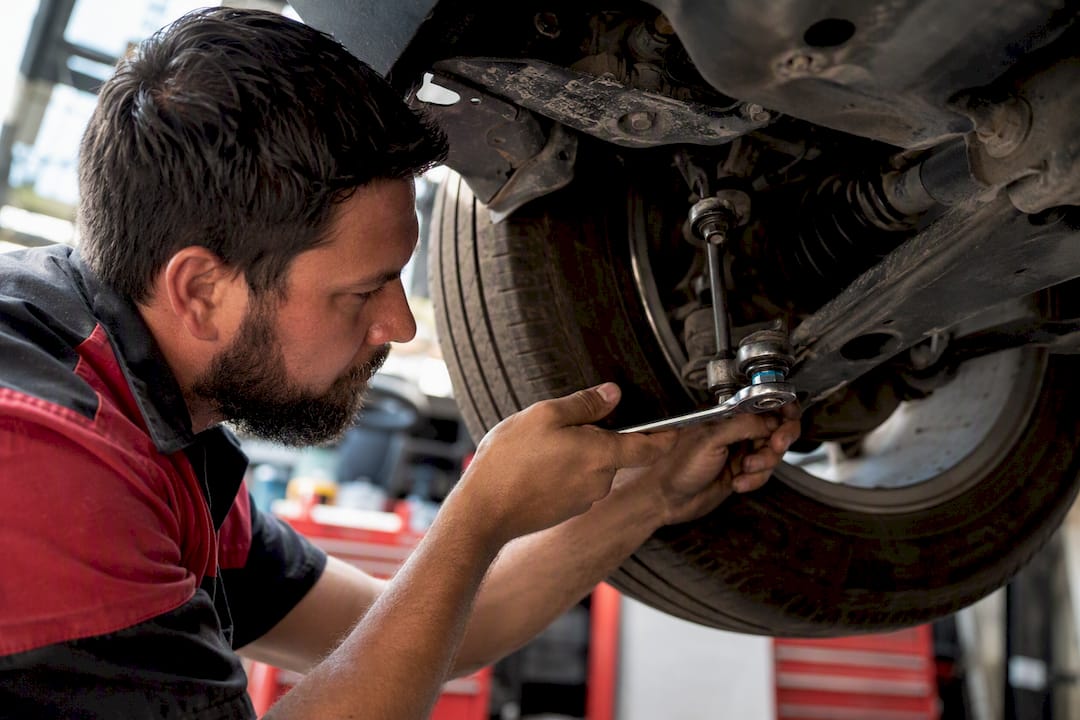
A hoist inspection with a mechanic levering each joint and bushing by hand is how you actually confirm play in a suspension part, rather than guessing based on sound alone. This single step is what separates a shop that swaps parts on a hunch from one that fixes the right thing the first time.
- The technician pries against each joint and bushing while the suspension is loaded, checking for movement that shouldn’t be there.
- Sound character and location from the road test tell the tech where to start looking first.
- Confirming play before ordering parts avoids the expensive trap of replacing components that were never the problem.
What Can You Check Yourself Before a Repair Visit?
You can gather useful information without any special tools, as long as you stay within a few safety limits.
- Park on level ground and look for torn CV boots, leaking struts, or visibly loose bolts around the suspension.
- Push down hard on each corner of the car and let go. It should settle back within one bounce; more than that suggests a worn shock.
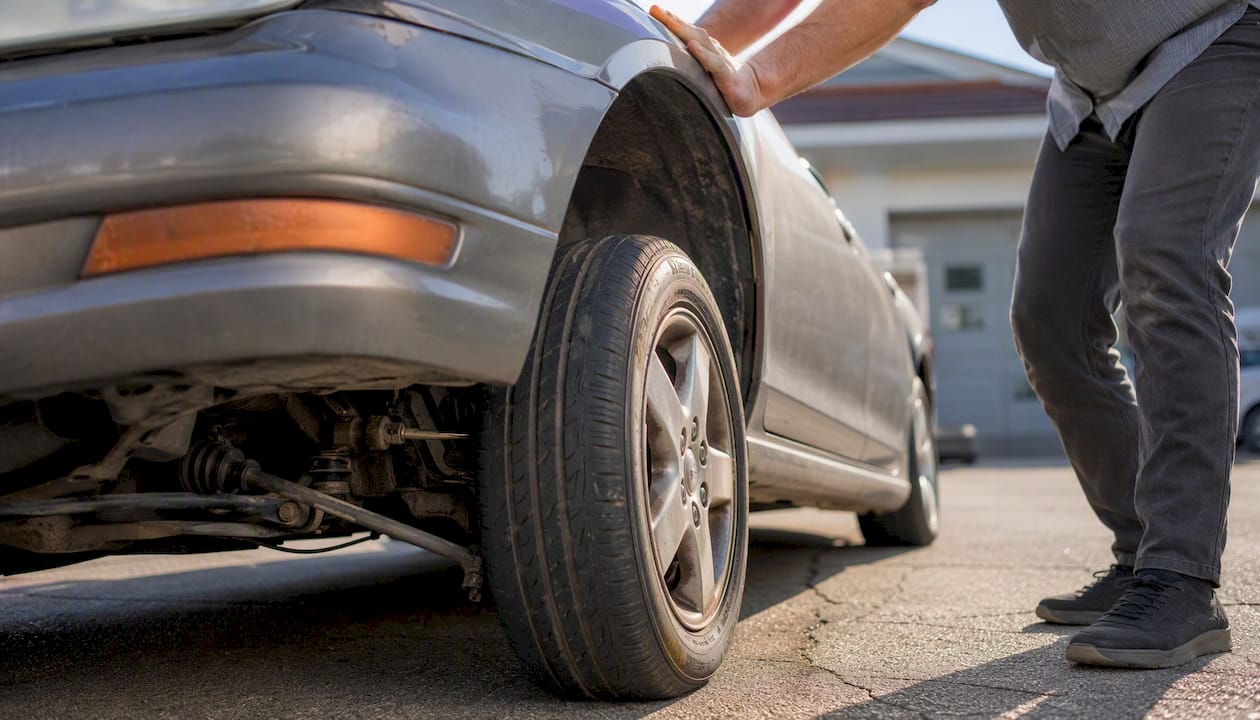
- With the car safely supported, grab each front wheel at the top and bottom and wiggle it. Play here can mean a bad ball joint or wheel bearing.
- Write down exactly what you did to reproduce the clunk, speed, bump type, steering angle, so the shop doesn’t have to rediscover it.
Never climb or reach under a car held up only by a jack. A jack can slip, and it’s not rated to support your body weight while you’re underneath.
Pro Tip: If you can, have someone bounce or steer the car while you watch the front end from a safe distance outside the vehicle. You’ll often spot the exact part moving.
How Much Does It Cost to Fix a Suspension Clunk?
Once a shop confirms the source, the fix is usually straightforward. Common repairs include:
- Sway bar link or end link replacement
- Control arm bushing replacement
- Ball joint replacement
- Strut or shock replacement
- Simply tightening loose hardware
Many of these jobs, especially anything involving a control arm or strut, disturb the vehicle’s alignment, so a wheel alignment often gets added to the ticket. That’s not an upsell; it’s a real requirement once a suspension arm has been unbolted and reinstalled.
Costs vary widely based on your vehicle, local labor rates, and parts choice, so obtaining a shop-specific quote is more reliable than generic estimates. What consistently affects your total bill is diagnosis quality: a shop that confirms the fault on a hoist before ordering parts tends to cost you less overall, because you’re not paying twice for a guess that didn’t fix anything.
How Can You Prevent Suspension Clunks From Coming Back?
A little routine attention keeps most of these problems from sneaking up on you.
- Have your suspension inspected at every oil change or at least once a year, checking boots, bushings, and mounts for wear.
- Replace worn bushings and links before they fail completely; cracked rubber or visible play are your early warning signs.
- Slow down for potholes and speed bumps instead of powering through them at full speed.
- Ask for a hoist inspection any time you buy a used car, since hidden suspension damage is easy to miss on a test drive alone.
What Should You Expect From a Trusted Repair Shop?
The gap between a shop that guesses and one that diagnoses correctly usually comes down to process and credentials, not luck.
- ASE-certified technicians trained specifically on suspension and steering systems
- Hoist-based inspection with manual levering of each joint, not a quick glance from underneath
- Professional-grade diagnostics paired with upfront pricing before any work begins
- A 24-month, 24,000-mile warranty backing the repair once it’s done
At Tom’s B & M Auto, a typical suspension visit starts with that road test and hoist inspection, moves into a written estimate you approve before anything gets replaced, and often wraps up the same day depending on parts availability.
Why the “Just Replace It” Approach to Suspension Repair Fails Owners
The conventional advice you’ll find online treats suspension noise like a checklist: hear a clunk, replace the sway bar links, still noisy, try the struts next. That approach wastes money and rarely fixes the problem on the first try, because it skips the one step that actually matters: confirming play with a loaded, levered inspection on a hoist.
What gets underestimated is how much the sound itself can mislead a DIYer. A dull thud feels like it must be the struts, but it’s frequently a control arm bushing doing the same job cheaper parts can’t. A sharp pop on turns gets dismissed as “just the CV joint” when it’s actually a ball joint with real safety implications.
Here’s what I’d prioritize if you’re staring down a clunk right now: do the bounce test and wheel wiggle at home, write down exactly when the noise happens, and then hand that information to a shop that will physically lever the joints rather than eyeball them from a creeper. That combination, your observations plus a proper hoist check, is what actually shortens the path to the right repair instead of the expensive detour through parts you didn’t need.
— Shingi
Get Your Suspension Checked Before a Small Clunk Becomes a Bigger Bill
A clunk you can hear today is almost always cheaper to fix than the one you ignore for another six months. Tom’s B & M Auto runs every suspension complaint through the same road test and hoist inspection described above, so you’re not paying to replace parts that were never the problem in the first place.
Our ASE-certified technicians handle the diagnosis with professional-grade equipment, quote you a price before touching anything, and back the finished repair with a 24-month, 24,000-mile warranty. Same-day appointments are often available if you’re in the Lynnwood area, and financing options exist if the repair turns out bigger than expected. Before your visit, jot down when the noise happens (speed, turns, bumps) so the technician can reproduce it fast.
Ready to get it looked at? Book a free digital vehicle inspection and find out exactly what’s causing that noise before it turns into a bigger repair.
Sources
Recommended
- Car Problem Sounds: What Each Noise Means and What to Do – Tom’s B & M Auto Blog
- Why Brakes Squeak: Causes, Fixes, and Warning Signs – Tom’s B & M Auto Blog
- Suspension Repair in Lynnwood, WA | Tom’s B&M Auto
- Suspension Repair in Shoreline, WA | Tom’s B&M Auto
Leave a Reply