
Volkswagen Timing Chain Issues: Causes, Symptoms, Fixes
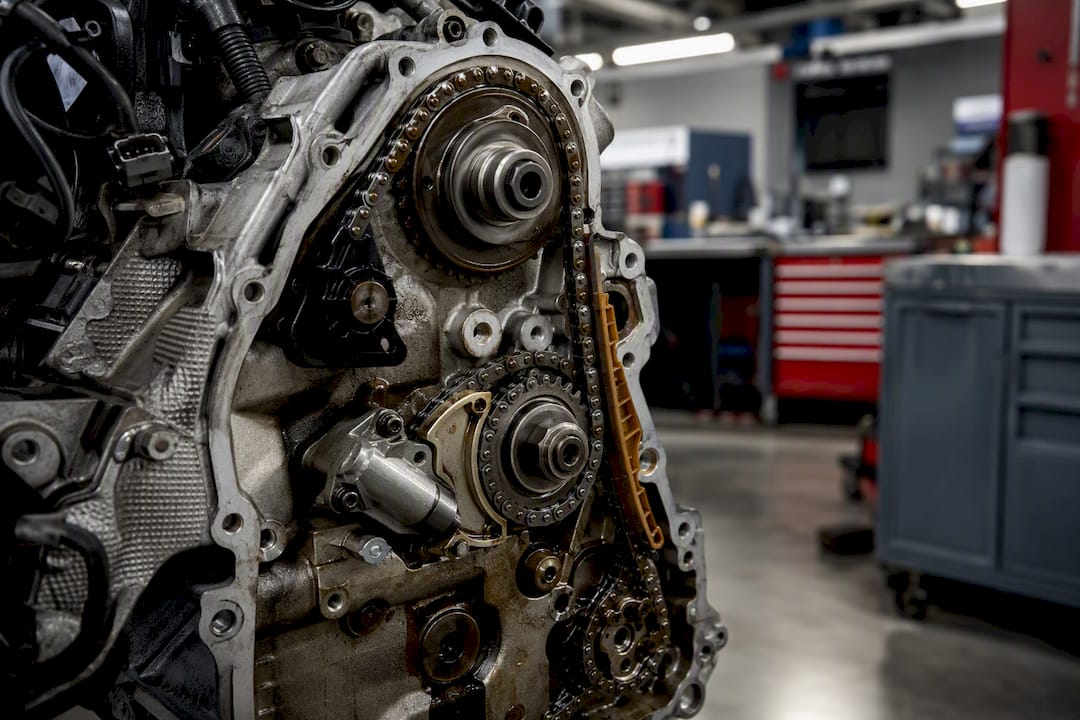
Most Volkswagen timing chain issues trace back to a failing hydraulic tensioner or worn plastic guides, and the 2.0 TSI EA888 engine is the most common offender. If you hear a metallic rattle when you start the car cold, that’s not a quirky sound to ignore. It’s the tensioner losing its grip on the chain.
Drive gently and get it inspected within days, not weeks. Waiting turns a $600 tensioner job into a $4,000 valve repair. Volkswagen’s own service bulletin outlines the exact fault-finding steps a shop should follow, and a trained technician like the team at Tom’s B & M Auto can confirm the diagnosis in under an hour.
- Cold-start rattle lasting 1 to 3 seconds: the classic early warning sign.
- Check engine light with cam or crank codes: often shows up before the noise gets worse.
- Rough idle, stalling, or a no-start condition: signs the chain has already skipped timing.
Key Takeaways
Volkswagen timing chain issues almost always start with a failing hydraulic tensioner on 2.0 TSI EA888 engines, and catching the cold-start rattle early is what separates a $600 repair from a $4,000 one.
| Point | Details |
|---|---|
| Cold-start rattle is the earliest sign | A 1 to 3 second metallic noise at startup means schedule an inspection immediately. |
| Codes P0016, P0017, P0340 matter | These cam/crank correlation codes usually point toward tensioner or chain stretch. |
| EA888 2.0 TSI carries the most risk | Pre-update tensioner castings from roughly 2008 through the mid 2010s fail most often. |
| Full kit beats tensioner-only in most cases | Guides hide wear a tensioner swap alone won’t catch, so shops often recommend the full kit. |
| Tom’s B & M Auto offers same-day diagnosis | ASE-certified techs confirm tensioner failure fast and back repairs with a 24-month/24,000-mile warranty. |
Essential Reading And Shop Resources
Start with Volkswagen’s service bulletin, Humble Mechanic’s teardown, and ShopDAP’s parts history, then explore Tom’s B & M Auto’s advanced timing procedures guide.
Table of Contents
- Symptoms Of Volkswagen Timing Chain Problems
- Which VW Engines Face The Highest Risk?
- Why Timing Chains And Tensioners Fail
- How Mechanics Diagnose A Failing Timing Chain
- Repair Costs For Volkswagen Timing Chain Replacement
- Preventing Timing Chain Failure Before It Starts
- What Owners Get Wrong About Timing Chain Repairs
- Get Your Timing Chain Checked At Tom’s B & M Auto
- Sources
Symptoms Of Volkswagen Timing Chain Problems
A cold-start rattle is the signature complaint. It happens because the hydraulic tensioner takes a second or two to build oil pressure and press against the chain guide. On a healthy engine, that rattle disappears in one to three seconds as oil pressure normalizes. On a failing one, it lingers, returns at idle, or shows up even after the engine has warmed up.
Scan tools usually turn up one of three codes tied to Volkswagen timing chain issues:
- P0016, crankshaft position/camshaft position correlation, meaning the two are out of sync.
- P0017, the same correlation fault on the exhaust bank.
- P0340, a camshaft position sensor circuit malfunction, sometimes a sensor issue but often tied to chain stretch.
As things get worse, you’ll notice misfires, a rough or uneven idle, sudden stalling, or the engine simply won’t crank into a start. That progression from rattle to misfire to no-start mirrors how far the chain has stretched or how badly the guides have fragmented.
Timing chain noise is different from a belt squeal or an accessory bearing whine. It’s metallic, comes from deep in the engine near the front cover, and is loudest at cold start. A worn belt tensioner or alternator bearing tends to whine constantly and gets worse with RPM, not better as the engine warms.
Which VW Engines Face The Highest Risk?
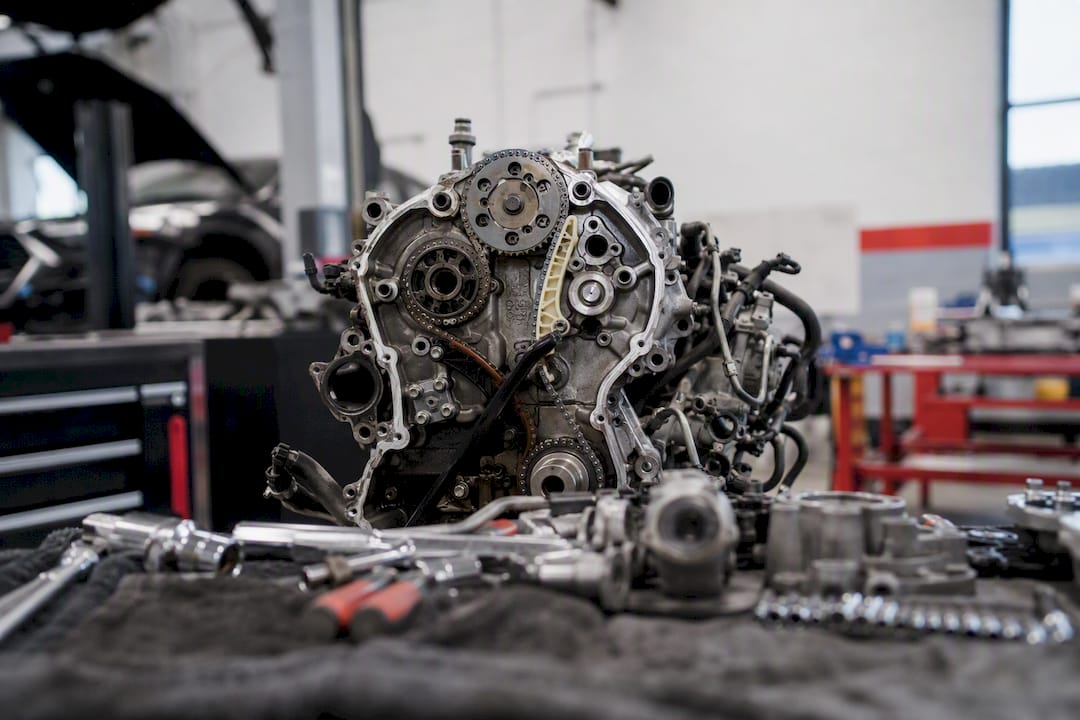
The 2.0 TSI (EA888) engine family carries the bulk of documented timing chain failures, spanning generations 1 through 3 used across VW and Audi lineups from roughly 2008 through the mid 2010s. Humble Mechanic’s detailed teardown shows exactly how the early tensioner design lets the chain skip under normal operating pressure.
- Earlier tensioner revisions, before Volkswagen’s part-number updates, are the most failure-prone.
- Engines built before the updated tensioner casting are at meaningfully higher risk than later production runs.
- Check your engine code (stamped on the block, usually near the front) and build date against your VIN to see where your car falls.
If you’re not sure how to read that code, any Volkswagen-familiar shop can pull it in minutes during a routine check.
Why Timing Chains And Tensioners Fail
The hydraulic tensioner uses oil pressure to keep constant tension on the chain as it stretches over time. When oil pressure drops, either from low oil level, degraded oil, or a worn tensioner ratchet mechanism, the tensioner can’t keep up. The chain goes slack, and slack chains skip teeth on the sprockets.
The guides that keep the chain riding straight are usually molded from plastic or nylon composite. Years of heat cycling make them brittle, and once they crack, fragments can drop into the oil pan or jam moving parts.
- Chain stretch throws camshaft and crankshaft timing out of sync.
- On an interference engine like the EA888, out-of-sync timing means valves and pistons can occupy the same space at the same moment.
- That contact bends valves, scores pistons, and sometimes cracks the head.
- Thin, degraded oil and frequent short cold starts accelerate every part of this failure chain.
Pro Tip: If your car sits for long stretches between short trips, that’s actually harder on the tensioner than highway driving. Cold starts are when oil pressure is lowest and tensioner wear happens fastest.
How Mechanics Diagnose A Failing Timing Chain
A proper diagnosis follows a sequence, not a guess. Skipping steps is how shops misdiagnose a $600 fix as a $3,000 one, or vice versa.
- Pull codes first. P0016, P0017, and P0340 point a technician toward cam/crank correlation before any metal gets touched.
- Listening test. A technician places a mechanic’s stethoscope near the timing cover during a cold start to isolate the rattle from accessory noise.
- Tensioner compression test. Volkswagen’s own service bulletin describes a piston-compressibility check: if the tensioner piston can be pushed in by hand, it has already failed.
- Scan-tool cam adaptation values. VCDS or ODIS software reads camshaft adaptation angles, which flag timing drift even before a code sets.
- Visual confirmation. If numbers look off, the shop pulls the timing cover to inspect guides and chain wear directly.
That hand-compression test is the fastest yes-or-no answer available, and it requires no disassembly to run. It’s also why a shop familiar with Volkswagen’s guided fault-finding sequence can often confirm tensioner failure in a single visit rather than sending your car home for a second appointment.
Repair Costs For Volkswagen Timing Chain Replacement
Costs scale directly with how much damage has already happened, which is exactly why catching the rattle early matters more than any other factor in this whole conversation.
- Tensioner-only replacement works when caught early, before any chain stretch or guide fragmentation shows up on inspection. Labor commonly runs around five hours since the front cover has to come off, and parts plus labor typically land in the lower end of the repair spectrum.
- Full timing chain kit (chains, guides, rails, and the updated tensioner together) is what most shops recommend, since guides often show hidden wear that a tensioner swap alone won’t fix. ShopDAP’s breakdown of part-number history explains why piecemeal repairs tend to come back.
- Head work or engine replacement becomes necessary once valves have contacted pistons. According to ShopDAP, that repair tier can run $2,000 to $4,000 or more depending on how many valves bent and whether the block itself took damage.
One detail owners miss: replacing just the tensioner still requires locking the camshafts and resetting cam adaptation values with a proper scan tool. Skip that step and you’ll get drivability issues even with new parts installed correctly. Shops also weigh OEM versus updated OE-spec parts, and most torque-to-yield head fasteners are single-use, adding a modest cost to any job that opens the head. A regional repair write-up makes the same point Tom’s B & M Auto sees in the shop: delaying full kit replacement after symptoms appear almost always costs more than doing it right the first time.
Preventing Timing Chain Failure Before It Starts
The single biggest lever you control is oil. Use Volkswagen-approved VW 502.00 or 504.00 spec oil, and consider changing it every 5,000 miles rather than stretching to the automaker’s longer published interval, especially if your driving is mostly short trips.
- Avoid a steady diet of short, cold trips that never let the engine reach full operating temperature.
- If you bought the car used and don’t know its full oil-change history, ask your shop about preventive tensioner and guide replacement around the 60,000 to 80,000 mile mark.
- Listen deliberately on every cold start for a few weeks after any oil change, since a new rattle is the earliest signal you’ll get.
- Ask for a scan during routine service visits to catch pending cam or crank codes before they trigger a check engine light.
Pro Tip: Keep a small notebook or phone note logging every oil change date and mileage. When you eventually sell or trade the car, that history is worth real money to the next owner.
Why Trust This Guide On VW Engine Timing Concerns
This guide was written by Shingi, drawing on Volkswagen’s own service guidance and documented technician procedures for advanced timing repairs.
- Tom’s B & M Auto has served Lynnwood, WA since 1985 with ASE-certified technicians on staff.
- Same-day diagnostic appointments are often available for suspected timing issues.
- Every completed repair carries a 24-month/24,000-mile warranty.
What Owners Get Wrong About Timing Chain Repairs
The conventional advice online tends to stop at “listen for the rattle,” as if the sound itself is the whole diagnosis. It isn’t. The rattle tells you something is wrong, not how far along the failure is, and that distinction is exactly what a compression test and cam adaptation reading exist to settle.
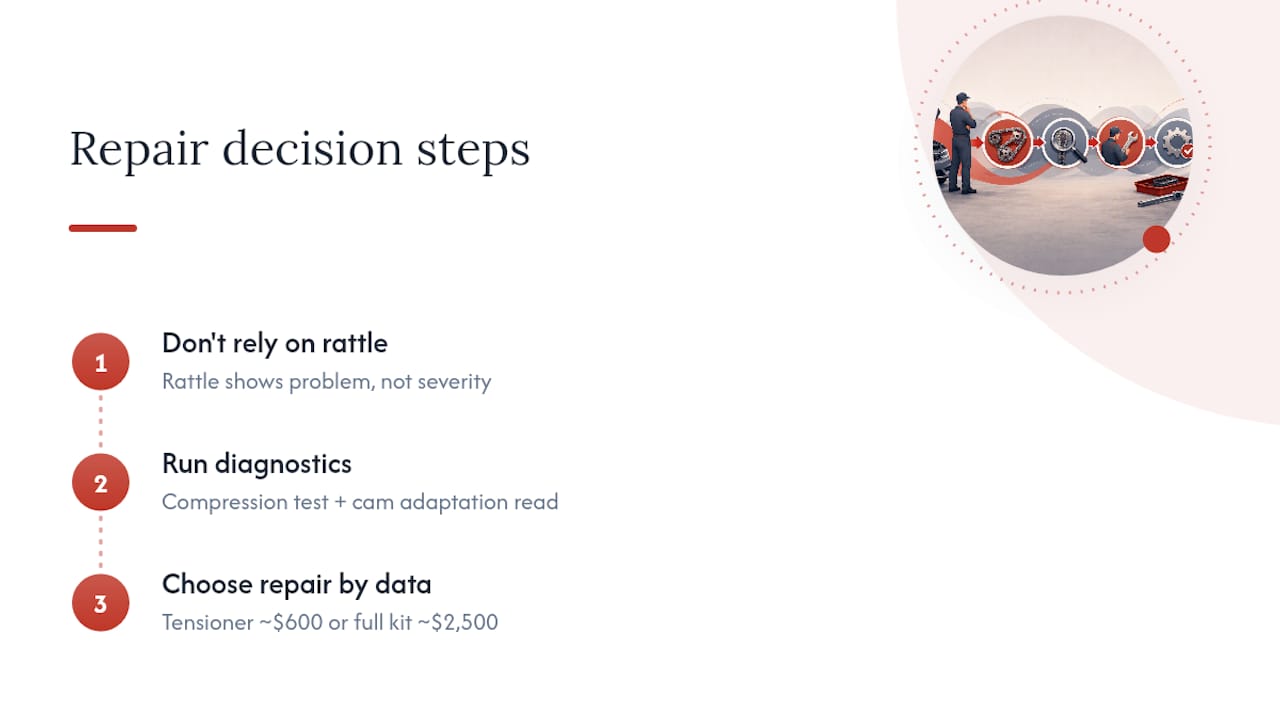
Where I think owners go wrong most often is treating the tensioner-only fix as the smart, budget-conscious choice. It sounds reasonable. In practice, guides that have been flexing under an already-weak tensioner rarely come out clean, and a shop that only swaps the tensioner is betting your money on parts they haven’t inspected. The full kit costs more upfront but avoids a second teardown six months later.
Prioritize the diagnostic step over the repair decision. Get the tensioner compression test done, get cam adaptation values read, and let those numbers, not a guess about your budget, decide whether you need a $600 job or a $2,500 one. That’s the difference between owning this problem and getting surprised by it.
— Shingi
Get Your Timing Chain Checked At Tom’s B & M Auto
Tom’s B & M Auto is the shop-backed alternative to guessing at forums and part-number spreadsheets for your Volkswagen timing chain issues. Since 1985, ASE-certified technicians in Lynnwood have run the exact tensioner compression tests and cam adaptation checks described above, with same-day appointments often available so a cold-start rattle doesn’t sit unresolved for weeks.
If you’re hearing that rattle or you’ve pulled a P0016 or P0017 code, book a free digital vehicle inspection before committing to any repair quote. For Volkswagen owners near Lynnwood, the Volkswagen repair page covers what a full diagnostic visit includes, and every completed repair carries a 24-month/24,000-mile warranty. If the diagnosis points toward head work, financing options are available so a bigger repair doesn’t have to happen all at once. Call or book online today to get the compression test done before that rattle becomes something worse.
Sources
- Volkswagen Group service bulletin (SB-10045560-1452)
- How The 2.0T TSI Timing Chain Tensioner Fails ~ Video – Humble Mechanic
- 2.0T VW and Audi TSI Timing Chain Tensioner Problems – Articles (ShopDAP)
- Volkswagen Timing Chain Issues in St. Marys, GA Can Damage Your Engine | Royalty Auto Service
Recommended
- Timing Chain Rattle: Is It Safe to Drive Right Now? – Tom’s B & M Auto Blog
- Advanced Engine Timing Procedures: Technician’s Guide – Tom’s B & M Auto Blog
- European Car Repair Challenges: What Owners Must Know – Tom’s B & M Auto Blog
- Common Honda Repair Needs: Your 2026 Owner’s Guide – Tom’s B & M Auto Blog
Leave a Reply