
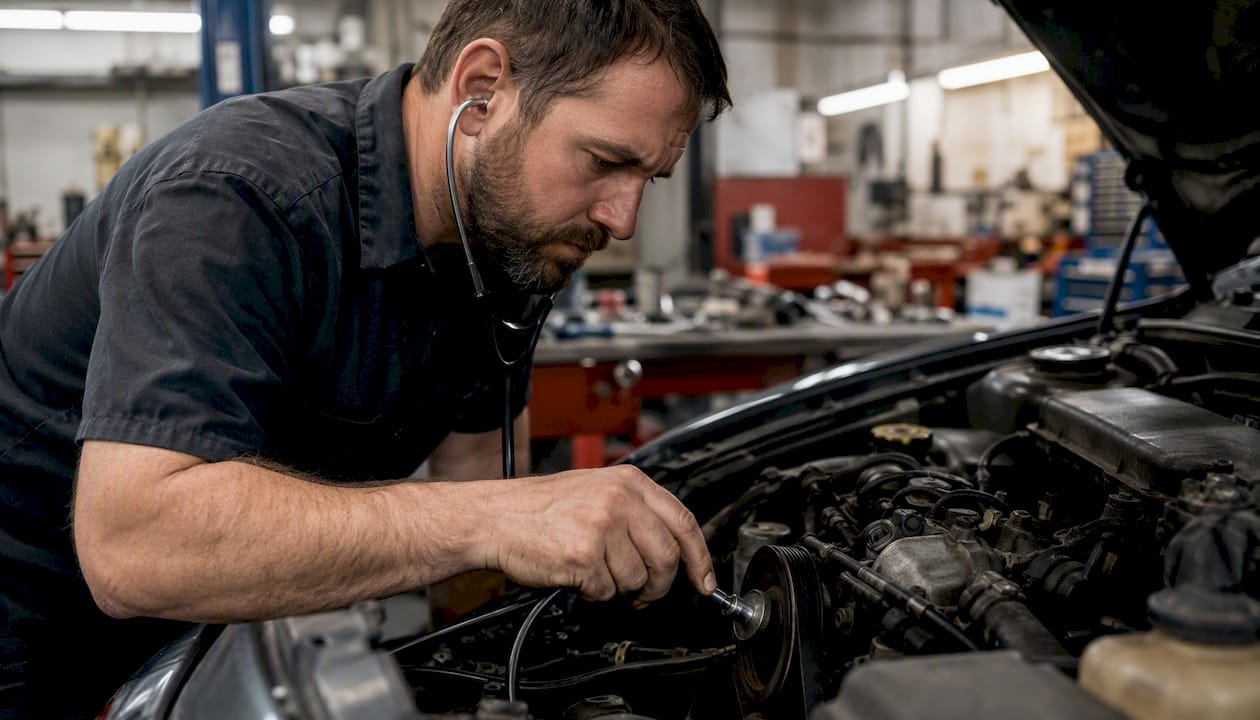
Serpentine Belt Noise: Quick Triage and Fix for DIYers
A chirping or squealing serpentine belt usually comes down to one of three things: misaligned pulleys, a slipping belt from low tension or contamination, or a tensioner and bearing on the way out. Chirp on startup or during quick throttle changes points to alignment. A longer squeal, especially in damp or cold weather, points to slipping. If the noise comes with grinding, smoke, or a squeal that gets worse under load, pull over and shut the engine off.
Before anything else, run the water test: with the engine idling, mist the belt’s rib side with a spray bottle. If the noise stops, you’re dealing with slip. If it doesn’t change, look at alignment and bearings instead. Dayco’s diagnostic guidance backs this test as the fastest way to split the two problems, and an ASE-certified mechanic will run the same check before touching a wrench.
- Chirp = likely misalignment or a bearing issue
- Squeal = likely slip from tension or contamination
- Grinding, burning smell, or smoke = stop driving now
Key Takeaways
Most serpentine belt noise traces back to misalignment, contamination, or a tensioner and bearing that need replacing alongside the belt itself.
| Point | Details |
|---|---|
| Run the water test first | Spray the belt ribs at idle: noise that stops means slip, noise that continues means alignment or a bearing. |
| Match symptom to cause | Chirp usually means misalignment or a bearing; squeal usually means slip from tension or contamination. |
| Replace tensioner with belt | A weak tensioner or rough idler bearing causes noise to return within days of a fresh belt. |
| Skip petroleum sprays | WD-40 and belt dressings degrade EPDM rubber and force an immediate belt replacement. |
| Get a pro inspection when unsure | Tom’s B & M Auto offers a free digital inspection and a 24-month/24,000-mile warranty on belt and tensioner work. |
Table of Contents
- Is It Safe to Keep Driving With a Noisy Serpentine Belt?
- How to Tell Chirp From Squeal (And Why It Matters)
- What Tools Do You Need for a DIY Belt Inspection?
- What’s Actually Causing the Noise, and How Is It Fixed?
- When Should You Replace the Belt, Tensioner, or Pulleys?
- What Should You Never Do to Quiet a Squealing Belt?
- When Do You Need a Professional Inspection Instead of DIY?
- Frequently Asked Questions
- Sources
Is It Safe to Keep Driving With a Noisy Serpentine Belt?
Grinding, metal-on-metal sounds, or visible smoke mean stop the car immediately and arrange a tow. A brief squeal on a cold start that clears up after a minute or two is usually low risk for a short trip, but keep it short. Continuous slipping under load, especially with a battery light or power steering that suddenly feels heavy, means stop driving.
- Dashboard warning lights (battery, temperature, power steering)
- Accessories cutting out (AC, power steering, alternator charging)
- Visible cracks, missing chunks, or fraying on the belt
- Smell of hot rubber or burning oil
How to Tell Chirp From Squeal (And Why It Matters)
A chirp is short, rhythmic, and often ties to the engine’s rotation, speeding up as RPM rises. It usually means a pulley is out of alignment or a bearing is starting to wobble. A squeal runs longer, sounds louder under load, and tends to show up worse in cold or wet conditions. That’s classic slip, whether from a stretched belt, weak tensioner spring, or oil on the ribs.
- Start the engine and let it idle in park or neutral.
- Locate the belt’s rib side (the grooved side, not the smooth back).
- Lightly mist the moving ribs with water from a spray bottle.
- Listen: if the noise disappears, you’ve confirmed slip; if it continues, suspect alignment or a bearing.
Dayco’s own troubleshooting page walks through this exact test and treats it as the first move before pulling anything apart.
Pro Tip: To find which pulley is chirping, roll a piece of cardboard tube (or use a mechanic’s stethoscope) near each pulley while the engine runs. The chirp gets noticeably louder right next to the offending one.
What Tools Do You Need for a DIY Belt Inspection?
Grab a flashlight, work gloves, a spray bottle of water, a 1/2 inch breaker bar or ratchet (most tensioners release with this), and a pry bar for stuck pulleys. A straightedge or a length of string helps check pulley alignment across the engine bay.
- Kill the engine and let it cool, then pop the hood and locate the belt routing diagram, usually on a sticker near the radiator.
- Run your fingers along the belt’s rib side, feeling for glazing (a shiny, hardened surface), cracks, or missing rib sections.
- Press down on the belt at its longest unsupported span. More than about half an inch of give suggests weak tension.
- Spin the tensioner and idler pulleys by hand with the belt off or loose. Roughness, grinding, or wobble means a bad bearing.
- Hold a straightedge across two or three pulleys to check they sit in the same plane. A pulley that’s out of line by even a fraction of an inch causes a chirp Dayco and others flag as a top cause.
- Look for rubber dust in the engine bay, a sign of chronic rib wear
- Check for oil or coolant sheen anywhere near the belt path
- With the belt removed, spin each accessory pulley alone to isolate a noisy alternator or AC compressor from the belt itself
What’s Actually Causing the Noise, and How Is It Fixed?
Each symptom points to a specific fix, and guessing wrong wastes both time and money.
- Misaligned pulley — symptom: sharp chirp that follows engine speed; test: straightedge across pulleys; fix: repair or replace the mounting bracket. DIY difficulty: moderate to hard, depending on access.
- Worn or glazed belt — symptom: squeal that worsens in damp weather; test: check ribs for a shiny, hardened surface; fix: replace the belt. DIY difficulty: easy, 30 to 60 minutes.
- Weak or failing tensioner — symptom: squeal returns quickly after a new belt, or a fluttering sound at idle; test: manually check tensioner arm travel and spring resistance; fix: replace the tensioner along with the belt. DIY difficulty: moderate.
- Contaminated belt — symptom: sudden squeal after an oil or coolant leak; test: look and smell for fluid on the ribs; fix: fix the leak first, then replace the belt.
- Worn accessory bearing — symptom: grinding or growling that continues with belt removed; test: spin each pulley by hand; fix: replace the specific component (alternator, idler, AC compressor).
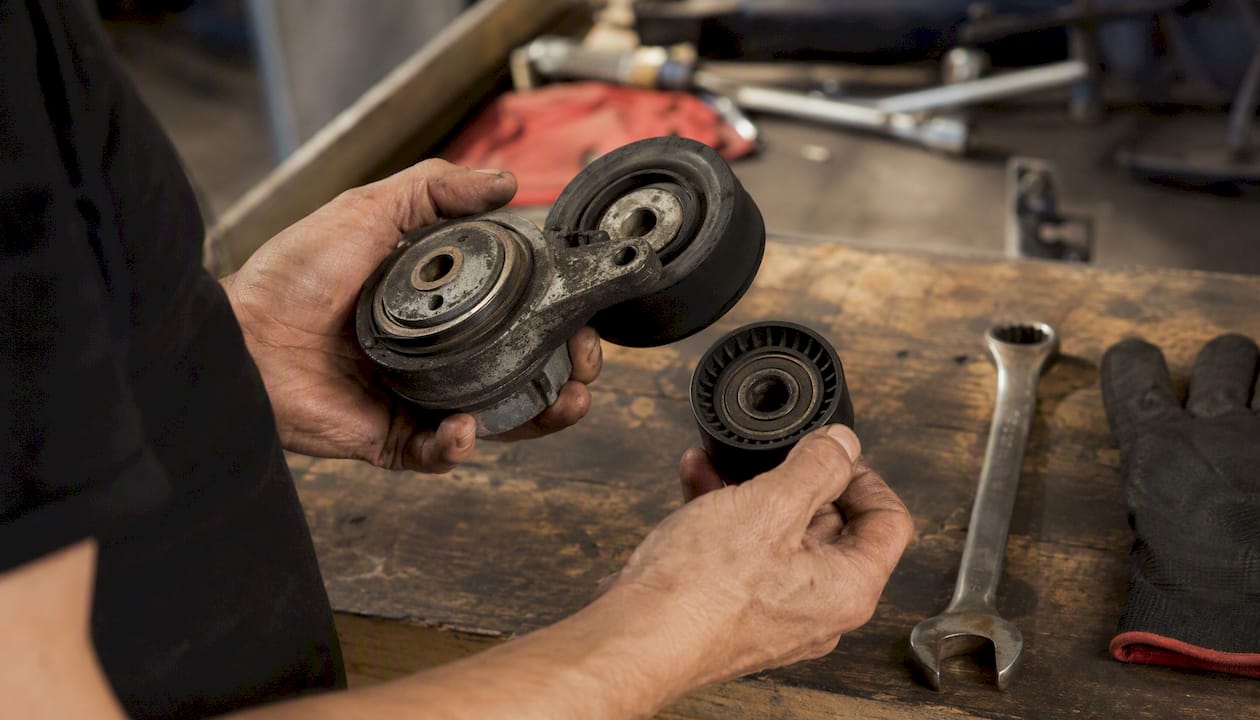
The most common DIYer mistake is buying a new belt, snapping it on, and calling it done. If the tensioner spring is weak or a pulley bearing is rough, the new belt will squeal again within days. Dayco’s own guidance recommends inspecting the tensioner and idlers any time a belt comes off, and replacing them together when wear shows.
When Should You Replace the Belt, Tensioner, or Pulleys?
Most manufacturers call for a visual inspection at every oil change and a full belt replacement somewhere between 60,000 and 100,000 miles, though that range depends heavily on the vehicle and driving conditions.
- Replace the belt at the first sign of glazing, cracking, or missing ribs, even if it hasn’t hit the mileage mark.
- Replace the tensioner and idler pulleys alongside the belt if either shows roughness, wobble, or reduced spring tension. Reusing a tired tensioner on a fresh belt is a common reason noise comes right back.
- Expect parts costs to be modest compared to labor. J.D. Power notes that total cost varies widely by make and model, with labor typically making up the larger share of the bill, since accessing the belt often means removing splash shields or other components first.
- A shop job usually takes under an hour; a careful DIY replacement runs closer to one to two hours for a first timer.
What Should You Never Do to Quiet a Squealing Belt?
Never spray WD-40, silicone spray, or any petroleum-based belt dressing on a serpentine belt. Modern belts are made from EPDM rubber, and petroleum products break that rubber down fast. D&R Rubber’s safety guidance is blunt about it: any belt exposed to oil-based products needs to be replaced, not treated.
- Don’t keep driving on a belt that’s visibly slipping to “see if it gets better.”
- Don’t reuse a belt that’s been soaked in oil or coolant, even after wiping it down.
- Don’t ignore a grinding pulley bearing because the belt itself looks fine.
The “quick fix” belt dressing myth persists because it can mask a squeal for a day or two. It doesn’t fix tension or alignment, and it leaves you with a softened, oil-slicked belt that fails sooner.
When Do You Need a Professional Inspection Instead of DIY?
Book a shop visit if you hear grinding or metal noise, see visible belt fraying or missing chunks, or if a squeal returns shortly after you’ve already replaced the belt yourself. Uncertainty after running the water test and checklist is also a good reason to hand it off.
A proper inspection covers the full front-end accessory drive, not just the belt: tensioner travel, idler bearing condition, pulley alignment, and a load test on the alternator and AC clutch. Ask for a written estimate that separates parts from labor, and ask the technician to show you the failed part before it goes in the trash.
A belt that starts squealing again within days of replacement almost always means the real problem was never the belt. It was the tensioner, a bearing, or a misaligned pulley that never got fixed.
Look for ASE-certified technicians and a shop that backs the repair with a real warranty, not just a handshake.
A Shop Technician’s Take on Recurring Belt Noise
A noisy belt is rarely a standalone problem. It’s usually the first sign that a tensioner or bearing is failing, which is why we replace both together instead of just the belt. A brand new belt that still squeals almost always means the underlying issue got missed.
If You’d Rather Have a Pro Handle It
Running the water test yourself is smart triage, but tracking down a worn tensioner bearing or a misaligned bracket takes a lift, a straightedge, and hands that do this daily. 
Tom’s B & M Auto has been sorting out belt noise, tensioner failures, and front-end drive issues for Lynnwood-area drivers since 1985. Every job includes a full inspection of the belt, tensioner, and idler pulleys, not just a belt swap, and every repair carries a 24-month/24,000-mile warranty regardless of make or model, including hybrids and European vehicles. If you’re not sure whether your noise is a $40 belt or a $400 tensioner job, a free digital vehicle inspection will give you a straight answer with photos, not guesswork. For drivers in the Lynnwood area, you can also go straight to the serpentine belt and hose service page to see what’s included and book a same-day slot when one’s open. Ask for a written inspection and warranty details up front, every time.
Frequently Asked Questions
Why does my serpentine belt squeal only when the engine is cold?
Cold rubber is stiffer and grips pulleys less effectively, so a belt with even slightly low tension or minor glazing will squeal until it warms up and expands. If the squeal disappears within a minute every time, it’s usually not urgent, but the water test still helps confirm it’s slip rather than a bearing issue.
Can I just tighten the belt to stop the chirping?
Most modern vehicles use a spring-loaded automatic tensioner, not a manual adjustment bolt, so there’s nothing to “tighten” by hand. If the tensioner isn’t holding proper tension on its own, the fix is replacing the tensioner, not cranking down a bolt that doesn’t exist on most setups.
Is it normal for a brand new belt to still make noise?
No. A new belt that squeals or chirps almost always means the tensioner, an idler bearing, or pulley alignment was never addressed. Treat continued noise after replacement as a sign to check the rest of the front-end drive system.
How much does serpentine belt replacement typically cost?
Cost depends heavily on the vehicle and how much labor it takes to access the belt, since some engine bays require removing other components first. Parts are usually the smaller portion of the bill, with labor making up the bulk of the cost.
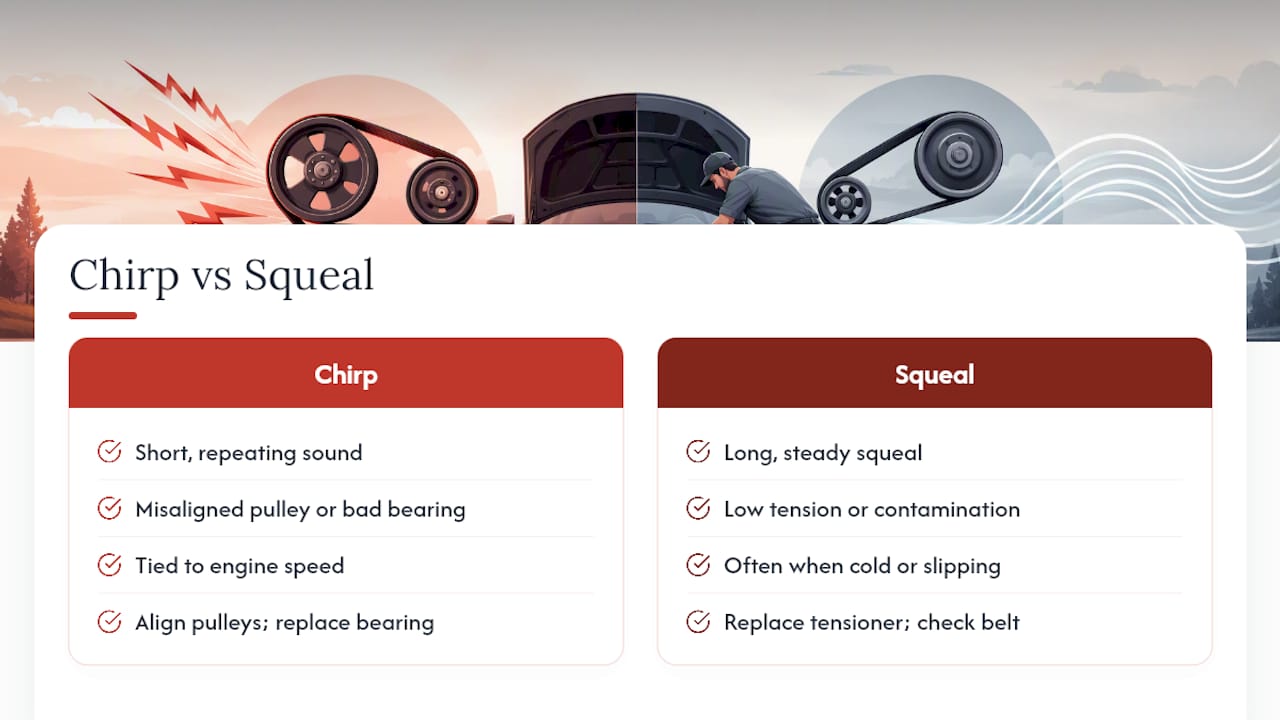
What’s the difference between a chirp and a squeal in plain terms?
A chirp is a short, repeating sound tied to engine speed, usually from a misaligned pulley or failing bearing. A squeal is longer and steadier, usually from a belt slipping due to low tension or contamination.
Sources
- How to Fix Serpentine Belt Noise – Dayco TechHub
- Car chirping? How to fix a belt tensioner – 1A Auto Blog
- How safe is it to use WD-40 on rubber? – D&R Rubber
- How much does it cost to replace a serpentine belt? – J.D. Power
Recommended
- The Role of Serpentine Belt: What Every Driver Should Know – Tom’s B & M Auto Blog
- Car Problem Sounds: What Each Noise Means and What to Do – Tom’s B & M Auto Blog
- Serpentine Belt & Hoses in Kenmore, WA | Tom’s B&M Auto
- Serpentine Belt & Hoses in Shoreline, WA | Tom’s B&M Auto
Leave a Reply