

How to Document Car Repair History: Lynnwood Guide
Documenting your car repair history means creating a dated, mileage-stamped, verifiable record of every service and repair — invoices, repair orders, odometer readings, shop name, parts, and photos — stored somewhere you can find and share it. Start right now: pull your most recent invoice, write the odometer reading on it, and drop it into a folder (paper, cloud, or app). Under the Magnuson-Moss Warranty Act, dated service records are your first line of defense if a manufacturer disputes a warranty claim. At Tom’s B & M Auto in Lynnwood, every completed job comes with a written repair order you can take home and file.
Three immediate steps:
- Collect your latest invoice. If you don’t have one, call the shop and request a copy — shops are required to provide it.
- Stamp it with mileage. The odometer reading at service time proves you followed manufacturer-recommended intervals.
- File it in one consistent place. A cloud folder, a maintenance app, or a labeled binder — pick one and use it every time.
Table of Contents
- How to document car repair history: what to record and keep
- How to recover records you no longer have
- How to organize, store, and back up your records
- Which digital tools actually help you track car repairs
- Why a documented history raises resale value and protects your warranty
- What to ask your repair shop before and after every service
- A ready-to-use template and after-service checklist
- Key Takeaways
- Why most car owners underestimate their own records
- Tom’s B & M Auto makes building your service history easy
- Useful sources
How to document car repair history: what to record and keep
A receipt alone won’t protect you in a warranty dispute or impress a serious buyer. A repair order (RO) is the document that actually matters — it lists the shop, service date, vehicle and mileage, technician notes, parts replaced (with part numbers), labor description, and the unique RO number that ties every document in a transaction together.
Capture these fields for every service event:
| Field | Why It Matters |
|---|---|
| Service date | Establishes timeline for warranty and resale |
| Odometer reading | Proves interval compliance |
| VIN | Links record to your specific vehicle |
| Shop name and contact | Verifies who performed the work |
| RO / invoice number | Unique identifier for retrieval |
| Parts replaced (part numbers) | Supports warranty and diagnostic follow-up |
| Labor description | Documents what was actually done |
| Estimate vs. final price | Flags unauthorized charges |
| Technician notes | Critical for recurring-diagnosis troubleshooting |
| Warranty terms | Length and coverage from the shop |
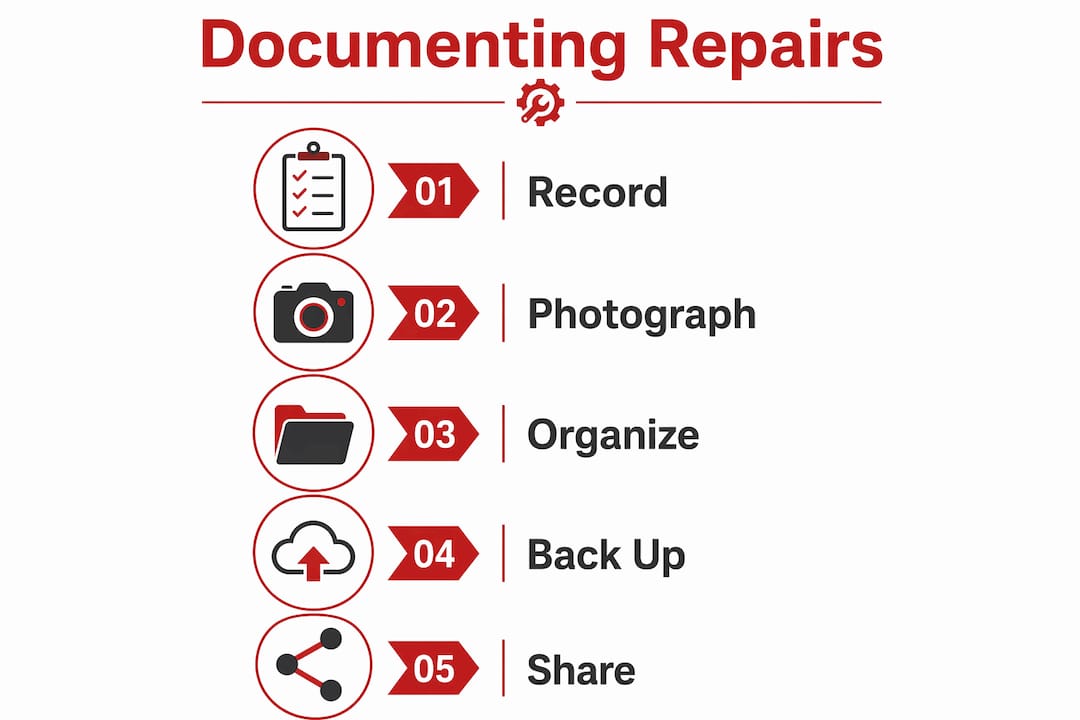
For DIY repairs, a receipt alone won’t hold up. Photograph the old part next to the new one, keep the packaging with the part number visible, and write a short note describing the symptoms and steps you took. Timestamp the photos on your phone — that metadata is your proof.
How to recover records you no longer have
Missing records are common, especially after switching shops or buying a used car. Work through these steps in order.
- Call the shop directly. Shops are required to retain estimates and work orders for at least three years. Give them your VIN, approximate service date, license plate, and the last four digits of the payment card you used — that combination speeds retrieval considerably.
- Check your email. Many shops send PDF invoices automatically. Search for the shop name or “repair order” in your inbox.
- Pull a VIN-based history report. Carfax and myCARFAX aggregate service events reported by participating shops. They’re useful for accidents and dealer visits, but independent shop visits often don’t appear in these reports — so don’t treat a clean Carfax as a complete history.
- Check any apps you’ve used. AUTOsist, Vehicle Maintenance Log, and 1Garage all store uploaded records you may have forgotten about.
- When records are gone for good, ask the shop for a signed statement confirming the service was performed, and photograph any remaining physical evidence (worn parts, stickers, stamps).
Shops sometimes charge a small administrative fee for archived records. Expect a few business days for older files.
Pro Tip: When calling a shop for old records, lead with your VIN and approximate date range before anything else. That’s how their filing systems are indexed — a name alone can take much longer to trace.
How to organize, store, and back up your records
Three systems work reliably. Pick the one you’ll actually use.

A. Paper binder. Label dividers by year or by vehicle if you own more than one. Keep the most recent invoice at the front. Simple, no tech required, and easy to hand to a buyer.
B. Cloud-synced folder. Create a folder named after your vehicle and use a consistent filename convention:
2019-Toyota-Camry_1HGBH41JXMN109186_87432mi_20240315_oilchange.pdf
Date, mileage, and service type in the filename means you can sort and search without opening every file.
Scan paper invoices with your phone camera — Google Drive and iCloud both have built-in document scanning. Follow a 2-1-1 backup rule: two copies, one local (your phone or laptop), one offsite (cloud). That way a lost phone doesn’t erase your history.
C. Maintenance-tracking app. Apps like AUTOsist, Vehicle Maintenance Log, and 1Garage auto-populate manufacturer maintenance schedules and send mileage-based reminders. They also export your full history as a PDF — useful when selling or filing a claim.
Pro Tip: Before sharing records with a buyer, redact your full VIN combined with your home address from any document. The VIN alone is fine to share; paired with personal data, it’s more than a buyer needs.
Which digital tools actually help you track car repairs
Two categories of tools serve different purposes, and the best approach uses both.
VIN-history services (Carfax, myCARFAX):
- Strong for accidents, title events, insurance claims, and dealer-reported service
- Free myCARFAX account lets you track your own vehicle and receive recall alerts
- Miss a significant share of independent-shop visits that never report to data aggregators
- Best used as a supplement to owner-kept records, not a replacement
Maintenance-tracking apps (AUTOsist, Vehicle Maintenance Log, 1Garage, MyRide901):
- Owner-controlled: you upload invoices, photos, and notes
- Photo OCR in apps like Vehicle Maintenance Log can extract service type, date, mileage, and cost automatically
- Exportable, timestamped history you can send to a buyer or a shop before your appointment
- Only as complete as what you put in — but that’s also what makes them trustworthy
The practical move: keep every original shop invoice and upload it to your app of choice. Then pull a Carfax report once a year to catch anything you may have missed. That combination gives you a buyer-ready packet with no gaps.
Why a documented history raises resale value and protects your warranty
A well-documented service history can add a noticeable amount in resale value in some cases, according to Vehicle Maintenance Log — a vendor claim worth treating as an order-of-magnitude estimate rather than a guarantee, but consistent with what dealers and private buyers actually pay for confidence.
A complete repair history turns a used car from a question mark into a known quantity. Buyers pay for certainty, and a dated, mileage-stamped service packet is the clearest form of it you can offer.
For warranty protection, the Magnuson-Moss Warranty Act means a manufacturer cannot void your warranty simply because you used an independent shop — but you do need records proving the work was done correctly and on schedule. Dated, mileage-stamped invoices are that proof.
For disputes, the evidence chain matters. Say a shop recommends replacing a part you had replaced eight months ago. Pull the prior repair order with technician notes, the part number, and the mileage stamp. That single document, combined with a photo of the replaced part, is usually enough to stop a redundant recommendation cold. Knowing how to avoid unnecessary upsells starts with having the paperwork to back up what’s already been done.
When selling, compile a single PDF service packet: key invoices in chronological order, a mileage timeline, and any photos of major work. Understanding how car history affects valuation helps you present that packet in a way that actually moves the needle with buyers and dealers.
What to ask your repair shop before and after every service
Most shops will give you everything you need — you just have to ask.
Before work starts: Request a written, itemized estimate with parts and labor listed separately. Confirm the shop records your odometer reading on the estimate. Under Bureau of Automotive Repair guidance, shops must obtain your authorization before beginning any work — written, electronic, or oral with a recorded confirmation. That authorization is a document you’re entitled to keep.
After work is done: Ask for the final repair order with the RO number, technician notes, part numbers, labor time, and the shop’s warranty terms in writing. A shop worth returning to will hand you a digital PDF the same day.
A trustworthy shop documents the work as thoroughly as it performs it. If the invoice is vague, the work probably was too.
Pro Tip: Use this one-line email after any service: “Hi, could you send a PDF of today’s repair order to [your email]? I keep digital records for all my vehicles.” It takes 10 seconds and creates an electronic trail automatically.
Tom’s B & M Auto provides itemized repair orders with technician notes on every job. Their accurate repair shop estimates process means you know what you’re authorizing before any work begins.
A ready-to-use template and after-service checklist
Copy this table into a spreadsheet or print it as your service log:
| Date | Mileage | Shop / Tech | RO # | Work Performed | Parts (Part #) | Labor | Total | Warranty | Notes |
|---|---|---|---|---|---|---|---|---|---|
| — | — | Tom’s B & M Auto | — | Oil change, filter | Mobil 1 5W-30 (#M1) | — | — | 24 mo/24k mi | No leaks noted |
Before you leave the shop, verify:
- Odometer reading matches what you drove in with
- Parts are itemized with part numbers (not just “misc. parts”)
- RO number appears on the invoice
- Warranty terms are written out (length and what’s covered)
- Technician name or ID is listed
The 60-second routine after every service: photograph the invoice with your phone, rename the file with the date and mileage, drop it into your vehicle folder or app, and tag it “needs export” if you’re building a sale packet. That’s it.
For DIY work: photograph the old part, the new part packaging (part number visible), and the installed result. Write two sentences describing the symptom and what you did. Add it to the same folder with the same naming convention.
Key Takeaways
Keeping a complete, mileage-stamped car repair history is the single most effective way to protect your warranty rights, resolve disputes, and maximize resale value.
| Point | Details |
|---|---|
| Collect and stamp every invoice | Record the odometer reading on every invoice — that mileage stamp proves interval compliance for warranty and resale. |
| Know your legal rights | Shops must provide written estimates and authorization records; you can request copies of any invoice retained within three years. |
| Use both VIN reports and an app | Carfax catches dealer and insurance events; a maintenance app captures independent-shop visits that VIN reports miss. |
| Build a sale packet before listing | Compile key invoices, a mileage timeline, and part photos into one PDF to hand buyers or appraisers. |
| Tom’s B & M Auto, Lynnwood | ASE-certified technicians provide itemized repair orders with a 24-month/24,000-mile warranty on every job — ask for your PDF copy at checkout. |
Why most car owners underestimate their own records
Most people think of a repair receipt as proof of payment. It isn’t — not for warranty purposes, not for resale, and not for disputes. What actually protects you is the repair order: the document that includes technician notes, specific part numbers, the odometer reading, and the shop’s authorization record. A receipt tells you money changed hands. An RO tells you what was done, why, and by whom.
The other thing people get wrong: they assume a Carfax report covers their history. It covers events that were reported to Carfax — accidents, dealer visits, some chain-shop services. An independent shop in Lynnwood that doesn’t subscribe to a reporting network? That visit simply doesn’t appear. Owner-kept records are the only reliable way to fill those gaps, and they’re also the only records you fully control.
The habit that makes all of this manageable is embarrassingly simple: photograph the invoice before you leave the parking lot. One photo, filed in one folder, every time. Do that consistently and you’ll have a complete, exportable service history without ever thinking about it again.
Tom’s B & M Auto makes building your service history easy
Forty-plus years serving Lynnwood means Tom’s B & M Auto has seen what a missing repair record costs — a denied warranty claim, a lowball trade-in offer, a dispute with no paper trail. Every job at the shop comes with a fully itemized repair order from an ASE-certified technician, backed by a 24-month/24,000-mile warranty on all work. OBD-II diagnostics produce documented fault codes and technician notes you can keep on file.
If you’re building a service packet for a sale or a warranty claim, Tom’s B & M Auto can help you pull together records from past visits and produce a clean PDF history. Start with a free digital vehicle inspection — the report itself becomes the first page of your documented history. Same-day appointments are often available. Bring your VIN and any records you already have, and the team will fill in the gaps.
Useful sources
- Bureau of Automotive Repair — Maintenance and Repairs: Consumer rights to written estimates and authorization before work begins.
- Bureau of Automotive Repair — Write It Right: Record-retention requirements (three years) and required fields on work orders.
- Granite — Car Service Record & Repair Order, Explained: What a repair order contains and why it matters for warranty and resale.
- Navy Federal Credit Union — Track Your Car Maintenance Records: Practical benefits of ongoing maintenance records including mileage stamping.
- Vehicle Maintenance Log — iOS App: App-based invoice extraction, exportable history, and resale-value context.
- 1Garage — Vehicle Maintenance Tracker: Manufacturer schedule auto-population and mileage-based service reminders.
- Autoris — Professional-Grade Documentation Guidance: Standards for dispute-ready documentation including photos, timestamps, and narratives.
- Kamocars — Car History’s Role in Valuation: How documented service history affects resale offers from buyers and dealers.
Recommended
- How to Find an ASE-Certified Mechanic Nearby – Tom’s B & M Auto Blog
- How to Get an Accurate Repair Shop Estimate in Lynnwood – Tom’s B & M Auto Blog
- Engine Repair in Lynnwood, WA | Tom’s B&M Auto
Leave a Reply