
ASE Certification for Technicians: What It Is and How to Get It
ASE certification is the voluntary professional credential that verifies a technician’s mastery of automotive service knowledge and job-related skills, issued by the National Institute for Automotive Service Excellence — an independent nonprofit that has set U.S. industry standards since 1972. Two reasons it matters most:
- For customers and employers: An ASE-certified technician has passed a standardized, industry-written exam and documented real hands-on experience. The ASE Blue Seal on a shop’s door is a verifiable quality signal, not a marketing claim.
- For technicians: Certification opens the door to higher pay, more complex work, and faster career advancement. According to industry reporting, ASE-certified technicians earn roughly 20% more on average than their non-certified peers.
You can confirm any technician’s current credential status through their myASE account or by requesting a printed certificate.
Table of Contents
- What is ASE certification and why does it carry weight?
- How the ASE certification process works
- What types of ASE tests are available?
- Why ASE certification benefits technicians and shops alike
- How to get ASE certified: a practical step-by-step checklist
- Study resources and realistic timelines for passing ASE tests
- How long does ASE certification last, and how do you renew it?
- What is ASE Master Technician status?
- ASE Entry-Level credentials vs. full professional certification
- How to verify ASE credentials and find certified technicians near you
- Key Takeaways
- Why ASE certification matters more than most shops admit
- Useful sources and further reading
What is ASE certification and why does it carry weight?
The National Institute for Automotive Service Excellence was founded in 1972 by the automotive industry itself, not by a government agency. That origin matters. ASE operates as an independent nonprofit, which means no single manufacturer, dealer group, or trade association controls what the tests measure. The credential stays credible because no one with a commercial stake in the outcome writes the exams.
What keeps the tests current is the panel process. Exam content is developed by national panels of working technicians, educators, and manufacturers who meet in workshops to map real job tasks to test questions. A question about diagnosing a hybrid drivetrain fault reflects what a technician actually encounters on the lift, not what a textbook committee decided was theoretically important.

ASE credentials are used by dealerships, independent shops, fleet operators, and vocational schools across the country. Because no federal licensing requirement exists for automotive technicians, ASE fills that gap as the recognized third-party standard. Employers use it for hiring decisions; customers use it to choose a shop.
How the ASE certification process works
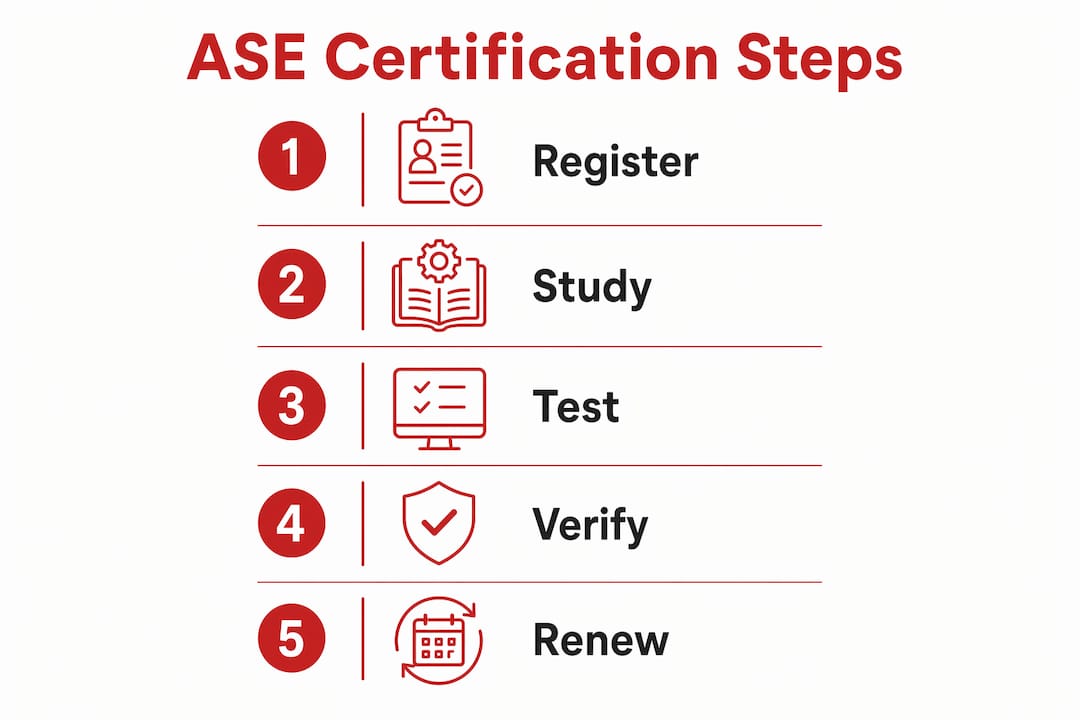
Three things must happen before ASE issues a credential: you pass a knowledge-based exam, you document qualifying hands-on work experience, and ASE verifies both. Miss any one of those and the certificate does not come.
The step-by-step flow looks like this:
- Create a myASE account at ase.com. This is your permanent credential record.
- Register and pay for your tests. ASE charges a per-order registration fee plus a per-test fee. Grouping multiple tests into a single order saves on the per-order charge.
- Schedule your test within 90 days. After purchase, you have a 90-day window to schedule and sit for the exam. Miss that window and you forfeit the fee.
- Take the test at an authorized testing center. Most tests run roughly 90 minutes.
- Submit work-experience documentation through your myASE account. Experience requirements vary by test but you must meet the hands-on professional experience standard for your exam—see ASE for specific requirements by test.
- Receive your certificate once ASE verifies both the passing score and the experience documentation.
Pro Tip: You can sit for ASE exams before you have finished accumulating the required experience. Many technicians test early to lock in a passing score, then submit experience documentation once they qualify. Just make sure your employer verification is accurate — errors there are the most common cause of credential delays.
What types of ASE tests are available?
ASE offers more than 50 tests organized into specialty series so technicians can certify in the areas that match their actual job. Here is a quick look at the major series:
| Series | Who It’s For | Typical Test Count |
|---|---|---|
| Automobile (A1–A9) | Light-vehicle technicians | 9 tests |
| L-Series (L1, L2, L3) | Advanced light-vehicle specialists | 3 tests |
| Medium/Heavy Truck (T-Series) | Truck technicians | 8 tests |
| Collision Repair & Refinish (B-Series) | Body and paint technicians | 5 tests |
| School Bus (S-Series) | School bus technicians | 7 tests |
| Parts Specialist (P-Series) | Parts counter professionals | 2 tests |
| Diesel Engines (E-Series) | Engine specialists | 2 tests |
The A-series is where most technicians start. A1 covers engine repair, A2 automatic transmission, A3 manual drivetrain, A4 suspension and steering, A5 brakes, A6 electrical systems, A7 heating and air conditioning, A8 engine performance, and A9 light vehicle diesel engines. Passing all eight core A-series tests plus A9 is the path to Automobile Master Technician status.
Why ASE certification benefits technicians and shops alike
The credential pays off on both sides of the service counter.
For technicians:
- Documented competence that travels with you across employers
- Higher earning potential — certified techs average about 20% more than non-certified counterparts
- Access to more complex diagnostic work, which typically means better flat-rate hours
- Stronger position during hiring negotiations and performance reviews
For shops and employers:
- About 40% better productivity from certified technicians, roughly 60% fewer comebacks, and around 30% lower turnover compared to non-certified staff
- The ASE Blue Seal of Excellence program lets shops with a high proportion of certified staff display a customer-facing quality indicator that is independently verifiable
- A defensible quality benchmark in customer disputes — a shop can point to specific credentials rather than vague claims of expertise
The Blue Seal is not just a sticker. It signals that a shop has committed to maintaining a certified workforce, which is a meaningful differentiator in a market where customers have no other easy way to compare technical competence across shops.
How to get ASE certified: a practical step-by-step checklist
The goal is straightforward: pass the required tests and submit verified work experience. Here is how to move through it efficiently.
- Choose your test series. Match the series to your current job or the role you are targeting. Most entry-level technicians start with A5 (brakes) or A6 (electrical) because those areas see the most daily work.
- Create your myASE account at ase.com. Keep your login credentials somewhere safe — this account holds your entire credential history.
- Purchase your tests. Order multiple tests in a single transaction to minimize the per-order registration fee.
- Schedule within 90 days. Pick a test date that gives you enough study time without burning the scheduling window.
- Take the exam. Most tests are 90 minutes at an authorized Prometric testing center. Bring valid ID.
- Submit your work-experience documentation. Log into myASE, enter your employer information, and have your supervisor verify your hours. ASE will not issue the credential until this step is complete and verified.
- Receive your certificate. Once experience is verified, ASE issues your credential. It is valid for five years.
- Plan your recertification. Mark your calendar for the renewal window before the five-year expiration.
A few cost-management tips worth knowing:
- Bundle tests into one order whenever possible to pay the registration fee only once.
- If your employer offers tuition assistance or training reimbursement, ASE test fees often qualify.
- Some vocational schools and community colleges cover exam costs for students who meet a score threshold — worth asking before you register.
The ASE FAQs page and the myASE registration portal are the authoritative next steps for current fee schedules and test availability.
Study resources and realistic timelines for passing ASE tests
Most technicians with solid hands-on experience need four to eight weeks of focused study per test. Someone newer to a specialty area should budget closer to ten to twelve weeks. Stacking multiple tests in one study cycle is possible but requires discipline — pick no more than two or three tests per study block unless you are already working in that specialty daily.
Where to study:
- Official ASE study guides and practice tests — available directly through ase.com; these mirror the actual exam format and are the most reliable prep material
- Community college and vocational school courses — many programs are aligned to ASE standards and can count toward experience requirements
- Employer-sponsored training — dealerships and larger independent shops often run in-house prep programs, sometimes with paid study time
- Online practice platforms — several third-party tools offer timed practice exams that simulate the test environment; useful for identifying weak areas before test day
- Service manuals and OBD-II diagnostic practice — for performance-heavy tests like A8, hands-on diagnostic work with a scan tool is more valuable than any flashcard
Pro Tip: Pull your shop’s most common comeback categories for the last six months and cross-reference them with the ASE task list for your target test. The areas where your shop sees repeat failures are almost always the areas the exam emphasizes most.
How long does ASE certification last, and how do you renew it?
ASE professional certifications expire after five years and must be renewed to keep the “ASE Certified” designation. Letting credentials lapse is more common than most technicians expect, especially when life gets busy and the renewal window sneaks up.
Renewal options include:
- Retaking the full test for each certification you want to maintain
- Using the ASE Renewal App where available, which offers a streamlined remote renewal path for qualifying technicians
- Remote proctoring options for certain tests, reducing the need to travel to a testing center
Pro Tip: Build a recertification calendar the day you receive your certificate. Set a reminder 18 months before expiration — that gives you time to study, schedule, and pass without rushing. Shops with multiple certified technicians should track expiration dates centrally; a single lapse in a key specialty can affect Blue Seal eligibility.
What is ASE Master Technician status?
Master Technician is the highest credential in the ASE automobile series. To earn it, a technician must pass all eight core A-series tests (A1 through A8) and meet the work-experience requirement for each. It is not a separate application — it is the result of completing the full series.
What it means in practice:
- Higher pay ceiling. Master Technician status consistently correlates with the top pay rates in the field, and career and salary data reflects that gap clearly.
- Access to complex diagnostics. Shops assign their most difficult intermittent faults and warranty-sensitive repairs to Master Technicians because the credential signals breadth across all vehicle systems.
- Career advancement. Master Technician status is often a prerequisite for shop foreman, lead technician, trainer, and service manager roles. Employers in the full-service dealership and independent shop space treat it as a hard requirement for senior positions.
The parallel exists in other ASE series too. A technician who completes all T-series tests earns Medium/Heavy Truck Master Technician status. The principle is the same: breadth across a specialty series demonstrates a level of competence that individual certifications alone do not.
ASE Entry-Level credentials vs. full professional certification
Students finishing a technical training program do not have to wait until they have two years of work experience to start building credentials. ASE Entry-Level certification is a knowledge-based credential designed specifically for that gap.
Key differences:
| Entry-Level | Professional Certification | |
|---|---|---|
| Who it’s for | Students in technical programs | Working technicians |
| Work experience required | None | Yes (required, varies by exam) |
| Validity | 2 years, no recertification | 5 years, renewable |
| Test type | Knowledge-based | Knowledge + diagnostic |
| Path forward | Stepping stone to professional track | Full industry credential |
Entry-Level credentials are available for the Automobile, Collision Repair/Refinish, and Medium/Heavy Truck series. They signal workforce readiness to employers even before a student has accumulated professional hours.
Pro Tip: If you are in a school shop program, document your hours carefully from day one. Many programs allow school shop hours to count toward the professional certification experience requirement when combined with post-graduation work. Getting that documentation right while you are still enrolled saves significant time later.
How to verify ASE credentials and find certified technicians near you
Credentials are only useful if you can confirm they are real. Here is how to do it:
- Ask for the technician’s myASE ID or printed certificate. A current certificate shows the test passed, the date, and the expiration.
- Check the expiration date. A certificate that expired two years ago is not a current credential.
- Confirm the shop’s Blue Seal status. The ASE Blue Seal program is independently verifiable — a shop claiming Blue Seal status should be able to show current documentation.
- Ask what percentage of the shop’s technicians are ASE certified. A shop with one certified tech out of eight is a different proposition than one where the entire service team holds credentials.
When evaluating a shop, useful questions include: What diagnostic tools do you use? What is your warranty on parts and labor? Which technician will work on my vehicle, and what are their certifications?
Tom’s B & M Auto in Lynnwood, WA, runs ASE-certified technicians across all makes — Toyota, Honda, Subaru, domestic, and European — with a 24-month/24,000-mile warranty on all work and same-day appointments often available. For a local verification starting point, a free digital vehicle inspection lets you see the shop’s diagnostic process firsthand. For guidance on finding a certified mechanic nearby, the Tom’s B & M Auto blog covers the verification checklist in detail.

Key Takeaways
ASE certification requires passing a standardized knowledge exam, documenting verified hands-on work experience, and renewing every five years to remain current.
| Point | Details |
|---|---|
| What ASE certification is | A voluntary professional credential from the National Institute for Automotive Service Excellence, verifying technician competence. |
| How to get certified | Pass the required ASE exam(s), submit employer-verified work experience through myASE, and receive your certificate. |
| Five-year recertification | All professional ASE credentials expire after five years and must be renewed by retesting or qualifying renewal options. |
| Master Technician path | Pass all eight core A-series tests (A1–A8) plus meet experience requirements to earn the highest automobile credential. |
| Verification route | Request a printed certificate or myASE ID, check the expiration date, and confirm the shop’s Blue Seal status. |
Why ASE certification matters more than most shops admit
The standard pitch for ASE certification focuses on pay and hiring. Those benefits are real, but they undersell what the credential actually does at the shop level.
The more important effect is diagnostic accountability. When a technician holds an ASE credential in a specific area, there is a documented baseline for what they should know. That matters when a repair goes wrong, when a customer disputes a diagnosis, or when a shop needs to defend a warranty claim. A shop full of uncertified technicians has no external standard to point to. A shop with certified staff and Blue Seal status has a defensible quality record built into its daily operation.
At Tom’s B & M Auto, that accountability shows up in the warranty we stand behind: 24 months or 24,000 miles on every repair. That kind of commitment only makes sense when the technicians doing the work have verified competence. Customers bringing in a Subaru, a domestic truck, or a European vehicle deserve to know the person diagnosing it has been tested on exactly that kind of work, not just trained in-house on whatever the shop happened to see last week. If you are weighing a repair that runs into the hundreds or thousands of dollars, financing options are available — but the more important protection is knowing the diagnosis was right the first time.
Useful sources and further reading
The sources below are the authoritative references for ASE registration, test descriptions, experience rules, and renewal logistics.
- ASE About Page — Background on ASE’s mission, nonprofit structure, and industry backing since 1972.
- ASE Tests: Work Experience — The definitive source for experience requirements, documentation rules, and the five-year recertification policy.
- ASE FAQs — Covers registration fees, the 90-day scheduling window, testing formats, and exam panel process.
- ASE Certification Pathway — Overview of all 50+ tests organized by series, useful for choosing which certifications to pursue.
- ASE Blue Seal Program — Explains shop-level Blue Seal eligibility and how to verify a shop’s status.
- ASE Education Foundation — Certification Benefits — Student-focused breakdown of Entry-Level vs. professional certification paths.
- Tom’s B & M Auto — Local shop reference for ASE-certified service in Lynnwood, WA, serving all makes with a 24-month/24,000-mile warranty.
Recommended
- ASE Certification Benefits for Mechanics: Career Guide – Tom’s B & M Auto Blog
- Shop Safety Checklist for Mechanics: 2026 Guide – Tom’s B & M Auto Blog
- How to Write Accurate Repair Order Notes That Work – Tom’s B & M Auto Blog
- European Car Repair Challenges: What Owners Must Know – Tom’s B & M Auto Blog
Leave a Reply