
Why Exhaust Rattles: Causes, Fixes, and Costs
An exhaust rattle is a metallic knocking or buzzing sound produced when loose, damaged, or worn parts in the exhaust system vibrate against each other or against the vehicle’s chassis. Understanding why exhaust rattles happen is the first step toward fixing the problem before it becomes expensive. Loose heat shields are the single most common cause, responsible for roughly 9 out of 10 cases when heat shields are identified as the source. Other frequent culprits include broken rubber exhaust hangers, failing catalytic converters, and loose clamps or flanges. Catching these issues early protects both your wallet and your safety.
Why exhaust rattles: the most common causes
Exhaust rattles come from specific components that loosen, corrode, or break over time. Each part produces a slightly different sound, which helps narrow down the source.
- Loose or corroded heat shields. Heat shields are thin metal plates that protect surrounding components from exhaust heat. When their mounting bolts rust or break, the shields vibrate against the exhaust pipe and produce a sharp metallic rattle. Heat shield fixes are typically quick and affordable, making this the most cost-effective rattle to address.
- Broken rubber exhaust hangers. Rubber hangers suspend the exhaust system beneath the car. When they crack or tear, the exhaust pipe sags and contacts the chassis or floorpan, creating a low-frequency knock. Replacing a broken hanger costs $5–$20 per unit and takes under 30 minutes.
- Damaged catalytic converter substrate. Inside every catalytic converter is a ceramic honeycomb structure. When that structure cracks or collapses, the broken pieces rattle inside the metal housing and produce a deep, hollow sound. Catalytic converter replacement ranges from $650 to $3,500 depending on the vehicle.
- Loose exhaust flanges or clamps. Flanges and clamps connect exhaust sections together. When they loosen, the pipes shift under engine vibration and produce a knocking noise. Loose joints also allow exhaust gases to escape, which creates a hissing sound alongside the rattle.
- Cracked or collapsed flex pipes. Flex pipes absorb engine movement and thermal expansion. A cracked flex pipe vibrates at its damaged section and produces a buzzing rattle that worsens under acceleration.
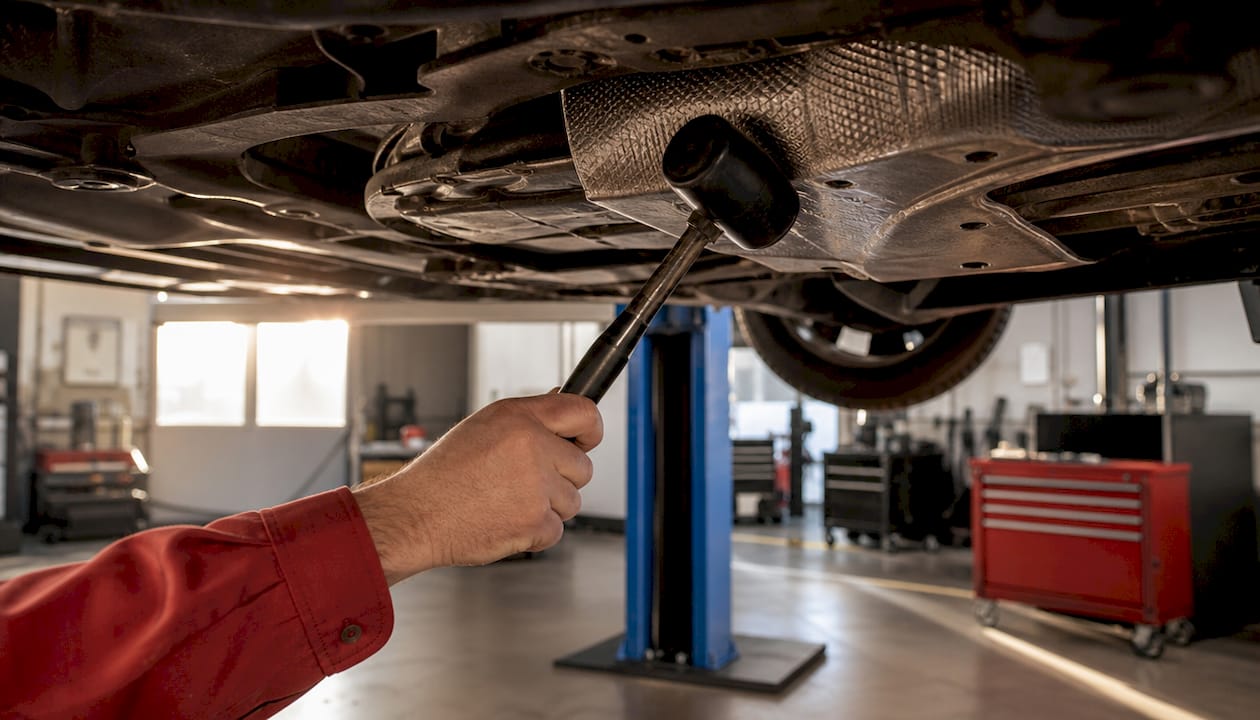
Pro Tip: Tap lightly along the exhaust system with a rubber mallet while the engine is cold. A loose heat shield will produce a distinctly hollow, tinny ring compared to the solid thud of an intact component.
| Component | Typical repair cost | Repair time |
|---|---|---|
| Heat shield tightening or replacement | $50–$150 | Under 1 hour |
| Rubber exhaust hanger | $5–$20 per unit | Under 30 minutes |
| Exhaust clamp or flange | $20–$100 | 30–60 minutes |
| Flex pipe replacement | $150–$400 | 1–2 hours |
| Catalytic converter | $650–$3,500 | 2–4 hours |
How can you diagnose an exhaust rattle at home?
Pinpointing the source of an exhaust rattle saves you from paying for repairs you do not need. The key is to pay attention to when the noise occurs and where it seems to come from.
- Note when the rattle appears. A rattle only at idle points toward a loose heat shield vibrating at low engine speed. A rattle under hard acceleration suggests a broken hanger or worn engine mount. A rattle when driving over bumps points to a sagging exhaust contacting the chassis.
- Listen for the sound character. A metallic knock or buzz is a classic exhaust rattle. A deep, hollow rumble from under the center of the car often signals catalytic converter damage. A hiss combined with a rattle usually means an exhaust leak at a joint.
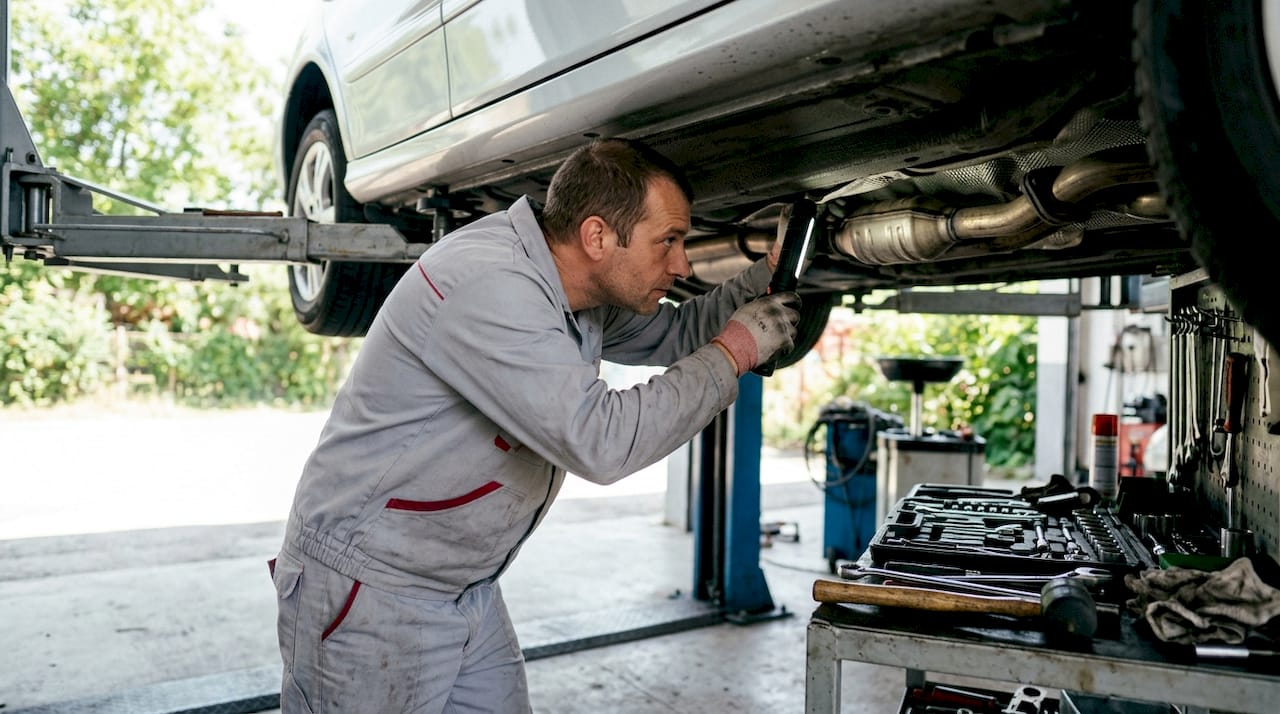
- Inspect the heat shields first. Crouch beside the car and look under the vehicle with a flashlight. Grab each heat shield and try to move it. Any shield that wiggles or rattles when you shake it is the likely culprit.
- Check the rubber hangers. Look for hangers that are cracked, stretched, or missing entirely. A hanger that has torn through will let the exhaust pipe hang visibly lower on one side.
- Look at clamps and flanges. Check each connection point for rust, gaps, or movement. A loose flange often shows a dark soot ring around the joint where exhaust gases have been escaping.
Pro Tip: Have a helper rev the engine to 2,000 RPM while you listen from outside the car. Many rattles become much louder at a specific engine speed, which helps isolate the vibrating component.
A common diagnostic mistake is confusing a suspension rattle with an exhaust rattle. Suspension noises typically change with steering input or road surface. Exhaust rattles stay consistent regardless of steering and often change with engine speed instead.
What repair options actually fix a rattling exhaust?
Fixing a rattling exhaust ranges from a five-minute tightening job to a full catalytic converter replacement. The right repair depends entirely on which component is causing the noise.
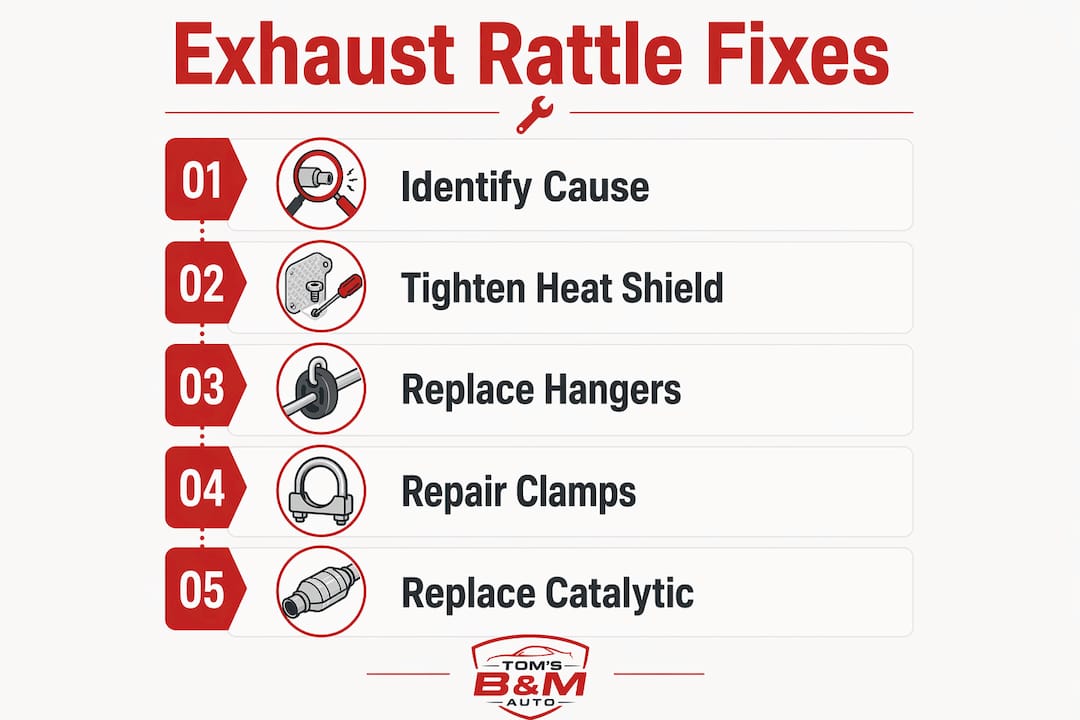
Heat shield repairs are the fastest and cheapest fix available. A technician can tighten loose mounting bolts, add a clamp to secure a vibrating shield, or replace the shield entirely. Most heat shield repairs are completed in under an hour. Skipping this repair is a mistake because a detached shield can contact hot exhaust components and create a fire risk.
Hanger replacement is nearly as simple. Rubber hangers cost very little and the swap takes under 30 minutes. Letting a broken hanger go unaddressed causes the exhaust pipe to sag progressively, which eventually cracks the pipe or damages the catalytic converter mounting flange.
Catalytic converter replacement is the most expensive repair on this list. Internal substrate failure produces a deep rattle that no amount of tightening will fix. The only solution is replacement. Costs run $650–$3,500 depending on whether the vehicle uses a standard or a direct-fit OEM-spec converter.
Clamp and flange repairs fall in the middle of the cost range. A technician will remove the corroded hardware, clean the mating surfaces, and install new clamps with proper torque. Anti-corrosion coating applied at this stage extends the life of the repair significantly.
Routine maintenance prevents most of these failures. Rust and corrosion from road salt are the primary enemies of exhaust longevity, especially in the Pacific Northwest where wet winters accelerate metal deterioration. Annual undercar inspections catch corrosion before it causes component failure.
Pro Tip: Ask your technician to apply a high-temperature anti-seize compound to heat shield bolts during any exhaust repair. This makes future removal far easier and reduces the chance of bolts snapping off.
How vibration and temperature make rattles unpredictable
One of the most frustrating aspects of exhaust noise causes is that rattles often come and go. Understanding why this happens makes diagnosis much less confusing.
Exhaust components vibrate at specific resonant frequencies. A loose heat shield, for example, may only rattle at 1,500 RPM because that is the engine speed at which exhaust pulses match the shield’s natural vibration frequency. At higher or lower RPM, the rattle disappears entirely. This explains why some drivers hear a rattle only during light acceleration and never at highway speed.
Heat cycling changes metal clearances as the exhaust system warms up and cools down. A component that rattles when cold may go quiet once the metal expands and closes the gap. The reverse is also true. A rattle that only appears after the engine reaches operating temperature often signals a component that fits tightly when cold but loosens as it heats up.
Worn engine and transmission mounts add another layer of complexity. When mounts deteriorate, the engine rocks under acceleration and physically pulls the exhaust system out of position. The resulting rattle appears under hard throttle or during gear changes and disappears at steady speed. Many drivers assume this is an exhaust problem when the actual fix is new engine mounts.
Road conditions also affect how rattles sound. A rattle that worsens on rough pavement but disappears on smooth highway suggests a hanger or mounting point that is borderline loose. The extra vibration from road imperfections pushes the component past its threshold.
Pro Tip: If your rattle only appears when the engine is cold and disappears after 10 minutes of driving, start your diagnosis with heat shields and flex pipes. Temperature-dependent rattles almost always trace back to components with small clearances that change with thermal expansion.
Key Takeaways
Exhaust rattles are caused by loose or damaged components vibrating against the vehicle, with heat shields, broken hangers, and failing catalytic converters being the most common and costly sources.
| Point | Details |
|---|---|
| Heat shields are the top cause | Roughly 9 in 10 exhaust rattles traced to a specific source involve loose or corroded heat shields. |
| Hanger replacement is the cheapest fix | A broken rubber hanger costs $5–$20 to replace and takes under 30 minutes to swap out. |
| Catalytic converter damage is expensive | Internal substrate failure requires full replacement, costing $650–$3,500 depending on the vehicle. |
| Rattles are often RPM or temperature dependent | Resonant frequency and heat cycling cause rattles to appear and disappear, making diagnosis tricky. |
| Delaying repairs increases total cost | Loose parts that contact other components cause secondary damage that turns a cheap fix into a major repair. |
The rattle most drivers ignore until it costs them
I have seen this pattern more times than I can count. A driver hears a faint metallic buzz under the car, assumes it is nothing serious, and drives on for six more months. By the time they bring the car in, what started as a $75 heat shield repair has turned into a cracked flex pipe and a damaged catalytic converter flange. The original rattle was a warning. They missed it.
The part that surprises most car owners is how often the fix is embarrassingly simple. A loose heat shield bolt. A $12 rubber hanger. These are not glamorous repairs, but they are the ones that prevent the expensive ones. The mistake is not the rattle itself. It is the assumption that a small noise means a small problem that can wait.
Pay attention to when the rattle changes. If it gets louder over two weeks, something is getting worse. If it disappears when the engine warms up, you have a temperature-dependent clearance issue that will eventually become permanent. Either way, the rattle is telling you something specific. Addressing exhaust rattles promptly prevents gradual worsening and larger repair bills. That is not a scare tactic. That is just how metal fatigue works.
My strongest advice: do not let a technician guess. Bring the car in when the rattle is present and reproducible. A good technician will listen to the sound, check the resonant frequency pattern, and inspect the system cold before it warms up and masks the problem. Diagnosis done right the first time saves everyone time and money.
— Shingi
Exhaust repair services at Tom’s B & M Auto
Tom’s B & M Auto has been diagnosing and fixing exhaust system issues for Lynnwood-area drivers since 1985. Whether your car has a loose heat shield, a broken hanger, or a failing catalytic converter, the ASE-certified technicians at Tom’s B & M Auto identify the exact source before recommending any repair.

Exhaust repair in Edmonds and Mountlake Terrace is available with same-day appointments often on hand. All exhaust work comes with a 24-month / 24,000-mile warranty. If the repair cost is a concern, flexible financing options are available to spread the cost without delaying a fix that protects your car. Schedule your inspection today and get a clear answer on what that rattle actually is.
FAQ
Why does my exhaust rattle only at certain RPMs?
Exhaust components vibrate at specific resonant frequencies, so a loose part may only rattle when engine speed matches that frequency. Raising or lowering the RPM moves the vibration out of that range and the noise disappears.
Is a rattling exhaust dangerous to drive with?
A rattling exhaust can become dangerous if left unaddressed. Loose parts can break off, contact hot components, or allow exhaust gases to enter the cabin, which creates a carbon monoxide risk.
How much does it cost to fix a rattling exhaust?
Repair costs range from $5–$20 for a rubber hanger to $650–$3,500 for a catalytic converter replacement. Heat shield repairs typically fall between $50 and $150.
Can I fix an exhaust rattle myself?
A loose heat shield bolt or a broken rubber hanger is within reach for a mechanically confident car owner with basic tools. Catalytic converter replacement, flex pipe repair, and flange work require a lift and professional equipment.
Why does my exhaust rattle disappear when the engine warms up?
Heat cycling causes metal expansion that temporarily closes the clearance between loose components. The rattle returns once the metal cools and the gap reopens, confirming a loose or worn part rather than a permanent failure.
Recommended
- Why Brakes Squeak: Causes, Fixes, and Warning Signs – Tom’s B & M Auto Blog
- Exhaust Repair in Mountlake Terrace, WA | Tom’s B&M Auto
- Exhaust Repair in Kenmore, WA | Tom’s B&M Auto
- Exhaust Repair in Edmonds, WA | Tom’s B&M Auto
Leave a Reply