

What Is a 24,000-Mile Warranty? Your Complete Guide
A 24,000-mile warranty is a limited vehicle warranty that expires at 24,000 miles or a set time period of approximately two years, whichever comes first. Before you rely on one, check three things in the written terms:
- Who issued it. A repair shop backs its own work; a dealer or manufacturer covers a broader set of components. These are not the same thing, and the issuer determines where you must go for repairs.
- What it actually covers. Most 24,000-mile warranties cover parts and labor for qualifying repairs, not routine maintenance. The federal emissions warranty standard sets a minimum of 2 years or 24,000 miles for certain emissions components, but that is a floor, not a full-coverage promise.
- The start date and any “parts-only” language. A warranty that started the day the original owner drove off the lot may have very little time left when you buy the car. “Parts only” means you pay labor if something fails.
Tom’s B & M Auto, a full-service shop in Lynnwood, WA, backs every repair with a 24-month/24,000-mile warranty performed by ASE-certified technicians. That is the model this guide uses as a concrete reference throughout.
Table of Contents
- What a 24,000-mile warranty actually is (and the types you’ll encounter)
- What does a 24,000-mile warranty include, and what does it leave out?
- How time and mileage limits interact
- How to make a claim and keep your warranty valid
- Does a 24,000-mile warranty transfer to a new owner?
- Is a 24,000-mile warranty worth it?
- What a strong 24-month/24,000-mile warranty looks like in practice
- Key Takeaways
- The fine print is where most people lose
- Tom’s B & M Auto backs every repair with a written 24-month/24,000-mile guarantee
- Useful sources
What a 24,000-mile warranty actually is (and the types you’ll encounter)
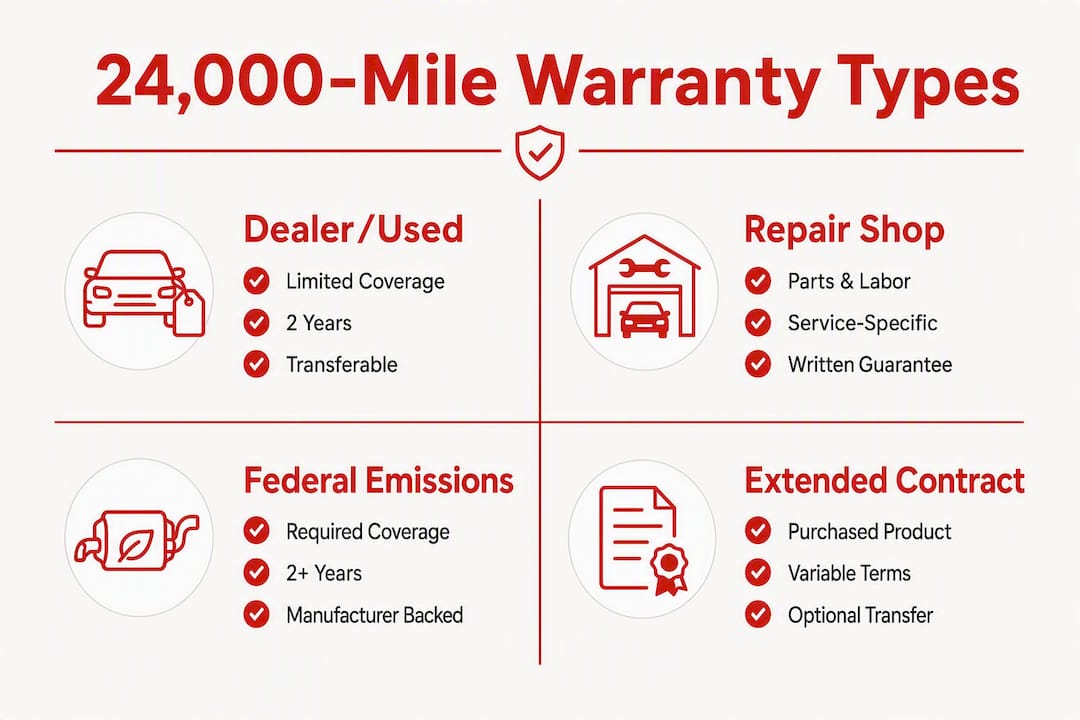
The phrase “24,000-mile warranty” covers several distinct warranty types. Knowing which one you’re dealing with changes everything about how you use it.
Repair-shop guarantee. A shop-backed warranty covers the specific repair the shop performed, parts and labor included. If the repaired component fails within 2 years or 24,000 miles, the shop fixes it at no charge. This type is often included with the service, not purchased separately. Tom’s B & M Auto’s 24-month/24,000-mile warranty is this kind.
Dealer or used-car limited warranty. Dealers sometimes offer a 2-year/24,000-mile limited warranty on used vehicles. Coverage is narrower than it sounds: it usually lists specific systems (powertrain, for example) and excludes everything else. Read the exclusions list before assuming broad protection.

Federal emissions warranty. Under federal law, manufacturers must cover certain emissions components for at least 2 years or 24,000 miles. This is a regulatory minimum, not a full-vehicle guarantee. California has its own, stricter emissions warranty rules.
Aftermarket service contract. This is a product you purchase separately, sometimes called an “extended warranty.” It is not a warranty in the legal sense. Service contracts differ from shop guarantees in claim rules, waiting periods, and exclusions, and they are worth scrutinizing carefully before buying.
| Type | Coverage | Issuer | Duration | Transferable | Repairs must be done by |
|---|---|---|---|---|---|
| Repair-shop guarantee | Parts & labor for repaired system | Shop | 2 yrs / 24,000 mi | Varies by shop | Issuing shop |
| Dealer/used-car limited | Listed systems only (e.g., powertrain) | Dealer | 2 yrs / 24,000 mi | Sometimes | Authorized dealer |
| Federal emissions warranty | Specific emissions components | Manufacturer | 2 yrs / 24,000 mi (minimum) | Yes (with vehicle) | Any authorized facility |
| Aftermarket service contract | Defined component list | Third-party | Varies | Often yes | Network shops |
For context, the standard new-car basic warranty from most manufacturers runs 3 years or 36,000 miles. A 24,000-mile warranty is shorter, which is why knowing exactly what it covers matters more, not less.
What does a 24,000-mile warranty include, and what does it leave out?
A common misconception is that a 24,000-mile warranty equals bumper-to-bumper coverage. It almost never does.
Typically covered:
- Parts and labor for the specific repair performed (shop guarantee)
- Workmanship defects on shop-completed work
- Emissions system components (federal minimum)
- Replacement of a failed part within the covered system
Typically excluded:
- Routine maintenance: oil changes, tire rotations, filter replacements
- Wear-and-tear items: brake pads, tires, belts, wiper blades
- Damage from accidents, floods, or fire
- Damage from neglect or improper maintenance
- Preexisting conditions at the time of repair
Consumer Reports specifically flags wear-and-tear items and accident damage as standard exclusions across virtually all warranty types. That guidance holds whether you’re looking at a shop guarantee or a dealer limited warranty.
Hidden limitations to watch for:
- Parts-only clauses: You pay labor if the part fails. On a complex repair, labor can exceed the part cost.
- Prorated coverage: The warranty pays a declining percentage as mileage or time increases.
- Capped labor rates: The warranty reimburses at a set hourly rate that may be lower than the shop’s actual rate.
- OEM parts requirement: Using aftermarket parts can void coverage. Verifying whether OEM parts are required is one of the most overlooked steps when evaluating a warranty.
- Geographic limits: Some warranties only honor claims at the issuing location.
- Claim windows: Some require you to report a failure within a set number of days.
Pro Tip: Scan the warranty document for the words “prorated” and “parts only” before signing anything. Either clause can cut the real value of a 2-year/24,000-mile warranty in half.
How time and mileage limits interact
The phrase “2 years or 24,000 miles, whichever comes first” is the standard phrasing for this warranty type. Providers use the dual limit because it protects against two opposite risk profiles: the driver who drives infrequently but keeps the car for years, and the driver who accumulates miles quickly. Coverage ends the moment either threshold is crossed.
The start-date question matters just as much as the limit itself. A shop guarantee typically starts on the date the repair is completed. CPO and dealer warranties often start at the vehicle’s original in-service date, not the resale date. A used car sold with a “2-year/24,000-mile warranty” may have only 8 months and 6,000 miles of coverage left if the clock started when the first owner bought it new.

How to make a claim and keep your warranty valid
Most claim denials are preventable. The two most common causes include missing maintenance records and repairs done outside the authorized network.
Step-by-step claim process:
- Stop using the vehicle if the failure creates a safety risk.
- Contact the warranty issuer immediately. Many warranties require prompt notification, and delay can be grounds for denial.
- Ask for written authorization before any repair begins. Verbal approvals rarely hold up.
- Get a written diagnostic estimate, including any OBD-II diagnostic codes, before work starts.
- Insist on a written claim decision. If denied, ask for the specific exclusion cited in writing.
Documentation you need to keep:
- Dated service receipts for every oil change and scheduled maintenance item
- OBD-II diagnostic printouts from any check-engine or warning-light event
- Dealer or shop stamps showing maintenance was performed on schedule
- Photos of any damage or failure before repairs begin
Providers routinely deny claims when maintenance records are incomplete. Keeping a documented repair history is the single most effective thing you can do to protect your coverage. A seasonal maintenance checklist helps you stay on schedule and creates a paper trail at the same time.
Common claim killers:
- Missed or undocumented oil changes
- Aftermarket modifications (suspension lifts, performance chips)
- Repairs done at an unauthorized shop when the warranty requires the issuing location
- Waiting too long to report a failure
Does a 24,000-mile warranty transfer to a new owner?
Transferability depends entirely on who issued the warranty and what the written terms say.
- Shop guarantees often do not transfer. The warranty covers the repair performed on a specific vehicle for the original customer. Some shops allow transfer with written notice; most do not.
- Manufacturer warranties (including the federal emissions warranty) generally transfer with the vehicle because they are tied to the car, not the owner.
- Dealer limited warranties vary. Some transfer automatically; others require a fee or written request within a set window.
- Aftermarket service contracts often transfer but may charge a transfer fee and require notification within 30 days of sale.
From a resale standpoint, a transferable written warranty adds real buyer confidence, especially on a used vehicle. A non-transferable warranty should be disclosed upfront and factored into the asking price.
Questions to ask a seller before buying a used car with a stated warranty:
- What is the exact start date of the warranty?
- Is it transferable, and what does the transfer process require?
- Can I see the written warranty document?
- Do you have maintenance records showing the vehicle was serviced on schedule?
CPO warranty durations often start at original registration, so used buyers should verify exactly how much coverage remains before treating a stated warranty term as a selling point.
Is a 24,000-mile warranty worth it?
For most car owners, yes, with conditions. The value depends on what the warranty actually covers and how you drive.
Reasons to accept or buy one:
- Predictable out-of-pocket cost if a covered repair fails within the window
- Peace of mind after a major repair (engine, transmission, brakes)
- Potential resale benefit if the warranty is transferable and documented
- Shop-backed warranties that include labor eliminate the biggest variable cost when a part fails again
Reasons to be skeptical:
- “Parts only” coverage leaves you exposed to labor costs, which often exceed the part itself
- Heavily prorated warranties pay less the longer you wait to make a claim
- High-mileage drivers may exhaust the mileage limit in under a year
- If a manufacturer warranty is still active, a dealer add-on may duplicate coverage you already have
Simple decision checklist:
- Accept or buy if: the vehicle is older, has a repair history, or you don’t have a repair savings buffer
- Accept or buy if: the warranty covers both parts and labor with no proration
- Skip if: coverage is “parts only” or prorated after the first year
- Skip if: it duplicates an active manufacturer warranty
- Skip if: the issuer cannot provide written terms before you sign
For a deeper look at how hidden repair costs compare to warranty premiums, the math often favors a solid shop-backed guarantee over paying out of pocket on an aging vehicle.
What a strong 24-month/24,000-mile warranty looks like in practice
A well-written shop warranty covers these elements explicitly:
- Coverage: Parts and labor for the specific repaired system (not the whole vehicle)
- Start date: Date the repair was completed (stated in writing, not implied)
- Mileage cap: 24,000 miles from the start date
- Time limit: 24 months from the start date
- Exclusions: Listed specifically: maintenance items, wear parts, accident damage, neglect
- Authorized repair requirement: Repairs must be returned to the issuing shop
- Transferability: Stated clearly as transferable or non-transferable
- Claim process: Named contact, phone number, and required documentation
Tom’s B & M Auto’s 24-month/24,000-mile warranty follows this structure. Every repair is performed by ASE-certified technicians using professional-grade OBD-II diagnostics, and written warranty terms are provided with the completed repair. The shop has served Lynnwood, WA since 1985 and covers all makes including European and hybrid vehicles. You can review their auto repair warranty details before booking.
Red flags in a seller’s offered warranty:
- No written start date (vague language like “from date of purchase” without a specific date)
- Exclusions described as “standard items” with no list
- “Honored at our discretion” language
- No named contact or claim process
- Verbal-only warranty with nothing in writing
Key Takeaways
A 24,000-mile warranty expires at 24,000 miles or 2 years, whichever comes first, and its real value depends entirely on whether it covers both parts and labor with a documented start date and clear exclusions.
| Point | Details |
|---|---|
| Whichever-comes-first rule | Coverage ends at 24,000 miles or 2 years, whichever threshold you hit first. |
| Check the start date | CPO and dealer warranties often start at original in-service date, not resale date, leaving less coverage than advertised. |
| Parts-and-labor matters | A warranty covering both parts and labor eliminates the biggest cost variable if a repair fails again. |
| Documentation is the claim-saver | Missing maintenance records are the most common reason warranty claims are denied. |
| Tom’s B & M Auto | Backs every repair with a 24-month/24,000-mile warranty from ASE-certified technicians in Lynnwood, WA. |
The fine print is where most people lose
The most underestimated part of a 24,000-mile warranty is not the mileage limit. It is the claim process. Most car owners assume a warranty works like insurance: something breaks, you call, they pay. That is not how shop or dealer warranties work in practice.
What actually happens is this: you must notify the issuer before repairs begin, get written authorization, use their approved facility, and prove the vehicle was maintained on schedule. Miss any one of those steps and the claim is gone, regardless of how clear-cut the failure looks.
The advice I’d give any car owner is to treat the warranty document the way you’d treat a lease agreement. Read the exclusions before you need them, not after. If a seller cannot hand you a written warranty document with a specific start date and a named contact for claims, that warranty is not worth the conversation. A shop that stands behind its work will put the terms in writing without hesitation.
If you’re negotiating warranty terms with a shop or dealer, ask for two specific additions: a listed start date and an itemized exclusions list. Most reputable shops will add them. If they won’t, that tells you something about how they handle claims.
Tom’s B & M Auto backs every repair with a written 24-month/24,000-mile guarantee
If you want a repair warranty you can actually read before you sign, Tom’s B & M Auto is worth a call. Every repair at the Lynnwood shop comes with a 24-month/24,000-mile written guarantee, performed by ASE-certified technicians with professional OBD-II diagnostics. Upfront pricing means no surprise labor charges after the fact.
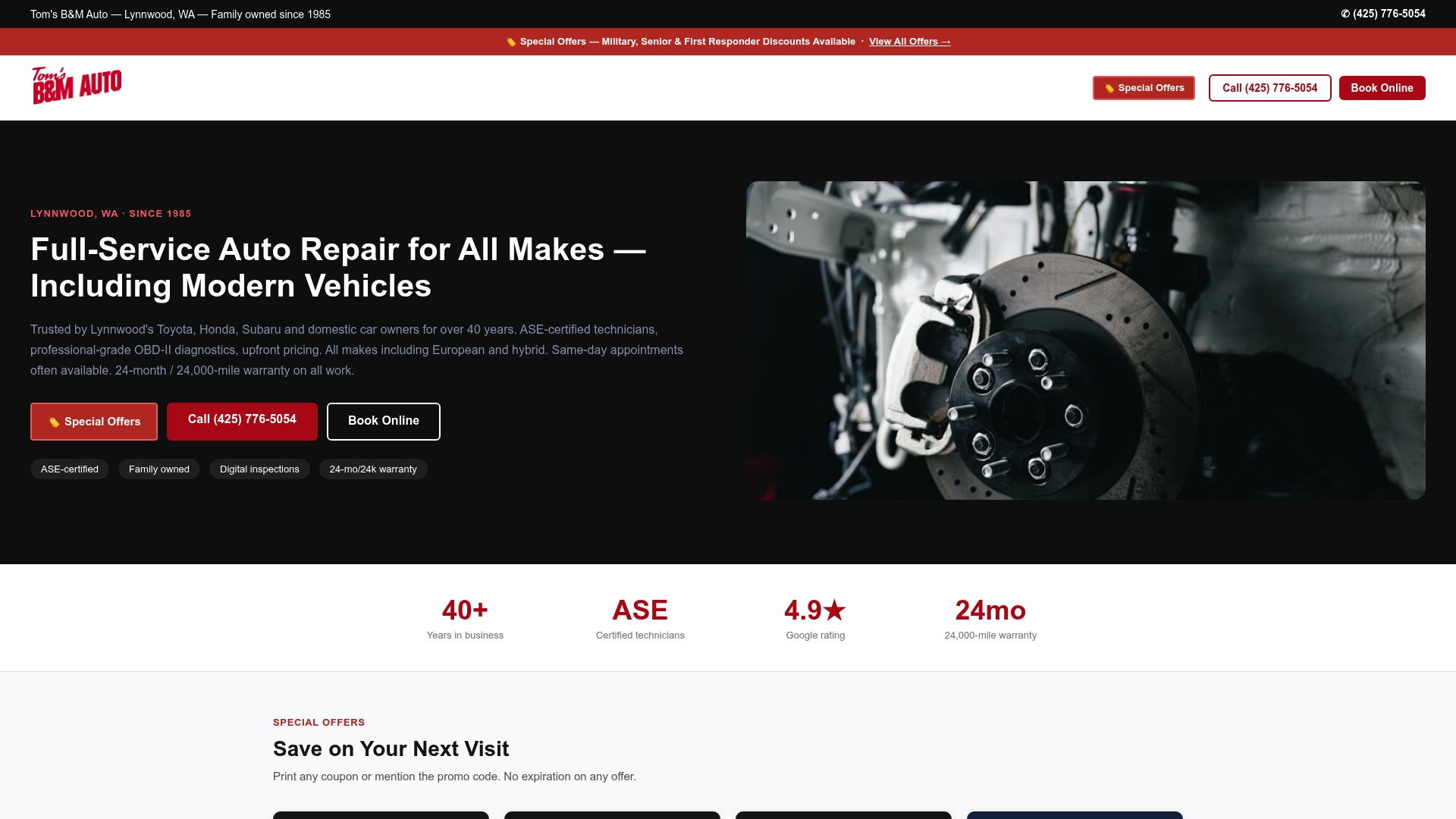
The shop covers all makes, including Toyota, Honda, Subaru, European vehicles, and hybrids. Same-day appointments are often available. Start with a Free Digital Vehicle Inspection to get a documented baseline before any repair decision. For engine work specifically, the Kenmore engine repair page has service details and booking options. If you need financing for a larger repair, financing options are available on-site.
Useful sources
- Your Guide to Car Warranties, Consumer Reports — best source for federal emissions warranty rules and standard exclusion guidance
- Used Car and Certified Pre-Owned CPO Warranties, Consumer Reports — explains CPO start-date nuances and remaining coverage calculations for used buyers
- Car Warranty Guide, Kelley Blue Book — practical overview of new-car warranty lengths, state variations, and component-specific coverage differences
- Auto Repair Warranty Explained, Tom’s B & M Auto Blog — shop-specific breakdown of repair warranty terms and documentation requirements
Recommended
- Auto Repair Warranty Explained: What Car Owners Must Know – Tom’s B & M Auto Blog
- High Mileage Vehicle Maintenance Tips That Work – Tom’s B & M Auto Blog
- How to Get an Accurate Repair Shop Estimate in Lynnwood – Tom’s B & M Auto Blog
- Free Digital Vehicle Inspection | Tom’s B&M Auto — Lynnwood WA
Leave a Reply