

55–75 mph Shake? Diagnose Steering Wheel Vibration in 10 Minutes
Most steering wheel vibration traces back to one of three sources: an out-of-balance or damaged tire/wheel, worn front brake rotors, or a failing wheel bearing. Check the speed it happens at and whether it only shows up while braking. Stop driving if you feel grinding, smell burning, or notice a tire bulge.
TL;DR:
- Tire imbalance is the primary cause of steering wheel vibration at highway speeds, especially between 55 and 75 mph, often requiring a road-force balance if issues persist after multiple standard balances.
- Vibration that worsens with speed or occurs only under braking usually indicates uneven brake rotors or a sticking caliper, necessitating rotor replacement or caliper inspection.
- Changes in vibration when steering or lane-swerve tests point to wheel bearing issues, which also cause noise and constant vibration across all speeds.
- Recent repairs, pothole impacts, or an uneven tire wear pattern can reveal specific causes like bent wheels or suspension wear, requiring visual inspection and professional diagnosis.
- Ignoring mild vibrations can lead to uneven tire wear and accelerated bearing or suspension damage, making timely checks and maintenance essential to prevent costly repairs.
Table of Contents
- What Causes Steering Wheel Vibration? A Five-Step Checklist
- Common Causes of Steering Wheel Vibration, Explained
- What Does a Mechanic Check to Diagnose Vibration?
- Is It Safe to Drive With a Shaking Steering Wheel?
- How Much Does It Cost to Fix Steering Wheel Vibration?
- What Can You Check Yourself Before Visiting a Shop?
- What Should a Professional Vibration Inspection Include?
- Why Small Vibration Problems Turn Into Big Repair Bills
- Book a Vibration Diagnosis at Tom’s B & M Auto
- Sources
- FAQ
What Causes Steering Wheel Vibration? A Five-Step Checklist
Run through these checks before you call a shop. They take about ten minutes and usually point you straight to the right subsystem.
- Cruise versus brake. Vibration that only appears when you press the brake pedal almost always traces to uneven front-rotor thickness or deposits. Vibration during steady cruising points elsewhere.
- Speed window. Note the exact range. Shaking that peaks somewhere between 55 and 75 mph usually means tire imbalance or runout.
- Location. Feel it in the steering wheel, or in the seat and floor? Steering wheel points to the front axle; seat and floor point to the rear.
- Swerve test. Gently change lanes at speed. If the vibration or a humming noise shifts with steering input, suspect a wheel bearing.
- Recent history. Did this start right after a tire rotation, a pothole hit, or brake work? That timing is often the whole diagnosis.
Common Causes of Steering Wheel Vibration, Explained
Once you know the speed and the trigger, matching your symptom to a cause gets a lot easier.
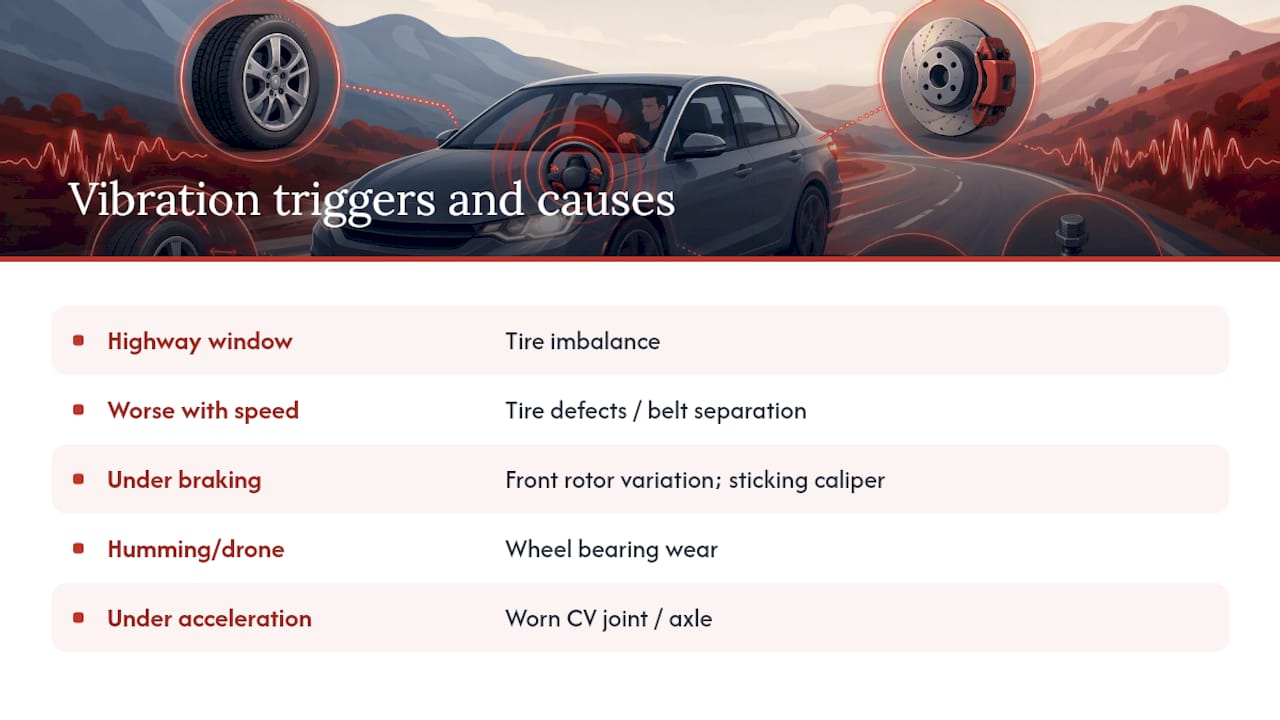
Tire imbalance. This is the most common reason a steering wheel shakes at highway speed. A smooth, rhythmic vibration that peaks between 55 and 75 mph is the signature of an unbalanced wheel. A standard balance usually fixes it. If it comes back after two or three balances, that’s a clue you’re dealing with something a spin balance can’t catch.
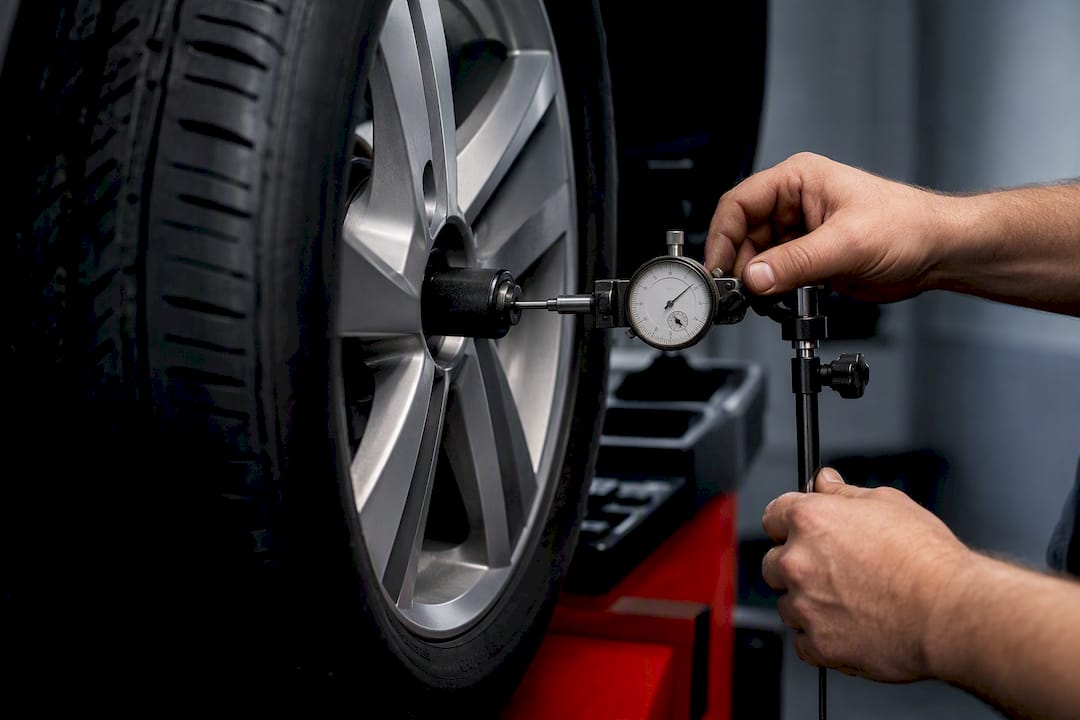
Bent wheel or tire runout. A pulsing or thumping feel, sometimes visible when the wheel spins slowly on a lift, means the wheel or tire isn’t running true. Weights alone won’t fix a bent rim. Runout needs a road-force check or a wheel swap.
Tire defects and belt separation. Vibration that gets progressively worse as speed climbs, rather than settling into one window, suggests an internal tire problem. Look for a sidewall bulge or an odd flat spot. This one is genuinely dangerous at speed, and it’s not a wait-and-see situation.
Front brake rotor variation. If the shake shows up specifically under braking, with a pulsing feel through the steering wheel and often the brake pedal too, uneven rotor thickness or heat deposits are the likely cause. Seat or floor vibration under braking usually means the rear rotors instead.
Sticking caliper. A caliper that won’t fully release drags one wheel, which can pull the car to that side under braking. After a short drive, that wheel often runs noticeably hotter than the other three, a quick giveaway if you’re checking things yourself.
Wheel bearing wear. A humming or droning noise that grows louder with speed and shifts when you steer is classic bearing wear. Unlike tire imbalance, bearing vibration tends to stay present across the whole speed range rather than peaking in one window.
Worn suspension components. Loose ball joints, tie rods, or worn control arm bushings tend to show up as shake over bumps and under braking, often with a clunk or a looseness you can feel through the wheel.
Drivetrain and CV joint issues. Vibration that appears specifically under acceleration, and not while coasting or braking, often means a worn CV joint or an axle problem rather than anything tire or brake related.
What Does a Mechanic Check to Diagnose Vibration?
A good technician doesn’t start pulling parts. They start with a road test, noting the exact speed window, whether the vibration changes when steering slightly, and whether it’s worse under braking or acceleration.
From there, the checklist usually looks like this:
- Swerve/steer test. Changing direction shifts the load on a wheel bearing, which changes the vibration or noise if that’s the culprit.
- Lift-and-spin inspection. With the wheel off the ground, a tech can spot runout visually and check for play that signals a loose or worn bearing.
- Road-force balance. This test measures radial force variation, the kind of out-of-round condition a standard spin balance can completely miss. If a wheel has already failed two standard balances, this is the next step, not another spin balance.
- Hot-wheel check. After a short drive, a wheel that’s noticeably hotter than the others usually means a dragging caliper.
Pro Tip: If your shop only offers standard balancing and the vibration keeps coming back, ask specifically for a road-force balance. It typically adds $20 to $30 per wheel but finds problems a regular balance can’t.
New rotors also need a proper bedding-in period. Skipping that step is a common reason judder returns within a few weeks of a “fixed” brake job.
Is It Safe to Drive With a Shaking Steering Wheel?
A mild vibration that’s been consistent for weeks isn’t an emergency, but it also won’t fix itself. A sudden or worsening vibration is a different story.
Short-term, slow down and avoid sustained highway driving if the shake is severe. If you had tires rotated or brake work done recently, check your lug nuts first. A wheel that isn’t torqued to spec can shift on the hub and mimic a much bigger problem.
Get the car towed rather than driven if you notice any of the following:
- Grinding or metal-on-metal noise
- Smoke or a burning smell
- A strong pull to one side
- The brake pedal sinking further than normal
- A visible bulge or lump in the tire sidewall
- Severe instability at low speed
When you call a shop, give them specifics: the exact speed range, whether it started after a pothole or a service visit, and whether it changes under braking or acceleration. That detail alone often cuts diagnostic time in half.
How Much Does It Cost to Fix Steering Wheel Vibration?
Prices vary by vehicle, but these ranges hold up across most independent shops:
- Wheel balance: $15–$40 per wheel; road-force balance adds another $20–$30 per wheel.
- Tire replacement: $100–$400 per tire depending on size and type.
- Bent rim repair or wheel replacement: $100–$400.
- Front brake rotors and pads: $250–$500 for the front axle. Rotors with uneven deposits usually need replacement rather than resurfacing.
- Wheel bearing replacement: $200–$400.
- CV axle or drivetrain repair: $250–$450.
The pattern worth remembering: ignored imbalance leads to uneven tire wear, and uneven wear puts extra load on bearings and suspension parts that were never designed to carry it. A $30 balance job delayed for months can turn into a $400 bearing replacement.
What Can You Check Yourself Before Visiting a Shop?
A few checks are safe and useful without any special tools.
- Check tire pressure on all four tires and compare against the sticker inside the driver’s door.
- Walk around the car and look for bulges, cuts, or wear that’s heavier on one side of a tire than the other, a sign of alignment trouble.
- If you’re comfortable using a jack and jack stands, check for wheel play by grabbing the tire at the 12 and 6 o’clock positions and rocking it. Excess play can indicate bearing or suspension wear.
- Confirm lug nuts are tight if you’ve had tires or wheels serviced recently.
Rotor machining, bearing replacement, and suspension work all require specialized tools and torque specs that directly affect steering safety. Don’t attempt those at home. If you’re unsure what you’re dealing with, a diagnostic road test at a shop you trust is worth more than guessing.
What Should a Professional Vibration Inspection Include?
A trustworthy inspection starts with ASE-certified technicians running professional-grade OBD-II diagnostics alongside a physical check of tires, wheels, brakes, and bearings, not just a computer scan. Ask about upfront, itemized pricing before any work starts, and whether the shop backs its labor with a real warranty. A warranty on completed work is a reasonable benchmark to expect. Same-day appointments and a documented digital inspection are both signs the shop is set up to diagnose, not just guess.
Why Small Vibration Problems Turn Into Big Repair Bills
The pattern repeats constantly: a driver ignores a mild highway shake for months, the imbalance wears one tire unevenly, and that uneven wear eventually stresses a bearing or suspension joint that had nothing to do with the original problem. One habit fixes most of this before it starts. Get your wheels checked after hitting a pothole hard, and rotate tires on the schedule your manufacturer actually recommends, not just when you remember.
— Shingi
Book a Vibration Diagnosis at Tom’s B & M Auto
Tom’s B & M Auto gives Lynnwood drivers a faster path to an answer than trial-and-error part swapping. Our free digital vehicle inspection includes test-drive notes on speed and braking behavior, visual tire and wheel checks, and a bearing inspection, the same triage steps outlined above, done by ASE-certified technicians with proper OBD-II diagnostics.
If the fix turns out to be a bigger job, like a wheel bearing replacement, financing options are available to help cover the cost without delaying the repair. Before you call, jot down the speed range where the vibration happens, whether it started after a pothole or recent service, and whether braking makes it worse. That handful of details lets us start testing instead of guessing. Ready to get it checked? Schedule your free inspection and get a real answer instead of another round of parts you don’t need.
Sources
- Steering wheel vibrates at highway speed — The Motor Guy
- Why your steering wheel shakes: 6 possible causes — AAA
- Steering wheel shakes at 60 mph: causes, diagnosis, and fixes — YourMotorCare
FAQ
What would cause a steering wheel to vibrate?
The most common causes are tire imbalance, a bent wheel or tire runout, uneven front brake rotors, or a worn wheel bearing. Speed and whether braking triggers it narrow down which one you’re dealing with.
Why does my steering wheel vibrate at 70 mph?
Vibration in the 55–75 mph range is the classic signature of tire imbalance or minor wheel runout. If it keeps getting worse the faster you go instead of settling into one window, an internal tire defect is more likely.
Is it okay to drive if my steering wheel is shaking?
A mild, steady vibration can usually wait a few days for a shop visit, but you should stop driving immediately if you notice grinding, smoke, a strong pull, or a bulging tire sidewall.
How can I fix a vibrating steering wheel?
Start with a standard wheel balance; if the vibration returns after multiple balances, ask for a road-force balance, which catches out-of-round tires that standard balancing misses. If the shake happens only under braking, front rotor replacement is the usual fix.
Can bad alignment cause steering wheel vibration?
Alignment problems don’t typically cause vibration directly, but they accelerate uneven tire wear, which then produces the same kind of shake you’d get from a poorly balanced wheel.
Recommended
- How to Diagnose Suspension Noise Before It Gets Worse
- Why Your Car Pulls to One Side: Causes and Fixes
- Power Steering Fluid Leak: EPS vs Hydraulic Checks and $15–$200 Costs
- Serpentine Belt Noise: Quick Triage and Fix for DIYers
Leave a Reply