
Differential Fluid Change Interval: When to Service Yours
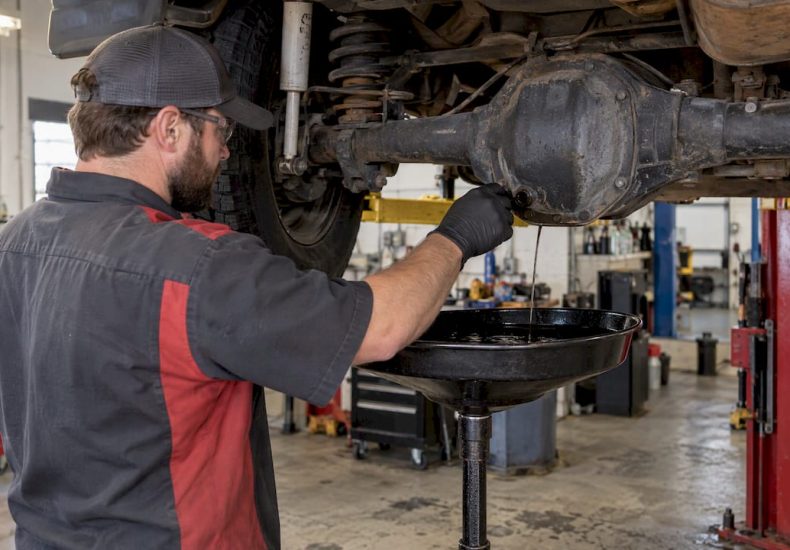
Most drivers should change differential fluid somewhere between 30,000 and 60,000 miles, and sooner if the vehicle tows, hauls, goes off-road or has been through deep water. Your owner’s manual sets the exact number, and it often lists the front differential, the rear differential and the transfer case as separate items. Read all of them, then match the schedule column (normal or severe) to how you actually drive. If you would rather not work that out alone, we at Tom’s B & M Auto in Lynnwood, WA service all makes and can go through the schedule with you.
TL;DR
- A common range for a rear differential is 30,000 to 60,000 miles, per Consumer Reports’ maintenance checklist. Some makers allow far longer in normal use, and some require far shorter intervals when towing.
- Severe use (towing, heavy loads, dusty or sandy roads, water exposure, short trips, fleet duty) moves you to the shorter schedule. If you do any of these regularly, treat the severe interval as your normal one.
- Time counts as well as miles. A low-mileage vehicle still has fluid that ages.
- GL-5 is the specification most hypoid axles call for. GL-4 is not a substitute where the manual says GL-5. Limited-slip axles may also need a friction modifier.
- A typical shop service runs roughly $70 to $230 per vehicle, far less than a damaged differential.
Table of Contents
- What the interval depends on
- Maker schedules show how wide the range is
- Severe use: when to change it sooner
- Time counts, not just miles
- GL-4 vs GL-5 gear oil
- Signs the fluid is overdue
- What a differential service costs
- How to set your own interval
- Our view on differential fluid
- Get the interval right for your vehicle
- FAQ
- Sources
What the interval depends on
A differential lets the left and right wheels turn at different speeds in a corner. Inside it, hardened gears run under heavy pressure, and the gear oil keeps a protective film between them. Over time, heat and shear wear that film down, and tiny metal particles collect in the oil.
Three things set your interval:
- The maker’s schedule for your exact vehicle. This is the number that matters. It can differ between model years and between FWD and AWD versions of the same model.
- How you drive. Makers split schedules into normal and severe service.
- How old the fluid is. Months matter as well as miles.
Mileage rules of thumb you see online range from 15,000 to 100,000 miles. That spread is real, not sloppy. It reflects how differently makers and driving conditions treat the same part.
Maker schedules show how wide the range is
A few published examples make the point.
| Vehicle | What the maker publishes |
|---|---|
| 2025 Nissan Rogue | AWD: inspect differential oil every 7,500 miles or 12 months in standard driving, replace every 20,000 miles or 24 months in severe driving. FWD: no differential maintenance. |
| 2018 Mazda CX-3 | Rear differential oil replaced every 45,000 km if driven primarily under severe conditions, and replaced if the unit has been submerged in water. |
| Ford F-150 (example reported by Jalopnik) | 150,000 miles under normal use, dropping to 30,000 miles with heavy towing in temperatures above 70 degrees and lots of throttle. |
Three vehicles, three very different answers. That is why a single mileage number from a forum thread should never override your manual. It is also why a front and rear differential on the same truck can each carry their own line in the schedule.
Read every line, not just the first
AWD and 4WD vehicles can have a front differential, a rear differential, a transfer case, and a transaxle, each with its own fluid. Consumer Reports notes that all- and four-wheel-drive models sometimes have more than one differential. If your manual lists only “transmission fluid,” check the AWD or driveline pages as well. Our guides to transfer case service and transmission fluid intervals cover the neighboring units.
When a manual says “lifetime fill,” it generally means no scheduled replacement under normal service. It does not mean the oil cannot wear out. If you bought a used vehicle and nobody knows the history, a first fluid change is a sensible reset.
Severe use: when to change it sooner
Makers use the word “severe” differently, but the same conditions keep appearing. Mazda’s manual lists towing a trailer or using a car-top carrier, dusty, sandy or wet conditions, extended idling or low-speed operation, and repeated short trips. Other makers add heavy payloads, off-road driving, and commercial or fleet use. Piston Ridge also lists water deep enough to reach the axle housing.
For Pacific Northwest drivers, several of these are routine: boat and camper trailers, hilly routes to the mountain passes, wet roads, and lots of short stop-and-go trips. If any of them describe your week, the severe column is your schedule.
Why does heat matter so much? As gear oil gets hotter it thins, the film between gear teeth is more easily sheared, and metal contact adds more friction and heat. Shortening the interval keeps fresh oil in the housing before that cycle starts.
Water exposure
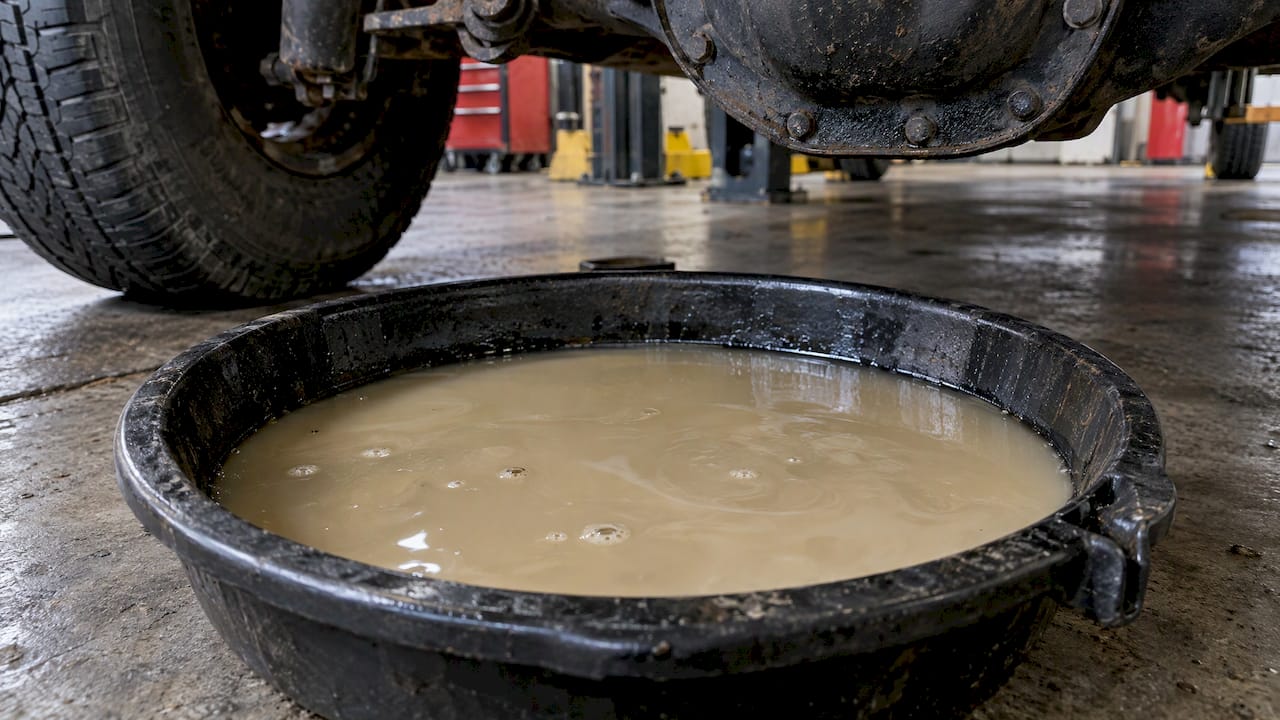
If you have driven through water high enough to reach the axle housing, don’t wait for the schedule. Milky or tan oil is a sign of water, and it can quickly rust bearings and gears. Have the fluid inspected and replaced if it is contaminated. Mazda’s own manual says to replace the oil if the unit has been submerged.
Fleet and work vehicles
Vans and trucks that carry loads all day are in severe service even if they never tow. If you manage vehicles for a business, build the severe interval into your maintenance calendar. We do fleet maintenance for local businesses, and the interval is easier to hold when it is scheduled alongside oil and brake work.
Time counts, not just miles
Mileage measures how hard the fluid has worked. Time matters because the oil’s chemistry breaks down with age. Car Talk’s Ray Magliozzi explains that Honda’s Maintenance Minder comes on after about three years, which assumes roughly 36,000 miles for an average driver. He would be comfortable waiting another year or two on a low-mileage car, but not indefinitely.
A practical way to use both:
- Use whichever limit your manual gives first, miles or months.
- If the manual gives only miles and you drive little, plan a fluid check by year three to five anyway.
- Write down which component was serviced and when. “Fluid changed” on an invoice is too vague. It should say rear differential, front differential or transfer case.
GL-4 vs GL-5 gear oil
This is the question behind many wrong fluid choices. The letters come from API, the American Petroleum Institute, and describe the type of gear service the oil is built for.
- GL-5 is defined for hypoid-gear axles under combined high-speed shock load and low-speed, high-torque conditions, per API’s November 2023 publication. Hypoid gears are the offset gears in most rear and front axles.
- GL-4 covers spiral-bevel axles under moderate to severe conditions, or hypoid axles under moderate conditions. It may be used in selected manual transmissions or transaxles.
The practical rule: use what your manual says, not what looks close. Most modern hypoid differentials require GL-5. Castrol warns that putting GL-4 in a differential that requires GL-5 can damage gear tooth surfaces within thousands of miles. API itself says to follow the equipment manufacturer’s lubricant recommendation.
The reverse matters too. Some manual gearboxes and transaxles are specified for GL-4, and fluid with a heavy extreme-pressure additive package can be wrong for their synchronizers. So don’t assume that GL-5 is always the upgrade. The spec on your manual’s fluid page is the answer, including the viscosity grade (75W-90, 75W-140 and so on).
Limited-slip differentials
Clutch-type limited-slip units need a friction modifier, either already in the gear oil or added at each change unless the maker says otherwise. Using the wrong fluid makes the unit chatter or groan in tight turns such as parking maneuvers, according to ASE-certified technician Richard McCuistian, quoted by CarParts.com. If your vehicle has a limited-slip axle, tell whoever services it before the fluid goes in. Shops that handle fluid service with fluid exchange equipment and the right additives keep this from becoming a problem.
On cost, synthetic is not automatically required. Consumer Reports’ auto testing manager advises sticking with the owner’s manual fluid recommendations, since synthetic is unnecessary if the manual does not require it. Match the spec and you are covered.
Signs the fluid is overdue
Fluid that is past due often gives hints, though the absence of symptoms does not mean the oil is fine. AutoZone lists these warning signs:
- Low fluid level, often from a leaking seal
- Milky fluid, which points to moisture
- Dark, gritty fluid with metal flakes
- A burnt smell
Other signs include whining or howling that changes with speed, clunking when you shift from drive to reverse, and vibration from the rear. Any of these deserves an inspection soon, not at the next oil change. It is rarely too late to change differential fluid, but fluid that is already contaminated with metal means the wear may be done. A change at that stage keeps things from getting worse and lets a technician see what is in the drain.
What a differential service costs
Published figures vary by vehicle and shop. Consumer Reports’ 2026 checklist lists a rear differential fluid change at $85 to $150, depending on model. MechanicRank’s October 2026 update puts independent-shop jobs at $70 to $230 and reports that a 4WD truck with front, rear and transfer case service runs $250 to $450 for everything.
Set that against the repair side. CarParts.com reports rear differential repairs commonly run $300 to $900 for seals and bearings, $1,000 to $2,500 for a rebuild, and about $2,500 to $6,000 or more for a full replacement. These are estimates from one parts retailer, so treat them as a guide to scale. The fluid change is the smaller bill by a wide margin.
How to set your own interval
- Find the schedule. Look in the maintenance section of your owner’s manual, or your maker’s online schedule for your model year and drivetrain.
- Pick the column. If you tow, haul, drive dusty roads, make many short trips or run a work vehicle, use severe.
- List every unit. Front differential, rear differential, transfer case, transaxle. Each has its own fluid, capacity and interval.
- Check the age. If the fluid is more than a few years old or has an unknown history, plan a change even at low mileage.
- Confirm the spec. Grade, API category and any friction modifier requirement must match the manual.
- Record it. Keep an invoice naming the component, the fluid and the mileage.
Hybrids and European cars add wrinkles, such as electric drive units and sealed assemblies with their own service rules. Our hybrid service guide and European maintenance schedule explain how those schedules differ. For Subarus, which are common around Lynnwood, the CVT has its own timetable in our Subaru CVT service guide.
Our view on differential fluid
Differential fluid is the service people skip because nothing seems wrong. The car drives the same at 40,000 miles as it did at 10,000, until the day it doesn’t.
We have been family-owned and operated in Lynnwood since 1985, and we work on Toyota, Honda, Subaru and domestic vehicles, plus European and hybrid models. Our approach is to start with the manufacturer’s schedule and then ask how the vehicle is really used. A Subaru that hauls a camper over the pass is not on the same clock as a commuter that never leaves town.
Our ASE-certified technicians work from upfront pricing, and everything we repair carries a 24-month / 24,000-mile warranty. For a service you only do every few years, having the work documented by component and backed by a warranty is worth as much as the fluid itself.
Shingi
Get the interval right for your vehicle
If you are due for driveline fluid service or can’t tell which schedule applies to your vehicle, bring it to us. We are an ASE-certified shop serving Lynnwood for over 40 years, we service all makes, and same-day appointments are often available. Routine intervals are covered in our 30k, 60k, 90k service, and drivetrain questions go through our Lynnwood transmission service page.
Tell us your vehicle, how you drive it and what your manual says, and we will help you set the schedule. Military members, seniors and first responders can ask about our exclusive discounts. You can reach us through Tom’s B & M Auto.
FAQ
How often should I change rear differential fluid?
A common range is 30,000 to 60,000 miles, but your manual governs. Some makers, such as Nissan on AWD models, publish inspection and replacement steps with their own mileage and month limits. Use the severe schedule if you tow, haul or drive in dust, sand or water.
Can I use GL-5 where GL-4 is specified, or the reverse?
Only if the manufacturer allows it. Most hypoid differentials require GL-5, and GL-4 can damage the gear surfaces. Some manual gearboxes are specified for GL-4, where certain GL-5 formulations can affect the synchronizers. Match the API category, viscosity and any friction modifier requirement in your manual.
What happens if I never change differential fluid?
The oil loses its protective film and collects metal particles, which speeds wear on gears and bearings. Repairs reported by one parts retailer range from $300 to $900 for seals and bearings up to $2,500 to $6,000 or more for a full replacement. The fluid change costs a small fraction of that.
Is it ever too late to change differential fluid?
It is rarely too late to change it, and fresh fluid is better than old fluid. If the oil is already gritty with metal flakes or smells burnt, wear may have started, so have it inspected. A technician can tell you what the drained fluid shows.
Do front and rear differentials share the same interval?
Not always. Manufacturers often list front differential, rear differential and transfer case as separate items with different intervals and fluids. Check every line in your schedule, and keep records that name the exact component serviced.
Sources
- 2025 Nissan Rogue differential oil maintenance schedule
- Consumer Reports’ Guide to Car Maintenance
- Mazda 2018 CX-3 owner’s manual, scheduled maintenance
- Jalopnik: How often do you need to change differential fluid
- Piston Ridge: differential fluid service intervals
- Car Talk: mileage and time for maintenance
- API: lubricant service designations for automotive manual transmissions and axles
- Castrol USA: how to change differential fluid
- CarParts.com: what is a rear differential
- AutoZone: what is differential fluid
- MechanicRank: differential fluid change cost
- Transmission fluid exchangers
Recommended
- 30,000–100,000 Miles: Transmission Fluid Change Interval for Drivers
- 2–3 Years? OEM Schedules and Tests Set Brake Fluid Change for Drivers
- Start at 60,000 Miles: Subaru CVT Service, Not Lifetime Fluid
- What Is Transfer Case Service? Your 4WD Guide
Leave a Reply