

Auto Repair Warranty Explained: What Car Owners Must Know
An auto repair warranty is a written agreement guaranteeing that specific repairs or part failures will be covered within a defined time period or mileage limit. To understand auto repair warranty coverage fully, you need to know the difference between what a manufacturer promises at the point of sale and what a third-party contract actually delivers. These two categories look similar on paper but carry very different legal weight, coverage scope, and consumer protections. Getting this wrong costs car owners hundreds or thousands of dollars in denied claims.
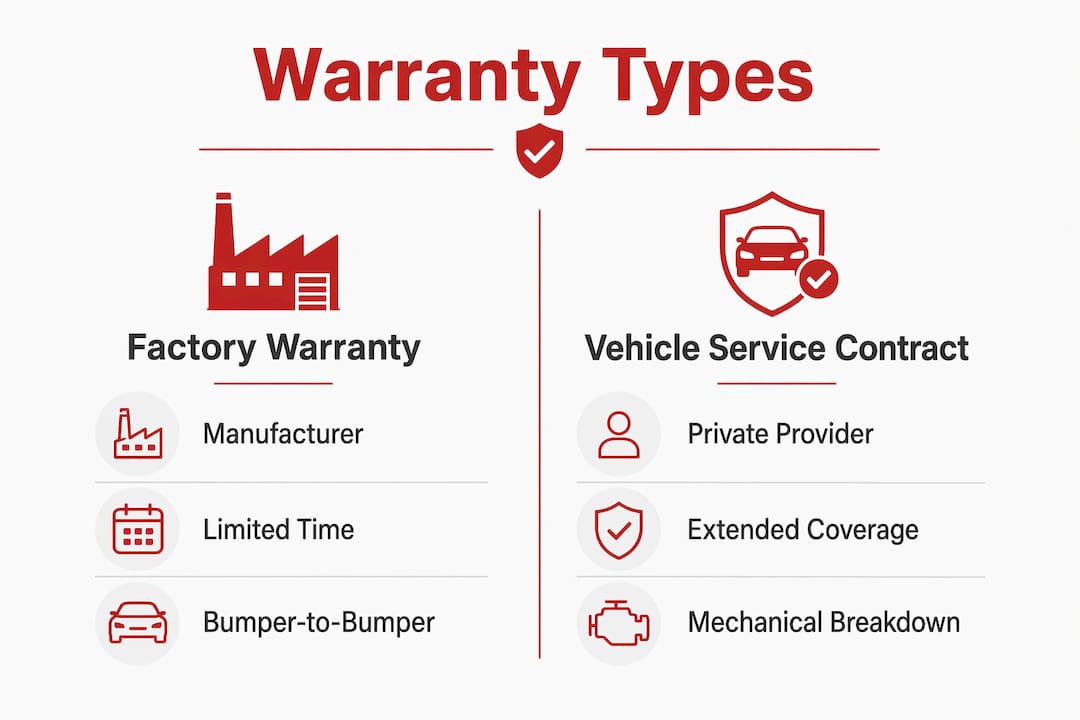
What types of auto repair warranties exist?
Factory warranties are provided directly by the vehicle manufacturer and cover defects or malfunctions during normal use. They typically include several distinct layers of protection, each with its own duration and scope.
The most common factory warranty types include:
- Bumper-to-bumper (comprehensive): Covers most vehicle systems except wear items. Typically lasts 3 years or 36,000 miles.
- Powertrain warranty: Covers the engine, transmission, and drivetrain. Many manufacturers offer 5 years or 60,000 miles, with some like Hyundai and Kia extending to 10 years or 100,000 miles.
- Corrosion warranty: Covers rust-through on body panels, often 5 to 7 years with no mileage cap.
- Emissions warranty: Federally mandated coverage for emissions-related components, typically 8 years or 80,000 miles.
- Safety restraint warranty: Covers airbags and seatbelt systems, often matching bumper-to-bumper terms.
Extended warranties are a different product entirely. The industry term for most of them is a Vehicle Service Contract (VSC). VSCs are purchased separately from dealerships or third-party providers and typically activate after the factory warranty expires. They are regulated differently from manufacturer warranties, which means your consumer protections depend heavily on your state and the provider you choose.
| Feature | Factory warranty | Vehicle service contract (VSC) |
|---|---|---|
| Provider | Vehicle manufacturer | Dealership or third party |
| Regulation | Federal and state law | State contract law (varies) |
| Coverage start | Day of purchase | After factory warranty or immediately |
| Negotiable terms | No | Sometimes |
| Transferable | Often yes | Depends on contract |
Many consumers confuse factory and extended warranties because marketing materials use the terms interchangeably. The distinction matters because factory warranties carry federal backing while VSCs are private contracts with no uniform standard.
How do auto repair warranties work?
Understanding car repair coverage means reading the actual contract, not the sales brochure. The written contract governs everything. Verbal promises and marketing materials do not override what the exclusions list says, and the exclusions list is the most critical section of any VSC.

What is and is not covered
Most VSCs cover mechanical breakdown of listed components. What they do not cover is just as telling. Routine maintenance like oil changes, tire rotations, and brake pad replacements are excluded from both factory warranties and VSCs. Prepaid maintenance contracts are a separate product that covers those services. Confusing the two leads to real frustration when a claim gets denied.
Waiting periods and coverage duration
Most VSCs include a waiting period of 30 days and 1,000 miles before coverage begins. This prevents buyers from purchasing a contract the day a warning light appears and immediately filing a claim. Coverage durations vary widely, from 1 year to 5 years or more, and are always tied to both a time limit and a mileage cap. Whichever comes first ends the coverage.
Deductibles and out-of-pocket costs
Deductibles typically range from $0 to $250 per claim. The structure matters more than the dollar amount. A per-repair deductible charges you separately for each system repaired in a single visit. If your alternator and water pump both fail on the same day, you pay two deductibles. A per-visit deductible caps your cost at one payment regardless of how many repairs happen simultaneously. Per-visit structures almost always protect your wallet better.
Pro Tip: When comparing VSC contracts, ask specifically whether the deductible is per-repair or per-visit. This single detail can change your actual out-of-pocket cost by hundreds of dollars on a complex repair.
How claims and payments work
Pre-authorization is required before repairs begin under most VSCs. Skipping this step is the most common reason claims get denied, even when the repair itself would have been covered. Once authorized, payment flows in one of two ways. Direct payment means the warranty company pays the repair shop directly, which reduces your financial exposure. Reimbursement models require you to pay the shop first and then submit for repayment, which shifts the financial risk to you while you wait.
Transferability, cancellation, and refunds
Transferable warranties add resale value because the coverage follows the vehicle to a new owner. Check the contract for transfer fees and required procedures. Most VSCs also allow cancellation with a prorated refund if you sell the vehicle or pay off the loan early. Read the cancellation terms before signing because some contracts charge administrative fees that reduce the refund significantly.
How to choose the best warranty for your vehicle
Selecting the right coverage starts with an honest assessment of your vehicle and your financial situation. Here is a practical framework:
- Check your current factory coverage. Pull your vehicle’s warranty documentation and confirm what is still active. Buying a VSC that overlaps with existing factory coverage wastes money.
- Assess your vehicle’s reliability profile. High-mileage vehicles, European makes, and luxury brands carry higher repair costs. A Toyota Corolla at 60,000 miles presents a very different risk profile than a BMW 5 Series at the same mileage. Tom’s B & M Auto’s team regularly sees European car repair costs that dwarf those of domestic or Japanese vehicles.
- Compare coverage scope and exclusions. Request a sample contract before purchasing. Any provider unwilling to share the full contract before payment is a red flag.
- Evaluate the provider’s claim payment practices. Providers that pay repair shops directly reduce your risk. Check Better Business Bureau ratings and state licensing records before committing.
- Understand the payment structure. Extended warranties offer monthly or upfront payment options, and upfront payment often comes with a discount. Run the numbers on both options against your expected repair costs.
- Check state-specific protections. Consumer protections vary by state, affecting cancellation rights, required disclosures, and enforcement. Washington State has specific rules governing VSC providers, so verify that any provider you consider is licensed to operate here.
Pro Tip: Never buy a VSC under high-pressure sales conditions at a dealership finance office. You can almost always purchase the same or better coverage later, after you have had time to compare contracts and providers.
Common pitfalls that lead to denied claims
Most warranty disappointments are preventable. They come from misreading the contract or skipping required steps.
- Assuming “extended warranty” means full coverage. Most VSCs cover listed components only. If a part is not named in the covered components section, it is excluded by default.
- Ignoring the waiting period. Filing a claim during the 30-day or 1,000-mile waiting window will result in automatic denial.
- Missing the pre-authorization step. Failing to get pre-authorization before repairs begin is the single most common reason for claim denial. Always call the warranty company before the shop starts work.
- Letting maintenance records lapse. Some providers require documented proof that you followed the manufacturer’s maintenance schedule. Missing an oil change or failing to keep receipts can void coverage on an otherwise valid claim.
- Confusing maintenance contracts with repair warranties. A prepaid oil change plan does not cover a blown head gasket. These are separate products with no overlap.
- Overlooking state law differences. Extended warranty contract terms differ by state of vehicle registration. A contract written for a buyer in Texas may carry different cancellation rights than the same contract sold in Washington.
Key takeaways
Understanding auto repair warranties requires distinguishing factory warranties from vehicle service contracts, reading the full contract before purchase, and following claim procedures precisely to avoid denial.
| Point | Details |
|---|---|
| Factory vs. VSC | Factory warranties carry federal backing; VSCs are private contracts with variable protections. |
| Read the exclusions | The exclusions list overrides all verbal promises and marketing materials. |
| Deductible structure | Per-visit deductibles protect your wallet better than per-repair structures on complex jobs. |
| Pre-authorization | Always call the warranty company before repairs begin to avoid automatic claim denial. |
| State law matters | Consumer protections, cancellation rights, and disclosures vary by state of vehicle registration. |
What I have learned after years of watching warranty claims play out
After seeing hundreds of repair jobs at shops like Tom’s B & M Auto, I have a clear opinion: most warranty frustrations are self-inflicted. Not because car owners are careless, but because the industry buries the most important information in contract language that nobody reads until something goes wrong.
The single most valuable thing you can do before buying any VSC is request the full sample contract and read the exclusions list first, not last. I have watched customers walk in with a VSC they paid $2,000 for, only to discover the specific component that failed is listed as excluded. The sales pitch never mentioned it. The brochure did not either. The contract did, on page 14.
My other strong opinion: direct shop payment is non-negotiable. Reimbursement models put you in the position of fronting a $3,000 repair bill and then waiting weeks for a check. That is a real financial burden for most households. Any reputable VSC provider should be willing to pay the repair facility directly.
On the question of whether extended warranties are worth buying at all: it depends entirely on the vehicle. For a well-maintained Toyota or Honda under 80,000 miles, the math rarely favors a VSC. For a high-mileage European vehicle or a used luxury car past its factory coverage, the calculus shifts. Know your vehicle’s repair cost profile before you decide.
— Shingi
Protect your vehicle with Tom’s B & M Auto
Tom’s B & M Auto has served Lynnwood, WA since 1985, and every repair job comes backed by a 24-month or 24,000-mile warranty on all work performed. Whether you are dealing with a warranty-covered repair, preparing documentation for a VSC claim, or simply want a second opinion before authorizing work, the ASE-certified team here handles all makes including Toyota, Honda, Subaru, European, and hybrid vehicles.
A free digital vehicle inspection is a smart first step before any major repair decision, especially when warranty coverage is in play. If repair costs are a concern, financing options are available to help manage out-of-pocket expenses. Same-day appointments are often available. Call or book online to get started.
FAQ
What is an auto repair warranty?
An auto repair warranty is a written agreement that guarantees specific repairs or component failures will be covered within a set time period or mileage limit. Factory warranties come from the manufacturer; vehicle service contracts are purchased separately from dealerships or third parties.
What does a factory warranty typically cover?
Factory warranties generally include bumper-to-bumper coverage for 3 years or 36,000 miles and powertrain coverage for 5 years or 60,000 miles, though some manufacturers extend powertrain coverage to 10 years or 100,000 miles. Routine maintenance items like oil changes and tires are excluded.
Why do warranty claims get denied?
The most common reasons for denial are failing to obtain pre-authorization before repairs begin, filing during a waiting period, and lacking documented proof of required maintenance. Reading the exclusions list before purchasing a contract prevents most of these surprises.
Is an extended warranty the same as a vehicle service contract?
No. An extended warranty is a marketing term; the correct industry term is a vehicle service contract (VSC). VSCs are private contracts regulated by state law, not federal warranty law, which means consumer protections vary significantly depending on where you live.
Can I transfer my warranty if I sell my vehicle?
Many factory warranties and some VSCs are transferable to a new owner, which can increase resale value. Transfer procedures and fees vary by contract, so review the transferability terms before purchasing and before listing your vehicle for sale.
Recommended
- European Car Repair Challenges: What Owners Must Know – Tom’s B & M Auto Blog
- Financing Available | Tom’s B&M Auto | Lynnwood, WA
- Examples of Preventive Car Care to Protect Your Vehicle – Tom’s B & M Auto Blog
- BMW Repair in Kenmore, WA | Tom’s B&M Auto
Leave a Reply