

Fleet Preventive Maintenance Schedule: Intervals and Setup
A fleet preventive maintenance schedule is a written list of what each vehicle gets, when it gets it, and who owns it. Start from the manufacturer’s intervals, trigger each service by mileage, time or engine hours (whichever comes first), adjust for how the vehicle really works, and record every job. For a small business fleet of vans, pickups and sedans, that is usually a simple set of tiers: a frequent light service, a mid-level inspection and a major service.
This guide shows you how to set those intervals, what real agency schedules look like, what to inspect, and how to keep the schedule from lapsing.
TL;DR
- Use the manufacturer’s schedule as your baseline, then shorten intervals for severe use (stop-and-go, towing, heavy idling) or extend them only with evidence.
- Trigger each service by mileage, calendar time or engine hours, and apply “whichever comes first.”
- Group vehicles into a few templates instead of writing custom rules for every unit.
- Give the schedule an owner, keep dated records, and review it at least once a year.
- Light-duty public fleets commonly service at 5,000 miles or 12 months, with tighter intervals for severe duty.
Table of Contents
- What a fleet PM schedule actually contains
- Step 1: Build the vehicle inventory
- Step 2: Set intervals from the manufacturer, then adjust
- Mileage, time or engine hours: pick the right trigger
- Real interval examples from public fleets
- A three-tier template for light-duty fleets
- What each inspection should cover
- Seasonal items in the Pacific Northwest
- Schedule the work so vehicles stay on the road
- Track it: records, reminders and ownership
- Our perspective: keep the schedule boring
- Fleet service at Tom’s B & M Auto
- Review the schedule every year
- FAQ
- Sources
What a fleet PM schedule actually contains
A good schedule answers four questions for every vehicle: what service, what trigger, when due, and who is responsible. The Federal Transit Administration’s maintenance review guide says a written maintenance plan should describe periodic inspections and preventive maintenance at defined intervals, and that those intervals may be based on miles since the last inspection, absolute miles, or hours of service, with room to account for manufacturer recommendations, vehicle age and operating conditions.
That is the whole idea. The rest is detail: which vehicles, which intervals, and how you make sure the work happens.
Step 1: Build the vehicle inventory
You cannot schedule what you have not listed. Make one row per vehicle with:
- Year, make, model and engine (hybrid, diesel, gas, turbo)
- VIN and plate
- Current odometer reading, and engine hours if the vehicle idles or runs equipment
- Primary use: highway delivery, stop-and-go service calls, towing, low-use backup
- Date and mileage of the last known service
New York’s guidance for small agencies recommends starting with an inventory and a written plan, then identifying intervals and inspection or service procedures by vehicle type and year, assigning responsibilities and records, and reviewing actual use and fleet changes every year. A spreadsheet is enough for a handful of vehicles. Once you manage a dozen or more, software with reminders pays for itself.
Step 2: Set intervals from the manufacturer, then adjust
The owner’s manual for each vehicle is your starting point. South Carolina’s DOT advises that intervals should never exceed manufacturer recommendations, while noting that shortening them can make sense depending on terrain, type of service and annual mileage.
J. J. Keller’s vehicle maintenance white paper takes the same view: begin with the OEM schedule, then adjust for intended use, fleet performance and the maintenance history of similar vehicles. Severe service calls for more frequent work, and lighter use may permit some extension.
What counts as severe service
Most manuals define severe duty, and it covers more fleet work than owners expect:
- Frequent short trips, especially in cold weather
- Stop-and-go delivery or service routes
- Extended idling
- Towing or carrying heavy loads
- Dusty, hilly or salted roads
If a van makes 20 stops a day around the Puget Sound area, treat it as severe even if the odometer climbs slowly.
Use common denominators
SCDOT also suggests choosing intervals that line up, such as rotating tires at 6,000 miles when oil changes happen at 3,000. Every visit then has a predictable bundle of work, and each vehicle spends less time off the road.
Mileage, time or engine hours: pick the right trigger
The trigger matters as much as the interval.
| Trigger | Best for | Weak spot |
|---|---|---|
| Mileage | Road vehicles that mostly drive | Understates wear from idling or equipment use |
| Calendar time | Low-use vehicles, backups, seasonal units | Ignores heavy use between dates |
| Engine hours | Idle-heavy or power-take-off vehicles | Needs a reliable hour meter or telematics |
J. J. Keller explains that mileage works well for roadway vehicles, but it can understate wear from excessive idling or power-take-off use, which is why engine hours suit vehicles like waste, ready-mix and pump trucks.
Time-based triggers protect parts that age whether or not the vehicle moves. MapTrack notes that brake fluid, coolant and tires degrade over time even if a vehicle sits for weeks. For a fleet, the practical rule is “whichever comes first”: the service is due at the earlier of the mileage, the hours or the date. TrackHawk describes this as the approach most well-run fleets use.
Real interval examples from public fleets
Public agencies publish their schedules, and they are a useful reality check for light-duty vehicles. These are examples, not rules for your vehicles. Your manuals still come first.
| Agency | Use | Interval |
|---|---|---|
| Alaska State Equipment Fleet | Regular and seasonal light-duty | 5,000 miles or 12 months |
| Alaska State Equipment Fleet | Pursuit units | 5,000 miles or 6 months |
| Alaska State Equipment Fleet | Severe service | 3,000 miles or 6 months |
| Washington Dept. of Enterprise Services | Other vehicles | A service every 5,000 miles, C service every 30,000 miles |
Notice the pattern: a short “A” service at a modest mileage, a larger one at a multiple of that, and tighter limits for harder use. For very low-mileage vehicles, New York’s guidance suggests that where annual mileage is under 10,000 per vehicle and semiannual inspections apply, setting maintenance every six months, just before those inspections, is the best fit.
A three-tier template for light-duty fleets
Here is a structure we see working for small business fleets. Treat the numbers as placeholders and replace them with each manufacturer’s figures.
Tier A: frequent service
Oil and filter, tire rotation and pressure check, fluid levels, lights, wipers, battery terminals and a quick visual on brakes and belts. Typical trigger: the manufacturer’s oil interval or your severe-duty shortening of it, or twice a year for low-use vehicles.
Tier B: inspection service
Everything in Tier A plus a full brake measurement, suspension and steering check, cooling system and hose inspection, belts, air filter and cabin filter, and a scan for stored codes. Typically every second Tier A visit.
Tier C: major interval service
The manufacturer’s 30,000, 60,000 and 90,000-mile items: fluids such as transmission, coolant and brake fluid where specified, spark plugs, timing belts where fitted, and a deeper inspection. Our 30k, 60k and 90k service follows that same logic, and it is where most fleet surprises get caught before they become roadside calls.
What each inspection should cover
A broad list of routine checks covers tires, wheels, brakes, fluids, filters, belts, hoses, lights, steering, suspension and safety equipment. J.E.B. Insurance Services’ guide to truck maintenance plans lists the same core systems and adds coupling devices and load-control gear for trailers.
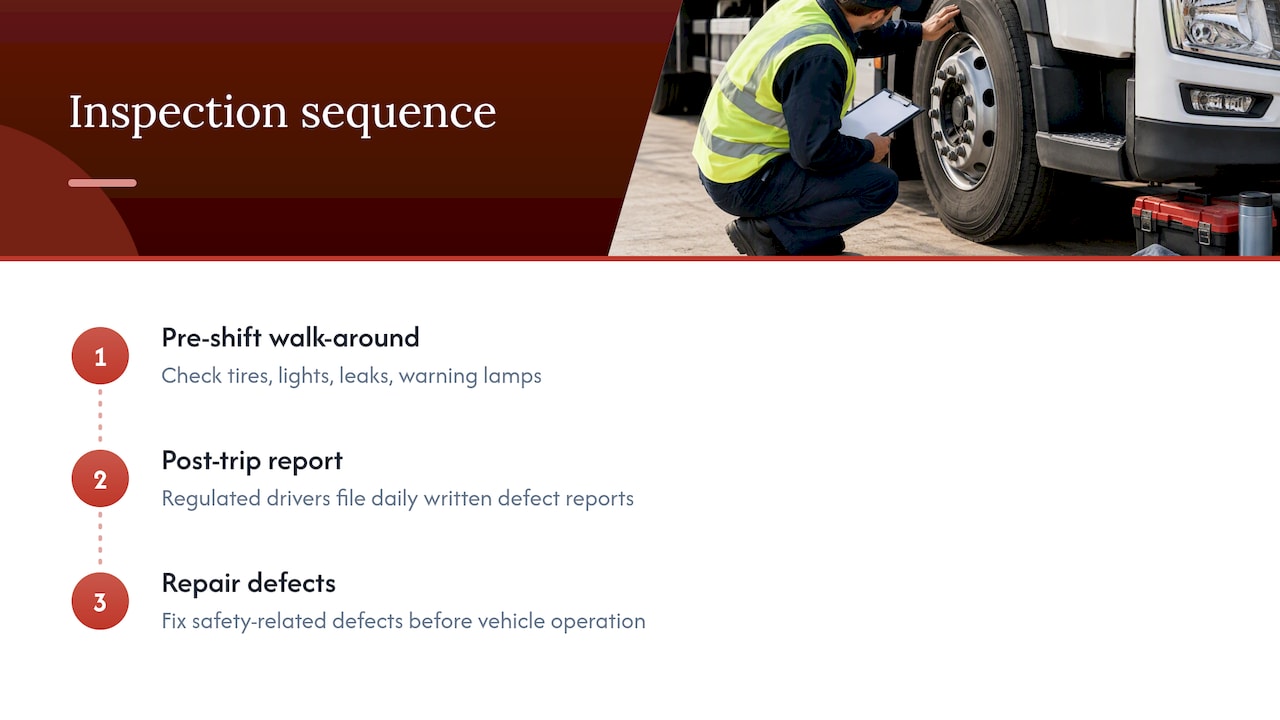
The driver is the first line of defense. A short walk-around before each shift catches flat tires, lights out, leaks and warning lamps long before a scheduled visit. For vehicles under federal motor carrier rules, drivers must complete daily written post-trip inspection reports for safety-related defects, and defects likely to affect safe operation must be repaired before the vehicle is operated again. Those requirements do not apply to non-business private motor carriers of passengers or carriers operating only one vehicle, so check which rules cover your vehicles. Many light-duty business fleets aren’t covered, but the habit is worth copying.
Brakes and fluids deserve their own line
Brakes are the item most often deferred and most expensive when deferred. Pad and rotor wear depends heavily on route type, so measure at every Tier B visit rather than waiting for noise. Brake fluid absorbs moisture, so it follows a calendar interval; see our guide to the brake fluid change interval. When a measurement says pads are close to the limit, schedule brake repair in the next planned window, not after the grinding starts.
Seasonal items in the Pacific Northwest
SCDOT suggests seasonal campaigns, such as spring A/C checks and fall heating and defrosting checks. In western Washington, a fall campaign should add wiper blades, tire tread and pressure, battery load testing, defroster and heater output, and lighting, because long wet, dark commutes expose weak parts quickly. Our seasonal car maintenance checklist breaks these out by season, and the car AC system checklist covers the spring check.
If your vehicles carry wraps, tint or paint protection, include the exterior in the seasonal routine too. Film and coatings last longer when they are cleaned and inspected properly, and this PPF maintenance guide explains how to keep film clear and protected.
Schedule the work so vehicles stay on the road
A calendar full of due dates fails if every van is due the same week. Fleetio recommends assigning dates with shop capacity and technician availability in mind, and staggering similar vehicles to avoid simultaneous downtime. In practice:
- Spread due dates across the month using each vehicle’s actual odometer, not the purchase date.
- Pre-book the next visit when the current one closes.
- Bundle Tier A with any open repair items, so one drop-off does the work of two.
- Keep one spare or loaner plan for the vehicles your business cannot do without.
Same-day appointments are often available at our shop, which helps when a vehicle can only be spared for a morning.
Track it: records, reminders and ownership
A schedule with no owner is the first thing to lapse when the workload rises, as MapTrack observes. Name one person who checks the due list weekly.
For tools, a spreadsheet works for a few vehicles. Telematics platforms can do more: Geotab’s maintenance schedules, for example, can use time, distance, engine hours or a combination as triggers, with notifications and a view of what is due.
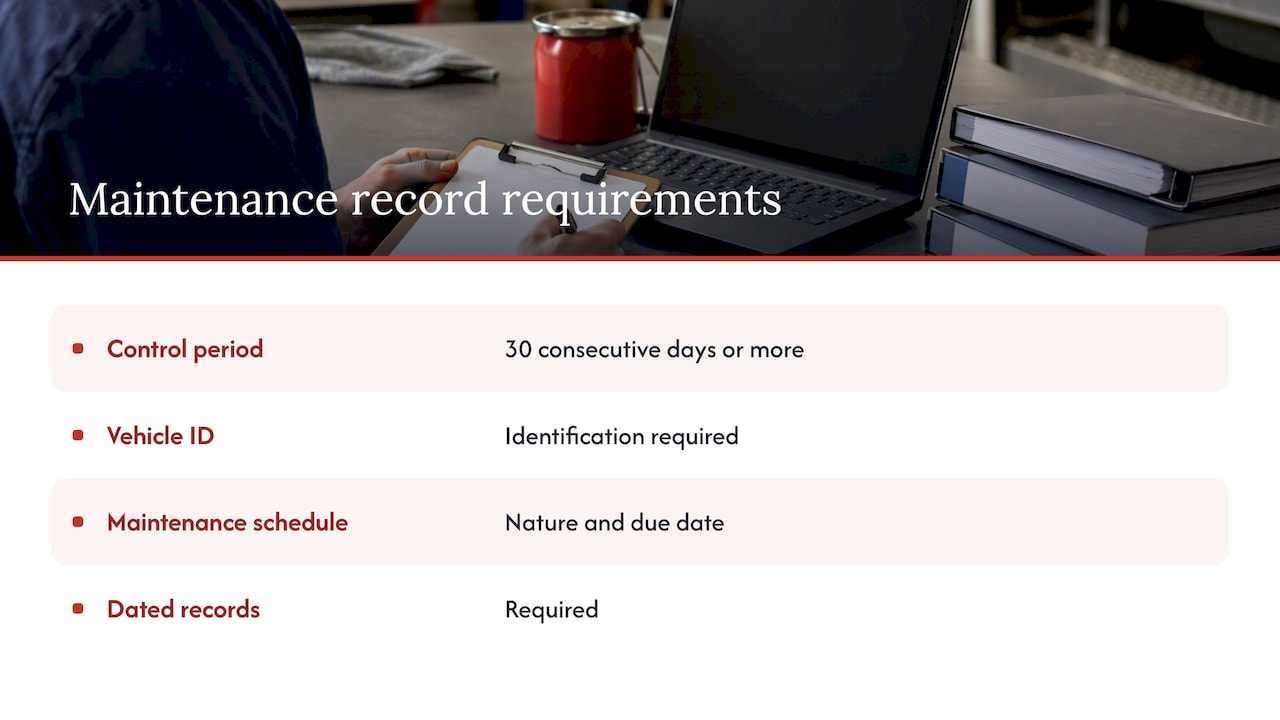
Whatever you use, keep dated records of every inspection, repair and service. For regulated motor carriers, FMCSA’s Part 396 brochure says vehicles controlled for 30 consecutive days or more require identification, a maintenance schedule showing the nature and due date of operations, and dated records. Even if you are not regulated, those three items are a sound template. Ask your shop for itemized invoices with mileage, and our digital inspections make that record easy to keep.
TrackHawk’s advice on keeping this manageable is to use a small number of templates by vehicle type, such as road vehicles, equipment-heavy units and seasonal backups, since custom intervals for every vehicle are hard to keep current.
Our perspective: keep the schedule boring
We have serviced vehicles in Lynnwood since 1985, and the fleets that run best are rarely the ones with the fanciest software. They are the ones with a short list of tiers, one person accountable, and a shop that tells them what is coming before it fails.
Three habits make the difference. First, treat the manufacturer’s interval as a ceiling, and shorten it for the way you really drive. Second, inspect before you replace: a measured brake pad or a battery test turns a guess into a decision. Third, plan the repair that an inspection finds for the next quiet day, so it never becomes an emergency tow.
Mixed fleets need extra care. A hybrid or European van has different fluids and intervals than a domestic pickup, so do not apply one template to everything. Our guides to hybrid vehicle service needs and the European car maintenance schedule explain the differences, and our fleet maintenance plan and fleet maintenance checklist go deeper on tiers and work orders.
— Shingi
Fleet service at Tom’s B & M Auto
We are a family-owned shop in Lynnwood, WA, working on all makes, including European and hybrid vehicles. Our ASE-certified technicians handle the work a fleet schedule calls for, from oil changes to brakes, AC, transmission service, suspension, batteries and timing belts, backed by a 24-month / 24,000-mile warranty on all work and upfront pricing.
Published starting prices: oil change from $100, brake repair from $280 per axle, and AC repair from $150. For fleet accounts and anything not listed, contact us through our main site and we will help you set up tiers around your vehicles.
Review the schedule every year
Schedules drift. Once a year, compare plan against reality:
- Which vehicles hit their mileage limit well before the calendar date? Switch them to meter-based triggers. MapTrack makes the same point: if telematics shows a vehicle consistently reaching its service limit early, calendar dates are the wrong trigger.
- Which vehicles had repeat failures between services? Shorten that item’s interval.
- Which were added, retired or reassigned? Update the inventory.
- Did any vehicle go through severe duty this year that the template did not anticipate?
The FTA frames this as lifecycle management: balance cost, risk, condition and performance to improve reliability and control total cost of ownership. A schedule that you review will stay accurate, and an accurate one saves money.
FAQ
How often should fleet vehicles get preventive maintenance?
It depends on the vehicle and its use. Public light-duty fleets commonly use 5,000 miles or 12 months for regular use and tighter limits such as 3,000 miles or 6 months for severe service, as in Alaska’s published schedules. Your manufacturer’s manual sets the ceiling.
Is there a federal mileage interval for fleet maintenance?
Not a universal one. According to J.E.B. Insurance Services, FMCSA does not set a single mileage interval, so carriers build programs from manufacturer guidance, duty cycles and inspection results.
Should I use mileage or time to schedule services?
Use both, and let whichever comes first trigger the service. Add engine hours for vehicles that idle a lot or power equipment. Low-use vehicles still need calendar-based service because fluids and tires age.
Can I extend intervals to save money?
Only with evidence. Lighter use may allow some extension, but the manufacturer’s interval is the starting point, and your own maintenance history should justify any change. Severe duty usually calls for the opposite.
Sources
- FTA FY2018 Comprehensive Review Guide, Section 7 Maintenance
- NYSDOT Guidelines for Small Agencies: Developing a Maintenance Plan
- SCDOT Comprehensive Preventive Maintenance Program
- Alaska State Equipment Fleet Preventive Maintenance Schedules
- Washington Department of Enterprise Services service intervals
- J. J. Keller: Implementing an Effective Vehicle Maintenance Program
- TrackHawk GPS: Mileage, Engine Hours, or Time
- MapTrack: How to Set Up a Fleet Maintenance Schedule
- MapTrack: Fleet Maintenance Guide
- J.E.B. Insurance Services: Commercial Truck Preventative Maintenance
- FMCSA: Inspection, Repair, and Maintenance, Part 396
- FMCSA Part 396 brochure
- Fleetio: Fleet Preventive Maintenance Plan
- Geotab Maintenance schedules
- FTA Asset Management Guide
Recommended
- 2–3 Years? OEM Schedules and Tests Set Brake Fluid Change for Drivers
- 30,000–100,000 Miles: Transmission Fluid Change Interval for Drivers
- Fleet Maintenance Plan Small Fleets Can Build in 6–8 Weeks Using Tiers
- Fleet Maintenance Checklist: Turn 4 Clocks Into Closed Work Orders
Leave a Reply