

No Crank No Start? Map the Clicks in 7 Steps, Drivers
Turn the key and get absolute silence, or one dull click, and the problem almost always lives in three places: a weak battery or corroded connection, a failing starter or solenoid, or a safety interlock (neutral safety switch, clutch switch, or immobilizer) blocking the start signal. Start with the dome light or headlights. If they’re dim or dead, try a safe jump-start before touching anything else. If the quick check doesn’t bring the crank back, work through the structured triage below.
TL;DR:
- A no-crank condition often results from a weak battery, corroded connection, or a faulty safety interlock, confirmed by testing dash and headlight brightness.
- Voltage-drop testing is essential to distinguish wiring faults from actual starter failure, especially considering high current loads or heat-related issues.
- Intermittent no-start symptoms can be caused by failing sensors like the crankshaft position sensor or issues with security systems, which are not always evident on static tests.
- Replacing parts randomly, like the battery or starter, wastes money; proper diagnostics such as voltage-drop tests prevent unnecessary repairs.
- Professional on-vehicle diagnostics and voltage-drop testing help accurately identify faults, avoiding guesswork that can lead to costly part swaps.
Table of Contents
- What Does a No Crank No Start Actually Sound Like?
- Step-by-Step Triage for a No-Crank Car
- How Do You Tell a Wiring Fault From a Starter Fault?
- What Causes Cranking Without Starting?
- When Should You Stop Troubleshooting and Call a Shop?
- Why Symptom Mapping Beats Parts Swapping
- Get Your No-Crank Problem Diagnosed the Right Way
- Sources
- FAQ
What Does a No Crank No Start Actually Sound Like?
A “no crank no start” means the engine never turns over. The starter doesn’t spin, so you hear nothing, or maybe a click. That’s different from a “crank but no start,” where the engine turns over fine but never fires up, which points toward fuel, spark, or sensor problems instead. Getting this distinction right saves you from chasing the wrong system.
What you hear when you turn the key narrows things down fast:
- Total silence, no dash lights: Dead battery, blown main fuse, or a corroded ground strap.
- Single click, dash lights normal: Usually the starter solenoid engaging without spinning the starter, often a worn starter or bad high-current connection.
- Rapid clicking: Classic sign of low voltage under load, either a weak battery or a bad connection that can’t supply cranking current.
- Cranks but won’t catch: Fuel or spark issue, not a starting-circuit problem at all.
An intermittent no-start symptom map groups these into four systems: starter circuit, charging system, immobilizer or security, and fuel/spark delivery. Also watch for a flashing key icon on the dash. That points to an immobilizer fault, not a mechanical one.
Step-by-Step Triage for a No-Crank Car
Work through this in order. Each step either fixes the problem or narrows down what’s actually broken.
- Check the dash and headlights. Full brightness suggests the battery is fine and the fault is downstream. Dim or flickering lights point straight at the battery or its connections.
- Inspect and wiggle the battery terminals. Loose or corroded terminals cause intermittent no-starts that come and go with vibration. This “wiggle test” catches a surprising number of cases that look like a dying battery but are actually just a loose clamp.
- Measure resting voltage if you have a multimeter. A healthy battery reads about 12.6 volts at rest, and shouldn’t drop below roughly 9 to 9.5 volts during cranking. A reading that collapses under load even though it looked fine at rest usually means bad cells or high resistance somewhere in the circuit.
- Attempt a jump-start. Connect positive to positive, negative to a grounded metal point away from the battery, and let the donor vehicle run a few minutes before attempting to start. If the car cranks immediately, your battery or connections are the culprit.
- Check fuses and swap relays. A blown fusible link or a stuck starter relay produces the same silent no-crank symptom as a dead battery.
- Try Neutral, and check the clutch pedal. Automatics stuck slightly out of Park, or a clutch safety switch that isn’t registering a full press, will block the start signal even with a perfectly healthy starter.
- Note the click pattern. No click at all after a good jump usually means the starter itself, or its trigger circuit, has failed.
Pro Tip: If you’re replacing the battery as part of this process, ask your shop to use a Keep Alive Memory tool during the swap. Without one, some vehicles lose radio presets, adaptive transmission settings, and other stored data the moment power drops.
How Do You Tell a Wiring Fault From a Starter Fault?
A shop separates a wiring problem from an actual starter failure with voltage-drop testing, which is more revealing than a simple voltage reading. You measure the voltage lost across a cable or connection while the circuit is under load (during cranking), not while it’s sitting idle. A cable in good shape drops only a fraction of a volt end to end. A drop of a volt or more across the positive cable or the chassis ground during cranking means resistance is eating your cranking power before it ever reaches the starter, even if the battery itself tests fine.
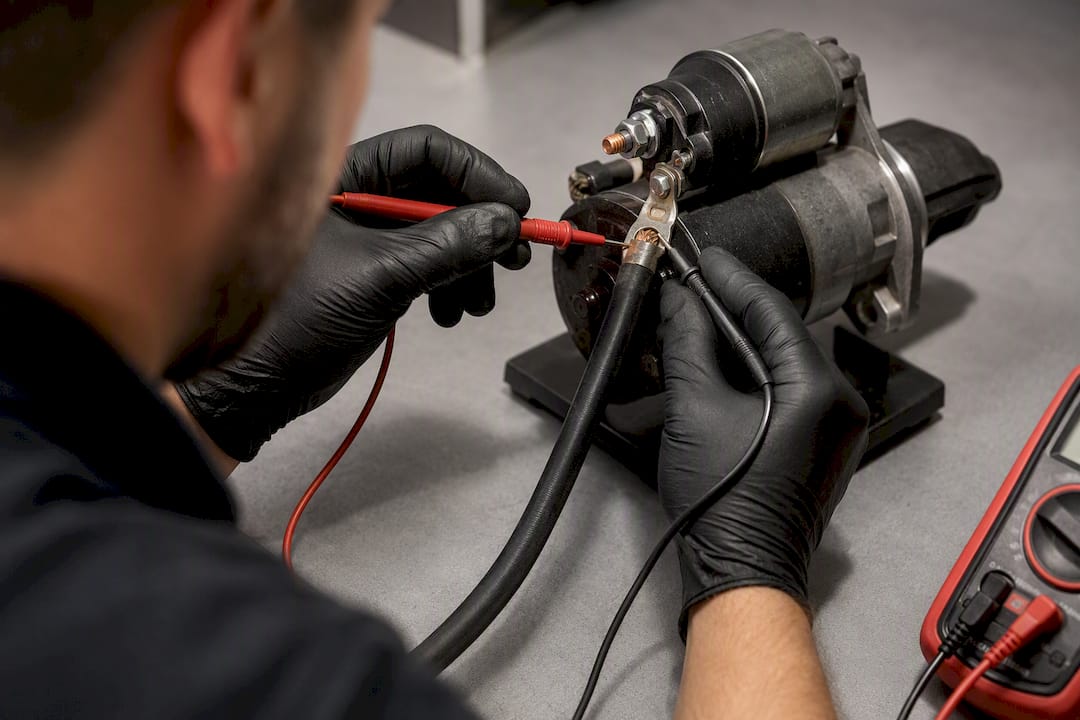
That distinction matters because static voltage checks lie. A battery that reads 12.4 volts at rest can still collapse under load, which points to either a weak battery cell or a high-resistance connection hiding somewhere in the circuit.
For the starter itself, technicians sometimes run a direct-trigger test on the solenoid: pull the small trigger wire connector, ground a test light to the engine block, and have someone turn the key while watching for 12 volts at that connector. This isolates the control circuit from the starter motor itself. No voltage at the trigger points at the ignition switch or a safety interlock. Voltage present but the starter still doesn’t spin points at the starter or solenoid contacts.
A few patterns worth knowing:
- Starters draw hundreds of amps during cranking, so worn brushes or pitted solenoid contacts fail under that load even when they test fine sitting still.
- A starter that cranks fine cold but goes silent once the engine is hot, or the reverse, usually means heat soak affecting the solenoid or brushes.
- This heat-soak pattern rules out a simple battery problem, since a bad battery doesn’t care about engine temperature.
Direct-trigger testing on a live circuit carries real shock and short-circuit risk, so leave this specific test to a technician if you’re not comfortable working near the starter and battery cables.
What Causes Cranking Without Starting?
If the engine turns over normally but never fires, you’re not dealing with the starting circuit at all. Cranking without starting almost always traces back to fuel, spark, or one of two sensors: the crankshaft position sensor (CKP) or the camshaft position sensor.
Work through these in order:
- Listen for the fuel pump prime. Turn the key to “on” without starting and listen near the fuel tank for a two-second hum. Silence suggests a dead fuel pump, a blown fuel pump fuse, or a failed relay.
- Check for spark. A shop can pull a spark plug and check for a visible spark during cranking; this isn’t something to attempt casually since ignition coils carry enough voltage to hurt you.
- Pull codes with an OBD-II scanner. Look specifically for pending crankshaft position sensor codes, injector circuit faults, or misfire codes across all cylinders, which usually means no spark or no fuel rather than one bad plug.
- Watch for the immobilizer light. A steady or flashing security icon means the car is refusing fuel or ignition on purpose, not because a part failed.
Intermittent hot no-starts, where the car cranks but won’t catch only after it’s been driven and warmed up, are a well-known signature of a failing crankshaft position sensor. These sensors often test fine cold on a bench and only fail once they reach operating temperature, which is exactly why they’re so frustrating to chase down without a scan tool logging live data. If this describes your car, our guide to fixing engine misfires step by step covers the fuel and spark side in more depth.
When Should You Stop Troubleshooting and Call a Shop?
Stop immediately if you smell burning, see sparks at the battery terminals, or the jump-start makes things worse instead of better. Those are signs of a genuine electrical fault that can damage wiring, your alternator, or start a fire if you keep forcing it. A car that shows zero improvement after a properly executed jump-start, or a voltage reading that keeps sagging no matter what you try, has moved past the DIY stage.
Before you call, write down exactly what happened. It saves diagnostic time and often saves you money:
- Which symptom bucket you heard: silence, single click, rapid clicking, or cranks but won’t catch.
- What you already tried, including jump-start results and terminal cleaning.
- Whether the fuel pump primed and whether any dash warning lights (especially the immobilizer icon) were on.
- Any recent battery, alarm, or aftermarket electrical work.
Automotive shops in the Lynnwood area have been sorting out exactly this kind of starting problem for drivers for many years. Technicians may use professional-grade OBD-II diagnostics to pull the actual fault codes rather than guessing, and repairs often carry warranties. If you’re weighing whether a fault lives upstream in the starter circuit, our starter motor replacement page walks through what that repair actually involves.
Why Symptom Mapping Beats Parts Swapping
Most owners default to replacing whatever part seems cheapest first, usually the battery, and hope it fixes the problem. That approach wastes money more often than it saves it. A five-minute voltage check or wiggle test costs nothing and tells you which system to actually suspect. Log what you hear, test the cheap stuff first, and hand a technician real observations instead of a guess.
— Shingi
Get Your No-Crank Problem Diagnosed the Right Way
Guessing at parts gets expensive fast. A new battery, alternator, and starter can run several hundred dollars combined, and none of it helps if the real fault was a corroded ground strap the whole time. Some shops run proper on-vehicle diagnostics first, including voltage-drop testing across battery cables and grounds, so customers replace only what’s actually failed.

Technicians may handle everything from battery and alternator testing to full starter motor replacement, with same-day appointments sometimes available. Repairs may come backed by warranties for additional coverage. If your check engine light came on alongside the starting trouble, our engine repair page covers sensor and ignition diagnostics too. Give us a call or book online through our main service page to get a real diagnosis instead of another parts-swap guess.
Sources
- Intermittent no-start symptom map: Battery vs Starter vs Alternator vs Security | Drive Sense
- AAA battery guide / DIY battery checks
- Car won’t start, no sound, no crank: what’s wrong? | AmpAuto
FAQ
Why Is My Car Not Starting and Not Cranking?
A car that won’t crank at all usually has a battery, connection, or starter circuit problem rather than a fuel or engine issue. Check dash light brightness first, since dim lights point to the battery while normal brightness with a click points toward the starter or solenoid.
What Sensors Can Cause a No Crank No Start?
The crankshaft position sensor is the most common sensor tied to starting failures, though it more often causes cranking-without-starting than a true no-crank. A failing immobilizer or key fob sensor can also block the start signal entirely, even though the starter itself is perfectly healthy.
I Turn the Key and Nothing Happens, No Click. What’s Wrong?
Total silence with no click usually means a dead battery, a blown fusible link, or a bad ground connection is cutting power before it reaches the starter. If the dash lights are also dim or off, check the battery and its connections first before assuming the starter has failed.
What Does “Crank No Start” Mean?
“Crank no start” means the engine turns over normally when you turn the key, but it never actually fires up and runs. That points to a fuel delivery, spark, or sensor problem rather than anything in the battery or starter circuit, since the starter is clearly doing its job.
Can Tom’s B & M Auto Diagnose an Intermittent No-Start?
Yes. Tom’s B & M Auto uses professional-grade OBD-II diagnostics along with on-vehicle voltage-drop testing to pinpoint intermittent starting faults that come and go, rather than guessing at parts. Current pricing for diagnostics and repairs is listed on the shop’s service pages.
Recommended
- Why Your Car Won’t Start in Cold Weather
- What Is Engine Knock and How to Fix It
- Car Stalls at Idle: Causes, Diagnosis, and Fixes
- What Is Engine Misfiring? Causes, Signs, and Fixes
Leave a Reply