
P0420 Code Fix: 5 Minute O2 Waveform Test That Can Save You Hundreds
P0420 means the catalytic converter on Bank 1 is reporting lower efficiency than the powertrain control module expects. That does not mean the converter is bad. Before you spend money on a P0420 code fix, capture live OBD-II data and compare the upstream and downstream oxygen sensors. Skip that step, and you risk paying for a new converter that gets returned or fails again within months.
TL;DR:
- Most P0420 codes are caused by faulty oxygen sensors, exhaust leaks, or misfires rather than a failed catalytic converter itself.
- Checking live oxygen sensor waveforms and inspecting for exhaust leaks first can prevent unnecessary converter replacements.
- High fuel trims, misfire codes, or sluggish downstream sensor responses often indicate upstream engine issues responsible for triggering the code.
- Physical tests like measuring inlet and outlet temperatures or backpressure help confirm if the converter is genuinely failed.
- Proper diagnosis and fixing upstream problems first can save hundreds of dollars and avoid premature catalytic converter replacements.
Table of Contents
- What Does P0420 Actually Mean?
- Quick Checklist Before You Diagnose P0420
- How Do You Diagnose a P0420 Code Correctly?
- What Proves the Catalytic Converter Itself Has Failed?
- What Does a P0420 Code Fix Actually Cost?
- Can You Fix P0420 Yourself, or Do You Need a Shop?
- Why Trust This Diagnostic Order?
- A Technician’s Take on Why “Replace the Cat” Is Usually Wrong
- Where Tom’s B & M Auto Fits Into Your P0420 Repair
- Sources
What Does P0420 Actually Mean?
P0420 stands for “Catalyst System Efficiency Below Threshold, Bank 1.” Your engine’s computer watches how the catalytic converter processes exhaust gases by comparing the oxygen sensor readings before and after the converter. When the downstream sensor starts behaving too much like the upstream one, the computer concludes the converter isn’t scrubbing pollutants the way it should, and it sets the code.
Here’s the part most owners never hear from a parts-counter clerk: P0420 is a symptom code, not a root-cause code. The KBB explanation of P0420 makes clear that technicians need to work backwards from the converter to the engine, checking exhaust integrity and sensor function first, because the converter usually fails as a result of something else going wrong upstream. Replace the converter without fixing that upstream cause, and the same code often comes right back.
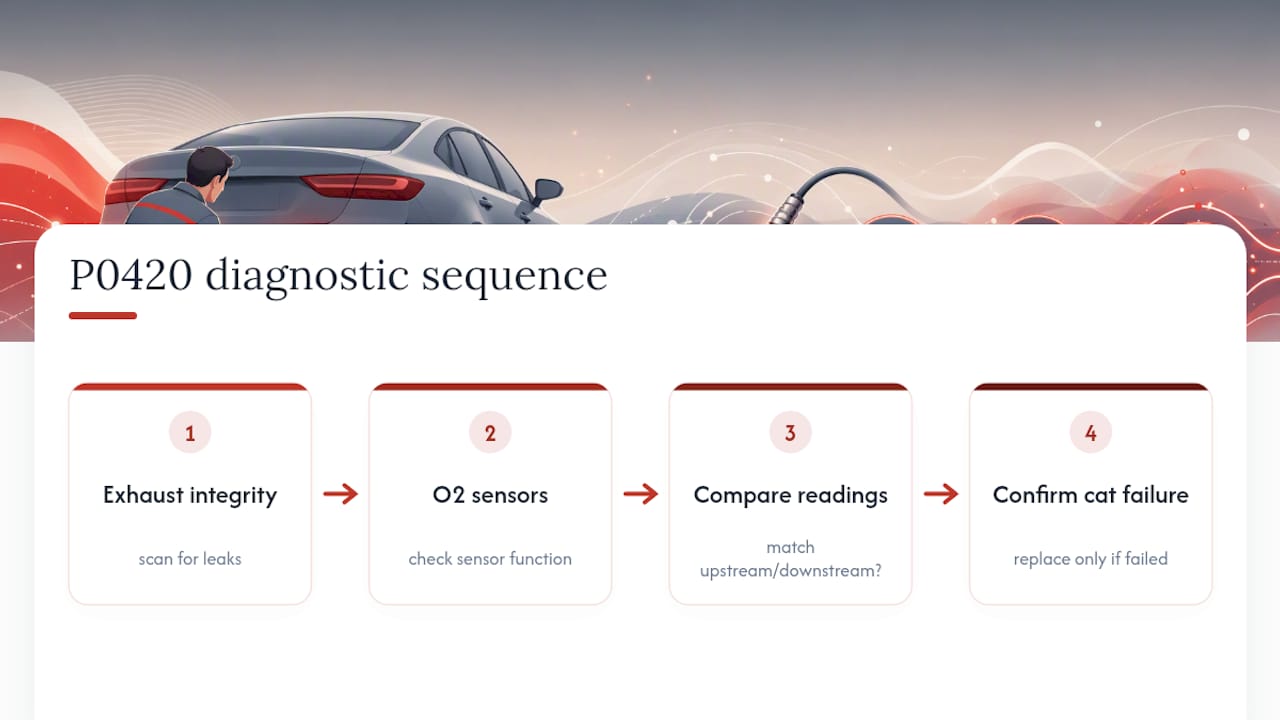
Roughly 40% of P0420 codes trace back to failing oxygen sensors, exhaust leaks, or contamination rather than a genuinely dead catalytic converter, according to a diagnostic tree analysis from Steer. That statistic alone should change how you approach this code. It’s not “replace the cat and move on.” It’s “find out what’s actually broken.”
Quick Checklist Before You Diagnose P0420
Run through this list before you touch a wrench or authorize any repair. It takes fifteen minutes and can save you hundreds of dollars in unnecessary parts.
- Scan for companion codes. Misfire codes (P0300 series), O2 sensor codes, or fuel-trim codes (P0171/P0174) almost always point to the real problem.
- Sniff and listen. A rotten-egg smell suggests converter contamination or a rich-running engine; a rattle under the car suggests a broken substrate inside the converter itself.
- Check for power loss under load. Struggling on hills or during acceleration hints at exhaust restriction, not just a sensor reading.
- Inspect for obvious exhaust leaks. Look at flanges, gaskets, and welds between the engine and the converter for soot streaks or a hissing sound at idle.
- Check O2 sensor wiring. Chafed, melted, or disconnected wiring near the exhaust manifold can mimic converter failure entirely.
- Request a live O2 waveform capture. Ask for Bank 1 Sensor 1 (upstream) versus Bank 1 Sensor 2 (downstream) data on a scan tool, not just the stored code.
Pro Tip: If a shop offers to replace your catalytic converter based on the code alone, without pulling live O2 data first, ask to see the waveform comparison before you approve the work. A five-minute scan can save you an unnecessary replacement.
How Do You Diagnose a P0420 Code Correctly?
The diagnostic order matters as much as the tests themselves. Technicians who chase P0420 successfully follow roughly the same sequence every time, and Rick’s Free Auto Repair Advice lays out that recommended order: confirm the code and freeze-frame data, check live O2 voltages, inspect for exhaust leaks, look at misfires and fuel trim, then run physical confirmatory tests only after all of that comes back clean.
-
Confirm the code and pull freeze-frame data. Your scanner will show the RPM, coolant temperature, and engine load recorded the moment P0420 triggered. A cold-start freeze-frame points toward a different cause than one recorded during highway cruising.
-
Inspect for exhaust leaks first. A leak anywhere between the engine and the downstream O2 sensor lets outside air into the exhaust stream, throwing off both sensors and making a perfectly healthy converter look inefficient. Check every gasket, flange, and weld between the manifold and the converter before you assume the converter is the problem.
-
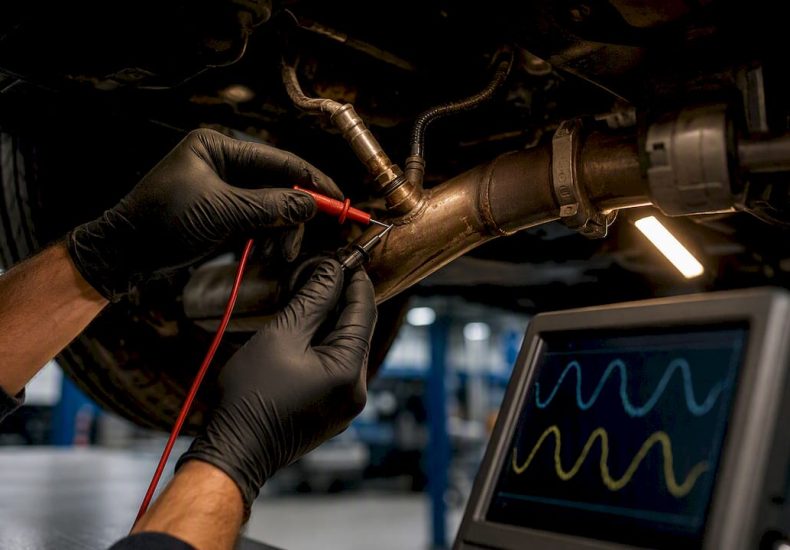
Compare upstream and downstream O2 sensor waveforms live. This is the test that actually separates a bad converter from a bad sensor or a false alarm. A healthy upstream sensor (B1S1) should switch rapidly between rich and lean, cycling several times per second under load. A healthy downstream sensor (B1S2) should read a relatively flat, steady voltage, because the converter is supposed to smooth out those fluctuations by storing and releasing oxygen. The iCarsoft diagnostic guidance confirms this pattern: when the downstream sensor starts mirroring the upstream sensor’s rapid switching instead of staying steady, the converter has lost its ability to buffer oxygen, and that’s real evidence of a failing catalyst.
-
Evaluate fuel trims and misfire counters. Pull up long-term and short-term fuel trim data. Trims running consistently above +10% or below negative 10% mean the engine is compensating for a rich or lean condition, and that condition is likely what damaged the converter in the first place. Misfires dump raw, unburned fuel into the exhaust, and that fuel ignites inside the converter, cooking the substrate from the inside. If you have any active or pending misfire codes, fix those before you spend a dollar on the converter. Unburned fuel and fuel-trim problems are the most common reasons converters die young in the first place.
-
Test the downstream O2 sensor’s response time. A sensor can pass a static voltage check but still respond too slowly to changing exhaust conditions, a condition technicians call a “lazy” sensor. Force a quick throttle snap, or briefly induce a rich or lean condition, and watch how fast the downstream sensor voltage reacts. A sluggish response, even with a technically healthy converter behind it, can trigger P0420 on its own. Since a lazy downstream sensor can be replaced for a fraction of what a new converter costs, this test alone can save real money.
Most common causes for P0420, in order of how often they show up: exhaust leaks, a failing downstream oxygen sensor, engine misfires, rich or lean fuel-trim conditions, and internal contamination from oil or coolant burning through the engine. Identifying and repairing those root causes first, according to research on P0420 causes, avoids a large share of unnecessary converter replacements.
What Proves the Catalytic Converter Itself Has Failed?
Once you’ve ruled out sensors, wiring, exhaust leaks, and misfires, three physical tests confirm whether the converter has actually failed rather than just tripped a threshold.
- Inlet versus outlet temperature. A working converter runs hotter at the outlet than the inlet, because the catalytic reaction generates heat as it processes exhaust gases. A converter that shows the same temperature at both ends, or runs cooler at the outlet, isn’t doing its job chemically, even if it’s not physically blocked.
- Backpressure testing. This test catches physical clogging that a temperature check can miss. A technician threads a pressure gauge into the exhaust system, usually at the oxygen sensor bung or a test port, and reads pressure at idle and under load. Backpressure readings that spike well above normal ranges indicate the honeycomb substrate has partially melted or collapsed, physically restricting exhaust flow.
- Rattle and visual inspection. Shake the converter housing gently or have someone rev the engine while you listen underneath the car. A rattling or shaking sound usually means the ceramic substrate has cracked or crumbled inside the shell, which is a mechanical failure no cleaning product or sensor swap will fix.
Here’s the practical distinction: a chemically depleted converter can lose its oxygen-storage capacity while the car still drives normally, showing no power loss at all. A physically clogged converter almost always causes noticeable power loss under load, because the exhaust literally cannot get out fast enough. If you’re losing power on hills or during acceleration, run the backpressure test first. If the car drives fine but the code won’t clear, focus on the sensor comparison and temperature delta instead.
What Does a P0420 Code Fix Actually Cost?
Repair costs for P0420 span a huge range, and the price tag should match what your diagnosis actually finds, not just what the code implies.
- Exhaust leak repair or gasket replacement: Often the cheapest real fix, typically running from a modest parts-and-labor charge for a flange gasket up to a few hundred dollars if a section of pipe or a manifold gasket needs replacing.
- Downstream O2 sensor replacement: A meaningful share of P0420 cases resolve with a new sensor, and OBD Advisor notes that O2 sensor replacement costs substantially less than converter replacement, generally in the range of one to two hundred dollars including labor depending on sensor location and accessibility.
- Misfire-related engine repair: Spark plugs, ignition coils, or fuel injector cleaning fall into a moderate cost range and directly protect a converter from further damage. Skipping this step means any new converter you install faces the same unburned-fuel damage that killed the old one.
- Catalytic converter replacement: The most expensive option by far. Aftermarket converters cost less than OEM units, but many states enforce CARB-compliant converters on newer vehicles regardless of which you choose, which affects both price and legality. Labor adds to the total, especially on vehicles where the converter is welded into the exhaust system rather than bolted with flanges.
Fuel additives marketed as catalytic converter cleaners deserve a specific, honest answer: do they work? Sometimes, partially, and only in a narrow situation. CRC Industries notes that these products are typically temporary measures for mild carbon buildup and cannot restore a converter that has chemically lost its oxygen-storage capacity or physically melted inside. If your converter is genuinely worn out, an additive buys you a clean readiness monitor for a state inspection at best. It won’t fix a mechanical failure, and it won’t stop the code from returning within a tank or two of fuel.
Can You Fix P0420 Yourself, or Do You Need a Shop?
Some of this diagnostic work is well within reach for an owner with a basic OBD-II scanner and some patience. Other parts genuinely require a lift, a backpressure gauge, and a technician who does this every week.
Safe to try yourself:
- Read and document the code, including freeze-frame data, before doing anything else.
- Visually inspect exhaust connections and O2 sensor wiring for obvious damage.
- Replace a downstream O2 sensor if you’ve confirmed with live data that it’s reading lazy or flat.
- Run one tank of a reputable catalytic converter cleaner as a short trial, understanding it’s a diagnostic experiment, not a guaranteed fix.
Call a shop when:
- Active misfire codes accompany the P0420.
- You suspect elevated backpressure but don’t have a gauge or safe way to test it.
- Wiring repairs involve multiple connectors or run deep under the vehicle.
- Live-data capture and waveform comparison require equipment you don’t own.
Pro Tip: Clearing the code without fixing the underlying cause resets your readiness monitors, which can cause you to fail an emissions inspection even if the car seems to be running fine. Fix first, then clear.
Why Trust This Diagnostic Order?
Tom’s B & M Auto has served Lynnwood, Washington drivers with Toyota, Honda, Subaru, and domestic vehicles for over 40 years, and every technician on staff is ASE-certified. That matters here because the live-data comparison and backpressure testing described above aren’t shortcuts. They’re the same sequence used on the shop floor every day, on professional-grade OBD-II equipment, not a fifteen-dollar code reader.
Same-day appointments are often available, and repairs carry a warranty, so a converter replacement isn’t a one-time gamble if something else surfaces later. The shop also publishes step-by-step diagnostic guides like this one specifically so owners understand what they’re paying for before authorizing work. If you’ve scanned a P0420 yourself and aren’t sure what to do next, a free check-engine-light review is a low-risk way to get a second opinion before spending money on parts.

A Technician’s Take on Why “Replace the Cat” Is Usually Wrong
“Replace the cat first” happens because it’s the part named in the code, and it’s an easy sale. But a converter is often the last domino to fall, not the first. It fails because something upstream, a leak, a lazy sensor, an unburned-fuel condition, wore it down over months.
My practical checklist for avoiding repeat failures: fix misfires before touching the converter, confirm the downstream sensor’s response time, and always retest with live data after any repair, not just a code clear. If a shop can’t show you the O2 waveform comparison, ask why not.
— Shingi
Where Tom’s B & M Auto Fits Into Your P0420 Repair
You’ve got options for chasing down a P0420 code: buy a scanner and work through the diagnostic order yourself, guess and replace parts one at a time, or bring it to a shop that already runs this exact sequence daily. Tom’s B & M Auto exists for the third option, and the diagnostic process matches everything covered above: live upstream versus downstream O2 data capture, a full exhaust leak inspection, and backpressure testing before anyone recommends a converter.
Technicians run these tests on professional-grade equipment, same-day appointments are often available, and repairs carry a warranty, so you’re not gambling on a repair that might not hold. If cost is a concern, financing options are available for larger repairs like converter replacement. The most useful first step is booking a check engine light diagnostic or requesting the shop’s free digital vehicle inspection before authorizing any parts. Get the live-data comparison done first, then decide what actually needs fixing.
Sources
For deeper technical background, the iCarsoft P0420 knowledge base and Rick’s Free Auto Repair Advice diagnostic walkthrough cover sensor waveform testing in more detail. Locally, see catalytic converter replacement in Lynnwood for service specifics, and a partner shop’s diagnostics overview for a second perspective on live-data scanning.
- P0420 Code: Catalyst System Efficiency Below Threshold (Fix) — iCarsoft US
- P0420 catalyst system efficiency below threshold causes/symptoms/fix — iCarsoft knowledge base
- P0420 trouble code explanation — Kelley Blue Book
Recommended
- Diagnose P0300 in 1–3 Hours: Lynnwood Mechanics’ Data First Fix
- Fix Engine Misfires Step by Step: A Car Owner’s Guide
- Types of Car Diagnostic Tests: 2026 Owner’s Guide
- What’s Causing Your Check Engine Light to Come On?
Leave a Reply