

The Role of Oil Control Solenoid: A Car Owner’s Guide
The oil control solenoid (OCS), also called a VVT solenoid or variable valve timing solenoid, is the ECU-controlled valve that routes pressurized engine oil to camshaft phasers so your engine can advance or retard valve timing on demand. When it fails, the engine loses its ability to optimize timing for the current load and speed, and you feel it immediately. The most common driver-facing signs are a Check Engine Light, rough idle, noticeable loss of power, poor fuel economy, and a ticking or rattling noise from the top of the engine.
If any of those symptoms sound familiar, check your oil level and condition right now. Low or dirty oil is often the real culprit. Note any OBD-II codes if your CEL is on, avoid hard acceleration or highway loads until you know what you’re dealing with, and book a diagnostic appointment if symptoms persist beyond a day or two.
Table of Contents
- What does the oil control solenoid actually do?
- What are the symptoms of a failing oil control solenoid?
- How do technicians diagnose oil control solenoid problems?
- What causes oil control solenoid problems?
- What does OCS repair cost in the U.S.?
- Is it safe to drive with a bad oil control solenoid?
- How to prevent oil control solenoid failure
- When should you bring your car to a professional?
- Key Takeaways
- Why the quick solenoid swap is usually the wrong first move
- Tom’s B & M Auto: OCS diagnostics and engine repair near Lynnwood
- Useful sources and further reading
What does the oil control solenoid actually do?
The OCS sits between the engine’s oil gallery and the camshaft phaser. When the ECU decides the engine needs more torque at low RPM, it commands the solenoid to open and direct pressurized oil into the advance chamber of the phaser, rotating the camshaft slightly relative to the crankshaft. To retard timing at high RPM for efficiency, it routes oil to the opposite chamber. The phaser is essentially a hydraulic actuator, and the OCS is the valve that tells it which way to move.
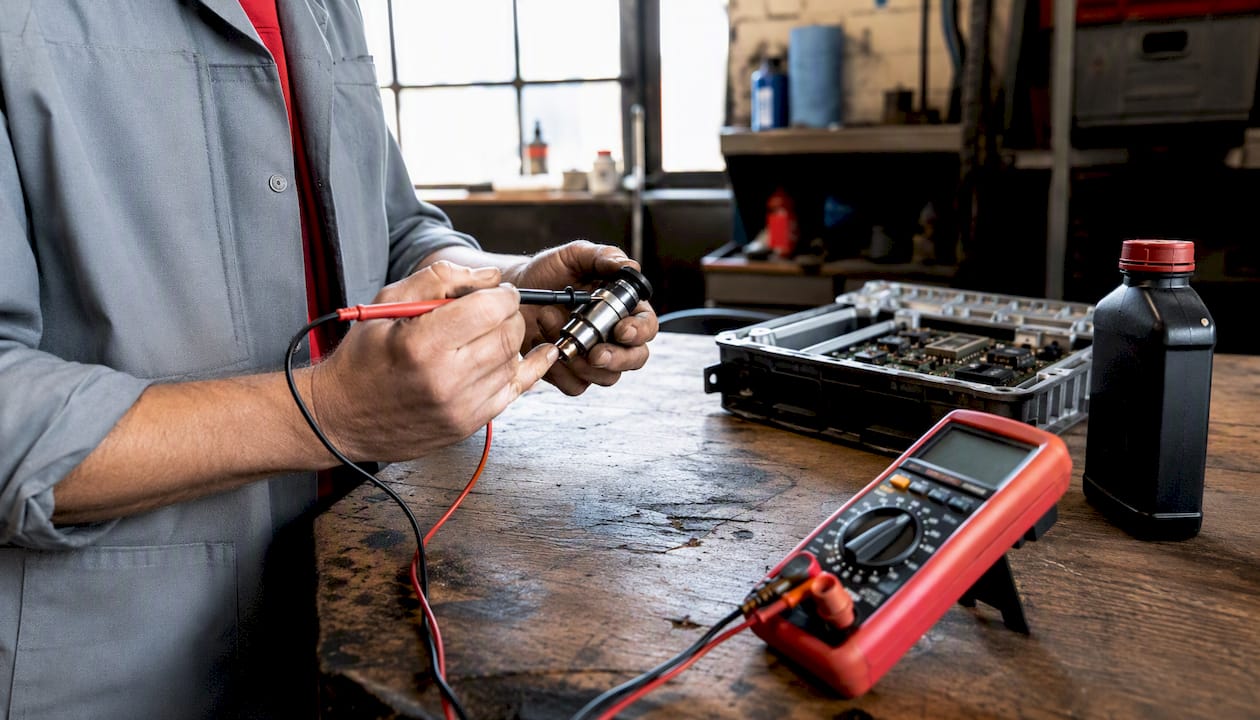
Variable valve timing systems work by using pressurized engine oil to rotate the camshaft actuator, which shifts the opening and closing events of the intake and exhaust valves relative to piston position. Without a functioning OCS, the phaser locks in one position, and the engine runs on fixed timing, like an older engine without VVT at all.
How the ECU controls the solenoid
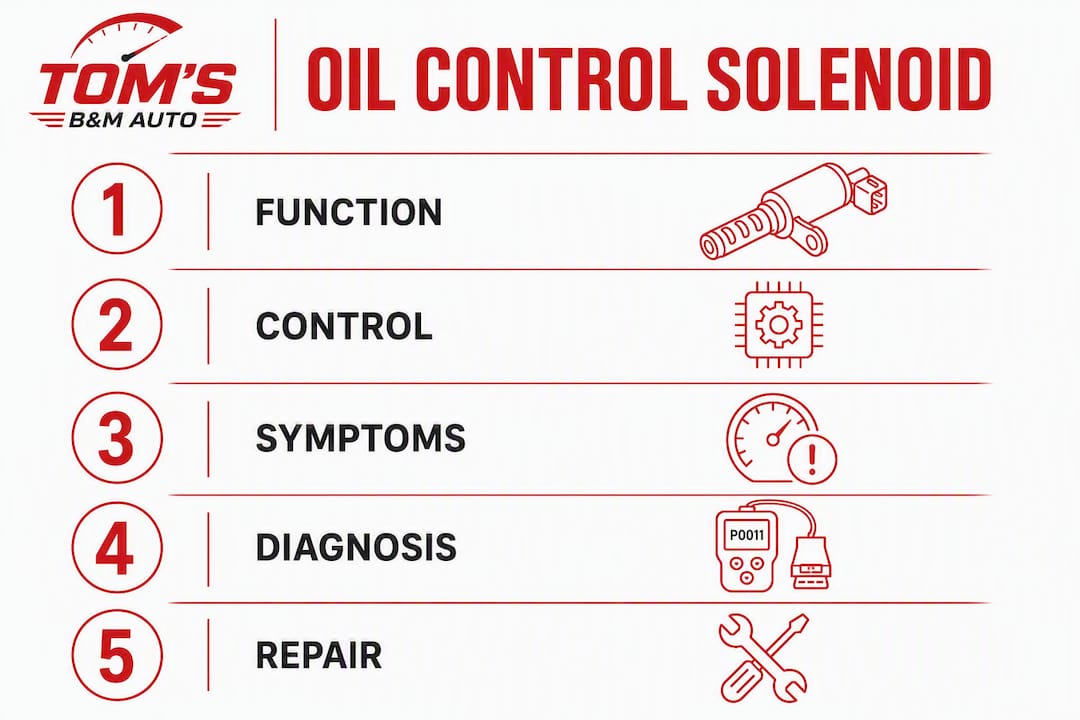
The ECU doesn’t just switch the OCS on or off. It uses pulse-width modulation (PWM), rapidly switching 12 volts on and off dozens of times per second. By varying the ratio of on-time to off-time, the ECU positions the solenoid plunger at any point along its travel, giving precise, continuous control over oil flow to the phaser. A 30% duty cycle holds the phaser partially advanced; 80% pushes it nearly to full advance. That granularity is what lets modern engines feel responsive at 1,500 RPM and efficient at 3,000 RPM.
What’s inside the solenoid and how it varies by engine
The OCS contains a few key parts:
- Electromagnetic coil — receives the PWM signal and generates a magnetic field
- Plunger/spool valve — moves in response to the magnetic field to open or close oil passages
- Fine mesh screen — filters debris before oil enters the valve body
- Oil passages and O-rings — route and seal pressurized oil to the phaser ports
Engine configuration matters here. Many 4-cylinder engines use a single OCS on the intake cam. V6 and V8 engines with dual-cam VVT can have up to four solenoids, one per cam per bank, each independently controlled. Some engines only vary intake timing; others vary both intake and exhaust, which doubles the number of solenoids and the number of potential failure points.
Pro Tip: Oil viscosity and cleanliness matter as much as the electrical signal. Contaminated or wrong-viscosity oil can make a perfectly functional solenoid appear faulty because the plunger moves correctly but the oil can’t flow fast enough to actuate the phaser.
What are the symptoms of a failing oil control solenoid?
A failing OCS commonly produces poor engine performance, reduced fuel efficiency, rough idling, stalling, rattling or ticking noises, and a triggered Check Engine Light. The tricky part is that several of these symptoms overlap with other engine problems, so the table below maps each symptom to its most likely OCS-related cause.

| Symptom | Most Likely Cause | Urgency |
|---|---|---|
| Check Engine Light (VVT codes) | ECU detects cam timing outside target range | Moderate — get codes read soon |
| Rough idle / hunting idle | Cam timing stuck or erratic at low RPM | Moderate |
| Loss of power under load | Phaser unable to advance timing for torque | Moderate |
| Poor fuel economy | Timing stuck in non-optimal position | Low to moderate |
| Ticking or rattling (cold start) | Locking pin not releasing, low oil pressure to phaser | Moderate to high |
| Engine knock or severe misfire | Timing severely retarded or advanced; pre-ignition | High — limit driving immediately |
| Stalling at idle | Extreme cam timing error disrupting combustion | High |
The ticking or rattling on cold start deserves a specific note. Many cam phasers include spring-loaded locking pins that hold the phaser in a fixed position when oil pressure is low at startup. If sludge or low oil pressure prevents those pins from releasing as the engine warms up, you get cold-start roughness and noise that can mimic a bad OCS even when the solenoid itself is fine. Engine knock and severe misfires are the two symptoms that warrant limiting driving right away. Everything else is a “get it diagnosed this week” situation, not a “pull over now” emergency.
How do technicians diagnose oil control solenoid problems?
Diagnosis is a sequence, not a single test. Jumping straight to solenoid replacement without working through the steps below is how shops end up replacing a functional part and missing the real problem.
Step-by-step diagnostic checklist
-
OBD-II scan with freeze-frame data. Pull all stored and pending codes. Common VVT-related DTCs include P0008, P0014, P0017, and manufacturer-specific camshaft timing codes. Freeze-frame data shows engine speed, load, and temperature at the moment the fault triggered, which narrows down whether the fault is cold-start, load-related, or constant.
-
Visual and wiring inspection. Check the OCS connector for corrosion, bent pins, or cracked insulation. Wiggle the harness with the engine running to see if symptoms change. A loose connector can cause intermittent codes that look like a failing solenoid.
-
Resistance and continuity test. Disconnect the OCS and measure coil resistance with a multimeter. Most solenoids specify coil resistance within a range depending on the application.; check the service manual for the exact value. An open circuit (infinite resistance) or short to ground confirms coil failure. Also check the wiring harness for continuity back to the ECU.
-
Commanded actuation via scan tool. A bidirectional scan tool can command the OCS to activate while monitoring cam position with a live data PID. If the ECU commands 80% duty cycle and cam position doesn’t change, the problem is either oil supply or a mechanical phaser issue, not the solenoid coil.
-
Oil condition and pressure check. Inspect the oil on the dipstick. Dark, sludgy oil or oil that smells burnt is a red flag. Check oil pressure at idle and at operating RPM. Low pressure starves the phaser regardless of what the solenoid does.
-
Oscilloscope or waveform capture. Connect an oscilloscope to the OCS signal wire to verify the ECU is actually sending a clean PWM signal. Capturing PWM waveforms with an oscilloscope or advanced scan tool separates ECU command problems from solenoid response problems. Compare the cam position sensor waveform against the crank sensor waveform to check for timing correlation.
Pro Tip: Disconnect the OCS before capturing cam/crank waveforms. With the solenoid connected, the ECU actively tries to correct any timing error, which can mask a stretched or jumped timing chain. Locking the cam mechanically first gives you a clean baseline.
The tool list for a complete diagnosis: OBD-II scanner with bidirectional control, digital multimeter, oscilloscope or advanced scan tool with waveform capability, bench power source for bench-testing the solenoid off the car, and basic hand tools for access.
A solenoid that tests electrically good can still fail to produce cam movement if the phaser is damaged or the oil supply is blocked. Electrical tests and oil-condition checks always go together. Skipping one makes the diagnosis incomplete.
What causes oil control solenoid problems?
Failures fall into three categories, and knowing which one applies changes the repair entirely.
Electrical failures
- Corroded or damaged connector pins — common on high-mileage vehicles or those exposed to road salt
- Open circuit in the solenoid coil from heat cycling over time
- Wiring shorts caused by chafing against engine components
- ECU output driver failure (less common, but possible on high-mileage vehicles)
Oil supply and contamination failures
- Sludge clogging the fine mesh screen inside the solenoid body, blocking oil flow even when the plunger moves correctly
- Wrong oil viscosity — too thick reduces flow speed; too thin reduces pressure
- Low oil level from consumption or leaks (see why your car burns oil for related causes)
- Low oil pressure from a worn pump or clogged pickup screen
Mechanical failures
- Worn or seized cam phaser that won’t rotate even with correct oil pressure
- Stretched or jumped timing chain causing a fixed cam-to-crank offset that no solenoid can correct
- Locking pin failure inside the phaser — a sheared pin can cause startup knock that mimics other timing problems
Heavy sludge is the clearest sign of maintenance neglect. If you pull the OCS and find the screen packed with black debris, the oil change intervals were too long or the wrong oil was used. That’s a systemic problem, not just a solenoid problem, and the phaser passages and oil galleries likely need cleaning too.
What does OCS repair cost in the U.S.?
Repair costs vary significantly depending on whether the problem is a simple solenoid swap, a contamination cleanup, or a full timing-chain job. A practical repair workflow often starts with an oil and filter service and targeted cleaning of the OCS passages before replacing the solenoid when contamination is the likely cause.
| Repair Type | Typical U.S. Cost Range | Notes |
|---|---|---|
| OCS replacement (parts + labor) | $150 to $400 | Varies by vehicle access and number of solenoids |
| Cleaning OCS passages + oil service | $100 to $250 | Often the first step when sludge is found |
| Cam phaser replacement | $400 to $900 | Labor-intensive; more on V6/V8 |
| Full timing-chain service | — | Depends heavily on engine layout and labor hours |
| Wiring/connector repair | $75 to $200 | Straightforward if harness damage is localized |
These are ballpark figures for the U.S. market. Actual quotes depend on your vehicle’s make, model, and how accessible the solenoid is. A Toyota Camry with a single intake OCS is a much simpler job than a BMW with four solenoids buried under intake manifolds.
When you get a repair estimate, ask for:
- A written diagnostic report showing the codes, waveform data, or resistance readings that confirmed the fault
- Photo evidence of sludge or failed parts if contamination was found
- The shop’s warranty terms on parts and labor
- Return of the replaced parts if you want to inspect them
Pro Tip: If a shop recommends replacing cam phasers or a timing chain without first showing you waveform proof or a failed resistance test, ask for the diagnostic data. Technicians emphasize pairing electrical tests with oil-pressure checks and mechanical timing verification to avoid replacing functional components. A $200 diagnostic can save you from an unnecessary $1,500 repair.
For larger repairs, financing options can make the cost manageable without delaying a necessary fix.
Is it safe to drive with a bad oil control solenoid?
Driving with a faulty OCS is possible but not recommended. Here’s how to think about the risk:
Short-term (days, not weeks):
- Degraded power and rough idle are annoying but not immediately dangerous
- Increased emissions may cause a failed smog test
- Short, low-load trips to a shop are generally acceptable
- Avoid highway driving, towing, or hard acceleration
Long-term risks if ignored:
- Sustained incorrect valve timing causes pre-ignition and knock, which damages pistons and rings
- Repeated misfires from timing errors accelerate catalytic converter wear
- A stuck-advanced cam can cause valve-to-piston contact on some interference engines
- Engine knock left unaddressed leads to bearing damage and, eventually, engine failure
The practical rule: if your only symptom is a CEL with a VVT code and the engine runs smoothly, you have a short window to get it diagnosed. If you hear engine knock, feel severe misfires, or the car stalls, limit driving to getting it to a shop and nothing more. Check your oil level before every drive in the meantime.
How to prevent oil control solenoid failure
Most OCS failures are preventable with consistent maintenance. The solenoid itself is a simple electromechanical part; what kills it is usually the oil it depends on.
- Follow your manufacturer’s oil change interval. Most modern engines specify an oil change interval within a moderate range for conventional oil and longer intervals for full synthetic. Extended drains with degraded oil are the single biggest cause of VVT sludge problems.
- Use the correct oil viscosity. Check your owner’s manual, not the parts-store shelf. A 5W-30 engine running 10W-40 will see reduced flow speed to the phaser, especially at cold start.
- Check oil level monthly. Low oil level reduces pressure to the phaser before any warning light comes on. A routine oil check takes 60 seconds and catches consumption problems early.
- Listen at cold start. A brief tick that disappears within 10–15 seconds as oil pressure builds is normal. A tick that persists past 30 seconds, or a rattle that comes and goes, is worth investigating.
- Inspect connectors at every major service. Connector corrosion is slow and invisible until it causes an intermittent fault. A quick visual check and dielectric grease application costs nothing.
- Address oil leaks promptly. Running low on oil from a slow leak is a common path to phaser and OCS damage. See why your car leaks oil for the most common sources.
For high-mileage vehicles, consider a shorter oil change interval and an engine flush if sludge is suspected before it reaches the OCS screen.
When should you bring your car to a professional?
Some checks, like reading your own OBD-II codes with a $30 scanner or checking oil condition on the dipstick, are genuinely useful for owners. But the full diagnostic sequence for an OCS problem requires equipment and training that go beyond DIY.
Bring your car in when you see any of these:
- CEL with a stored VVT or camshaft timing code (P0008, P0014, P0017, or similar)
- Engine knock at any RPM
- Repeated misfires that return after clearing codes
- Persistent loss of power that doesn’t improve after an oil change
- Cold-start rattle lasting more than 30 seconds
What to bring to the shop:
- A note of your symptoms: when they started, whether they’re worse at cold start or under load, and whether they’re constant or intermittent
- Any OBD-II codes you’ve already pulled
- Your recent oil change history: mileage, oil type, and who did it
- Any recent repairs that might be relevant
At Tom’s B & M Auto in Lynnwood, the diagnostic flow for an OCS concern starts with a full OBD-II scan and freeze-frame review, moves to a visual and electrical inspection of the solenoid and wiring, then to commanded actuation tests and waveform capture if needed. Oil condition and pressure are checked as part of the same visit, not as a separate appointment. If the phaser or timing chain needs attention, the shop documents findings with photos and waveform screenshots before recommending any additional work. All repairs carry a 24-month / 24,000-mile warranty, and pricing is given upfront before any work begins. Same-day appointments are often available for check engine light diagnostics.
For owners with advanced engine timing concerns, the shop’s ASE-certified technicians handle cam/crank waveform correlation and timing-chain diagnostics as part of the same service visit.
Key Takeaways
The oil control solenoid is an ECU-controlled valve that routes pressurized oil to camshaft phasers, and oil health, not just electrical function, determines whether it works correctly.
| Point | Details |
|---|---|
| OCS role | Routes pressurized oil to cam phasers under ECU/PWM control to advance or retard valve timing. |
| First owner action | Check oil level and condition, pull OBD-II codes, and limit hard driving until diagnosed. |
| Most common root cause | Sludge and wrong-viscosity oil block oil flow even when the solenoid coil tests electrically good. |
| Prevention | Follow manufacturer oil change intervals and use the correct viscosity to prevent sludge buildup. |
| Tom’s B & M Auto | Offers full OCS diagnostics with waveform capture, oil condition checks, and a 24-month / 24,000-mile warranty on all repairs. |
Why the quick solenoid swap is usually the wrong first move
The most common misdiagnosis pattern is straightforward: car comes in with a VVT code, shop replaces the solenoid, code returns two weeks later. The solenoid was never the problem. The oil was.
Trainers at Tomorrow’s Technician make the same point: the OCS gets blamed first because it’s accessible and relatively cheap to replace. But if the oil gallery is lined with sludge or the phaser’s locking pin has sheared, a new solenoid changes nothing. The fix costs the owner twice, and the underlying damage continues.
What actually protects owners is insisting on a complete diagnostic before any parts are ordered. A waveform check that shows the ECU commanding the solenoid correctly while cam position doesn’t respond tells you the problem is downstream of the solenoid, not in it. That one data point redirects the repair entirely. Get codes read before you buy anything.
Tom’s B & M Auto: OCS diagnostics and engine repair near Lynnwood
When a VVT code or rough idle sends you looking for answers, the difference between a $200 fix and a $1,500 one usually comes down to how thoroughly the shop diagnosed it before touching anything.
Tom’s B & M Auto has served Lynnwood, Kenmore, Mountlake Terrace, and surrounding communities since 1985. ASE-certified technicians run the full diagnostic sequence on every OCS concern: OBD-II scan, electrical resistance check, commanded actuation, waveform capture, and oil condition review, all in one visit. No guessing, no parts-swapping without evidence. Bring your symptom notes, any codes you’ve already pulled, and your recent oil change history. The shop handles all makes, including Toyota, Honda, Subaru, and domestic vehicles. Every repair carries a warranty covering parts and labor for a period defined by both time and mileage limits. Book your engine repair in Kenmore or claim a free digital vehicle inspection to get started.
Useful sources and further reading
For owners who want to go deeper on OCS function, diagnostics, and related systems, these are the most useful references:
- Valve Timing Control (VTC) Oil Control Solenoid — TroubleCodes.net — Clear explanation of how pressurized oil acts on camshaft actuators; useful for owners who want the mechanical picture.
- Types of Car Diagnostic Tests: 2026 Owner’s Guide — Tom’s B & M Auto Blog — Explains scan-tool capabilities and bidirectional testing for owners unfamiliar with what a shop’s diagnostic equipment can do.
- Fix Engine Misfires Step by Step — Tom’s B & M Auto Blog — Useful companion read for owners whose OCS symptoms include misfires.
Recommended
- The Role of Transmission Solenoid in Automatic Gear Shifting – Tom’s B & M Auto Blog
- Why Your Car Burns Oil: Causes, Checks, and Fixes – Tom’s B & M Auto Blog
- Common Honda Repair Needs: Your 2026 Owner’s Guide – Tom’s B & M Auto Blog
- Common Hybrid Vehicle Service Needs: 2026 Owner’s Guide – Tom’s B & M Auto Blog
Leave a Reply