

Common Honda Repair Needs: Your 2026 Owner’s Guide
Honda vehicles are defined by their reliability, but even the most dependable cars have predictable repair patterns. Honda ranks highest in reliability among 32 brands with only 0.3 unscheduled repairs per year on average. That number is impressive, but it does not mean zero repairs. Common Honda repair needs fall into two clear categories: routine maintenance items and engine-specific problems tied to particular models. Knowing which category your car falls into lets you plan ahead, budget accurately, and avoid the kind of neglect that turns a $200 fix into a $3,000 bill.
1. Common Honda repair needs: routine maintenance that prevents bigger problems
The most frequent Honda service requirements are not dramatic. They are oil changes, brake inspections, tire rotations, and fluid replacements. Skipping or delaying these tasks is the single fastest way to turn a reliable car into an expensive one.
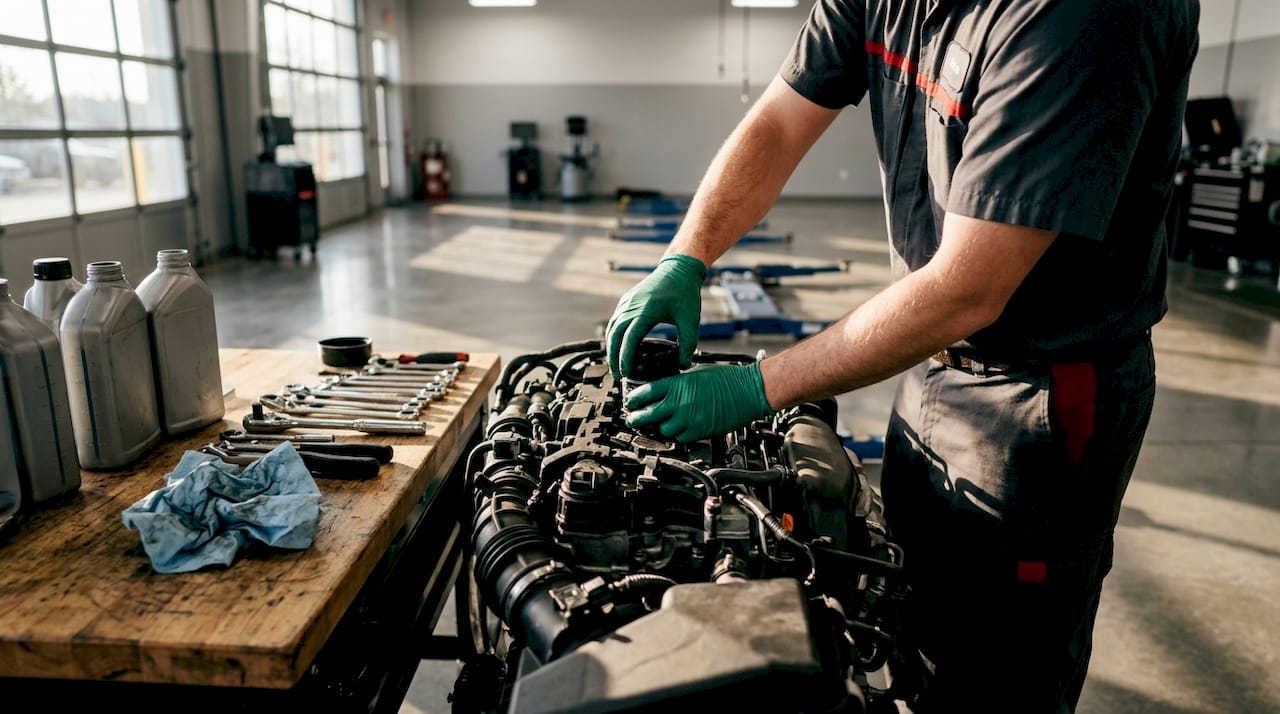
Oil and filter changes are the foundation of Honda longevity. Standard intervals apply for most drivers, but owners of 1.5-liter turbocharged engines in cold climates need to pay closer attention. Fuel dilution in these engines can cause the oil level to rise and the lubricating film to thin under load, which accelerates wear faster than the Maintenance Minder system detects.
Brake system care goes beyond pad replacement. Brake fluid replacement every 3 years is advised regardless of Maintenance Minder status to prevent hydraulic pressure loss and internal corrosion. This matters most in hilly or humid environments, where brake systems work harder and moisture absorption in the fluid accelerates.
Tire rotation and pressure checks should follow the Honda Maintenance Minder schedule, typically every 5,000–7,500 miles. Uneven wear on Hondas often signals an alignment issue rather than a tire problem, so catching it early saves both tires and suspension components.
- Oil and filter changes per Maintenance Minder or sooner in cold climates
- Brake fluid replacement every 3 years regardless of minder status
- Tire rotation every 5,000–7,500 miles with alignment checks
- Air filter replacement at 15,000–30,000 miles depending on driving conditions
- Cabin air filter replacement annually or when airflow drops noticeably
Pro Tip: Do not treat the Honda Maintenance Minder as a rigid calendar. Maintenance Minder does not replace attentive responses to warning lights or region-specific needs. If you drive short trips in cold weather, change your oil more often than the system suggests.
2. Timing belt replacement for Honda J-Series V6 engines
The timing belt is the most consequential scheduled service on any Honda with a J-Series V6 engine. This includes the Accord V6, Pilot, Odyssey, Ridgeline, and several Acura models. Four-cylinder Honda engines and newer V6 designs use timing chains, which are internal and do not require scheduled replacement. The J-Series V6 is the exception, and ignoring its service interval is one of the costliest mistakes a Honda owner can make.
The mandatory replacement interval is 105,000 miles or 7 years, whichever comes first. The preventive service costs $1,400–$2,200. If the belt snaps before replacement, engine repair or replacement runs $3,000–$6,000 or more. That gap in cost makes this the clearest example of why scheduled maintenance pays for itself.
| Service item | Interval | Estimated cost |
|---|---|---|
| Timing belt replacement | 105,000 miles or 7 years | $1,400–$2,200 |
| Water pump (replace simultaneously) | Same as timing belt | Included or minimal add-on |
| Tensioner and idler pulleys | Same as timing belt | Included or minimal add-on |
| Timing belt failure repair | N/A (emergency) | $3,000–$6,000+ |
Technicians recommend replacing the water pump, tensioner, and idler pulleys at the same time as the belt. Skipping any of these components means the engine must be fully disassembled again if one fails shortly after. The labor cost alone makes that scenario far more expensive than doing everything at once.
Pro Tip: If you bought a used Honda Accord V6 or Pilot and cannot confirm the timing belt history, treat it as overdue. A timing belt replacement done proactively costs a fraction of what a snapped belt will.
3. Fuel dilution in 1.5T engines and VCM oil consumption in V6s
Two engine-specific problems affect a significant portion of Honda’s modern lineup. Both are manageable, but only if you know they exist.
Fuel dilution in the 1.5-liter turbo engine
The 1.5T engine powers the Civic, CR-V, HR-V, and Accord four-cylinder. In cold climates, short trips prevent the engine from reaching full operating temperature. Gasoline washes past the piston rings and mixes with the oil, thinning it and raising the oil level on the dipstick. Cold-climate owners should change oil every 3,500–5,000 miles despite what the Maintenance Minder reads. Honda has issued software updates that partially reduce the problem, but they do not eliminate it entirely. If you live in the Pacific Northwest or anywhere with cold winters, check your oil level and smell between changes.
VCM oil consumption in V6 models
Variable Cylinder Management (VCM) is Honda’s fuel-saving technology that deactivates cylinders during light loads. The system works, but it creates uneven pressure cycles that accelerate valve seal wear and cause oil consumption in some V6 models. VCM-related oil consumption can often be addressed by replacing the solenoid screen or installing a VCM disabler device, with parts costing $30–$60. That targeted fix prevents a much more expensive engine overhaul.
Connecting rod bearing failures in 2016–2020 J35 V6 engines have generated more than 3,000 consumer complaints and triggered a federal investigation. Affected models include the Pilot, Ridgeline, Odyssey, Acura TLX, and MDX. Owners of these vehicles should check for open recalls and consider a pre-purchase inspection before buying used.
- Check for open recalls on your VIN at NHTSA.gov before any major repair
- Ask your technician to inspect rod bearing condition during any J35 V6 engine service
- For 1.5T owners, check oil level monthly and note any rise or fuel smell
- Request a software update check for 1.5T fuel dilution at your next service visit
- Do not ignore an oil consumption warning. Low oil pressure causes permanent engine damage fast
4. Additional frequent Honda repairs and early warning signs
Beyond the major engine-specific issues, Honda owners encounter a predictable set of secondary repairs as mileage climbs. Honda’s reliability reduces repair frequency, but repair complexity and cost increase noticeably after 60,000 miles. Knowing what to watch for keeps small problems from becoming large ones.
Power steering pump leaks appear in older Hondas with hydraulic steering systems. The first sign is usually a whining noise during low-speed turns. Catching a small leak early costs far less than replacing a pump that has run dry.
Starter motor failures tend to show up gradually. A slow crank or a single click when you turn the key are early warnings. Waiting until the car will not start at all means you are dealing with a tow truck on top of the repair bill.
Air conditioning problems are common in high-mileage Hondas, typically involving refrigerant leaks or compressor wear. AC repairs are worth addressing before summer, not during it, when shop schedules fill up.
Ignoring dashboard warning lights and delaying minor repairs often leads to expensive multi-thousand dollar problems. The check engine light alone covers dozens of potential issues, from a loose gas cap to a failing catalytic converter. Getting it read promptly at a shop with professional OBD-II diagnostics costs nothing compared to what delayed diagnosis can become.
Early warning signs worth acting on immediately:
- Check engine, oil pressure, or temperature warning lights
- Unusual noises during braking, turning, or acceleration
- Visible fluid spots under the car after parking
- Pulling to one side during braking or straight-line driving
- A fuel smell inside the cabin or near the engine bay
For owners managing post-warranty repair costs, building a small repair reserve each month makes a real difference. High-mileage Honda care is covered in detail in the maintenance tips for high-mileage vehicles guide from Tom’s B & M Auto.
Key takeaways
Honda’s most costly repairs are almost always the result of delayed maintenance, not mechanical failure. Proactive service on timing belts, oil changes, and brake fluid prevents the majority of expensive Honda repair bills.
| Point | Details |
|---|---|
| Timing belt is critical | Replace J-Series V6 timing belt at 105,000 miles or 7 years to avoid $3,000–$6,000+ failure costs. |
| 1.5T owners need more frequent oil changes | Cold-climate short trips cause fuel dilution; change oil every 3,500–5,000 miles regardless of minder. |
| VCM issues have cheap fixes | A $30–$60 solenoid screen or disabler device often resolves V6 oil consumption without an overhaul. |
| Brake fluid needs a 3-year schedule | Replace brake fluid every 3 years independent of Maintenance Minder to prevent hydraulic failure. |
| Dashboard lights demand prompt action | Delaying warning light diagnosis turns minor issues into multi-thousand dollar repairs. |
What 40 years of working on Hondas actually teaches you
Honda owners often fall into a false sense of security. The car starts every morning, runs quietly, and the Maintenance Minder stays green. So they wait. That waiting is exactly where the expensive repairs come from.
The timing belt is the clearest example I keep coming back to. A customer brings in a 2014 Pilot with 112,000 miles. The car drives fine. No warning lights. But the belt is 7,000 miles past its service interval and the water pump shows early weep marks. We replace everything together for just under $1,800. Two months later, another customer comes in with the same model, same mileage range, but the belt snapped on the highway. That repair crossed $5,200 before we were done.
The difference between those two outcomes was not luck. It was one owner following a schedule and one owner assuming “fine” meant “safe.”
The same logic applies to the 1.5T fuel dilution issue. Owners in Lynnwood and the surrounding area drive in exactly the conditions that trigger it: cold mornings, short commutes, stop-and-go traffic. The Maintenance Minder will tell you the oil is fine at 8,000 miles. Your dipstick will tell you a different story if you check it. Check it.
My honest advice: find a shop you trust, build a relationship with your technician, and treat your Honda’s service history as a financial document. Every skipped service is a deferred cost, and deferred costs always come due at the worst possible time.
— Shingi
Honda repair and maintenance at Tom’s B & M Auto
Tom’s B & M Auto has served Honda owners in the Lynnwood area since 1985. ASE-certified technicians handle everything from routine oil changes and brake fluid replacements to timing belt services and engine diagnostics using professional-grade OBD-II equipment.
If a repair estimate is larger than expected, financing options are available to spread the cost without delaying necessary work. Honda owners in the area can also book Honda repair in Edmonds or Honda repair in Alderwood Manor with same-day appointments often available. All work carries a 24-month / 24,000-mile warranty. Call or book online to schedule your next service.
FAQ
How often should I change oil in a Honda 1.5T engine?
Cold-climate owners driving short trips should change oil every 3,500–5,000 miles regardless of what the Maintenance Minder displays. Fuel dilution in the 1.5T engine thins the oil faster than the system detects.
Which Honda engines need a timing belt replacement?
Honda J-Series V6 engines require timing belt replacement at 105,000 miles or 7 years. Most Honda four-cylinder engines use a timing chain and do not require scheduled replacement.
What does VCM oil consumption look like in a Honda V6?
The most common signs are low oil level between changes and blue smoke from the exhaust under light throttle. A solenoid screen replacement or VCM disabler device often resolves the issue for $30–$60 in parts.
How do I know if my Honda has an open recall?
Enter your VIN at NHTSA.gov to check for open recalls. This is especially important for 2016–2020 Pilot, Odyssey, and Ridgeline owners given the federal investigation into J35 V6 connecting rod bearing failures.
What is the Honda Maintenance Minder and when should I override it?
The Honda Maintenance Minder calculates service intervals based on driving data. Override it for brake fluid replacement every 3 years and for oil changes in cold climates with short trips, where the system underestimates actual wear.
Recommended
- Hybrid Battery Service Explained: 2026 Owner’s Guide – Tom’s B & M Auto Blog
- How to Reset Service Maintenance Light: Car Owner Guide – Tom’s B & M Auto Blog
- European Car Repair Challenges: What Owners Must Know – Tom’s B & M Auto Blog
- Honda Repair in Edmonds, WA | Tom’s B&M Auto
Leave a Reply