How to Negotiate Auto Repair Costs and Pay Less
Negotiating auto repair costs is a normal, achievable practice that most car owners never attempt. The industry term for this process is cost negotiation on repair estimates, and it applies to labor rates, parts pricing, shop supply fees, and diagnostic charges. Tools like RepairPal, AutoMD, and labor guides from AllData give you the benchmarks to walk into any shop conversation with facts, not guesses. Consumer protection laws in many states also set legal limits on how much a shop can charge beyond a written estimate without your approval. Knowing these rules before you authorize any work puts real money back in your pocket.
What are the main components of auto repair costs?
Auto repair bills break down into four main categories: labor, parts, shop supplies, and diagnostic fees. Each one is negotiable to some degree, and each one has an industry standard you can reference.
Labor rates are the biggest variable. Standard shop labor rates range from $95 to $220 per hour as of Q2 2026. Dealerships typically sit at the top of that range. Independent shops often land in the middle or lower end.
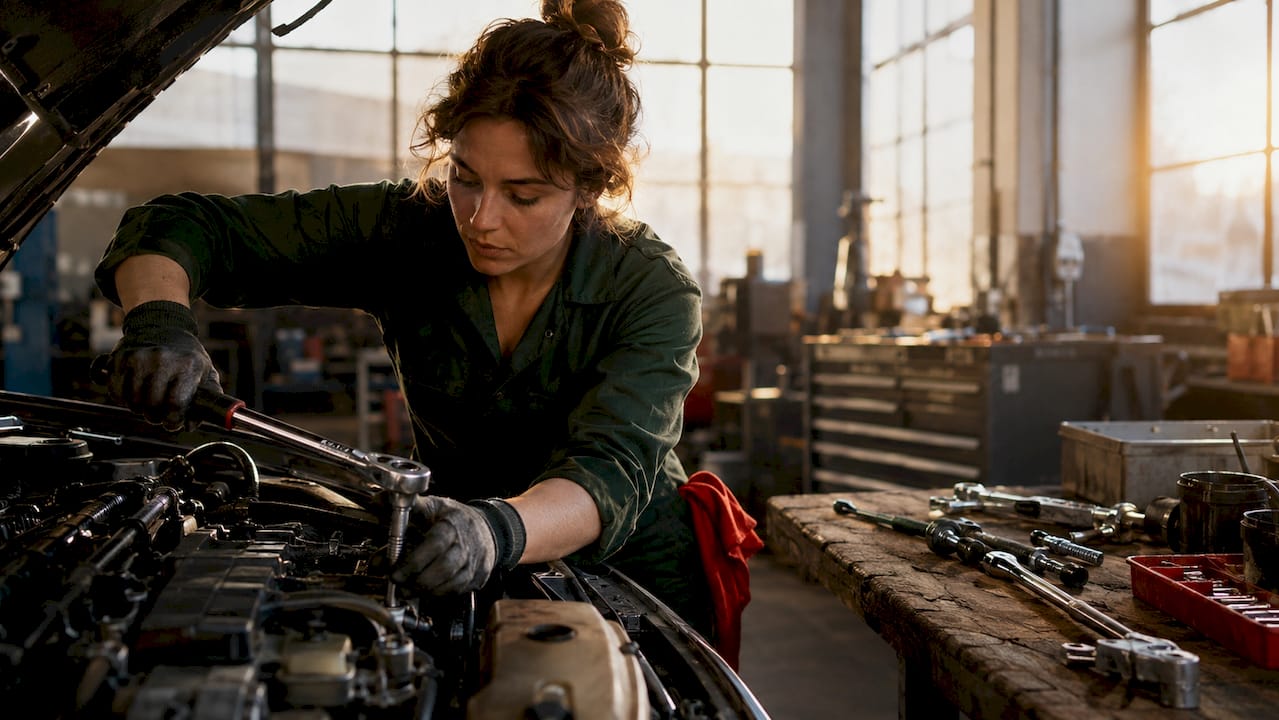
Parts pricing includes a markup that covers the shop’s sourcing, warranty, and logistics costs. That markup can run 30%–50% or more above the shop’s wholesale cost. Remanufactured parts can cost roughly 40% less than new OEM parts while still carrying a warranty. Asking whether aftermarket or remanufactured options are available is one of the fastest ways to reduce car repair bills.
Shop supply fees cover small consumables like rags, fluids, and fasteners. These fees typically run 5%–10% of total labor. A flat fee above $50 on a minor repair is worth questioning. Ask for an itemized breakdown if the supply charge looks high.
Diagnostic fees range widely by shop, usually $50–$100. Many shops credit that fee toward your final bill if you approve the repair. Always confirm this upfront before authorizing the diagnostic work.
- Labor: $95–$220/hr depending on shop type and location
- Parts: subject to 30%–50% markup; OEM, aftermarket, and remanufactured options exist
- Shop supplies: 5%–10% of labor; request itemization if the fee seems high
- Diagnostic fees: $50–$100; ask if credited toward repair approval
Pro Tip: Request a fully itemized estimate before approving any work. A line-by-line breakdown shows you exactly where the money goes and gives you specific items to discuss.
How should you prepare before negotiating repair costs?
Preparation is what separates a car owner who gets a discount from one who pays full price. The goal is to walk in with printed data, not just a feeling that the quote is too high.
- Get at least two or three estimates. Prices for the same repair can vary significantly between shops. Comparing auto repair quotes from multiple sources gives you a real market price, not just one shop’s number.
- Use online estimators. RepairPal and AutoMD both provide fair-price ranges for common repairs based on your zip code, vehicle make, and model. Print or screenshot the range before your appointment.
- Check book time. Labor hours are standardized through guides published by AllData and Mitchell. These are called “book time” hours. If a shop charges three hours for a job that book time lists at 1.5 hours, you have a concrete discrepancy to raise.
- Get a second opinion on large repairs. For any repair over $500, a second opinion costs $50–$100 and can save you far more. That cost is worth it when the original quote is for a transmission or engine job.
- Know your legal rights. In many states, shops cannot exceed a written estimate by more than 10% without your prior consent. If a shop wants to go over that threshold, they must contact you for approval before proceeding.
The table below shows the key research tools and what each one gives you.
| Tool | What it provides | Best used for |
|---|---|---|
| RepairPal | Fair price ranges by zip code and vehicle | Benchmarking labor and parts costs |
| AutoMD | Repair cost estimates and DIY guides | Comparing shop quotes |
| AllData | Industry book time labor hours | Verifying labor charges |
| Mitchell | Book time and OEM parts data | Cross-checking labor hours |
Pro Tip: Bring printed RepairPal or AutoMD estimates to the shop. A physical document carries more weight than a number you mention from memory.
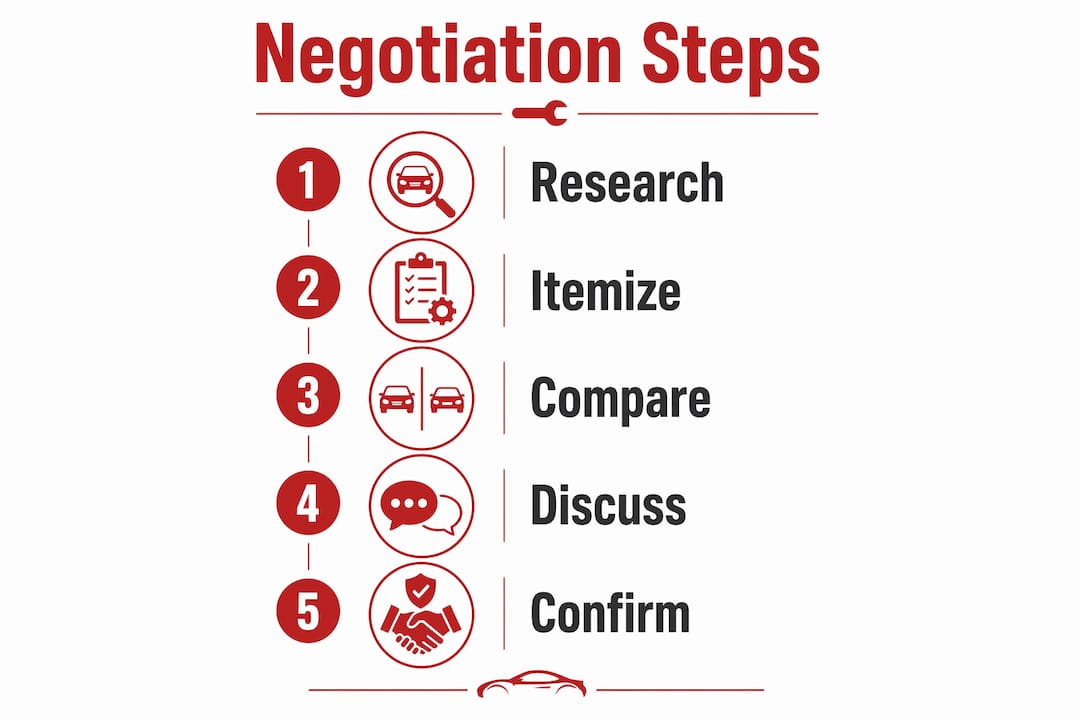
What negotiation techniques actually lower your repair bill?
Calm, data-driven conversation is the most effective negotiation technique. Aggression puts the service advisor on the defensive. Facts give them a reason to adjust.
- Lead with the discrepancy, not the complaint. Say: “RepairPal shows a fair range of $280–$340 for this job in Lynnwood. Your quote is $480. Can you walk me through the difference?” That framing invites explanation rather than confrontation.
- Request an itemized invoice. A line-by-line breakdown lets you identify which specific charges are high. You cannot negotiate what you cannot see.
- Negotiate parts choice. Ask directly: “Do you offer aftermarket or remanufactured options for this part?” Remanufactured parts carry warranties and cost significantly less than new OEM parts.
- Bundle repairs to cut labor. Bundling multiple repairs that share overlapping disassembly steps can reduce total labor charged. If the shop is already pulling the engine apart for one job, adding a second related repair avoids duplicate teardown time.
- Ask about the diagnostic fee. If you approve the repair, ask whether the diagnostic fee gets credited toward the total bill. Many shops say yes when asked directly.
- Request a goodwill adjustment. If you are a repeat customer or the shop made an error, ask politely for a goodwill adjustment. Shops value long-term customers and will often absorb small overcharges to keep the relationship.
- Confirm everything in writing. Get a written estimate before work starts. Authorize additional work only through a written update to that estimate.
“Presenting objective data like industry book time is more likely to secure discounts than aggressive tactics.” — Engineerskill.blog
Pro Tip: If a shop refuses to negotiate at all on a large repair, be prepared to walk away. A shop confident in fair pricing will explain their numbers. One that refuses to discuss them is a red flag.
What negotiation mistakes should car owners avoid?
The most common mistake is accepting the first estimate without any research. A car owner who walks in without benchmark data has no basis for discussion and will almost always pay the listed price.
- Skipping the comparison step. One estimate is not enough. Two or three estimates reveal the real market rate for your repair.
- Getting confrontational. Raising your voice or accusing a technician of fraud ends the conversation. Keep the tone professional and focused on numbers.
- Approving work verbally. Never approve additional repairs without a written update to your estimate. Verbal approvals are hard to dispute later.
- Ignoring shop supply fees. These small line items add up. A $75 supply fee on a $200 repair is worth questioning.
- Not checking labor hours. If a shop charges four hours for a job that AllData lists at two hours, that is a concrete overcharge you can dispute.
- Losing your documentation. Keep copies of every estimate, invoice, and written authorization. If a dispute arises, paying by credit card gives you access to the Fair Credit Billing Act as a consumer protection tool.
Learning how to avoid unnecessary upsells at your shop is a related skill that protects you from inflated bills before negotiation even becomes necessary.
How does shop type affect pricing and your ability to negotiate?
Where you take your car matters as much as how you negotiate. Shop type directly affects the labor rate you start from and how much flexibility the service advisor has.
| Shop type | Typical labor rate | Pricing flexibility | Notes |
|---|---|---|---|
| Dealership | High (top of $95–$220 range) | Low | Corporate rate structures limit discounts |
| Independent shop | Mid to low range | High | Owner-operated shops have more pricing flexibility |
| Local specialty shop | Varies | Moderate to high | Often more personalized; may negotiate on loyalty |
| Chain repair center | Mid range | Low to moderate | Standardized pricing; limited advisor authority |
Independent local shops often charge lower labor rates than dealerships while employing technicians with equivalent or greater experience. Many independent shops are staffed by former dealership master mechanics who left to reduce overhead. That lower overhead translates directly into lower rates for you.
Dealerships have corporate rate structures that service advisors cannot easily override. A dealership advisor who wants to help you may simply lack the authority to discount. An independent shop owner has full control over their pricing and a direct financial reason to keep you as a customer.
Community resources like owner forums on Reddit, Toyota Nation, and Honda-Tech regularly surface reviews of local shops. These forums often include specific labor rate data shared by other owners. That information gives you local market benchmarks that RepairPal and AutoMD sometimes miss.
For owners of specific makes, understanding the pricing environment for your vehicle type helps set realistic expectations. European car owners, for example, face higher parts costs and fewer aftermarket options, which changes the negotiation calculus compared to domestic or Japanese makes.
Key takeaways
Negotiating auto repair costs works when you combine benchmark research, itemized estimates, and calm professional conversation before authorizing any work.
| Point | Details |
|---|---|
| Know the cost components | Labor, parts, shop supplies, and diagnostic fees are all negotiable with the right data. |
| Research before you go | Use RepairPal, AutoMD, and AllData book time to build a fact-based position. |
| Choose parts strategically | Remanufactured parts can cost roughly 40% less than OEM while still carrying a warranty. |
| Bundle repairs when possible | Combining overlapping repairs reduces total labor by avoiding duplicate disassembly charges. |
| Document everything | Get written estimates and written authorization for all additional work before it starts. |
What I’ve learned from watching car owners negotiate repairs
The car owners who consistently pay less are not the loudest ones in the waiting room. They are the ones who arrive with a printed RepairPal estimate, ask for an itemized invoice without apology, and treat the service advisor like a professional they want to work with long-term.
I have seen bundling repairs save hundreds of dollars in a single visit. When a shop is already deep into a timing cover job, adding a water pump replacement at the same time costs a fraction of what it would as a standalone repair. Most shops will offer that discount without being asked. But if they do not, asking directly almost always works.
The remanufactured parts conversation is another one that pays off consistently. Most car owners do not know to ask. When you do ask, shops that carry remanufactured options will usually present them. The savings are real and the quality is often comparable to new OEM parts for common components like alternators, starters, and brake calipers.
The one habit I would push hardest: get everything in writing. A verbal agreement is worth nothing if the bill comes in $300 higher than discussed. Written estimates and written authorizations are your only real protection.
— Shingi
Fair pricing and financing at Tom’s B & M Auto
Tom’s B & M Auto has served Lynnwood, WA since 1985 with upfront pricing, written estimates, and ASE-certified technicians on every job. When you bring a RepairPal benchmark or a competing quote, the team will walk through the numbers with you directly.
For repairs that run higher than expected, Tom’s B & M Auto offers financing options to help spread the cost without delaying necessary work. Current specials include $50 off any repair over $300 and $150 off any repair over $1,000. Same-day appointments are often available, and all work carries a 24-month / 24,000-mile warranty. Call (425) 776-5054 or visit bandmautocare.com to schedule.
FAQ
Can you actually negotiate with a mechanic on price?
Yes. Presenting benchmark data from tools like RepairPal or AllData book time gives you a factual basis for discussion, and calm, data-driven conversation is the most effective approach.
How much can a shop legally charge over the written estimate?
In many states, shops cannot exceed a written estimate by more than 10% without your prior consent. Any additional work requires a new written authorization from you.
Are remanufactured parts a good way to lower repair costs?
Remanufactured parts typically cost around 40% less than new OEM parts and still carry a warranty. They are a reliable option for components like alternators, starters, and brake calipers.
When should I get a second opinion on a repair?
Get a second opinion on any repair quoted over $500. A second diagnostic typically costs $50–$100 and can reveal significant price differences between shops.
What should I do if a shop charges more than the agreed estimate?
Request an itemized invoice and compare it against your written estimate. If the overcharge exceeds 10% without your prior approval, you have grounds to dispute it. Paying by credit card also gives you access to the Fair Credit Billing Act as a dispute tool.
Recommended
- Financing Available | Tom’s B&M Auto | Lynnwood, WA
- How to Avoid Unnecessary Upsells at Your Auto Shop – Tom’s B & M Auto Blog
- How to Get an Accurate Repair Shop Estimate in Lynnwood – Tom’s B & M Auto Blog
- Auto Repair Warranty Explained: What Car Owners Must Know – Tom’s B & M Auto Blog
Leave a Reply