
Hidden Car Repair Costs: Real Examples and How to Avoid Them
Hidden car repair costs are unexpected fees and charges that inflate your final bill well beyond the original quoted price. These costs show up in many forms: diagnostic fees charged multiple times, parts markups buried in vague invoices, unauthorized add-on repairs, and storage fees that start accruing without warning. Organizations like AAA, the California Bureau of Automotive Repair, and Motor1 have all documented how common these examples of hidden car repair costs are. Knowing what to look for before you approve any work is the most effective way to protect your budget.
1. What are examples of hidden car repair costs?
Hidden repair costs, also called undisclosed auto repair fees, are charges that were not clearly explained or agreed upon before work began. They fall into several predictable categories. Vague or uncapped fees like shop supplies and environmental charges presented as open-ended percentages are among the most common red flags. Duplicate diagnostic charges, parts markups without itemization, unauthorized add-on repairs, and post-repair storage fees round out the list.
The core problem is an information gap. Many drivers cannot judge fair prices or verify repairs independently. That gap makes it easy for a shop to add charges you would never question. The sections below break down each category with real examples.

2. Diagnostic fees charged more than once
Diagnostic fees cover the technician’s time and the equipment used to identify a fault. A single OBD-II scan for a check engine light is reasonable. The problem starts when your car has multiple warning lights, such as ABS, traction control, and a check engine light, and the shop charges a separate diagnostic fee for each one.
AAA Northeast advises car owners to ask about the full scope of diagnostics upfront and to consider second opinions when results seem incomplete or expensive. Incomplete diagnostics are another trap. If a technician misdiagnoses the root cause, you pay again when the car comes back with the same problem. That second fee is rarely flagged as a repeat charge.
Red flags to watch for:
- Multiple line items labeled “diagnostic” on the same estimate
- No explanation of which system each diagnostic covers
- A diagnostic fee that does not apply toward the repair cost
- A new diagnostic fee issued after partial disassembly with no new written estimate
Pro Tip: Ask the shop directly: “Does this diagnostic fee apply toward the repair total, and under what conditions would you issue a new diagnostic charge?” Get the answer in writing before approving any work. LegalClarity recommends this as a standard budgeting step.
3. Parts markup and vague invoicing
Parts markup is the difference between what a shop pays for a part wholesale and what it charges you. Every shop adds markup. That is normal and legal. The hidden cost arrives when the invoice gives you no way to evaluate whether the markup is fair.
Mechanic Insights identifies several invoice red flags that signal a parts pricing problem. Vague descriptions like “sensor” or “gasket” with no brand name, part number, or OEM versus aftermarket classification make it impossible to compare prices. You also cannot verify warranty coverage without that information. A bundled line item that combines parts and labor into one price hides the markup entirely.
Invoice red flags for parts pricing:
- No brand name or part number listed
- No indication of OEM, aftermarket, or remanufactured status
- Parts and labor combined into a single line item
- No warranty information for the part installed
- Refusal to provide an itemized breakdown on request
Pro Tip: Insist on a fully itemized invoice before approving repairs. It should list each part’s brand, part number, OEM or aftermarket status, individual price, and warranty. Requiring separate itemization of parts versus labor is the clearest way to spot excessive markup.
4. Unauthorized add-on repairs that expand your bill
This category produces some of the most dramatic examples of car repair fees growing out of control. A real case reported by Motor1 shows how a straightforward repair can spiral: what started as a single repair turned into a $4,000 total bill after a dealership added a thermostat replacement, a coolant leak repair, and strut work once the car was already partially disassembled.
A UK mystery shopping investigation found even starker results. Garages quoted up to five times the expected cost for a simple oxygen sensor replacement. Some garages quoted as high as £672 for a repair expected to cost around £110, then added unrelated recommendations like brakes and spark plugs worth an additional £400 to £950.
The legal protection here is clear. Mechanics must get explicit authorization before performing any work beyond what you originally approved. Unauthorized repairs can be legally challenged and may not be payable.
Here is how to handle add-on repair requests:
- Ask the technician to show you the problem directly, either in person or through photos.
- Treat every added repair as a separate authorization decision, not a package deal.
- Request a revised written estimate before approving any additional work.
- Ask whether the added repair is safety-critical or can wait for a second opinion.
- Never approve add-ons verbally. Written or recorded approval is your legal protection.
“When estimates increase due to additional findings, request photographic or documented proof and treat added work as separately authorized to negate unwarranted add-ons.” — Motor1 case analysis
You can also read more about how to avoid unnecessary upsells before your next shop visit.
5. Storage fees and other non-service charges
Storage fees are charges a shop applies when your vehicle sits on their lot after repairs are completed and you have been notified to pick it up. The California Bureau of Automotive Repair specifies that storage fees start accruing only after approved repairs are finished and the owner has been properly notified. Fees that begin before notification or before work is complete are potentially unlawful and can be disputed.
Beyond storage, car owners sometimes encounter miscellaneous administrative fees, hazardous waste disposal charges, and shop supply fees that appear on the final invoice with no prior disclosure. The table below shows common non-service fees and what to ask about each one.
| Fee Type | When It Applies | What to Ask |
|---|---|---|
| Storage fee | After repair completion and owner notification | “When exactly does storage begin, and what is the daily rate?” |
| Shop supply fee | Consumables like rags, cleaners, and fluids | “Is this a fixed amount or a percentage of the bill?” |
| Environmental fee | Disposal of fluids and hazardous materials | “What does this cover, and is it capped?” |
| Administrative fee | Paperwork or processing charges | “Is this disclosed in your written estimate?” |
Pick up your vehicle promptly once notified. Even a few extra days can add meaningful costs. If you are facing a large repair bill and need time to arrange payment, financing options can help you retrieve your car faster and avoid storage fee accrual.
6. How to identify and avoid surprising car repair charges
Proactive habits eliminate most invisible repair costs before they appear on your invoice. The single most effective step is reviewing every line of an estimate before you sign anything. Estimates with vague line items, duplicate diagnostics, and unexplained percentage fees are the clearest signs that a bill will grow unexpectedly.
Practical steps to protect yourself:
- Review every estimate line by line and ask for plain-language explanations of anything unclear.
- Get a written authorization form for every repair, including any additions discovered mid-job.
- Request a second opinion for any repair quoted above a few hundred dollars or with an ambiguous diagnosis.
- Ask for an itemized invoice separating parts, labor, and fees with full descriptions.
- Check whether your vehicle’s warranty or extended service plan covers any of the recommended repairs before approving them. The auto repair warranty guide from Tom’s B & M Auto explains what coverage typically applies.
- Use a shop that offers digital vehicle inspections with photos, so you can see the problem yourself.
Pro Tip: A free check engine light review, like the one Tom’s B & M Auto offers, removes the first diagnostic fee entirely. Starting with a free check engine review gives you a baseline before any paid work begins.
The costs of neglected car maintenance compound over time. Skipping routine services creates the exact conditions where a shop can justify multiple repairs at once, making it harder to separate what is genuinely urgent from what is not.
Key Takeaways
Hidden auto repair costs are predictable and avoidable when you review every estimate line by line, require written authorization for all work, and insist on itemized invoices that separate parts, labor, and fees.
| Point | Details |
|---|---|
| Diagnostic fees can multiply | Ask upfront if the fee applies toward repairs and whether separate warning lights trigger separate charges. |
| Parts markup hides without itemization | Require brand name, part number, OEM or aftermarket status, and warranty on every invoice. |
| Add-ons need separate written approval | Never authorize additional repairs verbally; written consent is your legal protection against unauthorized charges. |
| Storage fees start after notification | Pick up your vehicle promptly once notified to prevent daily storage fees from accruing. |
| Second opinions cut costs | For any repair over a few hundred dollars, a second opinion often reveals a lower price or a simpler fix. |
What I’ve learned about hidden fees after 40 years of watching repair bills
The pattern I see most often is not outright fraud. It is a slow accumulation of small, poorly explained charges that no single customer thinks to question. A $45 shop supply fee here, a second diagnostic charge there, and a vague “miscellaneous” line item at the bottom. Individually, none of them seem worth arguing about. Together, they can add $200 to $400 to a bill before any actual repair work is even discussed.
The most effective thing a car owner can do is slow down the approval process. Shops count on customers feeling pressured to say yes quickly, especially when the car is already on the lift. Asking for a written estimate, taking five minutes to read it, and asking one or two direct questions about unclear items changes the dynamic entirely. Shops that give clear answers are worth trusting. Shops that get defensive about basic questions are telling you something.
I also think the second-opinion habit is underused. Most car owners treat it as an insult to the first shop. It is not. For any repair above a few hundred dollars, a second opinion is just good financial practice. AAA’s own Car Doctor column recommends it for complex diagnostics. If both shops agree, you have confidence. If they disagree, you have information.
The information gap is the real engine behind most hidden car repair expenses. The more you know about what a repair should cost and what a fair invoice looks like, the less room there is for surprise charges to appear.
— Shingi
Transparent repairs and financing at Tom’s B & M Auto
Tom’s B & M Auto has served Lynnwood, WA since 1985 with upfront pricing, ASE-certified technicians, and itemized estimates on every job.
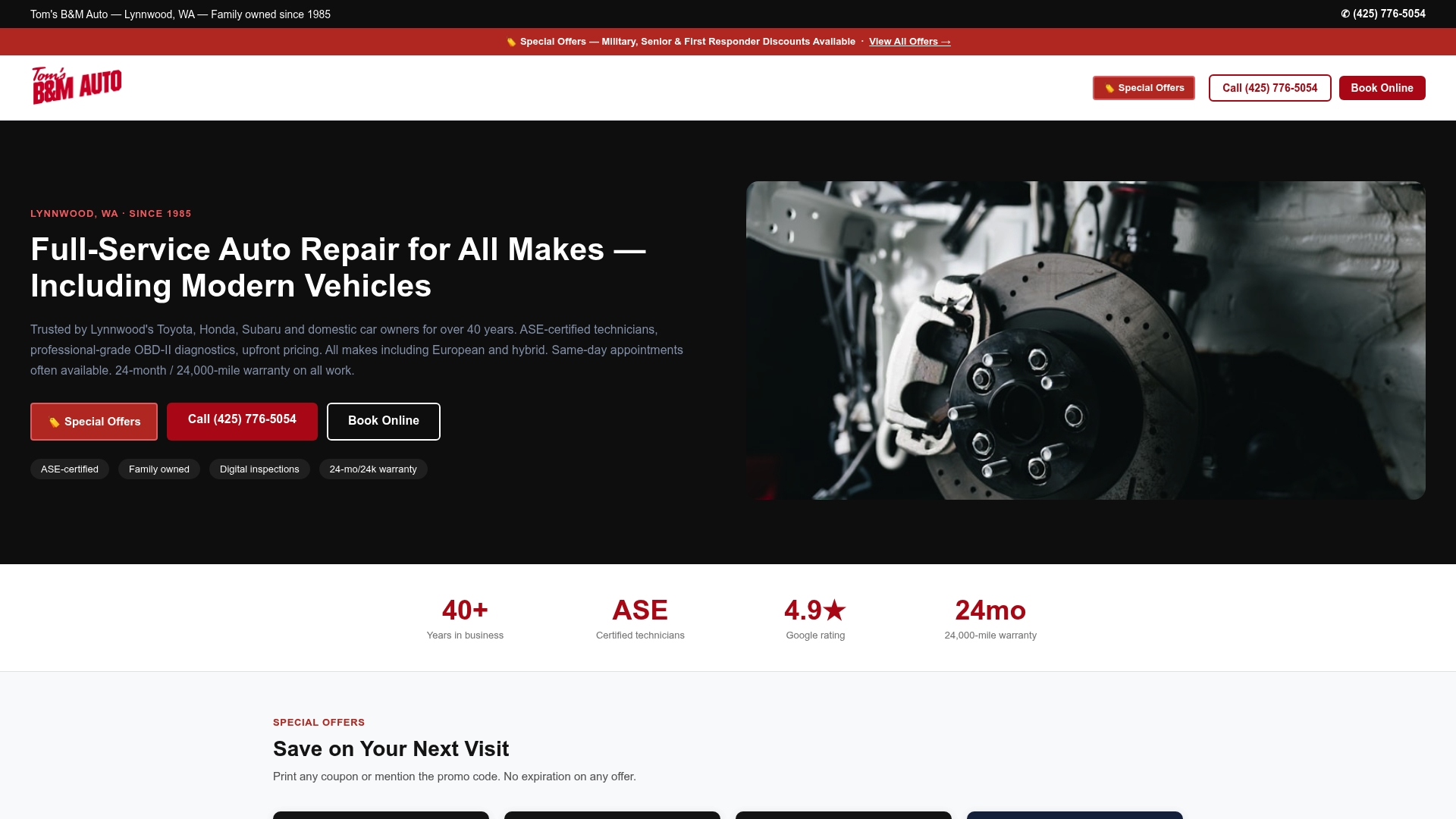
Every repair starts with a clear written estimate. Tom’s B & M Auto offers a free digital vehicle inspection so you can see exactly what needs attention before approving any work. For larger repairs, repair financing is available to help you manage costs without delaying necessary service. Same-day appointments are often available, and all work carries a 24-month / 24,000-mile warranty. Call or book online to get a straight answer on what your car actually needs.
FAQ
What are the most common hidden car repair costs?
The most common hidden auto repair costs include duplicate diagnostic fees, parts markup without itemization, unauthorized add-on repairs, uncapped shop supply fees, and post-repair storage charges. Reviewing your estimate line by line before approving work is the most direct way to catch them.
Can a mechanic legally charge for work you did not approve?
No. Mechanics must get explicit authorization before performing any work beyond what you originally approved. Unauthorized repairs can be legally challenged and may not be payable.
When do storage fees start at a repair shop?
Storage fees are only allowed to start after approved repairs are completed and the vehicle owner has been properly notified. Fees that begin before notification are potentially unlawful under California BAR rules and similar consumer protection standards in other states.
How do I spot parts markup on my invoice?
Parts markup is hidden when invoices list vague descriptions with no brand name, part number, or OEM versus aftermarket status. Require a fully itemized invoice that separates parts from labor and includes warranty information for every part installed.
Should I get a second opinion on a large repair estimate?
Yes. AAA Northeast recommends second opinions for complex or costly repairs, particularly when diagnostic results are ambiguous. A second opinion either confirms the first shop’s findings or reveals a lower-cost alternative.
Recommended
- European Car Repair Challenges: What Owners Must Know – Tom’s B & M Auto Blog
- Financing Available | Tom’s B&M Auto | Lynnwood, WA
- How to Avoid Unnecessary Upsells at Your Auto Shop – Tom’s B & M Auto Blog
- Auto Repair Warranty Explained: What Car Owners Must Know – Tom’s B & M Auto Blog
Leave a Reply