
How to Avoid Unnecessary Upsells at Your Auto Shop
Unnecessary upsells at an auto shop are defined as services a technician recommends that your vehicle’s manufacturer schedule, current condition, or diagnostic data does not support. The industry term for this practice is “service padding,” and it costs American car owners real money every visit. The FTC warned 97 auto dealership groups in March 2026 about deceptive pricing practices, including undisclosed add-on fees and bundled services not reflected in advertised prices. To avoid unnecessary upsells at your auto shop, you need three things: knowledge of your car’s actual maintenance schedule, a written itemized estimate before any work starts, and the confidence to say no until you see supporting evidence.
How to avoid unnecessary upsells using your maintenance schedule
Your car’s owner’s manual is the single most reliable source for knowing what services are actually due. Toyota, Honda, Subaru, and most domestic manufacturers publish precise mileage and time intervals for every service item. When a shop recommends something not listed in that schedule, the burden of proof is on them, not you.

The Edmunds Maintenance Guide is a free online resource that cross-references manufacturer schedules by year, make, and model. It gives you an independent second opinion before you even walk into a shop. Tools like CarMD Connect go further by pulling live OBD-II diagnostic data from your vehicle, so you can see exactly which fault codes are active and which systems are running normally.
Shops that skip asking about your maintenance history rely on your uncertainty. If you walk in knowing your last oil change was 4,200 miles ago and your brake fluid was replaced 18 months ago, you are far harder to upsell. Many additives, treatments, and flushes that shops recommend are already covered by modern synthetic oils and fuel formulations, making them genuinely unnecessary for most vehicles.
- Check your owner’s manual before every service visit and note what is actually due.
- Cross-reference with the Edmunds Maintenance Guide for an independent confirmation.
- Use CarMD Connect or a personal OBD-II reader to verify active fault codes yourself.
- Keep a written maintenance log with dates, mileage, and services performed.
Pro Tip: When a shop recommends a service, ask them to show you the manufacturer’s specification that supports it. A trustworthy shop will pull up the data without hesitation. One that deflects or uses vague urgency language is a red flag.
What legally protects you from upsells: authorization and itemized estimates
The strongest legal protection against service padding is documented authorization. California’s Bureau of Automotive Repair (BAR) publishes the “Write It Right” framework, which requires shops to obtain customer authorization before beginning any repairs. That authorization must be recorded on the estimate, and customers must receive a copy of any signed document. While this is California law, it reflects best practice that every car owner in every state should demand.
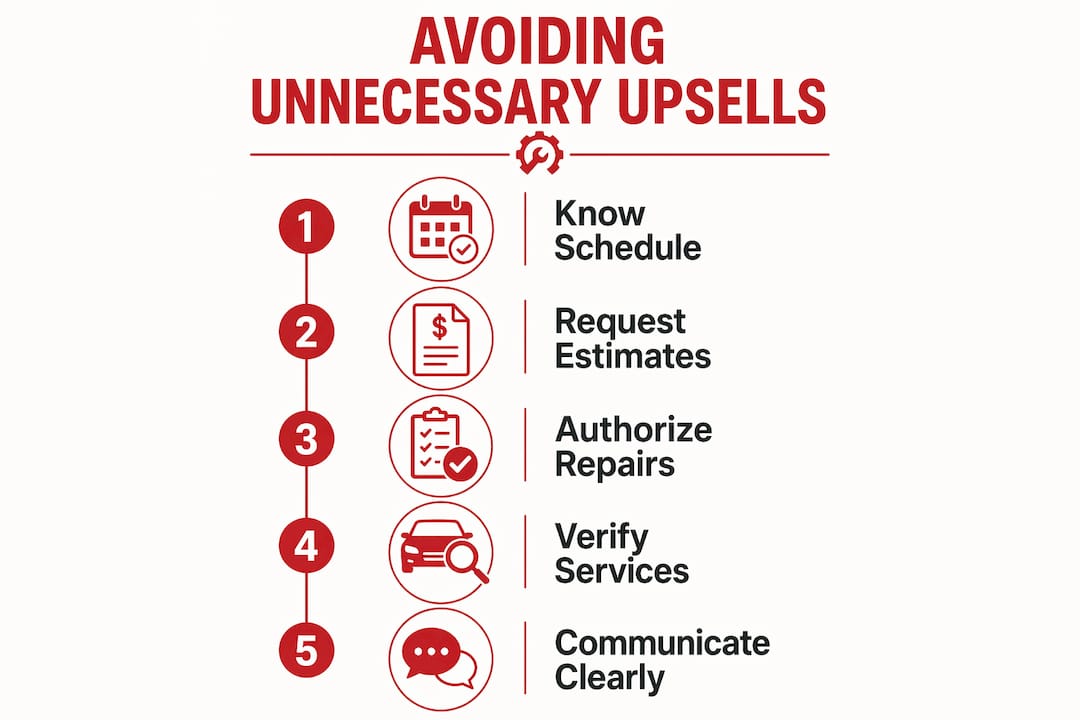
Itemized estimates are not just a courtesy. They are your financial defense. California regulations require that hazardous waste disposal costs be listed separately by job on both the estimate and the invoice. Generic “shop supply” or “miscellaneous parts” line items without job-specific detail are prohibited under these rules. If your estimate contains vague fees, ask for a line-by-line breakdown before signing anything.
Here is how authorization boundaries work in practice:
- Authorize the diagnosis only. Pay for the diagnostic inspection first, separately from any repair work. This prevents a shop from starting repairs before you know the full picture.
- Authorize required immediate repairs. Once you have the diagnostic results, approve only the work that is confirmed necessary and urgent.
- Evaluate optional services separately. Any recommended but non-urgent service gets its own written estimate and its own authorization. Never bundle optional items into a single approval.
- Request written documentation for each step. Every authorization should be on paper or email, with your signature or written confirmation.
- Verify fees are job-specific. Confirm that any disposal or supply fees on your invoice correspond to the specific job performed, not a blanket shop charge.
Pro Tip: Ask the shop to separate your authorization into three distinct approvals: diagnosis, required repairs, and optional services. Shops that support authorization boundaries help you stay in control of costs and prevent scope creep.
| Service Category | When to Authorize |
|---|---|
| Diagnostic inspection | Always first, before any repair discussion |
| Safety-critical repairs | After reviewing written diagnostic results |
| Manufacturer-scheduled maintenance | When confirmed due per owner’s manual |
| Optional flushes or treatments | Only with manufacturer data supporting need |
| Hazardous waste or supply fees | Only when itemized by specific job on estimate |
Common upsell tactics auto shops use and how to spot them
Rising repair costs create the conditions for fear-based selling. The average check engine light repair cost rose 33% to $554 in 2025, driven by a 51% increase in labor costs and a 23% rise in parts prices. Shops know that number scares customers, and some use it to push repairs that are not immediately necessary.
The most common upsell tactics follow predictable patterns. Recognizing them before you sit across from a service advisor gives you a significant advantage.
- Urgency language without data. Phrases like “you really need this today” or “I wouldn’t drive it out of here without fixing this” are pressure tactics unless backed by a written diagnostic report.
- Premature parts replacement. Brake pads, air filters, and belts have measurable wear indicators. If a shop recommends replacement without showing you the measurement or wear reading, ask to see it.
- Redundant flushes and additives. Transmission flushes, fuel injector treatments, and coolant additives are frequently recommended on vehicles that do not need them. Modern synthetic fluids already contain the additives these services claim to add.
- Bundled “while we’re in there” services. A legitimate add-on is one that saves labor because the component is already accessible. An upsell is one that adds unrelated work to an open repair order.
- Vague line items on estimates. “Miscellaneous parts” or “shop supplies” without job-specific detail are a signal to ask questions. Charging separately for shop supplies without itemization is prohibited under California BAR regulations.
| Common Upsell | When It’s Genuinely Needed | When It’s Likely Padding |
|---|---|---|
| Fuel injector treatment | Confirmed injector deposits via diagnostic | Routine oil change visit with no fault codes |
| Transmission flush | Manufacturer interval reached or fluid is dark | Under mileage threshold, fluid tests clean |
| Brake fluid flush | Moisture content test shows contamination | Arbitrary time interval with no test data |
| Cabin air filter replacement | Filter visibly clogged or past interval | Recently replaced, no mileage basis given |
| Coolant flush | Corrosion inhibitor depleted on test strip | Manufacturer interval not yet reached |
How to communicate with your mechanic to reduce upsells
Clear communication before and during a service visit is the most practical tool you have. Ask for a written, itemized estimate before approving any work. This is not an unusual request. Any shop that resists providing one in writing is telling you something important about how they operate.
Visual walkthroughs and clear explanations of mechanical issues reduce the predatory element of upsells by giving you direct knowledge of what is actually wrong. A trustworthy shop will walk you to the vehicle, show you the worn component, and explain why it needs attention now versus later. If a shop cannot or will not do this, that is a reason to get a second opinion.
Here are specific steps to take on every service visit:
- State your budget and priorities upfront. Tell the service advisor you want to address safety-critical items first and would like any additional recommendations in writing with supporting data.
- Ask “can this wait?” for every non-urgent recommendation. Shops that distinguish between needs-now and needs-later repairs are the ones worth trusting. A good shop will tell you honestly when something can be safely deferred.
- Request the parts pricing breakdown. Understanding how parts pricing works in auto repair helps you recognize when a markup is reasonable versus excessive.
- Use polite but firm language. “I’d like to think about that one” or “Can you put that recommendation in writing with the manufacturer spec?” are completely reasonable responses to any upsell.
- Get a second opinion on repairs over $300. For any significant repair, a second written estimate from another ASE-certified shop gives you both a price check and a confirmation of necessity.
The goal is not to be adversarial. It is to be informed. Shops that operate with integrity welcome informed customers because those customers become long-term clients.
Key takeaways
Avoiding service padding at an auto shop requires documented authorization, a written itemized estimate, and knowledge of your car’s actual manufacturer maintenance schedule before you approve any work.
| Point | Details |
|---|---|
| Know your maintenance schedule | Use your owner’s manual and Edmunds Maintenance Guide to confirm what is actually due before each visit. |
| Demand itemized estimates | Require written, job-specific line items for every fee, including hazardous waste disposal, before authorizing work. |
| Use authorization boundaries | Approve diagnosis, required repairs, and optional services separately to prevent scope creep and surprise charges. |
| Recognize upsell red flags | Urgency language without diagnostic data, vague line items, and redundant flushes are the most common warning signs. |
| Ask for evidence, not just advice | Request manufacturer specs or wear measurements to support any repair recommendation before you say yes. |
Why trust matters more than tactics in auto repair
I have spent enough time around auto repair shops to know that most service advisors are not villains. They work on commission or quota structures that reward upsells, and the incentive is built into the business model. That does not make it right, but it does explain why it happens so consistently.
The customers who get the best outcomes are not the ones who argue the most. They are the ones who come in prepared. They know their maintenance history, they ask for written estimates without apology, and they treat “no” as a complete sentence when a recommendation lacks supporting data. That posture signals to a shop that you are not a soft target, and most advisors will adjust accordingly.
What I find genuinely useful is the authorization boundary approach. Approving diagnosis first, then required repairs, then optional services as three separate decisions changes the entire dynamic of a service visit. You stop being a passenger in the process and start being the decision-maker. That shift alone eliminates most of the upsell pressure before it starts.
The shops worth returning to are the ones that distinguish between what needs attention now and what can safely wait. That kind of honesty costs them short-term revenue and builds long-term trust. It is a trade most good shops are willing to make. Your job is to find them and reward them with your loyalty.
— Shingi
Transparent repairs at Tom’s B & M Auto in Lynnwood
Tom’s B & M Auto has served Lynnwood and the surrounding area since 1985 with a straightforward commitment: no work starts without your written approval, and every estimate is itemized before you sign anything. ASE-certified technicians use professional-grade OBD-II diagnostics to show you exactly what your vehicle needs, not what generates the largest ticket.
Tom’s B & M Auto offers a free digital vehicle inspection and a free check engine light review so you know what you are dealing with before committing to any repair. If a larger repair is confirmed necessary, financing options are available to help you manage costs without pressure. Same-day appointments are often available. Call (425) 776-5054 or visit Tom’s B & M Auto to schedule your inspection today.
FAQ
What is an upsell at an auto shop?
An upsell at an auto shop is a service recommendation that goes beyond what your vehicle’s manufacturer schedule or current diagnostic data supports. The industry term is “service padding,” and it ranges from unnecessary flushes to premature parts replacement.
Do I have the right to a written estimate before repairs start?
Yes. California BAR regulations require shops to obtain written authorization before beginning any repair, and customers must receive a copy. Even outside California, requesting a written itemized estimate before approving work is a standard consumer right.
How do I know if a recommended service is actually needed?
Ask the shop to show you the manufacturer specification or wear measurement that supports the recommendation. If they cannot produce it, cross-reference your owner’s manual or the Edmunds Maintenance Guide before agreeing to the service.
Are check engine light repairs always urgent?
Not always. The average check engine light repair cost $554 in 2025, but many fault codes indicate issues that can be safely monitored rather than repaired immediately. Ask the shop to clarify whether the code represents an active safety risk or a deferred maintenance item.
What should I do if a shop adds fees I did not authorize?
Request a line-by-line breakdown of every charge on the invoice. Under California BAR regulations, vague shop supply charges without job-specific itemization are prohibited. Dispute any fee that does not correspond to a specific authorized service.
Recommended
- Financing Available | Tom’s B&M Auto | Lynnwood, WA
- Auto Tune-Up in Edmonds, WA | Tom’s B&M Auto
- Auto Tune-Up in Shoreline, WA | Tom’s B&M Auto
- Auto Tune-Up in Kenmore, WA | Tom’s B&M Auto
Leave a Reply