
What Is an Active Suspension System? A Driver’s Guide
An active suspension system is a vehicle suspension that uses onboard sensors and actuators to control wheel and chassis movement in real time, replacing the passive role of springs and fixed dampers with a dynamic, computer-driven response. Unlike conventional automotive suspension systems that simply react to road inputs, active suspension technology anticipates and counteracts body roll, pitch, and vertical movement before the driver feels them. The result is a vehicle that can simultaneously deliver sports-car handling and luxury-grade ride comfort. Ferrari, Porsche, and Multimatic have all deployed production-ready versions of this technology in 2026, making it more relevant than ever for enthusiasts and everyday car owners alike.
What is an active suspension system, exactly?
An active suspension system is defined as a suspension that uses an onboard control system with sensors and actuators to manage vertical wheel movement independently at each corner of the vehicle. Passive systems use springs and dampers that absorb energy from road inputs but cannot add force or adjust in real time. Active systems break that limitation entirely.
The two main categories are true active and adaptive (semi-active) suspension. True active systems can raise or lower the chassis, inject force into each wheel corner, and control roll and pitch independently. Adaptive systems, sometimes called semi-active, adjust damping resistance electronically but cannot generate actuation force. Both are improvements over passive suspension, but they operate on fundamentally different principles.
This distinction matters because marketing language often blurs the line. A manufacturer calling a system “active” may mean anything from a simple electronically adjustable damper to a full 48-volt motorized actuator setup. Knowing the difference helps you evaluate what you are actually getting in a vehicle.
How does active suspension work?
Active suspension performance depends on three core elements working together: sensors, a control algorithm, and actuators. Each one has a specific job, and the system is only as good as the speed and accuracy of all three combined.
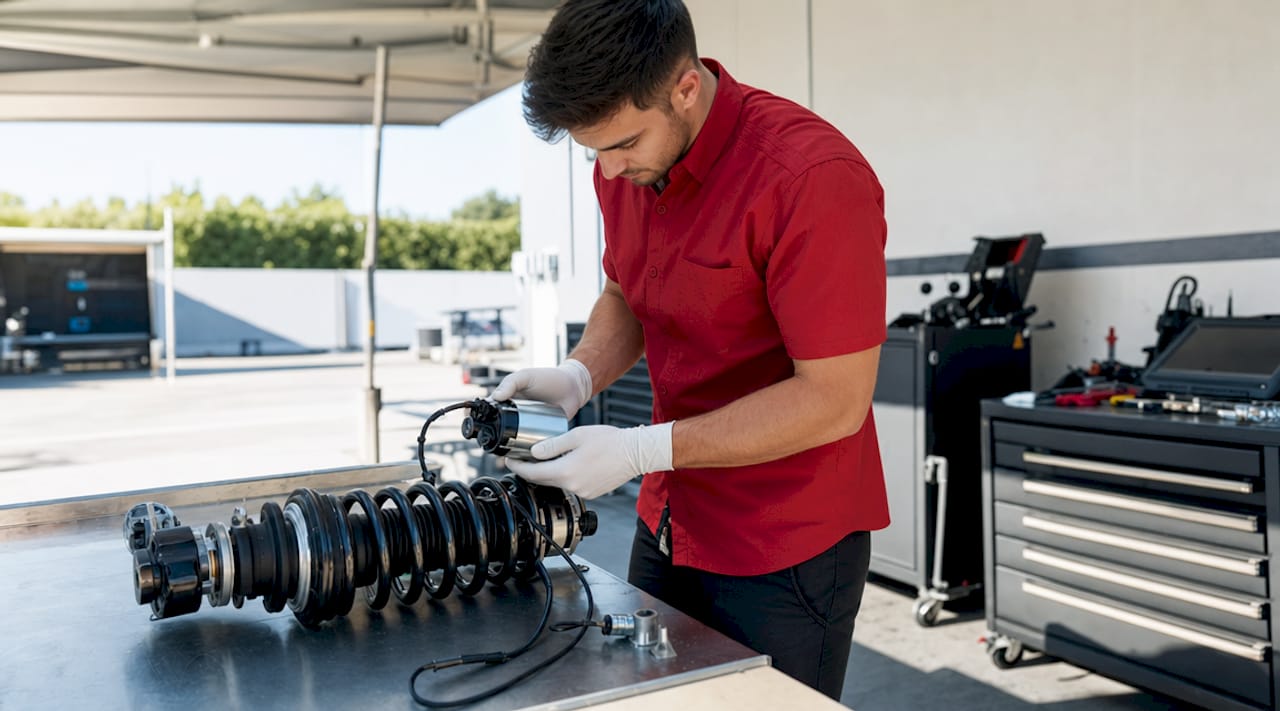
Sensor inputs are the system’s eyes and ears. Accelerometers, wheel position sensors, yaw sensors, and steering angle sensors feed continuous data to the control module. Ferrari’s active suspension uses individual motor control modules per damper, coordinating sensor arrays including accelerometers and yaw sensors to achieve smooth, real-time adaptive performance at each wheel corner.
The control algorithm processes all incoming sensor data and calculates the precise force or damping adjustment needed at each wheel. This is a closed-loop system, meaning it constantly compares the vehicle’s actual state to the target state and corrects any deviation. The speed of this loop is what separates good active suspension from great active suspension.
Actuators execute the algorithm’s commands. In the most advanced systems, these are electric motors. Multimatic’s True Active Spool Valve suspension uses a 48-volt motor capable of applying up to 1,120 lbs of force per damper, enabling continuous, proactive control independent of road inputs. That force capacity is what allows the system to counteract body roll before it develops rather than simply damping it after the fact.
- Accelerometers detect vertical body movement and lateral g-forces
- Wheel position sensors track suspension travel at each corner
- Yaw sensors measure rotational movement around the vehicle’s vertical axis
- 48V electric motors or hydraulic actuators apply corrective force in milliseconds
- Closed-loop algorithms coordinate all four corners simultaneously
Pro Tip: If you are shopping for a vehicle with active suspension, ask specifically whether the system uses actuators that can add force or only variable dampers. The answer tells you whether you are looking at true active or semi-active technology.
Active suspension vs. passive and semi-active: what sets them apart?
The clearest way to understand the three suspension types is by what each one can and cannot do with energy and force.
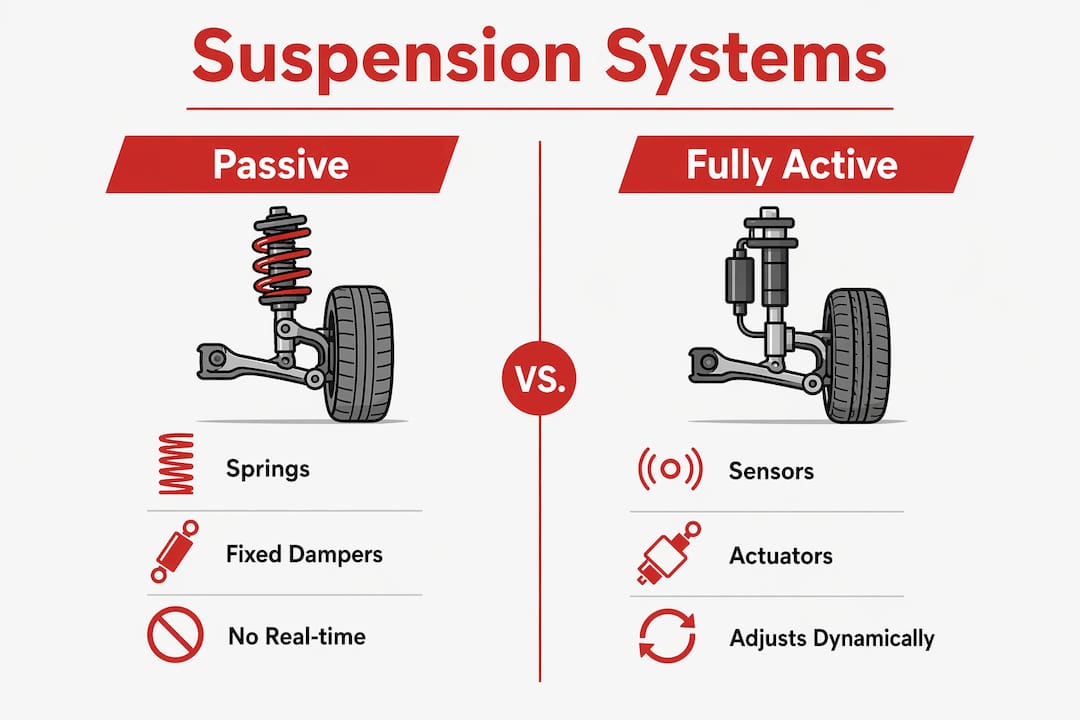
Passive suspension uses mechanical springs and fixed-rate dampers. It absorbs and dissipates energy from road inputs but has no ability to adjust. The spring rate and damper tuning are set at the factory as a compromise between ride comfort and handling. Every bump, corner, and braking event is handled by the same fixed setup regardless of conditions.
Semi-active suspension introduces electronic control over damping resistance. Magnetorheological dampers in semi-active systems can adjust damping up to 1,000 times per second based on sensor inputs. That is a significant improvement over passive systems, but the key limitation is that semi-active systems can only vary how much they resist movement. They cannot add force to move the suspension in a desired direction. Adaptive semi-active suspensions change damping coefficients without adding energy, which keeps cost and energy consumption lower but limits dynamic control.
Fully active suspension removes that limitation. The actuators can push or pull the suspension, actively leveling the body, eliminating roll, and adjusting ride height on the fly.
| Feature | Passive | Semi-active | Fully active |
|---|---|---|---|
| Adjusts in real time | No | Damping only | Force and damping |
| Can add force to suspension | No | No | Yes |
| Energy consumption | Minimal | Low | Moderate to high |
| Typical cost | Low | Moderate | High |
| Body roll control | Limited | Improved | Near-elimination |
| Maintenance complexity | Simple | Moderate | High |
Fully active suspensions provide better performance across a wide range of road conditions, but at the cost of complexity, high energy demand, and higher maintenance. Semi-active systems offer a commercially viable compromise, which is why they have been widely favored since the 1990s.
Pro Tip: Semi-active systems like those using magnetorheological fluid are far more common in production vehicles than true active systems. If your current vehicle has “adaptive” or “electronic” dampers, it is almost certainly semi-active, not fully active.
Benefits and limitations of active suspension systems
The benefits of active suspension are real, but they are also specific. Understanding exactly what the technology does and does not fix prevents disappointment and helps you make smarter buying decisions.
What active suspension genuinely improves:
- Body roll: True active systems can nearly eliminate body roll during cornering, as demonstrated by Porsche’s Active Ride system. This improves both driver confidence and passenger comfort.
- Pitch control: Hard braking and acceleration cause the nose to dive or the rear to squat. Active suspension counteracts these forces in real time, keeping the chassis level.
- Ride comfort: By proactively adjusting to road surface changes, active systems reduce the harshness transmitted to the cabin without sacrificing handling.
- Grip and stability: Keeping each tire in better contact with the road surface improves traction, particularly in cornering and on uneven surfaces.
- Ride height adjustment: True active systems can raise the vehicle for rough terrain and lower it at speed for aerodynamic efficiency.
Where active suspension hits its limits:
Active suspension cannot compensate for tire deflection or the road texture felt through the tires themselves. Porsche’s Active Ride system nearly eliminates body roll but cannot filter out the vibration transmitted directly through tire sidewalls and wheel mass. That sensation is a physical property of the tire, not the suspension. Even the best active suspensions cannot eliminate road texture perception because tire behavior limits vibration isolation at that frequency range.
The other honest trade-off is cost and complexity. True active systems require 48V electrical architecture, sophisticated control software, and precision actuators at each corner. Repair costs are significantly higher than passive or semi-active systems, and not every independent shop has the diagnostic tools or training to service them correctly. Energy consumption is also a real factor, particularly in hybrid and electric vehicles where every watt matters.
Applications of active suspension in modern vehicles
Active suspension technology has moved well beyond concept cars and Formula One prototypes. Production vehicles across multiple segments now use it, and the 2026 model year represents a high-water mark for the technology’s accessibility.
Ferrari’s Purosangue SUV and its latest sports cars use a system with liquid-cooled 48V motors providing up to 6,000 Newtons of force per wheel corner. The system achieves independent control of each wheel’s damper and eliminates the need for traditional anti-roll bars entirely. That is a significant engineering achievement because anti-roll bars have been a suspension staple for decades. Removing them while improving roll control demonstrates how capable true active systems have become.
Multimatic’s True Active Spool Valve system has appeared in high-performance road cars and is being adopted by additional manufacturers. Its 48-volt architecture and 1,120-lb force capacity per damper make it one of the most capable production systems available today.
Luxury SUVs from brands including Mercedes-Benz and Land Rover use semi-active and adaptive air suspension systems that adjust ride height and damping across terrain types. These are not true active systems in the strictest sense, but they deliver meaningful improvements over passive setups for their intended use cases.
Active suspension development in Formula One was banned in 1994 due to safety concerns related to the extreme speeds and complexity it enabled. That ban pushed engineers toward road car applications, accelerating the development of the semi-active and fully active systems now found in production vehicles.
Aftermarket retrofit of true active suspension is not practical for most vehicles. The technology requires purpose-built mounting points, dedicated electrical architecture, and integrated software. Semi-active upgrades, such as aftermarket coilovers with electronic damping, are more feasible but still require careful compatibility research.
Key takeaways
Active suspension systems deliver superior ride and handling by using sensors and actuators to control each wheel independently in real time, something no passive or semi-active system can fully replicate.
| Point | Details |
|---|---|
| True active vs. semi-active | True active systems inject force; semi-active systems only vary damping resistance. |
| Core components | Sensors, closed-loop algorithms, and 48V actuators work together to control each wheel corner. |
| Real-world limits | Active suspension cannot eliminate road texture felt through tires, only body roll and pitch. |
| Cost and complexity | Fully active systems carry higher repair costs and energy demands than passive alternatives. |
| Leading 2026 examples | Ferrari’s Purosangue and Multimatic’s True Active Spool Valve represent the current production standard. |
Why the semi-active vs. fully active debate matters more than most reviews admit
Most automotive coverage treats active suspension as a single category and moves on. After spending time with the technical details and real-world test data, I think that framing does a disservice to anyone trying to make an informed decision.
The gap between semi-active and fully active is not incremental. It is the difference between a system that manages energy and a system that generates it. A magnetorheological damper adjusting 1,000 times per second is genuinely impressive engineering, but it is still fundamentally reactive. A 48-volt actuator pushing 1,120 lbs of force per corner is doing something categorically different. Calling both “active suspension” in a spec sheet is like calling both a bicycle and a motorcycle “two-wheeled vehicles.”
What I find most interesting about the 2026 generation of true active systems is the decision to eliminate anti-roll bars entirely. That is not a marketing move. It reflects genuine confidence in the actuator’s ability to handle lateral load transfer in real time. For enthusiasts, that means the suspension geometry can be tuned purely for ride quality and straight-line compliance, with roll control handled electronically.
My practical advice: if you own a vehicle with adaptive dampers and are considering an upgrade, focus on whether your current system’s limitations are in damping response or in force generation. Most drivers will never need true active capability. But if you corner hard, carry varying loads, or drive on genuinely mixed surfaces, the difference is worth understanding before you spend money.
— Shingi
Suspension service and upgrades at Tom’s B & M Auto
Whether your vehicle runs a conventional passive setup or a modern adaptive system, the suspension components underneath it wear over time. Worn dampers, degraded bushings, and misaligned geometry affect ride quality and handling regardless of how sophisticated the original design was. At Tom’s B & M Auto, ASE-certified technicians have serviced suspension systems on Toyota, Honda, Subaru, European, and domestic vehicles since 1985. If you are in the Lynnwood area and want a professional assessment of your suspension’s condition, schedule a suspension inspection and get upfront pricing with no surprises. For more extensive repairs or upgrades, financing options are available to help manage the cost. Same-day appointments are often available.
FAQ
What is the difference between active and passive suspension?
Passive suspension uses fixed springs and dampers that react to road inputs without adjustment. Active suspension uses sensors and actuators to control wheel movement in real time, allowing it to counteract body roll, pitch, and ride height changes proactively.
Can active suspension be added to any car?
True active suspension retrofit is not practical for most vehicles because it requires dedicated electrical architecture, purpose-built mounting points, and integrated control software. Semi-active upgrades using electronic dampers are more feasible but still require careful compatibility checks.
Why was active suspension banned in Formula One?
Active suspension was banned in Formula One in 1994 due to safety concerns related to the extreme performance levels and system complexity it enabled at racing speeds. The ban accelerated development of road car applications.
Does active suspension improve fuel economy?
True active systems consume moderate to high amounts of energy due to their 48-volt actuators, which can offset fuel economy gains from improved aerodynamics. Semi-active systems use significantly less energy and have a smaller impact on fuel consumption.
How do I know if my car has active suspension?
Check your owner’s manual for terms like “adaptive dampers,” “active chassis control,” “MagneRide,” or “Dynamic Damper Control.” These indicate semi-active systems. True active systems are currently found in high-performance vehicles like the Ferrari Purosangue and select Porsche models.
Recommended
- Suspension Repair in Mountlake Terrace, WA | Tom’s B&M Auto
- Suspension Repair in Kenmore, WA | Tom’s B&M Auto
- Suspension Repair in Lynnwood, WA | Tom’s B&M Auto
- Suspension Repair in Alderwood Manor, WA | Tom’s B&M Auto
Leave a Reply