Catalytic Converter Theft Prevention: What Works in Washington
The best protection against catalytic converter theft is layers: park where thieves can’t work unseen, put a permanent VIN mark on the converter, and add a hardened shield or cage that turns a one-minute cut into a long, noisy job. No single measure is foolproof, but together they make your car the one a thief skips. Below is what each layer does, what to check before you buy a shield, and what Washington law now says.
TL;DR
- Thieves want fast, quiet jobs. Anything that adds time, noise or visibility (a garage, bright lights, a cage, an alarm) lowers your risk.
- Mark the converter with your VIN. Washington law now treats unmarked detached converters as a problem for whoever holds them.
- Choose a shield that fits your exhaust routing. A badly fitted one can chafe brake lines or trap heat.
- If yours is stolen, replace it with an OEM-quality part and add protection during the same visit.
- Bring your car in for a look underneath before you buy anything. We can check clearance on your specific make and model.
Table of Contents
- Why thieves go after catalytic converters
- Layer one: where and how you park
- Layer two: VIN marking
- Layer three: shields, cages, cable locks and alarms
- What a good setup looks like
- Where thieves sell: pressure on the receiving end
- Our perspective on prevention
- If your converter is already gone
- Get it checked and protected in Lynnwood
- FAQ
- Sources
Why thieves go after catalytic converters
The converter holds platinum, palladium and rhodium. The National Insurance Crime Bureau (NICB) notes these metals are worth more than gold, which is why a part bolted under your car is worth cutting off. A thief with a battery saw can do it in about a minute, and the car looks untouched until you start it.
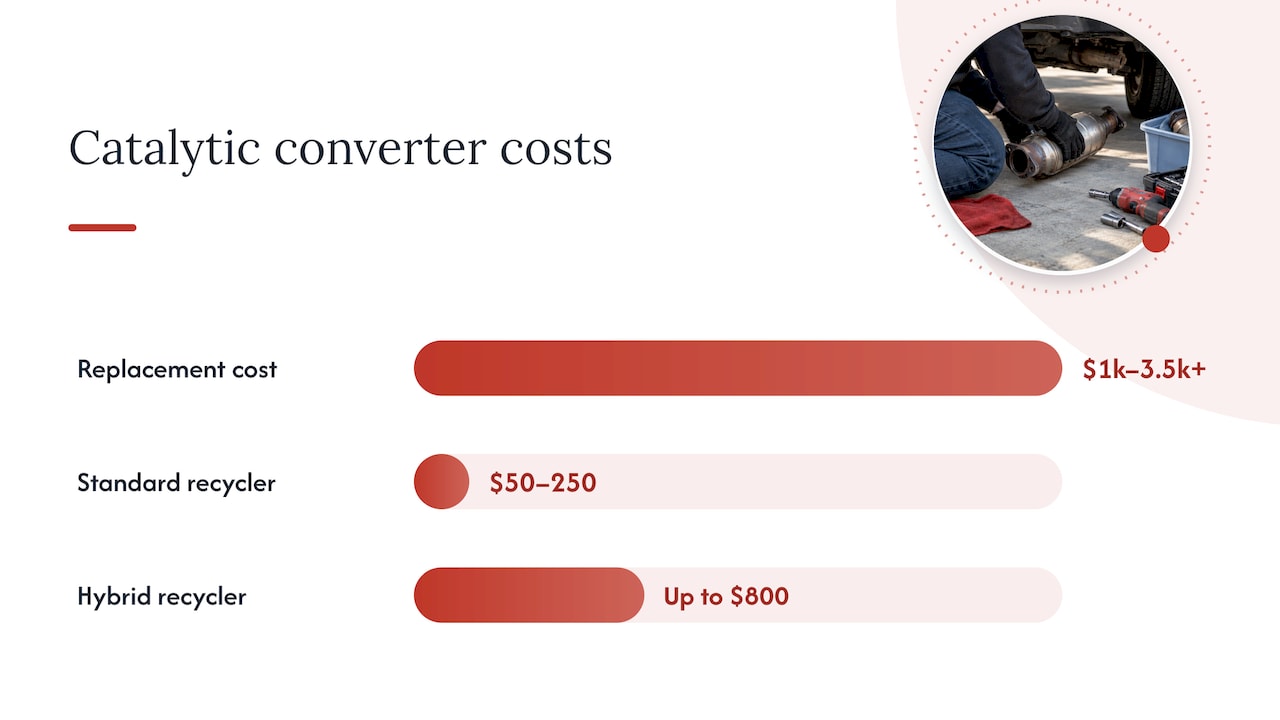
The cost lands on you. According to the same NICB report, replacement after a theft can run from $1,000 to $3,500 or more, while a thief may only get $50 to $250 from a recycler for a standard converter, or up to $800 for one from a hybrid. NICB also reports that theft claims rose from 16,660 in 2020 to 64,701 in 2022, and that rates have since moved up and down with precious metal prices.
That last point matters. Theft is not a problem that went away. NICB regional reporting from May 2026 says hybrids and trucks are often targeted, and that drivers should watch where and how they park.
Which vehicles get hit
Trucks and SUVs sit high, so a thief can slide under quickly. Hybrids are attractive because their converters tend to carry more precious metal. That makes Toyota and Honda hybrids common targets, and many Lynnwood drivers own both. If you drive one, treat prevention as a priority rather than an option.
Layer one: where and how you park
This costs nothing and works better than most people expect. The California Bureau of Automotive Repair (BAR) advises parking in a locked garage when you can. Outdoors, it recommends motion-sensitive lighting and well-lit, busy or camera-monitored spots.
Practical habits for our area:
- Garage first. If your garage is full of boxes, clearing it is the cheapest anti-theft device you can buy.
- Back against a wall. If you park in a driveway, back in close to the garage door or a fence so there is less room to slide underneath.
- Pick visible spots. At apartments, work and shopping centers, choose spots near entrances, cameras and foot traffic over far corners of the lot.
- Box in a second car. If you own two vehicles, park the more vulnerable one where the other limits access.
- Add a motion light. A light aimed at the driveway and a camera that shows is a deterrent in itself.
None of this stops a determined thief, and BAR says so in effect: parking awareness works best combined with marking and physical barriers.
Layer two: VIN marking
Etching or marking your VIN or license plate number on the converter makes it traceable. It also makes it harder to sell, because a scrap buyer can see the part is identifiable.
Washington has written this into law:
- Under RCW 46.70.350, a vehicle dealer must offer the purchaser the option to have the last eight digits of the VIN marked on the converter before sale. The marking must be done where the converter is visible and readily accessible without removing parts, and a permanent marker is sufficient. The dealer can charge a separate fee.
- Under RCW 9A.82.180, anyone who removes a converter for a reason other than maintenance, repair or demolition, or who knowingly possesses an unmarked detached converter, must permanently mark it.
The practical takeaway: if you bought your car from a dealer and declined marking, you can still have it done. A paint pen or engraving works. Professional engraving is more durable than marker, and a mark that survives heat and road grime is the point. Your local police department may also know of community VIN-etching events, so call and ask.
Marking is not a lock. It deters resale and helps police, but it won’t stop the cut. That’s why it is one layer, not the plan.
Layer three: shields, cages, cable locks and alarms
This is the layer the top-ranking pages are all selling, so it deserves a straight look. The main device types:
| Device | What it does | Watch for |
|---|---|---|
| Steel shield or plate | Covers the converter and blocks saw access | Fit, heat clearance, rattles |
| Cage or clamp-style lock | Wraps the converter and pipes | Pipe diameter, vehicle compatibility |
| Cable lock | Adds cutting time and noise | Weaker than solid steel; a thief with the right cutter beats it |
| Alarm or vibration sensor | Sounds when the exhaust is sawed or the car is jostled | False alarms; a thief may finish before you react |
| Etched or painted marking | Makes the part traceable | Does not prevent cutting |
BAR says physical deterrents such as steel cages, protective plates, shields and cable locks work because they increase the time and effort needed to remove the converter, often making thieves give up. That is the honest promise: delay, not immunity.
What to check before you buy
Generic shields are sold as universal fits. They aren’t always. Two checks matter:
- Don’t alter the converter itself. BAR warns that a device must not modify or damage the converter, because that can cause a failed emissions inspection in states that test. Washington’s current test rules are worth confirming for your vehicle, but the principle holds: don’t drill, weld or cut the converter to attach something.
- Watch for interference. BAR also notes that aftermarket covers must be engineered so they don’t chafe on critical components such as hydraulic brake lines. A shield that rubs a brake line is a safety problem, not a security feature.
BAR recommends having an ASE-certified technician confirm a shield or cage fits your make and model’s exhaust routing and heat clearance. That’s what our technicians do every day. Our digital inspection lets you see underneath your car before you spend on a product.
What a good setup looks like
Here is how the layers combine in three common situations.
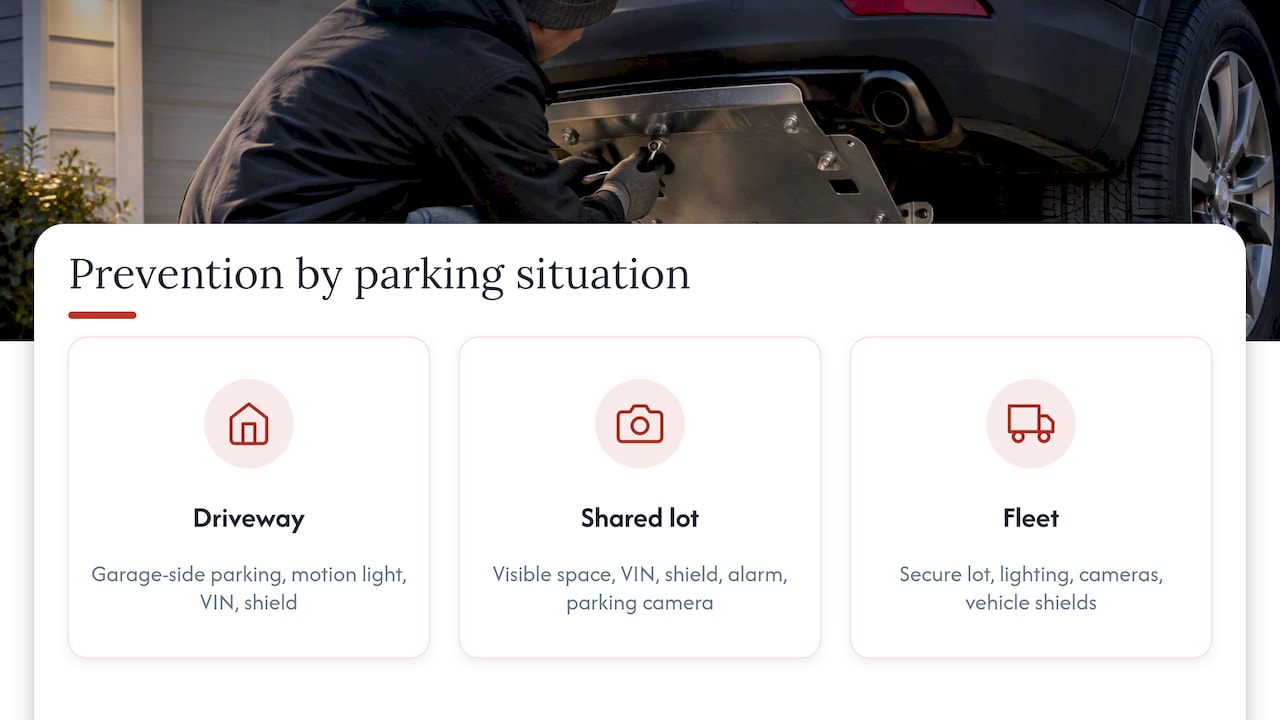
Hybrid owner with a driveway. Back into the driveway close to the garage, add a motion light, mark the converter with your VIN, and have a fitted steel shield installed. This is the highest-risk profile, so use every layer.
Apartment dweller with a shared lot. You can’t control the lighting, so choose the most visible space, mark the converter, and consider a shield plus a vibration alarm. A camera with a parking mode adds evidence if something happens.
Fleet or work truck parked outside overnight. Fleet managers should consider securing the lot, adding lighting and cameras, and fitting shields on every vehicle that sleeps outside. A single theft takes a truck off the road for days and costs far more than the prevention.
Where thieves sell: pressure on the receiving end
Theft only pays if someone buys the part. Lawmakers have shifted toward the buyers. According to NICB, authorities are putting due diligence rules, documentation requirements and fines on recyclers, scrap dealers and wreckers. In Washington, ESHB 2153 took effect on April 1, 2025, regulating the converter market and giving Washington State Patrol inspectors more resources for enforcement.
If you ever have a car that isn’t worth fixing, such as a total loss after a theft plus other damage, know that legitimate buyers keep paperwork. A guide to how scrap buyers price vehicles shows how much value sits in a car’s metals. It is written for Ohio, so use it only to understand how pricing works, not for Washington rules.
Our perspective on prevention
We have fixed cars in Lynnwood since 1985, and the thefts we see share a pattern: the owner had no idea until the engine roared on startup. The part was gone, the exhaust was open and the repair bill was larger than a shield would have cost.
Our view, after working on Toyotas, Hondas, Subarus, domestic vehicles and hybrids:
- Prevention beats insurance. A claim means a deductible, time without your car and often a wait for parts. Industry experts say the same: prevention is the most cost-effective approach.
- Fit matters more than brand. We would rather you spend a bit more on a shield that clears your brake lines and heat shields than buy a universal one that rattles loose.
- Don’t skip the replacement quality. If a converter is stolen, an OEM-quality replacement is what we install. Popular Mechanics notes that aftermarket units can trigger codes such as P0420 or P0430 because they may not meet the efficiency of original parts. Fitting a quality converter and a protection system in one visit saves a second trip.
- A look underneath is free. Rust, loose hangers and exhaust leaks are easier to spot on a lift than in a catalog.
We stand behind our work with a 24-month / 24,000-mile warranty on all repairs.
— Shingi
If your converter is already gone
The signs: a loud roar on startup, a rough idle, a check engine light and a car that feels weak. A car can often still run without its converter, but it will be loud, will pollute and shouldn’t be driven far. Our guide on what to do when a catalytic converter is stolen covers the police report, photos and towing. And if you only have a P0420 code and no sign of theft, read why that code alone isn’t proof of a failed converter, because replacing a working part is an expensive mistake.
File a police report first, then call your insurer. Deductibles and coverage vary by policy, so ask your agent whether comprehensive coverage applies to your car.
Get it checked and protected in Lynnwood
If you want a second opinion before buying a shield, start with a free digital vehicle inspection. We look at your exhaust routing, hangers and clearances, and show you photos. If a converter does need replacing, see our catalytic converter replacement in Lynnwood page. We serve drivers in Lynnwood and nearby communities, with same-day appointments often available. Military members, seniors and first responders qualify for exclusive discounts. You can also look at our full list of services.
FAQ
What is the best deterrent for catalytic converter theft?
No single device wins. A fitted steel shield or cage is the strongest physical barrier, but it works best alongside VIN marking and smart parking. The goal is to make removal slow, loud and visible, so a thief moves on to an easier car.
Does VIN etching really help?
It helps police trace stolen parts and makes converters harder to sell. Washington law now requires dealers to offer the marking at sale, and requires unmarked detached converters to be marked. It won’t stop the cut, so pair it with a physical barrier.
Will my car run if the catalytic converter is stolen?
Usually it will start, but it will be loud, may idle roughly and will throw a check engine light. It is also illegal to knowingly drive without required emissions equipment in many places. Have it towed or driven carefully to a shop rather than a long trip.
Can a shield damage my car?
A badly fitted one can. BAR warns about shields that chafe against hydraulic brake lines or alter the converter itself. Have an ASE-certified technician confirm the fit for your make and model before installation.
Sources
- NICB: Catalytic converter thefts surge nationwide
- NICB: Texas sees surge in catalytic converter thefts
- California BAR: Catalytic converter theft and the Smog Check Program
- RCW 46.70.350: Catalytic converters marking
- RCW 9A.82.180
- KOMO News: New Washington law helps combat catalytic converter theft
- Consumer Reports: How to prevent catalytic converter theft
- Popular Mechanics: Catalytic converter theft and how to protect yours
Leave a Reply