
Verify Any Estimate: Toyota 60K Service Checklist from an ASE Shop
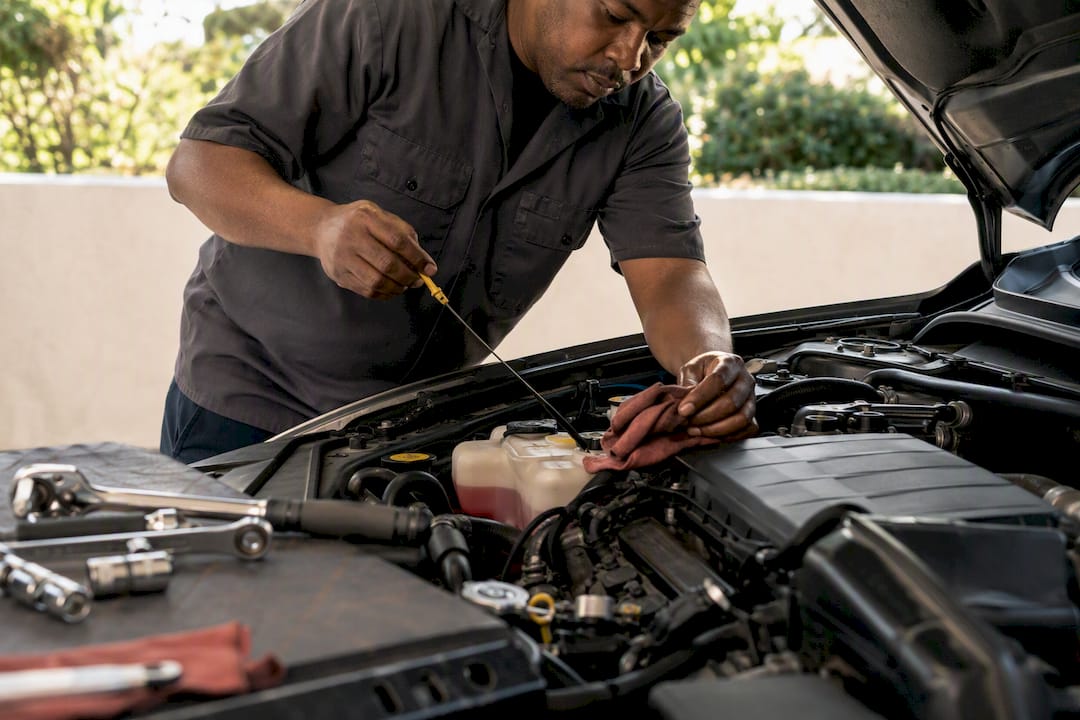
Yes, 60,000 miles is a major scheduled maintenance milestone. A proper toyota 60k service typically covers oil and filter replacement, fluid services for the transmission and coolant system, brake fluid inspection, filter and spark-plug checks, a tire rotation, and a full multi-point inspection. It’s also the point where documentation starts to matter for warranty protection and resale value.
TL;DR:
- Fluids for automatic transmission, transfer case, and coolant require careful inspection and model-specific intervals to avoid shifting problems or engine overheating.
- Brake components and fluid condition should be measured precisely, with attention to uneven tire wear indicating alignment issues that can affect safety and tire lifespan.
- Spark plugs, air filters, and drive belts may need replacement or inspection based on engine type and driving conditions, directly influencing fuel economy and engine performance.
- Independent shops often provide the same warranty protection as dealers with itemized, transparent estimates and can be less expensive for basic services.
- Maintaining documented service history before the appointment ensures warranty coverage and resale value, especially for vehicles driven under extreme conditions or short trips.
Table of Contents
- What Does 60K Service Include? A Quick Checklist
- Fluids and Powertrain Service: What Actually Needs Attention
- Ignition and Filters: Spark Plugs, Air Filters, and Belts
- Brakes, Suspension, and Tires: The Safety Checklist
- What a 60K Mile Service Cost Typically Looks Like
- Does Skipping the 60K Service Actually Matter?
- How to Prepare for Your 60K Appointment
- Why Trust This Guide
- The Real Value of a 60K Service Isn’t the Checklist
- Book Your 60K Service With Tom’s B & M Auto
- Sources
What Does 60K Service Include? A Quick Checklist
Every dealer and independent shop organizes the paperwork a little differently, but the actual work at 60,000 miles clusters into five groups. Here’s what most shops check or replace during a toyota 60,000-mile service:
Engine and fluids
- Engine oil and filter change
- Coolant level and condition check (flush if due)
- Power steering fluid inspection
Drivetrain
- Transmission fluid inspection or replacement, model-dependent
- Differential or transfer-case service on AWD and 4WD models
Brakes and suspension
- Brake pad, rotor, and line inspection
- Suspension component check, including shocks and struts
Filters and ignition
- Engine air filter and cabin air filter replacement
- Spark plug inspection or replacement, model-dependent
Tires and general inspection
- Tire rotation and tread wear check
- Multi-point inspection covering belts, hoses, battery, and exhaust
Some of these are inspection-only line items, where parts are checked and replaced only if worn. That’s worth remembering when an estimate looks longer than you expected. Your owner’s manual has the factory-recommended list for your exact model and trim, and it’s worth cross-checking it against whatever the shop hands you before you approve anything.
Fluids and Powertrain Service: What Actually Needs Attention
This is where 60K service costs vary the most, because fluid type and interval depend entirely on what’s under the hood. Toyota’s own schedule treats 30K, 60K, and 90K as major service intervals, and transmission fluid is usually the biggest question mark at this mileage.
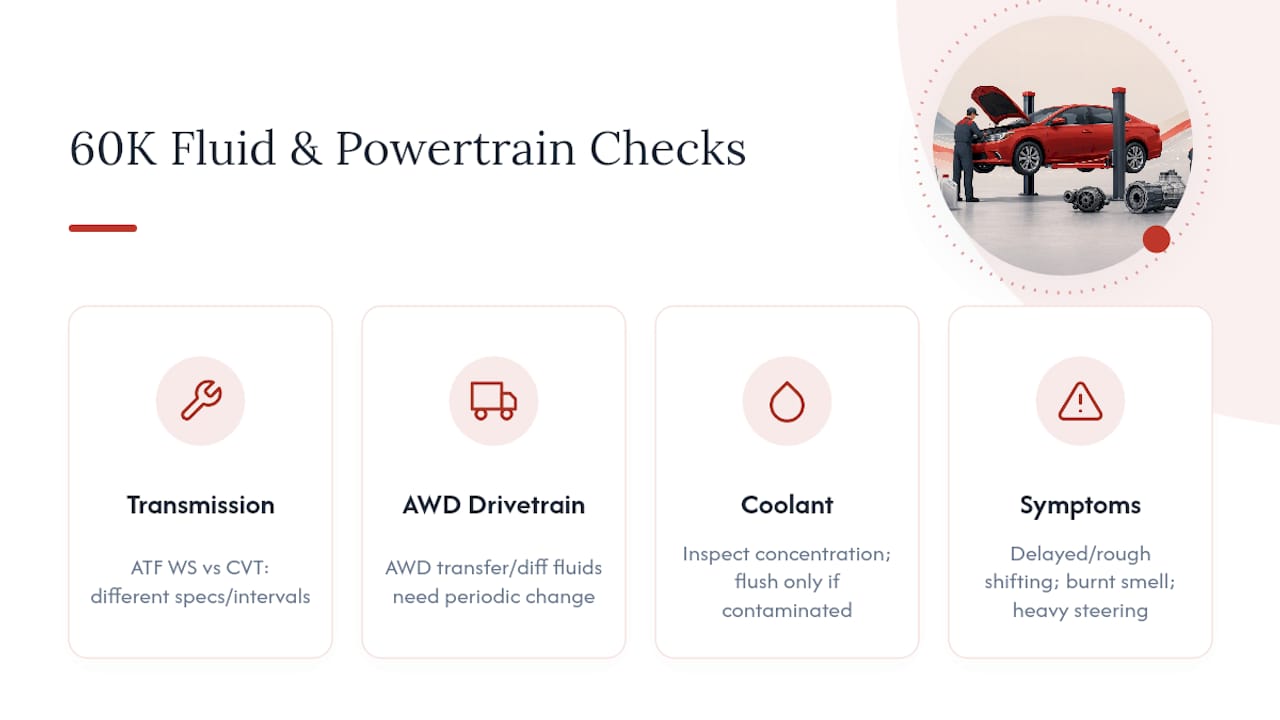
Automatic transmission fluid. Vehicles using Toyota’s ATF WS fluid often go longer between changes than older conventional automatics, but CVTs run on their own specific fluid and typically follow a different interval. Mixing these up, or using the wrong spec, can cause shifting problems down the road. Model-specific literature on fluid types and intervals is the only reliable way to know which applies to your car.
Differential and transfer case. If you drive an AWD RAV4, 4Runner, or Tacoma, the transfer case and differential carry their own fluid that needs periodic attention, something covered in more depth in our guide to transfer case service for 4WD owners.
Coolant. Most shops inspect coolant condition and concentration rather than flushing it automatically at 60K, unless the fluid shows contamination or the vehicle is well past its factory-recommended coolant interval.
Power steering fluid gets a level and condition check, with replacement recommended only if it’s dark or contaminated.
Watch for symptoms that suggest a fluid is already overdue: delayed or rough shifting, a burnt smell from the transmission, or a steering wheel that feels heavier than usual at low speeds.
Ignition and Filters: Spark Plugs, Air Filters, and Belts
Not every Toyota needs new spark plugs at 60,000 miles. Many modern four-cylinder engines run iridium plugs rated for 100,000 miles or more, so a technician may only inspect and gap-check them at this interval. Older V6 engines or vehicles with conventional plugs are more likely to need replacement now.
Filters are a more predictable story:
- Engine air filter usually needs replacement around 30,000 to 60,000 miles, sooner if you drive in dusty or heavily polluted conditions.
- Cabin air filter follows a similar window and directly affects how your HVAC system smells and performs.
- Drive belts get a visual inspection for cracking, glazing, or fraying.
- Timing belt vs. timing chain matters here. Most current Toyota engines use a timing chain that doesn’t need scheduled replacement, but a handful of older models still use a timing belt with its own separate interval, so check which your engine has.
A clogged air filter forces the engine to work harder and can measurably hurt fuel economy. Worn plugs cause misfires, rough idle, and reduced power, so this category isn’t just about ticking boxes. It affects how the car actually drives.
Brakes, Suspension, and Tires: The Safety Checklist
Brake work is the category most likely to turn a routine visit into a bigger bill, because wear depends entirely on your driving and where you live.
A full brake inspection covers pad thickness, rotor condition and thickness, and the flexible lines and hoses for cracking or leaks. Brake fluid also gets checked, since it absorbs moisture over time and typically needs replacement every two to three years regardless of mileage.
- Pads and rotors get measured, not guessed at
- Brake fluid condition and moisture content checked
- Ball joints, control arm boots, and shocks/struts inspected for wear or leaks
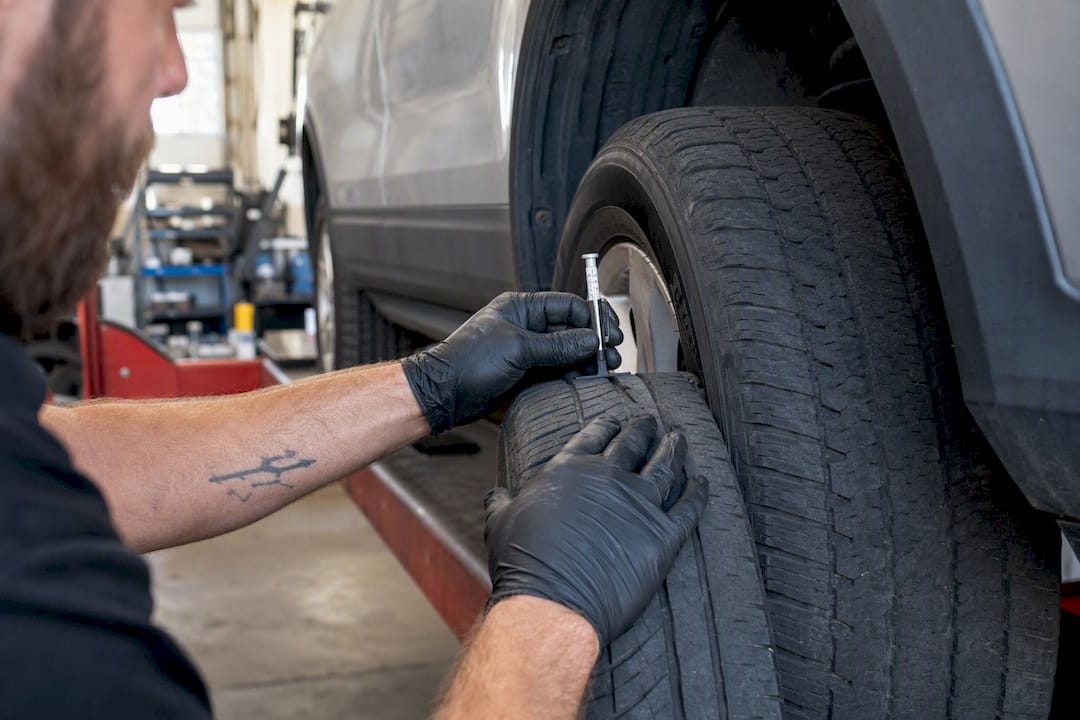
- Tires rotated, balanced, and checked for uneven wear patterns that point to alignment issues
Pro Tip: If a technician tells you a component “should be fine for now,” ask them to note the measurement or wear percentage on your invoice. It gives you a real baseline to compare against next time instead of relying on memory.
Uneven tire wear at 60,000 miles almost always signals an alignment problem worth fixing before new tires go on, not after.
What a 60K Mile Service Cost Typically Looks Like
Toyota 60k maintenance cost varies with what your specific model needs, but core service (oil change, filters, inspection, tire rotation) typically runs less at an independent shop than at a dealership for the same scope of work. Add-ons like a coolant flush, transmission fluid service, or spark plug replacement push the total higher.
Most 60K appointments take roughly 1.5 to 2 hours, longer if the inspection turns up work that needs doing the same day.
- Ask for an itemized estimate before approving anything
- Separate what’s a required replacement from what’s a recommended upsell
- Confirm whether pricing includes parts, labor, or both
Does Skipping the 60K Service Actually Matter?
It does, more than most owners assume. Skipping scheduled maintenance can lead to premature failure of major components and put your warranty coverage at risk if a related part fails later and there’s no service record to show the vehicle was maintained.
Documented service, done by qualified technicians, is what protects you in that scenario. If you tow frequently, drive mostly short trips, or deal with extreme heat or cold, your vehicle qualifies for Toyota’s “severe” maintenance schedule, which calls for earlier or more frequent service. A stack of service receipts also tends to raise resale and trade-in value, since buyers and dealers both look for it.
How to Prepare for Your 60K Appointment
Walking in prepared saves time and often saves money. Before your appointment:
- Bring your service history, including any major work like a previous transmission service or timing belt replacement.
- Ask for a written, itemized estimate that separates inspections from actual part replacements.
- Request OE part numbers if you specifically want OEM components rather than aftermarket equivalents.
- Confirm the warranty on parts and labor, and get everything documented in writing before you leave.
This short list is also useful groundwork if you want a broader look at safety inspection points worth checking at every major service, not just 60K.
Why Trust This Guide
Tom’s B & M Auto has been trusted by Lynnwood’s Toyota, Honda, Subaru, and domestic car owners for over 40 years. Our ASE-certified technicians run professional-grade OBD-II diagnostics and give upfront pricing before any work starts, on Toyota models and European or hybrid vehicles alike, often with same-day appointments available. Every job comes with a 24-month, 24,000-mile warranty. Our workflow starts with diagnostics, not guesswork, and every inspection gets documented so you leave with a real record, not just a receipt.
The Real Value of a 60K Service Isn’t the Checklist
Most articles on this topic treat 60,000 miles like a shopping list: here’s what gets replaced, here’s what it costs, done. That misses the point. The actual value of the 60K interval is that it’s the last easy checkpoint before deferred wear starts compounding into expensive failures, and before warranty windows on major components start closing.
Conventional advice tends to treat dealer estimates as gospel and independent shops as a downgrade. That’s backwards. What actually protects you is documentation and diagnostic rigor, not who has the manufacturer’s logo on the wall. An independent shop using equivalent-spec parts with clear, itemized invoices gives you the same warranty-protecting paper trail a dealer does, usually for less.
If you take one thing from this guide, make it this: don’t approve a 60K estimate you can’t read line by line. Ask which items are inspections and which are replacements. That single habit will save you more money over the life of your Toyota than any specific fluid or filter ever will.
— Shingi
Book Your 60K Service With Tom’s B & M Auto
Tom’s B & M Auto gives Lynnwood-area Toyota owners a dealer-alternative that doesn’t cut corners on documentation. You get ASE-certified technicians, upfront itemized pricing before any work begins, and a 24-month, 24,000-mile warranty backing every job, whether it’s a straightforward oil and filter change or a full transmission fluid service.
If your Toyota is closing in on 60,000 miles, or you’ve already got an estimate from somewhere else you want a second opinion on, bring it in. We’ll walk through what’s actually due versus what’s optional, using your factory schedule as the baseline. Larger jobs that turn up during inspection, including engine repair, are also covered under financing options if the timing is tight. Schedule your appointment through Tom’s B & M Auto in Lynnwood and get a written, itemized estimate before any work starts.
Sources
- Toyota maintenance schedule guide
- Toyota maintenance — Consumer Affairs
- Toyota maintenance schedule — ToyotaSpace
Leave a Reply