
How Your Automotive Heating System Works: What Car Owners Need to Know
An automotive heating system moves heat from your engine (or, in an electric vehicle, from a dedicated electric element) into the cabin to keep you warm and keep your windshield clear. If you have no heat right now, here are three quick checks to run before anything else.
No-heat emergency checklist:
- Check the coolant level with the engine cold. A low reservoir is the single most common cause of sudden heat loss. Never open the radiator cap on a hot engine.
- Set the controls to maximum heat and let the engine reach full operating temperature (watch the temperature gauge). Owner’s manual guidance confirms that full defrost heat is only available after the engine warms up.
- Feel both heater hoses (the two rubber hoses running through the firewall into the cabin). If one is hot and one is cold, the heater core or its control valve is likely blocked or stuck.
Safety first: Coolant is pressurized and scalding hot when the engine is warm. Never remove the radiator cap or squeeze hoses when the engine is at operating temperature. If you see coolant dripping inside the cabin or smell something sweet, stop driving and call a shop.
Pro Tip: If your temperature gauge is climbing toward the red and you have no other option, turn the heater to full hot with the blower on high. The heater core acts as a small auxiliary radiator and can pull heat away from the engine in an emergency — but this is a stopgap, not a fix.
Key Takeaways
A well-maintained automotive heating system depends on clean coolant, a functioning thermostat, and intact hoses — neglecting any one of them is the most direct path to a cold cabin or a costly heater-core replacement.
| Point | Details |
|---|---|
| Check coolant and controls first | Low coolant and wrong control settings cause most no-heat complaints before any part fails. |
| Use A/C for defogging | The A/C compressor removes moisture; running it during defrost clears fog faster than heat alone. |
| Flush coolant on schedule | Every ~30,000 miles or two years prevents heater-core blockage and protects the whole cooling system. |
| Know the red flags | Sweet smell, cabin fogging, or rapid coolant loss means stop driving and call a shop. |
| Tom’s B & M Auto | ASE-certified diagnostics and heater repairs with a 24-month/24,000-mile warranty in Lynnwood, WA. |
Table of Contents
- How the automotive heating system moves heat into your cabin
- Main parts of a vehicle heating system and how each one fails
- What type of heating system does your vehicle use?
- Common heating problems and how to troubleshoot them safely
- Routine maintenance that keeps your heater reliable
- When you need a mechanic: red flags and what a shop will do
- How Tom’s B & M Auto diagnoses heater problems
- A note from the shop floor
- Tom’s B & M Auto can handle your heater repair
- Sources
How the automotive heating system moves heat into your cabin
The path heat takes from source to seat is straightforward once you see it as a loop. Hot coolant leaves the engine, passes through the heater core under the dashboard, gives up its heat to the air the blower pushes across it, and that warm air flows through the vents into the cabin. The coolant then cycles back to the engine to pick up more heat and repeat.
Each stage in that loop has a specific job:
- Heat source. In a gasoline or diesel vehicle, the engine generates heat as a byproduct of combustion, and the coolant absorbs it. In an EV, a resistive PTC (positive temperature coefficient) heater or a heat pump generates heat electrically.
- Heat exchanger. The heater core is a small liquid-to-air radiator mounted behind the dashboard. Hot coolant flows through its tubes; the blower pushes cabin air across its fins. In EVs, a PTC element or heat-pump evaporator-condenser plays this role instead.
- Blower motor. An electric fan that pushes air across the heater core and through the duct system. Speed is controlled by the fan dial on your dash.
- Blend and mode doors. Motorized flaps inside the duct box that mix hot and cold air to hit your target temperature and direct airflow to the vents, floor, or defrost outlets.
- Controls. The temperature dial, fan speed, and vent-selector buttons send signals to actuators that move the blend doors and, in some systems, open or close a heater control valve in the coolant line.
One thing many drivers don’t realize: your A/C compressor runs during defrost even in winter. The evaporator pulls moisture out of the cabin air before the heater warms it, which is why keeping A/C on during defrost clears fog faster than heat alone. Many modern cars engage the compressor automatically when you hit the defrost button.
A mid-size vehicle’s heater core typically delivers 5–8 kW of heat at maximum flow and blower speed, with blower airflow commonly ranging 150–400 CFM and engine coolant running at roughly 80–95°C under normal operating conditions.
Main parts of a vehicle heating system and how each one fails
The core components are: heater core, water pump, thermostat, coolant hoses, blower motor, blend doors and actuators, heater control valve, controls, and cabin air filter. Here is what each one does and what its failure looks like from the driver’s seat.
| Component | Function | Failure sign |
|---|---|---|
| Heater core | Liquid-to-air heat exchanger under the dash | Sweet smell, fogging, wet passenger carpet |
| Water pump | Circulates coolant through engine and heater core | Overheating, no heat, coolant leak at pump |
| Thermostat | Holds coolant in engine until it reaches operating temp | Engine slow to warm, temp gauge swings, no heat |
| Coolant hoses | Carry hot coolant to and from the heater core | Soft/spongy hoses, visible leaks, low coolant |
| Blower motor | Pushes air across the heater core and through vents | No airflow, weak airflow, noise at certain speeds |
| Blend door / actuator | Mixes hot and cold air to set discharge temperature | Uneven temps, clicking noise behind dash |
| Heater control valve | Opens/closes coolant flow to the heater core | No heat or heat stuck on full regardless of setting |
| Cabin air filter | Filters incoming air before it reaches the blower | Reduced airflow, musty smell |
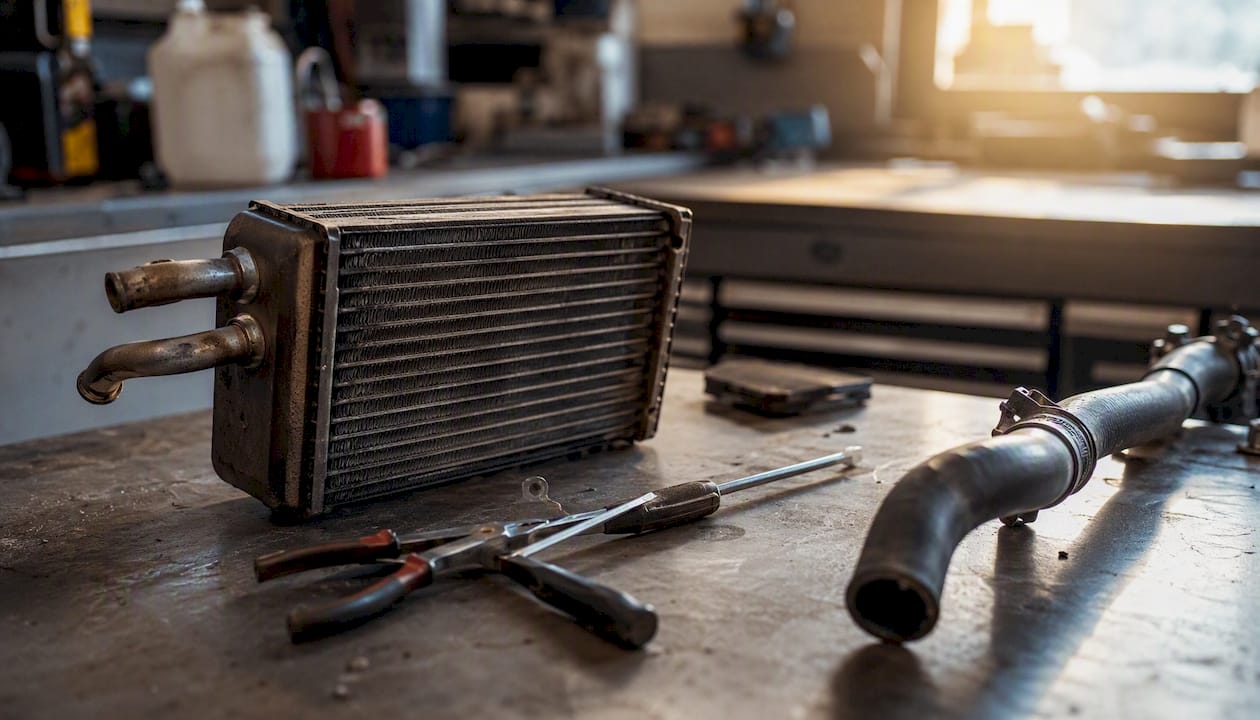
The heater core sits deep behind the dashboard, which is why replacing it is one of the most labor-intensive heating repairs a shop performs. A slow leak often shows up first as a faint sweet, syrupy smell and a windshield that keeps fogging from the inside no matter how long you run the defroster.
Blend doors and coolant control valves are the parts most often behind fluctuating or uneven cabin temperatures. A stuck actuator can leave you with heat on one side of the car and cold air on the other, or a temperature that drifts regardless of where you set the dial.
What type of heating system does your vehicle use?
The answer depends on whether you drive a combustion vehicle, a hybrid, or a full EV. Each approach has real trade-offs in warm-up time, energy cost, and cold-weather performance.
Engine coolant-based (ICE vehicles)
The dominant design for over a century. Essentially free to run once the engine is warm, but it takes 5–10 minutes to deliver meaningful heat in cold weather because the engine itself has to warm up first.
Resistive PTC electric heaters (most EVs)
A PTC element heats up almost instantly, which is a genuine advantage on cold mornings. The problem is energy cost: a PTC heater draws significant battery power, reducing EV range noticeably in cold weather. Most early and mid-range EVs use this approach.
Vapor-compression heat pumps (newer EVs)
Heat pumps move heat rather than generate it, making them two to three times more efficient than PTC heaters under moderate conditions. The catch is low-temperature performance: efficiency drops sharply below roughly 14°F (–10°C), which is why some EVs combine a heat pump with a PTC backup element to maintain heat.
Secondary-loop systems
MHI’s secondary-loop design combines refrigerant and coolant circuits so the system can maintain cabin heating at low outside temperatures without falling back on power-hungry resistive heaters. This is an active area of EV R&D.
Niche and emerging approaches
Fuel-combustion auxiliary heaters (common on diesel trucks and some European vehicles) burn a small amount of fuel to warm the coolant independently of the engine. Adsorption systems and waste-heat recovery are research-stage technologies aimed at recovering energy that would otherwise be lost.
| Heating method | Efficiency | Low-temp performance | Range/energy impact | Complexity |
|---|---|---|---|---|
| Engine coolant (ICE) | High once warm | Good | Minimal (waste heat) | Low |
| Resistive PTC (EV) | Low | Excellent | High (significant draw) | Low |
| Heat pump (EV) | High | Moderate (drops below –10°C) | Low to moderate | Medium |
| Secondary-loop HP (EV) | High | Good | Low | High |
| Auxiliary combustion heater | Moderate | Good | Fuel cost | Medium |
For hybrid owners, the picture is more nuanced. See the hybrid vehicle service guide for how heating interacts with battery management and range on plug-in hybrids.
Common heating problems and how to troubleshoot them safely
The most common symptoms are: no heat at all, weak or insufficient heat, temperature that fluctuates or drifts, a sweet or syrupy smell inside the cabin, and persistent windshield fogging. Each points to a different part of the system.
Symptom-to-cause map:
- No heat: Low coolant level, stuck-closed thermostat, clogged heater core, failed heater control valve, or a broken blend door stuck on cold.
- Weak heat: Partially clogged heater core, low coolant, blower motor running at reduced speed, or a cabin air filter so dirty it restricts airflow.
- Fluctuating temperature: Stuck or failing blend door actuator, air pocket in the coolant system, or a thermostat that opens and closes erratically. Blend door actuator faults are a frequent culprit on vehicles with dual-zone climate control.
- Sweet smell + fogging: A leaking heater core. The coolant contains ethylene glycol, which smells distinctly sweet. Fogging that clears briefly and returns is a classic sign.
- Coolant smell without fogging: Could be an external hose leak near the firewall rather than the core itself.
Safe DIY checks, in order:
- Check coolant level cold. Pop the hood before the first drive of the day. The reservoir should be between MIN and MAX. If it is consistently low, you have a leak somewhere.
- Set controls to max heat, blower on high. Let the engine reach full operating temperature (temperature gauge in the normal range). Full heat output is only available once the engine warms up.
- Feel both heater hoses at the firewall. With the engine at operating temperature, both hoses should be hot. A cold outlet hose with a hot inlet hose points to a blocked heater core or closed control valve.
- Check the cabin air filter. A clogged filter cuts airflow dramatically. It is usually behind the glove box and takes about 10 minutes to swap.
- Look for wet carpet on the passenger side. A damp or sticky floor mat under the glove box is a strong indicator of a heater-core leak.
Safety reminders: Never squeeze hoses or open the coolant system when the engine is hot. Coolant is toxic to pets and children; clean up any spills immediately. If you see active dripping inside the cabin, do not drive the vehicle.
For related HVAC airflow issues, the car AC troubleshooting guide covers blower and duct problems that overlap with heating faults.
Routine maintenance that keeps your heater reliable
The single most effective thing you can do for your car heater system is keep the coolant fresh and the cabin filter clean. Everything else in the system depends on those two basics.
Maintenance checklist with intervals:
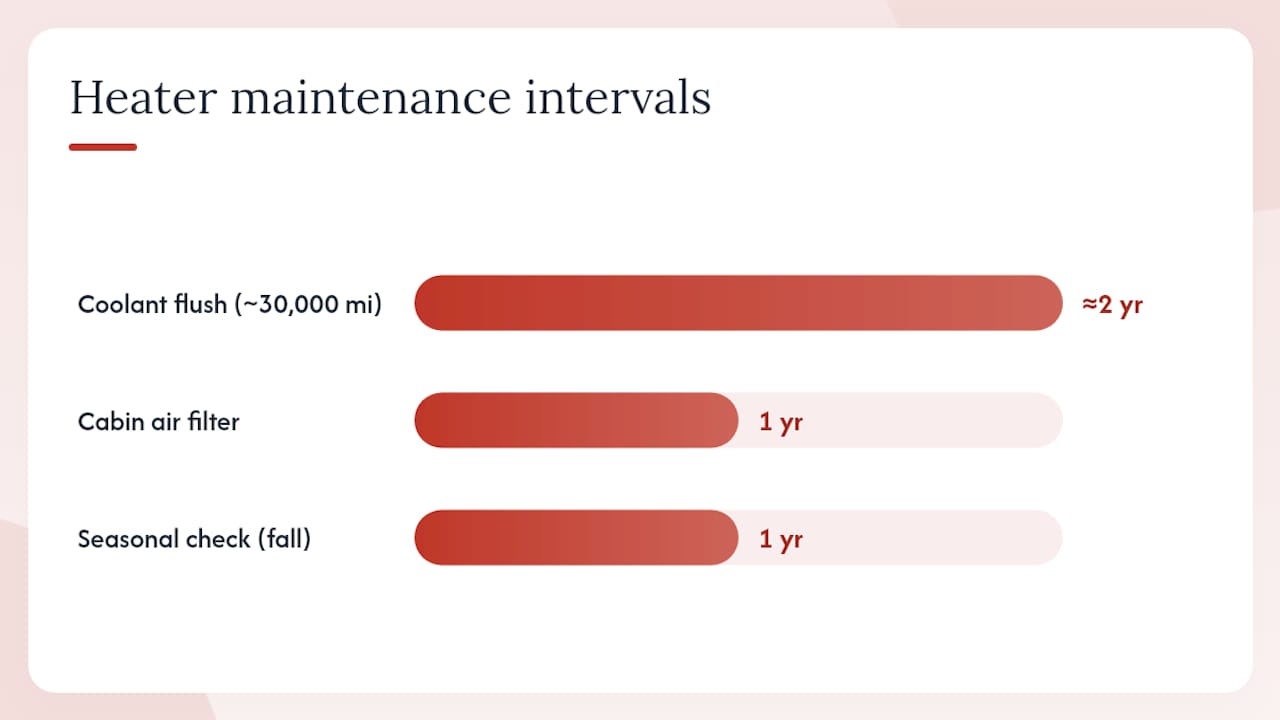
- Coolant flush: Every ~30,000 miles or two years, whichever comes first (check your owner’s manual — some modern long-life coolants extend this). Old coolant becomes acidic and deposits scale inside the heater core passages, restricting flow and reducing heat output.
- Cabin air filter: Replace annually or per your owner’s manual. A dirty filter cuts blower airflow and makes the system work harder for less heat.
- Hose inspection: Squeeze the heater hoses during any scheduled service. Soft, spongy, or cracked hoses are close to failing. Replace them before they do.
- Thermostat check: If the engine takes unusually long to warm up or the temperature gauge swings, have the thermostat tested. A stuck-open thermostat means the coolant never gets hot enough to deliver real heat. See how the thermostat affects heater performance for a deeper explanation.
- Seasonal check: Add a heating system inspection to your fall maintenance routine. Catching a marginal hose or low coolant in October is far easier than diagnosing a no-heat problem in January.
Pro Tip: During a coolant flush, ask your shop to run the engine with the heater set to full hot and the blower on. This forces fresh coolant through the heater core matrix and flushes out any sediment that would otherwise stay trapped inside it.
Also: run your A/C during winter defrost. The evaporator removes moisture from the cabin air before the heater warms it, which is why the A/C compressor engages automatically on most modern defrost settings. Turning it off manually slows defogging noticeably.
For a full seasonal checklist, the seasonal car maintenance guide covers when to schedule heating-related inspections alongside other fall and winter service items.
When you need a mechanic: red flags and what a shop will do
Some heating problems are safe to investigate yourself. Others are not. Stop DIY work and call a shop when you see any of these:
- Coolant dripping or pooling inside the cabin
- The temperature gauge moving into the red or overheating warning light on
- Rapid coolant loss (reservoir drops noticeably between checks)
- Sweet smell that persists after the engine warms up, especially combined with fogging
- Any electrical burning smell from the blower or controls
What a shop will check:
- Coolant system pressure test. A technician pressurizes the system and watches for pressure drop, which pinpoints leaks the eye cannot see.
- Heater-core flow check. Measures temperature differential between the inlet and outlet hoses to confirm whether the core is flowing or blocked.
- Thermostat and coolant-temperature diagnosis. An OBD-II scan and infrared thermometer confirm whether the thermostat is opening at the correct temperature.
- Blower motor and actuator tests. Voltage and resistance checks on the blower motor, resistor pack, and blend door actuators.
- Cabin inspection. Check for wet carpet, coolant residue, or fogging patterns that confirm a heater-core leak.
Typical repair cost ranges (approximate, US):
- Thermostat replacement: $150–$300 parts and labor
- Heater hose replacement: $100–$250
- Blower motor replacement: $200–$450
- Heater core replacement: $800–$1,500+ (labor-intensive; often requires dashboard removal)
Heater-core replacement is one of the most labor-intensive jobs in automotive heating and air conditioning repair. Ask your shop upfront whether dash removal is required, what the labor estimate covers, and what warranty applies to the work. If the core leaked long enough to soak the carpet or reach electronics, factor in interior repair costs as well.
For engine-cooling faults that affect cabin heat, the engine overheating guide explains the cooling-system failures that cascade into heating problems.
How Tom’s B & M Auto diagnoses heater problems
Tom’s B & M Auto has been diagnosing automobile heating system faults on domestic, Asian, European, and hybrid vehicles in the Lynnwood area since 1985. The shop’s ASE-certified technicians work on all makes, which matters because heater-core access, blend door design, and coolant system architecture vary significantly between a Toyota Camry, a Subaru Outback, and a European import.
Shop intake checklist:
- Symptom review: when the problem started, whether it is constant or intermittent, any smells or sounds
- Cold-start and warm-up observation: does the temperature gauge reach normal range? How long does it take?
- Coolant system pressure test to locate leaks before opening anything
- Cabin inspection for wet carpet, syrupy residue, or fogging patterns
- OBD-II scan for coolant-temperature codes and HVAC actuator faults
What to tell your technician before the appointment:
- Exactly when the heat loss started (after a cold snap, after a coolant top-up, gradually over weeks)
- Whether you smell anything sweet, especially with the defroster running
- Whether the temperature gauge behaves normally
- Whether the problem is worse at idle vs. highway speed (points to water pump flow)
Tom’s B & M Auto backs all work with a 24-month/24,000-mile warranty in Lynnwood, WA. Same-day appointments are often available.
A note from the shop floor
The most overlooked step in heater maintenance is also the simplest: tell your shop to run the heater on full hot during a coolant flush. Most technicians do this automatically, but it is worth asking for explicitly because it forces fresh coolant through the heater-core matrix and clears any sediment sitting in the passages. Skipping it leaves old deposits behind, and those deposits are what cause a “weak heat” complaint six months after a flush.
If you drive a hybrid or EV, the heating picture is different enough that it is worth a separate conversation with your technician about how your specific system manages cabin heat and what that means for your range in winter.
Tom’s B & M Auto can handle your heater repair
Heater repairs range from a $20 cabin filter to a heater-core job that runs past $1,000 once labor is factored in. The difference between those two outcomes often comes down to catching the problem early, which is exactly what a professional diagnostic is for.
Tom’s B & M Auto offers a free digital vehicle inspection that covers the cooling and heating system as part of the intake check. ASE-certified technicians run a pressure test, check coolant condition, and inspect hoses and controls before quoting any repair. If the job runs larger, financing is available so the cost does not have to come all at once. The shop backs every repair with a 24-month/24,000-mile warranty, and same-day appointments are often available.
If your heater is blowing cold, your temperature gauge is acting up, or you caught a sweet smell you cannot explain, book a free inspection and let the team at Tom’s B & M Auto tell you exactly what you are dealing with before you decide on next steps.
Sources
The references below are a mix of technical reviews, mechanics’ guidance, and manufacturer documentation used to build this guide.
- Heater core
- All of the Car AC Buttons, Explained | Family Handyman
- Review of EV heating systems (PMC article)
- Automotive Heating Systems: Engine & Electric Technologies – HVAC Systems Encyclopedia
- How a car heating system works
- Development of Heating System for Electric Vehicles Combining Refrigerant and Coolant Circuits
- What is a car heater matrix? | Haynes US blog
- Seatia
Recommended
- What Is Radiator Function in Your Car’s Cooling System – Tom’s B & M Auto Blog
- The Role of Thermostat in Engine: Owner’s Guide – Tom’s B & M Auto Blog
- Auto Repair Warranty Explained: What Car Owners Must Know – Tom’s B & M Auto Blog
- What Is Engine Coolant and Why Your Car Needs It – Tom’s B & M Auto Blog
Leave a Reply