Dealership vs Independent Repair Shop: When to Pick Each
If your car is under an active factory warranty or has an open recall, go to the dealership. For everything else, a reputable independent shop almost always gives you better value, faster scheduling, and more honest diagnostics. That single rule covers the majority of repair decisions most drivers will ever face.
Table of Contents
- How dealerships and independent shops compare across every key decision
- When a dealership is clearly the right call
- When an independent shop is the better choice
- Warranty, recalls, and parts: what the law actually says
- How diagnostics actually differ between dealers and independents
- How to pick the right shop for this specific job
- Why Tom’s B & M Auto is a source worth trusting on this
- Key Takeaways
- The part most guides skip over
- Tom’s B & M Auto: a local independent worth considering
- Useful sources
How dealerships and independent shops compare across every key decision
The gap between a dealership and an independent shop is real, but it’s not the same gap for every job. Cost, parts, and turnaround time all look different depending on what your car needs.
| Dimension | Dealership | Independent Shop |
|---|---|---|
| Labor rate | typically $120–$150 per hour at dealerships (higher for luxury brands) | typically $80–$120 per hour at independent shops |
| Parts markup | usually 30–50% at dealerships | typically 15–30% at independent shops |
| Warranty/recall work | Only authorized option for manufacturer coverage | Not eligible for manufacturer reimbursement |
| Diagnostic tools | OEM scan tools, factory TSBs | Aftermarket scan tools; failure-mode troubleshooting |
| Parts options | OEM only | OEM or quality aftermarket |
| Loaner cars / shuttle | Often available | Varies by shop |
| Turnaround time | Can be days; high volume | Often same-day or next-day |
| Price transparency | Written estimates standard | Written estimates standard at reputable shops |
| Insurance (accident work) | May not be a preferred provider | Often accepted by insurers |
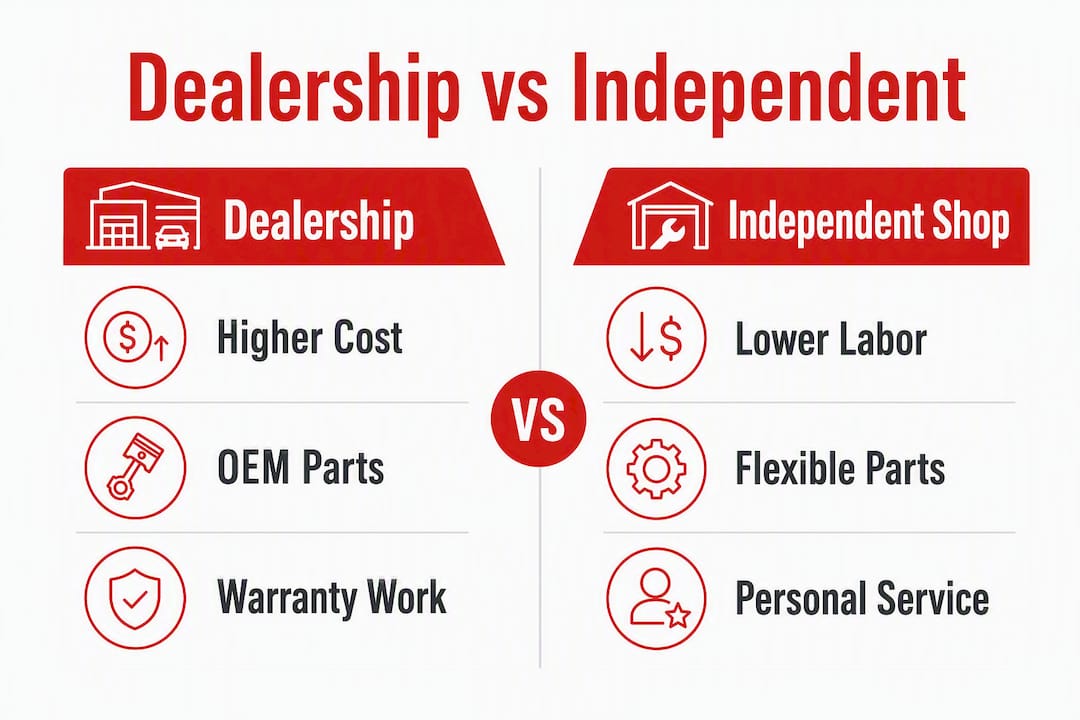
Consumer Reports’ member survey data (2024) found independent shops outperform dealerships on price satisfaction and overall satisfaction. Dealerships scored higher on waiting-room amenities and loaner car availability. That tradeoff is worth knowing before you decide.
Pro Tip: When comparing quotes, ask for a line-item breakdown of labor hours and parts cost separately. A lower headline price can hide a higher parts markup, or vice versa. The only way to compare apples to apples is to see both numbers.
When a dealership is clearly the right call
Some situations genuinely require a dealer. Not because independents lack skill, but because manufacturers control the tools, software, and reimbursement process.
- Active factory warranty repairs. If the failure is covered under the manufacturer’s bumper-to-bumper or powertrain warranty, the dealership is the only authorized option to perform that work at no cost to you.
- Safety recalls and manufacturer service campaigns. Recall work (airbag module replacements, fuel pump campaigns, seatbelt pretensioner fixes) is performed free at the dealer. An independent shop cannot bill the manufacturer for recall labor.
- ECU reprogramming and software flashes. Late-model vehicles increasingly require manufacturer-specific software updates. Dealers have OEM scan tools and direct access to TSBs and calibration procedures that most independents simply don’t carry.
- ADAS calibration after collision repairs. Forward-collision cameras, lane-departure sensors, and adaptive cruise systems often need factory-level recalibration after windshield replacement or front-end work. Dealer tooling is the safest bet here.
- Brand-new or very low-mileage vehicles with proprietary systems. Some first- and second-year models have undocumented quirks that only the dealer’s technical hotline and internal TSB database will catch.
Pro Tip: Every time a dealer performs warranty or recall work, ask for a copy of the repair order. Keep those records in a folder. A complete dealer service history can add negotiating power when you sell the car and can support future warranty claims if a related issue surfaces later.
When an independent shop is the better choice
Once a car is out of warranty, the math shifts fast. Reputable independent shops frequently offer equal or superior value for routine maintenance and general repairs on vehicles older than five years, often with more flexible scheduling.
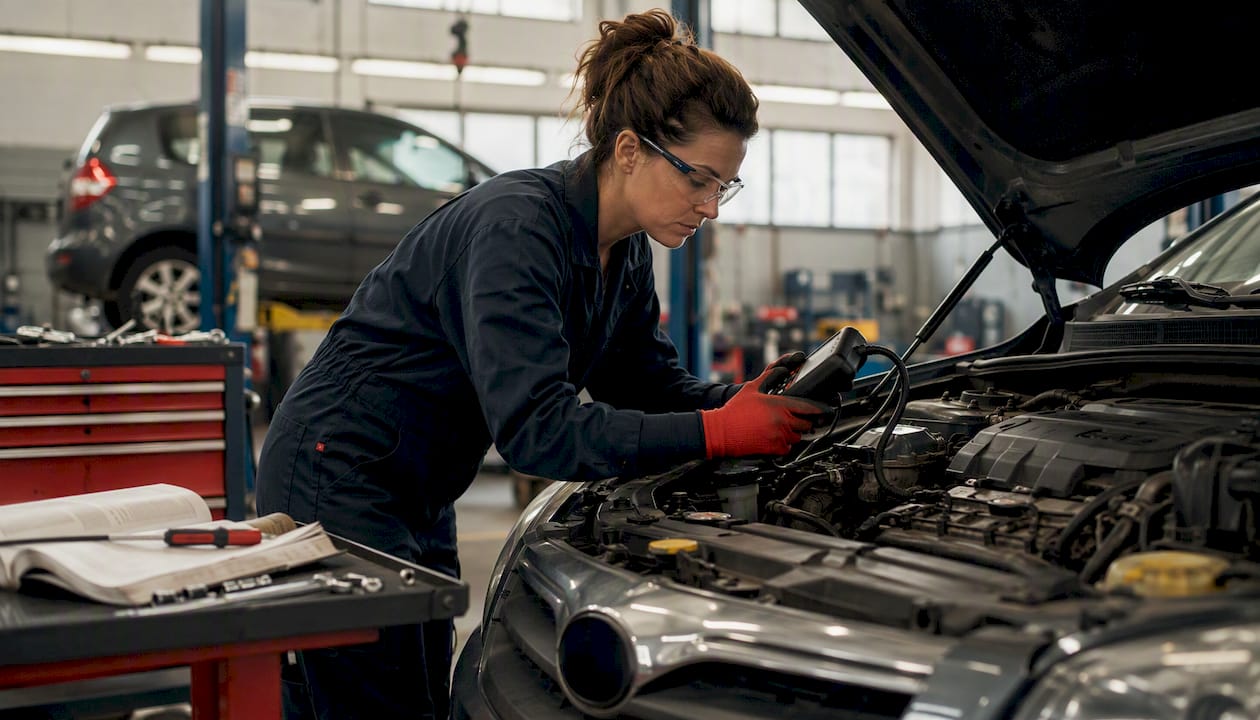
The jobs where independents consistently win on cost and turnaround include oil changes, brake pad and rotor replacements, suspension work (struts, control arms, sway bar links), cooling system service, and out-of-warranty diagnostic work. A brake job commonly costs significantly less at a well-equipped independent compared to a dealer service department, using equally good parts. Multiply that across a few services per year and the savings add up quickly.
Older vehicles are another strong case for independents. A 2012 Honda Accord doesn’t need factory scan tools or proprietary software. It needs a technician who knows the car’s common failure points and can diagnose them without defaulting to whole-assembly replacement. Many lead technicians at reputable independent shops are former dealership master techs, which explains why the quality gap people assume exists often doesn’t.
Specialty independents are worth seeking out for European and performance vehicles. A shop that focuses on BMW, Mercedes-Benz, or Subaru all day develops pattern recognition that a generalist dealer service lane doesn’t always match. For high-mileage vehicle maintenance, a trusted independent who knows your car’s history is often the most cost-effective option available.
Warranty, recalls, and parts: what the law actually says
Here’s the part most car owners get wrong. Using an independent shop for maintenance does not automatically void your factory warranty. Federal law protects your right to choose your repair provider.
The Magnuson-Moss Warranty Act requires a manufacturer to prove that an aftermarket part or third-party service directly caused the failure before denying a warranty claim. They cannot void coverage simply because your oil change happened at an independent shop. The FTC has taken action against companies that used illegal warranty restriction language to pressure consumers into dealer-only service.
That said, there are two situations where dealer-only matters regardless of Magnuson-Moss:
- Recall and warranty work billed to the manufacturer. The manufacturer reimburses only authorized dealers. An independent shop can perform the same physical repair, but you’ll pay out of pocket.
- Warranty claims on parts the dealer installed. If a dealer-installed part fails under its own warranty, the dealer handles that claim. An independent shop’s repair warranty covers only the work that shop performed.
What to keep on file:
- Itemized repair orders from every service visit (dealer or independent)
- Receipts showing parts brand, part number, and specification compliance
- Mileage and date of every oil change and fluid service
- Written warranty terms from the shop (what’s covered, for how long, and what voids it)
For a deeper look at how shop warranties work, the auto repair warranty guide at Tom’s B & M Auto breaks down what to look for in writing before you authorize any job.
Independent shops rated higher on price satisfaction in Consumer Reports’ 2024 member survey, while dealerships led on loaner car availability and waiting-room comfort.
How diagnostics actually differ between dealers and independents
Dealer diagnostics and independent diagnostics are not the same process, and understanding the difference can save you money.
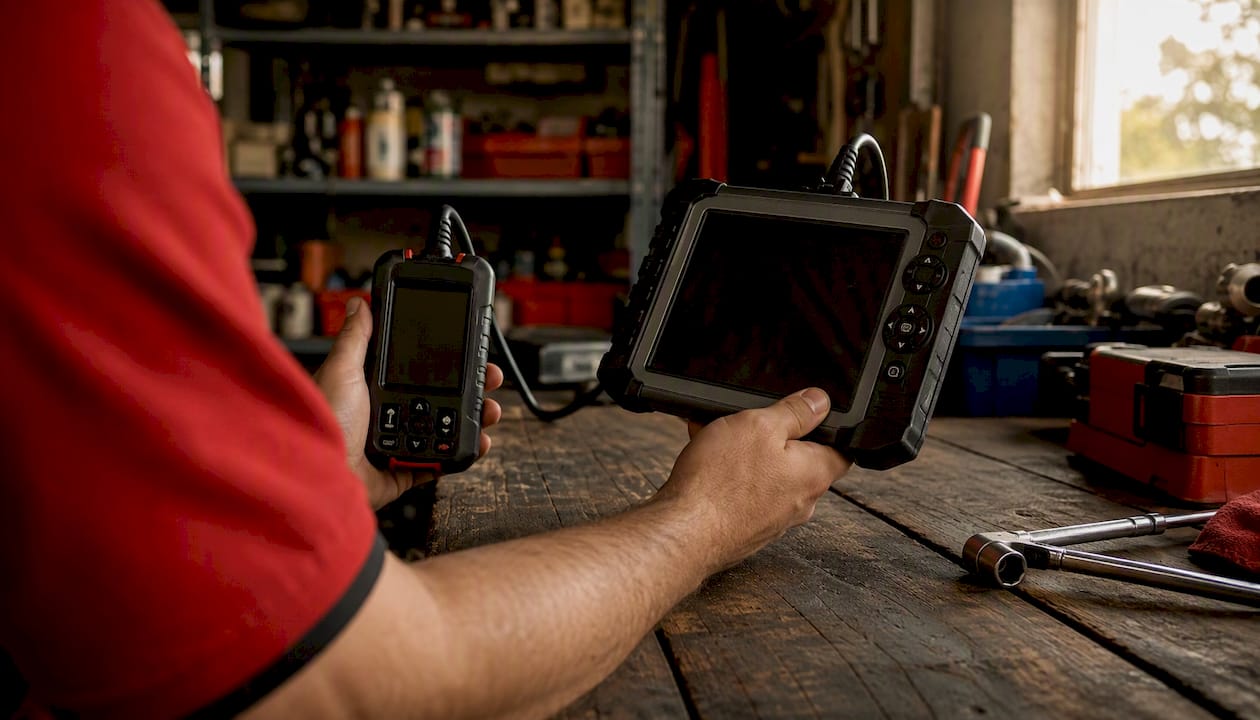
A dealer technician typically follows a manufacturer-prescribed flowchart: connect the OEM scan tool, pull the fault code, cross-reference the TSB database, and replace the assembly the flowchart points to. That process is fast and accurate for factory-documented faults. It can also result in replacing a $400 assembly when a $30 sensor was the actual failure, because the flowchart doesn’t always route to the component-level fix.
Independent technicians commonly use failure-mode diagnostics: they read the code, then test the circuit, check live data, and isolate the actual failed component before ordering parts. That approach takes longer up front but often avoids unnecessary assembly replacements. It’s one reason why skilled independents can match dealer repair quality at lower cost on out-of-warranty vehicles.
Questions worth asking any service advisor before you authorize diagnostic work:
- “How will you diagnose this? Will you test the circuit or go straight to the part the code points to?”
- “Do you use a digital vehicle inspection with photos or video?”
- “Can I keep the old part after the repair?”
- “What’s your diagnostic fee, and does it apply toward the repair if I approve the work?”
Pro Tip: Always request a digital vehicle inspection. Shops that photograph or video the problem area before and after the repair give you documentation that protects both parties. If a dispute arises later, those images are your evidence. For more on what diagnostic tests actually involve, the car diagnostic tests guide at Tom’s B & M Auto walks through the main scan tool types and what each one reveals.
How to pick the right shop for this specific job
The shop that’s right for a recall is not necessarily right for a brake job. Run through this before you hand over your keys.
Checklist for evaluating any quote:
- Request a written estimate before authorizing any work. A verbal quote is not a commitment.
- Ask for a line-item breakdown: labor hours, labor rate, and each part with its price.
- Confirm the parts spec: OEM, OEM-equivalent, or aftermarket, and ask which brand.
- Ask about the shop’s warranty on parts and labor in writing (12-month/12,000-mile minimum is a reasonable baseline; Tom’s B & M Auto offers 24-month/24,000-mile).
- Ask about the diagnostic fee policy: is it applied toward the repair if you approve it?
- Confirm turnaround time before you drop off, not after.
- Ask to keep the old part after replacement.
Questions that reveal how a shop actually operates:
- “Are your technicians ASE-certified?”
- “Do you offer a digital inspection with photos?”
- “How will you diagnose this specific problem?”
- “What happens if the repair doesn’t fix the issue?”
Red flags to watch for:
- Pressure to approve additional repairs before the original diagnosis is complete
- Refusal to provide a written estimate
- Vague answers about parts brand or specification
- No warranty offered on labor
- Unwillingness to return the old part
Common upsell tactics include recommending fluid flushes, cabin air filters, and “preventive” part replacements during every visit regardless of actual condition. Some of those services are legitimate; many are timed to catch owners off guard. The upsell avoidance guide at Tom’s B & M Auto covers the most common ones and how to push back.
Getting a second opinion is always reasonable for any repair over $500. A reputable shop will not pressure you to decide on the spot.
Pro Tip: If a shop quotes a repair and you’re unsure, ask them to document the failure in writing (fault code, test result, or photo) before you leave. That documentation lets a second shop verify the diagnosis without starting from scratch, which saves you a second diagnostic fee.
Why Tom’s B & M Auto is a source worth trusting on this
Tom’s B & M Auto has been serving the Lynnwood, WA area since 1985, which means over 40 years of working on the same makes, the same roads, and the same kinds of repair decisions this article covers.
- ASE-certified technicians on staff for all service categories
- All makes and models serviced: Toyota, Honda, Subaru, domestic vehicles, European brands, and hybrids
- Professional-grade OBD-II diagnostics for accurate fault isolation
- 24-month / 24,000-mile warranty on all parts and labor, in writing
- Upfront pricing with written estimates before any work is authorized
- Same-day appointments often available for Lynnwood-area customers
- Educational blog covering diagnostics, maintenance, warranty rights, and cost transparency for car owners
Key Takeaways
For most U.S. car owners, the decision comes down to one rule: use the dealer when the manufacturer is paying, and use a trusted independent shop when you are.
| Point | Details |
|---|---|
| Warranty and recalls go to the dealer | Only authorized dealers can perform manufacturer-covered warranty and recall work at no cost to you. |
| Independents win on cost for everything else | Labor rates tend to be lower at independent shops compared to dealerships, and parts markups are generally cheaper as well. |
| Your warranty is legally protected | Under Magnuson-Moss, a manufacturer must prove independent service caused a failure before denying a claim. |
| Always get it in writing | Written estimates, parts specs, and shop warranty terms protect you at any shop, dealer or independent. |
| Tom’s B & M Auto | ASE-certified, all-makes independent shop in Lynnwood, WA with a 24-month/24,000-mile warranty on all work. |
The part most guides skip over
The dealership-vs-independent debate gets framed as a quality question. It’s really a coverage question. Dealers aren’t better mechanics. They’re the only mechanics the manufacturer will reimburse. Once you separate those two things, the decision gets a lot clearer.
What concerns me more than where people take their car is how they choose a shop at all. Most drivers pick based on proximity or a quick Google search, then hand over their keys without asking a single question about how the diagnosis will be done, what parts will be used, or what warranty covers the work. That’s where the real money gets lost, not in the dealer-vs-independent choice itself.
A shop’s willingness to give you a written estimate, explain the diagnostic process, and return your old parts tells you more about its quality than its brand affiliation. I’ve seen dealerships do excellent, transparent work. I’ve seen independents cut corners badly. The checklist in this article works for both.
If you’re in the Lynnwood area and want a shop that will walk you through the diagnosis before asking you to approve anything, use the checklist above when you call around. Ask the questions. The answers will tell you what you need to know.
Tom’s B & M Auto: a local independent worth considering
Forty years of full-service repair in Lynnwood, WA means Tom’s B & M Auto has handled the exact tradeoffs this article covers, thousands of times. The shop services all makes including Toyota, Honda, Subaru, domestic vehicles, European brands, and hybrids, with ASE-certified technicians and professional-grade diagnostics on every job.
What sets Tom’s B & M Auto apart from a dealer service lane for out-of-warranty work:
- Written estimates before any work begins, with line-item labor and parts pricing
- 24-month / 24,000-mile warranty on all parts and labor
- OEM and quality aftermarket parts sourced to your vehicle’s specification
- Same-day appointments often available, no weeks-long wait
- Financing available for larger repairs through flexible payment options
If your check engine light is on and you’re not sure whether it’s a dealer issue or something an independent can handle, Tom’s B & M Auto offers a free check engine light review for Lynnwood-area drivers. For major engine work, the shop serves customers across the north Seattle area including engine repair in Kenmore. Call or book online to get a written estimate the same day.
Useful sources
- Consumer Reports: Car Repair Shop Survey — 2024 member survey data on price satisfaction, overall satisfaction, and amenities across dealerships, chains, and independents.
- MechanicSeeker: Dealer vs Independent Mechanic — Labor rate and parts markup ranges, plus analysis of when each shop type delivers better value.
- TrueCar Blog: Mechanic or Dealership? — Summary of FTC guidance and Magnuson-Moss protections for consumers using independent shops.
- Jalopnik: Dealership Service Center vs Independent Mechanic — Practical breakdown of Magnuson-Moss warranty rules and what manufacturers can and cannot do when you use an independent shop.
- MotiveWorks Auto: Dealership vs Independent Auto Repair — Covers diagnostic philosophy differences and transparency practices (digital inspections, returning old parts) that distinguish quality independents.
- FTC Consumer Alert: Warranty Restrictions — Primary government source on illegal warranty restriction practices and consumer rights under federal law.
- Tom’s B & M Auto Blog — Auto repair warranty explainer covering what shop warranties cover, how long they last, and what to ask before authorizing work.
Recommended
- How to Avoid Unnecessary Upsells at Your Auto Shop – Tom’s B & M Auto Blog
- How to Explain Repair Costs to Customers Clearly – Tom’s B & M Auto Blog
- How to Get an Accurate Repair Shop Estimate in Lynnwood – Tom’s B & M Auto Blog
- Hidden Car Repair Costs: Real Examples and How to Avoid Them – Tom’s B & M Auto Blog
Leave a Reply