
How to Explain Repair Costs to Customers Clearly
Explaining repair costs to customers means providing a detailed, transparent breakdown of parts, labor, and fees in plain language that connects each charge to a specific reason. Most car owners feel confused or suspicious when handed a repair bill without context. That confusion is not a knowledge problem. It is a communication problem. The 2025 Vehicle Health Index reports the average check-engine-light repair cost was $415.31 in 2024, with labor rates mostly between $120 and $159 per hour. When shops present those numbers without explanation, customers push back or walk away.
What are the main elements of an auto repair cost breakdown?
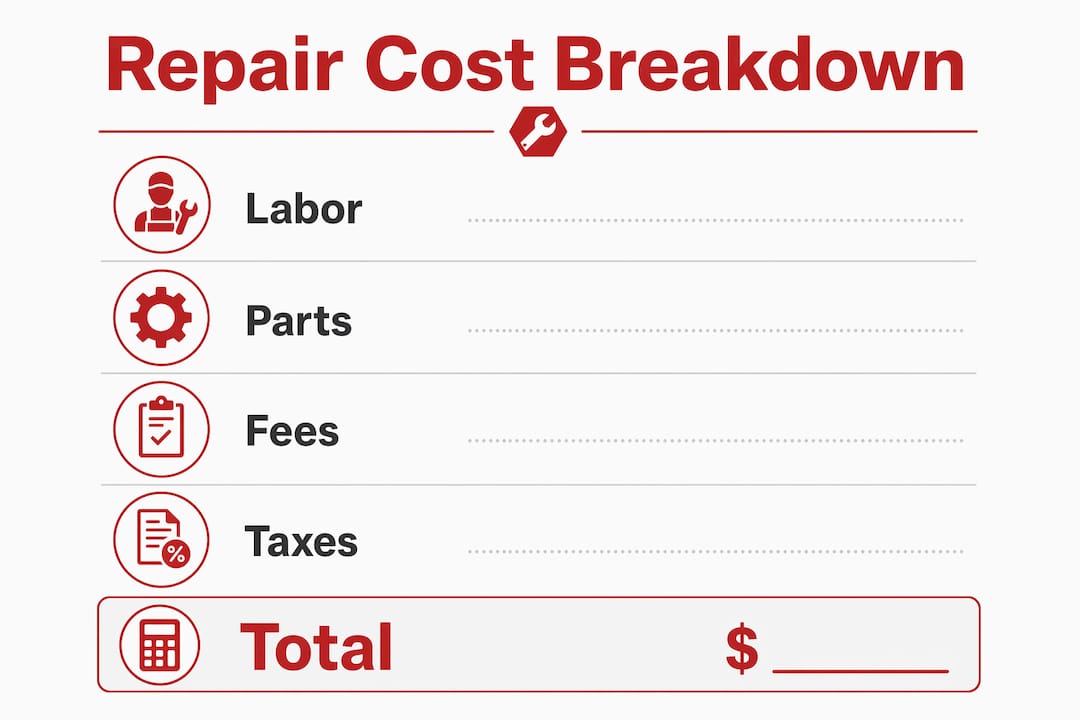
A repair estimate is made up of four core components: labor, parts, fees, and taxes. Understanding each one removes the mystery from the final number.
Labor charges
Labor is typically the largest line item on any estimate. Shops bill labor using one of two methods: flat rate or hourly. Flat rate billing uses a standardized time guide (such as the Mitchell or Chilton labor guides) to assign a fixed number of hours to each job, regardless of how long the technician actually takes. Hourly billing charges for actual time spent. Most shops use flat rate. Labor rates typically fall between $120 and $159 per hour depending on location, shop type, and technician certification level. That range reflects ASE-certified shops in markets like Lynnwood, WA, where Tom’s B & M Auto has operated since 1985.
Parts: OEM vs. aftermarket
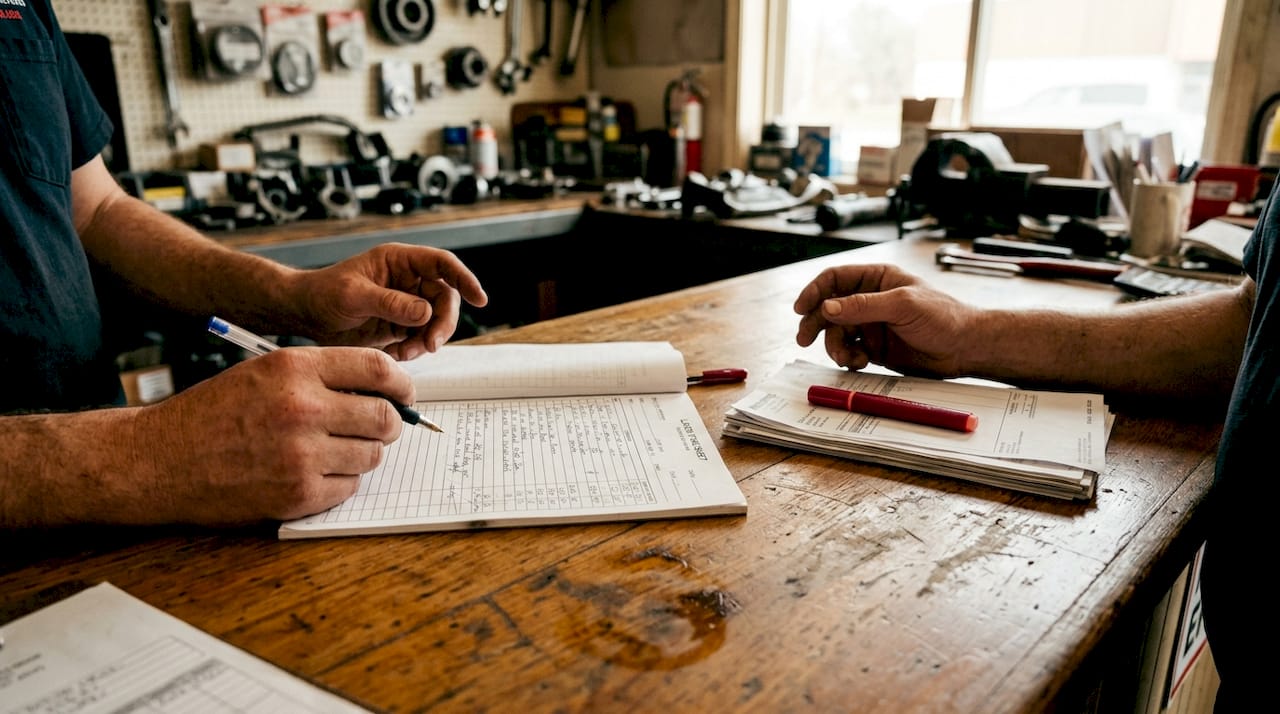
Parts costs vary significantly based on quality tier. OEM (Original Equipment Manufacturer) parts come directly from the vehicle’s manufacturer and carry the highest price. Aftermarket parts are made by third-party suppliers and cost less, though quality varies widely. Shops mark up parts above their wholesale cost to cover warranty obligations, sourcing time, and inventory risk. Parts markup is a standard practice, but excessive or unexplained markup is a legitimate red flag worth questioning.
Fees and taxes
Beyond labor and parts, estimates often include shop supply fees, diagnostic fees, and environmental disposal fees. Diagnostic fees are charged for the time a technician spends confirming the root cause of a failure. Shops that disclose whether the diagnostic fee is refundable or credited toward the repair earn higher trust from customers. Sales tax treatment varies by state. In Washington State, labor is not taxed but parts are, so your final bill will reflect tax on parts only.
| Cost Element | What It Covers | What to Ask |
|---|---|---|
| Labor | Technician time at flat rate or hourly | Which method is used and what the rate is |
| OEM Parts | Manufacturer-sourced components | Whether aftermarket is available and what the quality difference is |
| Aftermarket Parts | Third-party components | Brand name and warranty coverage |
| Diagnostic Fee | Time to confirm failure cause | Whether it is credited toward the repair |
| Shop Supplies | Fluids, rags, disposal materials | Whether it is a flat fee or percentage |
| Environmental Fee | Disposal of oil, coolant, batteries | Fixed amount per service |
| Sales Tax | Applied to parts in most states | Confirm what is taxable in your state |
Pro Tip: Ask for the estimate in writing before any work begins. California’s repair shop regulations and AAA guidance both confirm that a good written estimate includes itemized labor and parts with rates, caps, taxes, and clear authorization language.
How do shops explain repair cost estimates to reduce sticker shock?
Customers reject repair work most often when they receive only a total price with no context. Focusing the conversation on why a repair is needed, not just what it costs, improves approval rates and reduces conflict. The best shops use a tiered presentation structure to organize repairs by urgency.
The three tiers work like this:
- Safety-critical repairs. These are items that affect the vehicle’s ability to stop, steer, or protect occupants. Brake failure, steering component wear, and tire separation risk fall here. Present these first and explain the consequence of deferring them.
- Confirmed repairs. These are items with a confirmed failure that will worsen or cause secondary damage if ignored. A leaking valve cover gasket that is dripping onto an exhaust manifold is a confirmed repair with a clear escalation path.
- Recommended maintenance. These are items that are not yet failing but are due based on mileage, age, or manufacturer schedule. Cabin air filters and coolant flushes typically land here.
Tiered repair presentations increase approval rates and build trust because customers can make informed choices about what to authorize now versus later. Presenting all repairs as equally urgent destroys credibility.
The communication method matters as much as the structure. Text-based, line-item approval estimates convert 15–30% more revenue than verbal all-or-nothing methods. Customers can review each line, approve individual items, and respond on their own schedule. That flexibility reduces pressure and increases confidence.
Plain English is non-negotiable. “Your rear brake pads are at 2mm. The minimum safe thickness is 3mm. Driving on them risks metal-to-metal contact, which damages the rotors and doubles the repair cost” is more persuasive than “rear brakes need replacement.” Link the symptom to the consequence. Respect the customer’s ability to make a decision when given real information.
Pro Tip: Never discount as a first response to price objections. Discounting signals that the original price was inflated. Instead, offer to defer non-urgent items and explain which repairs are safe to postpone.
How can car owners critically review a repair cost breakdown?
Car owners have every right to question any line on an estimate. Knowing what to look for protects you from vague charges and unnecessary work.
Red flags to watch for
- “Miscellaneous” or “shop package” charges with no itemized breakdown. Ask what specific supplies or services are included.
- Vague labor descriptions like “engine work” or “electrical diagnosis” without a specific task listed.
- Parts listed without brand names or quality tier. You cannot evaluate a parts cost without knowing whether it is OEM, name-brand aftermarket, or a generic part.
- No diagnostic proof. A shop should be able to show you a photo, a measurement, or an OBD-II scan result that confirms the failure. Tom’s B & M Auto uses professional-grade OBD-II diagnostics and provides photo documentation as standard practice.
- Full labor charged for multiple repairs that share disassembly. This is the labor overlap problem.
Understanding labor overlap
Labor overlap occurs when two or more repairs require the same disassembly steps. For example, replacing a timing belt and a water pump on many engines requires removing the same components. A fair estimate accounts for the shared labor and charges a reduced combined rate. Some shops charge full labor for each job separately, which inflates the total. Always ask: “Do any of these repairs share disassembly time, and has that been accounted for in the estimate?”
Questions every car owner should ask
- What parts brand are you using, and does it carry a warranty?
- Is the diagnostic fee credited toward the repair if I approve the work?
- Which of these repairs are safety-critical versus recommended?
- Can I see the photo or measurement that confirms this failure?
- Have you accounted for labor overlap on any of these jobs?
Pro Tip: If an estimate feels high and you cannot get clear answers to these questions, a second opinion is reasonable. A shop confident in its pricing will not object to the request. Check out hidden repair cost patterns to know what to look for before you ask.
What tools help shops and customers communicate repair costs clearly?
The format of an estimate determines how well the information lands. A handwritten total on a paper form communicates almost nothing. A digitally itemized estimate with photos, categories, and approval checkpoints communicates everything.
Itemized digital estimates with line-by-line approval increase customer engagement and reduce friction in the repair approval process. Customers can approve safety-critical items immediately and defer recommended maintenance without a phone call. That control builds confidence and reduces the anxiety that drives customers to delay necessary repairs.
Photos and written defect descriptions are the strongest trust tools available. A photo of a cracked serpentine belt or a measurement showing brake pad thickness at 1.5mm removes all ambiguity. The customer sees exactly what the technician sees. That shared visibility eliminates the “how do I know it’s really broken?” objection before it is raised.
Capped estimates protect customers from surprise final bills. A cap means the shop commits to not exceeding the quoted amount without prior authorization. This is standard practice at reputable shops and is required by law in several states.
| Estimate Method | Strengths | Weaknesses |
|---|---|---|
| Verbal estimate | Fast, conversational | No record, easy to misremember |
| Paper itemized estimate | Documented, signable | Hard to update, no photos |
| Digital itemized estimate | Photos, line approval, text delivery | Requires shop software investment |
| Text-based line-item approval | High approval rates, customer-paced review | Needs clear descriptions per line |
Communication protocol matters too. The best practice is to send the digital estimate by text first, then follow up with a phone call to answer questions. Customers who have already reviewed the estimate arrive at the conversation informed rather than defensive.
Pro Tip: When reviewing an estimate, ask if you can negotiate repair costs by deferring non-urgent items rather than asking for a blanket discount. This keeps the shop’s pricing integrity intact and gives you real control over what you spend.
Key Takeaways
Clear repair cost communication requires linking every charge to a specific reason, presented in writing with evidence and organized by urgency.
| Point | Details |
|---|---|
| Know the four cost components | Labor, parts, fees, and taxes each have distinct logic. Ask about all four. |
| Request tiered estimates | Safety-critical, confirmed, and recommended repairs should be listed separately. |
| Watch for labor overlap | Ask if shared disassembly was accounted for when multiple repairs are quoted together. |
| Demand written proof | Photos, measurements, and OBD-II scan results confirm a failure is real. |
| Use digital estimates | Line-item text approval converts more approvals and gives customers control. |
Why I think most repair cost confusion is a shop problem, not a customer problem
After years of watching car owners struggle with repair estimates, I am convinced the confusion is almost never about the customer’s ability to understand. It is about how the information is delivered. A customer handed a $1,200 estimate with four vague line items and no explanation will feel suspicious. The same customer handed a digital estimate with photos, plain-English descriptions, and a tiered breakdown will ask one or two questions and approve the work.
The shops that resist detailed estimates usually argue it takes too long. That argument does not hold up. The time spent explaining a repair upfront is always less than the time spent managing a dispute, a chargeback, or a customer who leaves and never returns. Transparency is not a courtesy. It is the most efficient way to run a repair business.
At Tom’s B & M Auto, the standard is written estimates with itemized labor and parts before any work begins. ASE-certified technicians document findings with photos and OBD-II data. Customers see exactly what was found and why it matters. That approach has built a 40-year reputation in Lynnwood, WA, and it is the only approach I trust.
My advice to any car owner: do not accept a verbal estimate for any repair over $200. Do not approve work without seeing the proof. And do not hesitate to ask whether labor overlap was considered when multiple repairs are quoted together. A shop that cannot answer those questions clearly is not a shop you want working on your vehicle.
— Shingi
Upfront pricing and financing at Tom’s B & M Auto
Tom’s B & M Auto has provided written, itemized estimates to Lynnwood-area car owners since 1985. Every estimate includes a line-by-line breakdown of labor, parts, and fees, organized by urgency so you know exactly what needs attention now and what can wait. ASE-certified technicians back every recommendation with photo documentation and OBD-II diagnostic data.
Repair costs can add up, and Tom’s B & M Auto offers financing options to help you manage larger jobs without deferring safety-critical work. A free digital vehicle inspection is also available, giving you a full picture of your vehicle’s condition before you commit to anything. Same-day appointments are often available. All work carries a 24-month / 24,000-mile warranty.
FAQ
What does a repair cost breakdown include?
A repair cost breakdown includes itemized labor charges, parts costs with quality tier noted, diagnostic fees, shop supply fees, environmental fees, and applicable sales tax. Each line should list the specific task, rate, and total.
Why do labor rates vary so much between shops?
Labor rates reflect technician certification level, shop location, and overhead costs. Rates between $120 and $159 per hour are typical for ASE-certified shops, with rates in higher-cost metro areas trending toward the top of that range.
What is labor overlap and why does it matter?
Labor overlap occurs when two repairs share the same disassembly steps. Fair billing reduces the combined labor charge to reflect shared work. Always ask if overlap was accounted for when multiple repairs appear on the same estimate.
Should I always get a second opinion on a large repair estimate?
A second opinion is reasonable for any estimate above $500 or for any repair you cannot verify with photos or diagnostic data. A confident shop will not object to the request.
Are diagnostic fees always charged separately?
Diagnostic fees are standard when a technician must spend time confirming a failure’s root cause. Ask upfront whether the fee is credited toward the repair if you approve the work. Shops that credit the fee demonstrate fair billing practices.
Recommended
- Hidden Car Repair Costs: Real Examples and How to Avoid Them – Tom’s B & M Auto Blog
- Financing Available | Tom’s B&M Auto | Lynnwood, WA
- How to Get an Accurate Repair Shop Estimate in Lynnwood – Tom’s B & M Auto Blog
- How to Negotiate Auto Repair Costs and Pay Less – Tom’s B & M Auto Blog
Leave a Reply