
What Is Transfer Case Service? Your 4WD Guide
Transfer case service is defined as the periodic inspection and replacement of the fluid inside your transfer case, the drivetrain component that splits engine power between your front and rear axles in 4WD and AWD vehicles. Without this service, the gears, chains, and clutch packs inside the transfer case run hot and dry, leading to failures that cost between $1,500 and $4,000 to repair. A fluid change, by contrast, costs a fraction of that. Most manufacturers recommend transfer case service every 30,000–60,000 miles for normal driving. Tom’s B & M Auto has handled drivetrain maintenance for Lynnwood-area vehicle owners since 1985, and neglected transfer cases are one of the most preventable repair bills we see.
What is transfer case service and why does it matter?
The transfer case is a gearbox mounted between your transmission and your front and rear driveshafts. Its job is to receive power from the transmission and distribute it to both axles, either equally or in variable proportions depending on your driving mode. Inside the housing sit gears, drive chains, and clutch packs, all spinning at high speed and generating significant heat.
Transfer case fluid lubricates every one of those moving parts, prevents metal-on-metal contact, and carries heat away from the clutch packs. When the fluid breaks down, friction increases, temperatures spike, and the clutch packs begin to wear unevenly. Neglecting this service causes overheating, erratic AWD engagement, and eventually full transfer case failure.
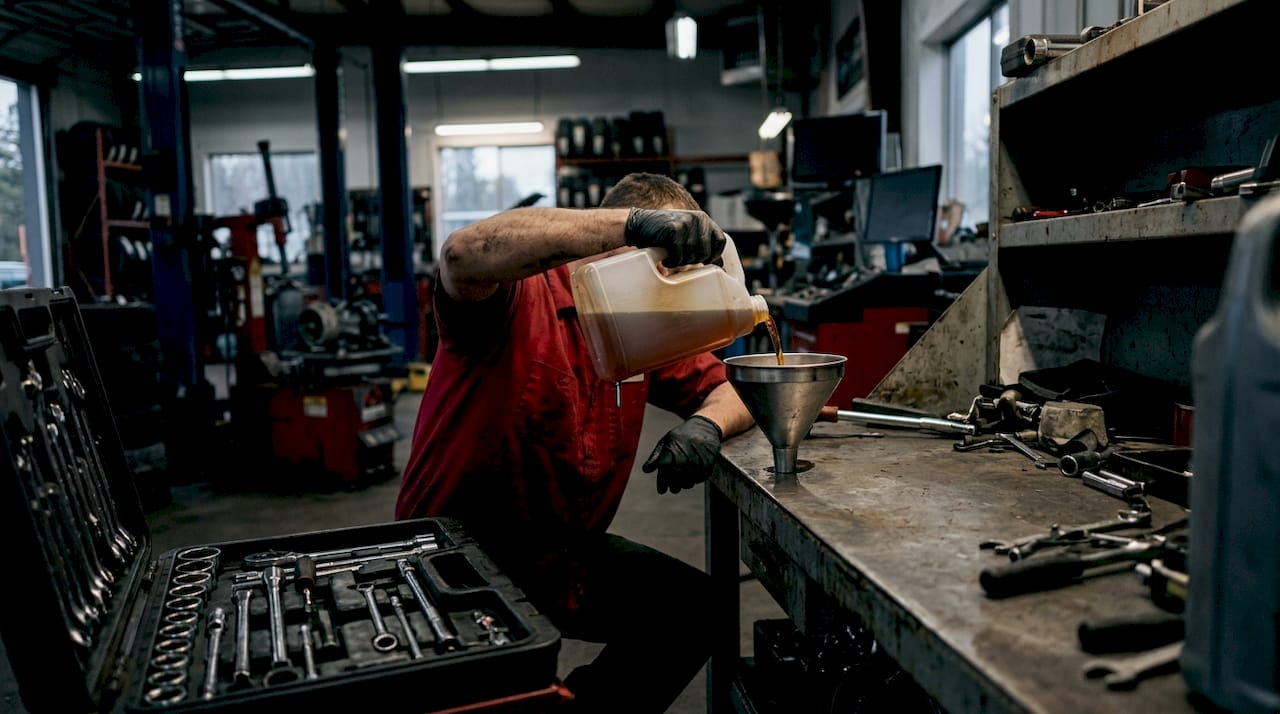
Transfer case service is not the same as an oil change or a transmission service. Many owners assume routine oil changes cover the entire drivetrain. They do not. The transfer case has its own sealed fluid supply that degrades independently, and it needs its own dedicated service interval.
How does a transfer case work?
Understanding the mechanics helps you appreciate why the fluid matters so much. When you engage 4WD or your AWD system activates automatically, the transfer case routes torque to whichever axle needs it. In part-time 4WD systems, you select high or low range manually. In full-time AWD systems, the transfer case manages power split continuously without driver input.
The internal components that make this possible include:
- Gears and planetary gear sets that multiply torque in low range
- Drive chains that connect the front output shaft to the rear
- Clutch packs that modulate power distribution in AWD systems
- Seals and bearings that keep fluid in and contaminants out
Degraded fluid affects the friction modifier chemistry in clutch packs directly. That chemistry is what allows clutch packs to engage smoothly. Once it breaks down, you get shuddering, slipping, and uneven power delivery.
Pro Tip: Transfer case fluid and transmission fluid are not interchangeable. Always use the fluid type specified in your owner’s manual. Using incorrect fluid can cause premature seal failure and internal leaks.
What are the recommended service intervals?
Most automotive manufacturers recommend changing transfer case fluid every 30,000–60,000 miles under normal driving conditions. That range exists because vehicle designs, fluid formulations, and usage patterns vary widely. The only reliable source for your specific interval is your owner’s manual.
Severe service conditions shorten that window considerably. Towing heavy loads, frequent off-roading, driving in extreme heat, and stop-and-go traffic all accelerate fluid degradation. Under severe conditions, service intervals drop to every 25,000–30,000 miles.
| Condition | Recommended interval |
|---|---|
| Normal highway driving | 30,000–60,000 miles |
| Frequent towing | 25,000–30,000 miles |
| Regular off-road use | 25,000–30,000 miles |
| Hot climate driving | 25,000–30,000 miles |
| High mileage vehicles | Consult owner’s manual |
Drivers unaware of severe service criteria often face early drivetrain failures because they follow the standard interval while driving under conditions that demand more frequent service. If you tow a trailer even occasionally or take your truck off-road a few times a year, treat your vehicle as a severe service vehicle and service accordingly.
There is no universal interval that fits every driver. Off-roaders and drivers in hot climates should default to the severe service schedule regardless of what the standard manual recommendation says.
What are the signs of transfer case problems?
Catching transfer case problems early is the difference between a fluid change and a four-figure repair bill. The warning signs are specific enough that you can recognize them without any mechanical training.
Watch for these symptoms:
- AWD or 4WD warning light on the dashboard. This is the most direct signal that the system has detected a fault.
- Grinding, whining, or clunking noises during acceleration or when shifting between drive modes. These sounds indicate metal contact inside the case.
- Fluid puddles under the vehicle center. Transfer case leaks often appear as reddish puddles and are sometimes confused with transmission fluid. Ignoring them accelerates internal damage.
- Burning smell while driving, especially after highway runs or towing.
- Difficulty engaging or disengaging 4WD modes. If your selector feels stiff or the system hesitates, the fluid or clutch packs are likely compromised.
Early symptoms like grinding or clutch slipping can sometimes be resolved with a fluid change and a software adaptation reset, avoiding far more expensive repairs. The key is acting on symptoms immediately rather than waiting for the next scheduled service.
Pro Tip: Mismatched tire sizes force the clutch packs inside your transfer case to constantly compensate for the speed difference between axles. This accelerates fluid contamination and wear. Keep all four tires the same size and tread depth.
What does a transfer case service involve?
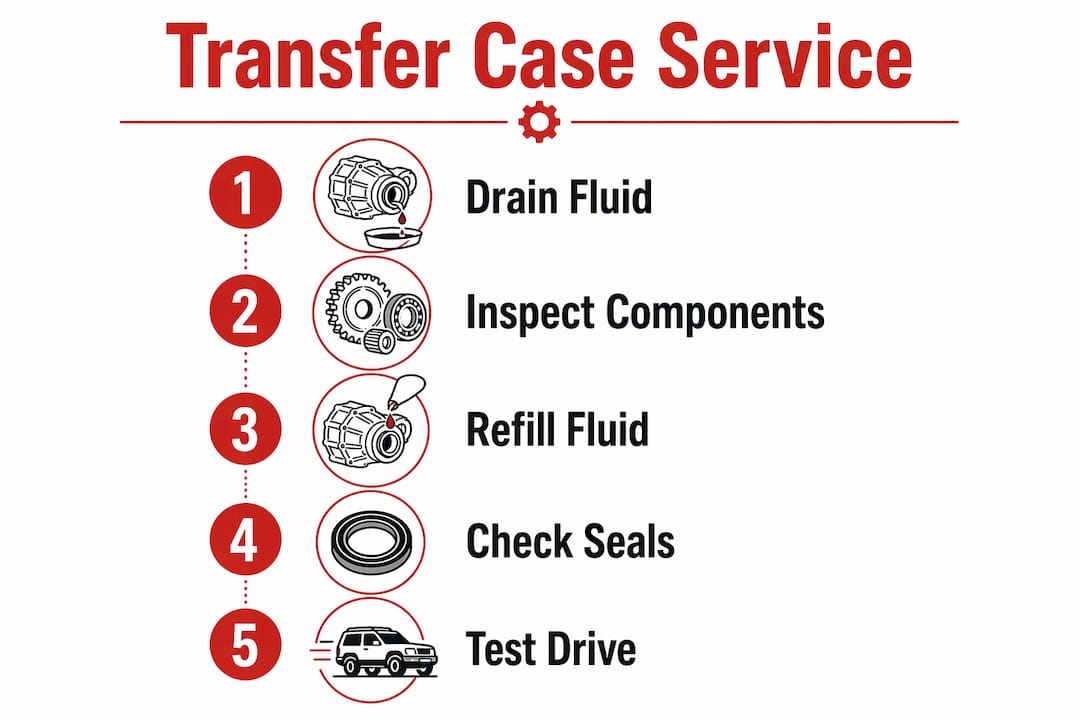
A proper transfer case service follows a clear sequence. Knowing the steps helps you verify that any shop you use is doing the job correctly.
- Lift and secure the vehicle on a level surface. Level positioning is critical because most transfer cases have no dipstick. Fluid level is checked and set through a fill plug, and the vehicle must be flat for an accurate reading.
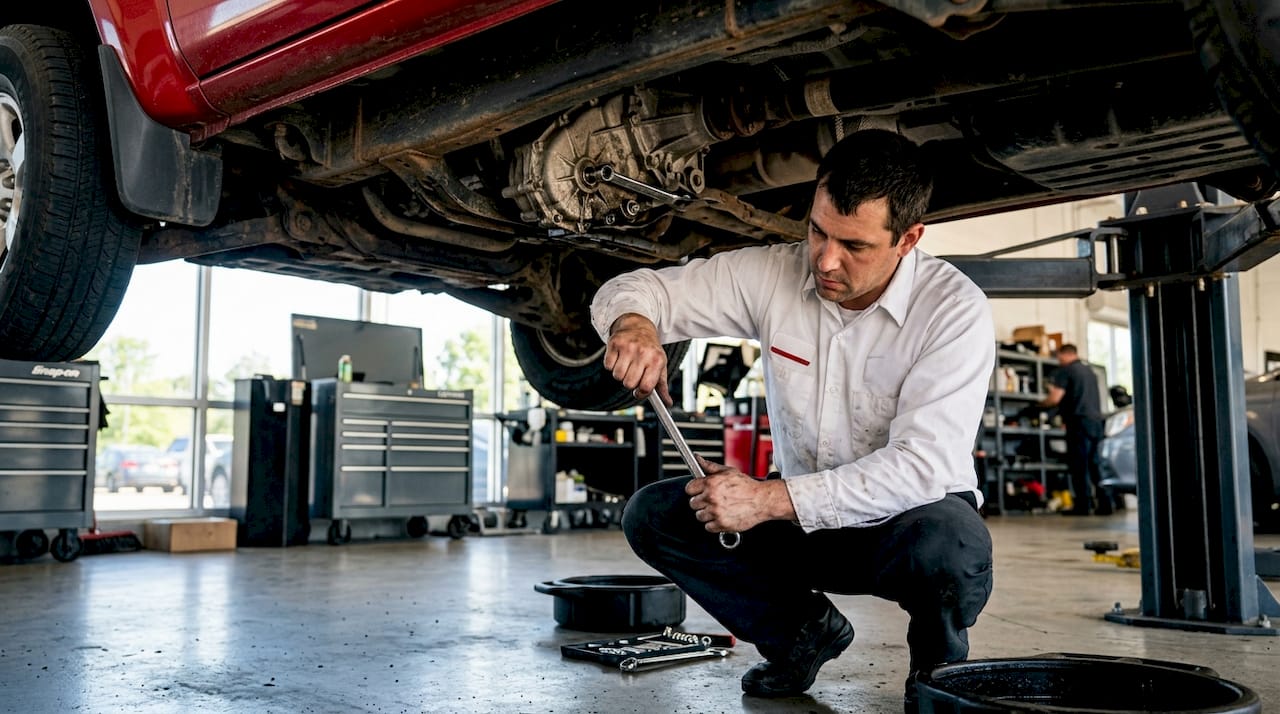
- Remove the drain plug and drain the old fluid completely into a catch pan. Technicians inspect the drained fluid for metal particles, which indicate internal wear.
- Inspect accessible seals and the transfer case housing for cracks, leaks, or damage. A quick undercarriage inspection takes under two minutes and can catch leaks before they cause damage.
- Reinstall the drain plug with a new crush washer or thread sealant as specified.
- Refill with manufacturer-specified fluid through the fill plug until fluid reaches the correct level.
- Test drive and recheck for leaks or warning lights.
Many transfer cases lack dipsticks, which makes fluid level verification impractical without a lift. This is one reason regular scheduled fluid changes are more cost-effective than trying to check fluid condition at home. A shop with a lift can complete the full service in under an hour.
For high mileage vehicles, technicians may also check the transfer case mounting hardware and output shaft seals, since older seals are more prone to weeping after fluid changes disturb them.
Key Takeaways
Transfer case service is the single most cost-effective way to protect a 4WD or AWD drivetrain, with fluid changes costing a fraction of the $1,500–$4,000 repair bill that follows a neglected case.
| Point | Details |
|---|---|
| Define the service | Transfer case service means draining old fluid and refilling with manufacturer-specified fluid on schedule. |
| Know your interval | Normal use requires service every 30,000–60,000 miles; severe use shortens that to 25,000–30,000 miles. |
| Spot warning signs early | Grinding noises, AWD warning lights, and fluid puddles under the vehicle center all demand immediate attention. |
| Match your tires | Mismatched tire sizes accelerate clutch pack wear and fluid contamination inside the transfer case. |
| Use the right fluid | Incorrect fluid causes seal failure; always follow the owner’s manual specification for fluid type. |
The repair bill I keep seeing that should never happen
I have watched the same scenario play out more times than I can count. A driver brings in a truck or SUV with a grinding transfer case, and when I ask about service history, the answer is almost always the same: “I thought it was covered in the oil change.” It is not. Transfer case fluid sits in a sealed housing and degrades on its own timeline, completely independent of your engine oil.
What makes this frustrating is that the fix, when caught early, is genuinely cheap. A fluid change is a minor service. But once the clutch packs are worn and the gears are scored, you are looking at a rebuild or replacement. The cost difference between proactive and reactive maintenance here is not marginal. It is the difference between a routine service visit and a repair that can exceed $2,000.
My advice is simple. Keep a maintenance log that includes your transfer case fluid changes. When you bring your vehicle in, tell the technician exactly what you have noticed, specific noises, when they occur, and under what driving conditions. Detailed symptom history helps technicians diagnose accurately and avoid wasted repairs. And if you drive off-road or tow regularly, stop waiting for the standard interval. Treat your drivetrain like the severe-use system it actually is.
— Shingi
Transfer case service at Tom’s B & M Auto
Tom’s B & M Auto has served 4WD and AWD owners across Lynnwood, Kenmore, and the surrounding area since 1985. The ASE-certified technicians here handle transfer case fluid changes, drivetrain inspections, and full engine repair in Kenmore with upfront pricing and a 24-month/24,000-mile warranty on all work.
Same-day appointments are often available, and financing options are on the table for larger repairs. If your 4WD warning light is on, you have noticed unusual noises, or you simply cannot remember the last time your transfer case fluid was changed, now is the time to get it checked. Book your inspection at Tom’s B & M Auto and know exactly where your drivetrain stands.
FAQ
What is transfer case service?
Transfer case service is the process of draining old transfer case fluid and refilling it with manufacturer-specified fluid to lubricate and cool the internal gears, chains, and clutch packs. It is a separate service from oil changes or transmission service.
How often should I change my transfer case fluid?
Most manufacturers recommend every 30,000–60,000 miles for normal driving. Severe use such as towing, off-roading, or driving in hot climates shortens that interval to every 25,000–30,000 miles.
What are the signs my transfer case needs service?
Common signs include AWD or 4WD warning lights, grinding or whining noises, fluid puddles under the center of the vehicle, a burning smell, and difficulty engaging 4WD modes.
Can I check my transfer case fluid myself?
Most transfer cases do not have a dipstick, so checking fluid level requires accessing a fill plug with the vehicle on a level surface and a lift. Professional service is the practical choice for most owners.
How much does transfer case service cost?
A fluid change is part of combined drivetrain services that typically run between $160 and $460. Waiting until the transfer case fails raises that cost to $1,500–$4,000 for repair or replacement.
Recommended
- Transmission Service in Kenmore, WA | Tom’s B&M Auto
- Transmission Service in Mountlake Terrace, WA | Tom’s B&M Auto
- Transmission Service in Lynnwood, WA | Tom’s B&M Auto
- Transmission Service in Shoreline, WA | Tom’s B&M Auto
Leave a Reply