
Mechanic Flat Rate Efficiency Tips to Maximize Pay
Flat rate pay is defined as a compensation structure where technicians earn a fixed number of hours per job, regardless of how long the actual repair takes. Mastering mechanic flat rate efficiency tips is the fastest way to close the gap between clock hours and flagged hours. Shops that enforce strict job card discipline and weekly efficiency tracking see 5–10% efficiency gains within 90 days, recovering $35,000–$70,000 annually in a typical three-tech shop billing at $180 per hour. That number shows exactly how much money sits on the table when workflow is loose. Tom’s B & M Auto, serving Lynnwood since 1985, has built its reputation on the kind of disciplined, ASE-certified workflow that makes flat rate pay work for everyone.
1. Mechanic flat rate efficiency tips start with workspace organization
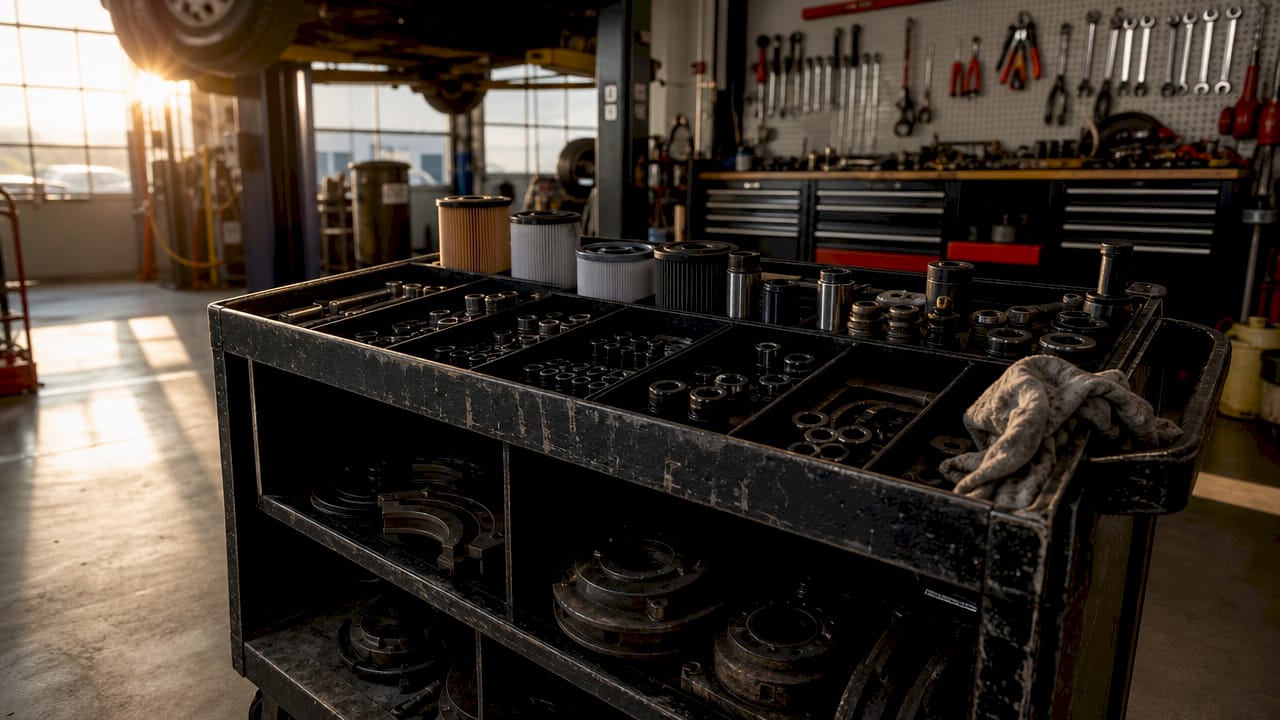
A disorganized workspace is a direct tax on your flagged hours. Every trip back to the main toolbox, every minute hunting for a socket, is time you will never bill. Organizing roll carts daily based on the scheduled repairs cuts motion waste and keeps your focus on the job in front of you.
The goal is to treat your cart like a prep station. Before the first car rolls in, pull every tool and fastener you expect to need for that day’s jobs. Group them by vehicle, not by tool type. This single habit removes the most common source of wasted motion in a flat rate bay.
Phone use and workspace clutter are the other two killers. A cluttered bay forces you to move things before you can work. Personal phone distractions break your mental rhythm and add minutes to every job. Neither costs you anything to fix.
- Load your roll cart the night before or first thing in the morning based on the day’s repair schedule.
- Keep hardware, clips, and fasteners in labeled bins on the cart, not loose in a drawer.
- Clear your bay floor between jobs so the next car can pull straight in.
- Set your phone to do-not-disturb during active repair time.
Pro Tip: Customize tool placement on your cart by job type. Brake jobs get one shelf, oil service gets another. You will reach for the right tool without thinking.
2. What is repair triage and how does it improve shop throughput?
Repair triage is the practice of sorting incoming vehicles by labor complexity before assigning them to bays, exactly as an emergency room sorts patients by urgency. The payoff is significant. 65–70% of vehicles entering service bays require under 4 hours of labor, which means most of your daily ticket volume qualifies for a fast-turn workflow.
Shops that ignore triage assign a 30-minute oil service to a full-lift bay and then wonder why throughput is slow. Dedicated express bays for jobs under two hours keep those tickets moving and free your diagnostic bays for complex work. The result is more jobs completed per day without adding staff.
The table below shows how triage categories map to realistic labor time and bay assignment.
| Job category | Typical labor time | Recommended bay type |
|---|---|---|
| Express service (oil, filters, wipers) | Under 1 hour | Express bay |
| Light repair (brakes, battery, belts) | 1–3 hours | Standard bay |
| Moderate repair (suspension, exhaust) | 3–5 hours | Standard or lift bay |
| Complex repair (engine, transmission) | 5+ hours | Dedicated diagnostic bay |
Implementing triage requires a service advisor who reviews every repair order at write-up and assigns a category before the car enters the shop. This one process change reduces bay downtime and keeps technicians working on jobs matched to their current capacity.
3. Why multitasking is the core skill for flat rate success
Top flat rate technicians treat their bay as a dynamic system, managing multiple jobs simultaneously rather than working one car start to finish. This is not about rushing. It is about eliminating idle time while waiting for fluids to drain, parts to arrive, or approvals to come through.
The practical version looks like this: you start a coolant flush on car one, then move to a brake inspection on car two while the system drains. By the time the inspection is written up, car one is ready for the next step. Neither job sits idle, and neither does your hands.
- Start fluid drains and soaks on one vehicle before moving to a second car for inspection or diagnosis.
- Stage parts for the next job while the current job is in a wait phase.
- Prep your next repair order while a vehicle is on the alignment rack.
- Never stand and watch a machine run. Use that time on a billable task.
Proactive communication with dispatchers is what keeps this system running. If you finish a job and have nothing queued, that is income lost. Tell your dispatcher before you finish, not after.
Pro Tip: Think of “empty hands” as a direct pay cut. Every minute without a billable task is money you will not recover. Keep a mental queue of at least two jobs at all times.
4. How to identify and fix workflow bottlenecks that cut flagged hours
The industry benchmark is clear: technicians should flag 90% or more of actual clock hours. When flagged hours fall below 80%, the problem is almost always a systemic workflow issue, not technician speed. Blaming the tech before auditing the workflow is the most common mistake shop owners make.
Delayed estimate approvals are one of the biggest sources of unbilled waiting time. A technician who finishes a diagnosis and then waits 45 minutes for a customer callback earns nothing during that window. Shops using digital customer portals, where inspection results and estimates are sent by text or email for instant approval, shrink that gap significantly.
Common bottlenecks to audit in your shop:
- Estimate approval delays caused by phone-tag with customers.
- Parts procurement lags from suppliers without same-day availability.
- Dispatcher inefficiencies where work is not pre-assigned before a bay opens.
- Informal quick jobs completed without a job card, which creates unbilled time that never gets recovered.
Enforcing strict job card discipline is the fastest single fix for recovering lost hours. Every job, including a five-minute tire pressure check, needs a card. Reading about how to avoid unnecessary upsells also helps service advisors write cleaner estimates that get approved faster, which directly reduces technician idle time.
5. How shop layout and faster equipment drive flat rate productivity
Shop infrastructure is a bigger efficiency driver than most owners realize. Upgrading to high-speed lifts that rise and lower twice as fast as standard equipment increases the number of jobs a technician can complete per day without any change in their skill level or work pace. The lift is the bottleneck, not the tech.
Bay layout follows the same logic. If a technician has to walk 40 feet to reach the parts counter, the tire machine, or the alignment rack, those steps add up across a full day. Positioning high-use equipment within the natural flow of the bay cuts travel time and keeps hands on billable work.
| Equipment or layout factor | Impact on throughput |
|---|---|
| High-speed lift vs. standard lift | More vehicle cycles per day per bay |
| Parts counter within bay reach | Fewer trips, less time off the job |
| Dedicated alignment bay | No waiting for shared equipment |
| Digital inspection tablet at bay | Faster write-up, faster customer approval |
Investing in faster shop infrastructure consistently yields higher efficiency returns than pressuring technicians to work faster. Speed without the right tools creates errors. Better tools create speed naturally. For small and medium shops, even repositioning one piece of equipment can free up meaningful time across a week.
Getting a fast, accurate repair estimate also reduces the back-and-forth that stalls work in the bay. When estimates are clear and complete at write-up, approvals come faster and technicians stay productive.
Key takeaways
Flat rate efficiency is determined by workflow discipline, workspace setup, and shop infrastructure, not just technician speed.
| Point | Details |
|---|---|
| Flag 90% of clock hours | Falling below 80% signals a shop bottleneck, not a technician problem. |
| Organize your cart daily | Align tool placement with the day’s repair schedule to cut motion waste. |
| Use repair triage | Assign express bays to jobs under 4 hours to keep throughput high. |
| Multitask between jobs | Stage parts and run parallel tasks to eliminate idle time and protect income. |
| Fix the workflow first | Digital approvals and strict job cards recover more flagged hours than speed alone. |
The real flat rate problem most shops ignore
I have watched technicians with genuine skill consistently underperform on flat rate, and the cause is almost never their hands. It is their system. The techs who flag the most hours are not the fastest wrenchers. They are the best planners.
The mindset shift that matters most is moving from “I am fixing this car” to “I am managing this bay.” Once you see your workspace as a production system, every decision changes. You stop waiting. You start staging. You communicate before you need something, not after you are already idle.
The other thing I have seen consistently is that shops blame flat rate pay when the real problem is workflow friction. Flat rate frustrations commonly stem from inefficient workflows, not the pay structure itself. Fix the bottlenecks and flat rate becomes one of the most rewarding pay structures in the trades.
The shops that get this right invest in their infrastructure and their processes before they push their people. That order matters. A technician working in a well-organized bay with fast equipment and clean job cards will outperform a faster technician working in a chaotic one every single time.
— Shingi
Tom’s B & M Auto: where efficiency meets quality repair
Tom’s B & M Auto has served Lynnwood drivers since 1985 with the kind of disciplined, transparent workflow that flat rate efficiency demands. ASE-certified technicians, professional-grade OBD-II diagnostics, and upfront pricing mean fewer approval delays and more time on billable work.
For shop owners looking to invest in equipment or infrastructure upgrades, financing options are available to make those improvements accessible without a large upfront cost. Tom’s B & M Auto also offers a free digital vehicle inspection that speeds up the customer approval process and keeps technicians moving. Same-day appointments are often available, and all work is backed by a 24-month / 24,000-mile warranty.
FAQ
What is the flat rate pay structure in auto repair?
Flat rate pay compensates technicians based on a fixed number of hours assigned to each job, not the actual time spent. A technician who completes a two-hour job in 90 minutes still earns two hours of pay.
What flagged-hour percentage should a flat rate technician target?
Technicians should aim to flag 90% or more of their actual clock hours. Rates below 80% indicate a shop-level workflow problem that needs to be addressed before evaluating individual performance.
How does repair triage improve flat rate efficiency?
Repair triage assigns vehicles to bays based on job complexity before work begins. Since 65–70% of vehicles need under 4 hours of labor, routing short jobs to express bays keeps throughput high and reduces bay downtime.
Why do flat rate technicians multitask between jobs?
Managing multiple jobs simultaneously prevents idle time during wait phases like fluid drains or parts delivery. Empty hands on flat rate pay directly reduce income, so staging parallel tasks is a core productivity habit.
What is the fastest way to recover lost flagged hours?
Enforcing strict job card discipline on every repair, including minor services, is the fastest recovery method. Shops that implement job card discipline recover the most unbilled time within the first 90 days of the change.
Recommended
- How to Avoid Unnecessary Upsells at Your Auto Shop – Tom’s B & M Auto Blog
- Hidden Car Repair Costs: Real Examples and How to Avoid Them – Tom’s B & M Auto Blog
- Financing Available | Tom’s B&M Auto | Lynnwood, WA
- ASE Certification Benefits for Mechanics: Career Guide – Tom’s B & M Auto Blog
Leave a Reply