
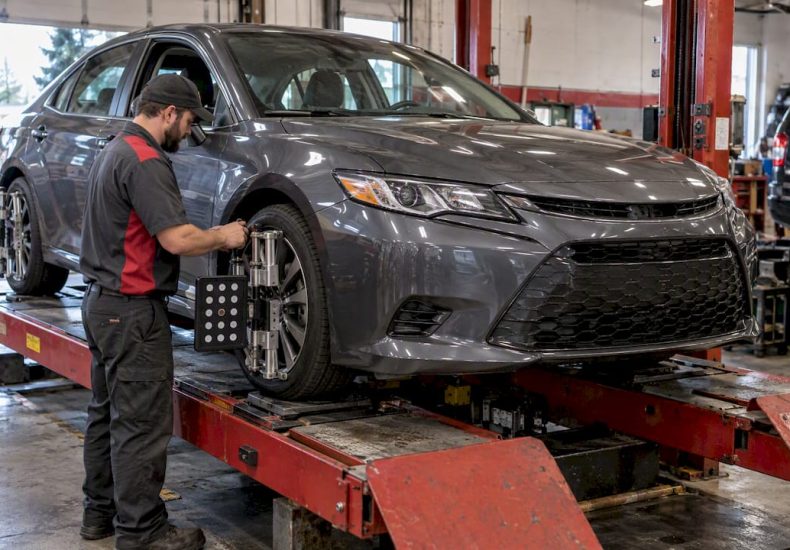
Wheel Alignment After Suspension Work: When You Need It
Yes, get an alignment after most suspension work. Any repair that touches a part setting toe, camber or caster, such as tie rods, control arms, struts, ball joints, springs or a subframe, changes your wheel angles. Simple add-ons like sway bar links usually do not. Do the alignment after the repair is finished and the car is back on the ground, and before you put many miles on the tires.
Below: which repairs require it, why a car that drives straight can still be out of spec, what it costs in 2026, and how to avoid paying for the same job twice.
TL;DR
- Alignment is needed after tie rods, control arms, struts, ball joints, springs, steering racks and subframe work. It is optional for plain shocks, sway bar links and bushings.
- Always align after the parts are installed, never before. A new part changes the geometry the old one had worn into.
- Driving straight proves nothing. Only the alignment rack shows the real angles.
- Expect roughly $80 to $273 for a four-wheel alignment, plus $100 to $300 more if your car needs driver-assist sensor recalibration.
- Ask the shop doing your suspension repair to plan the alignment into the same visit.
Table of Contents
- Which suspension repairs change your alignment
- Alignment after control arm replacement
- Alignment after tie rod replacement
- Why a car that drives straight can still be out of spec
- Before or after? Timing it right
- Newer cars: driver-assist sensors need attention too
- What a wheel alignment costs in 2026
- Our view: plan the alignment before the first bolt comes off
- Suspension repair in Lynnwood and nearby
- FAQ
- Sources
Which suspension repairs change your alignment
Your alignment is the set of angles at which each wheel meets the road. Three matter most: toe (how far the fronts of the tires point in or out), camber (the inward or outward lean of the wheel) and caster (the angle of the steering axis, which affects stability and steering return). Any part that locates the wheel can move one of them.
The guidance from independent repair sources is consistent: have the alignment checked after replacing any suspension or steering part that can change toe, camber, caster or ride height, which covers most strut, tie rod, control arm, ball joint, spring, steering rack and subframe jobs.
Here is how the common repairs sort out.
| Repair | Alignment needed? | Why |
|---|---|---|
| Outer or inner tie rods | Always | Directly sets toe |
| Control arms | Always | Moves camber and often caster |
| Ball joints | Almost always | Changes the wheel’s pivot position |
| Struts and coil springs | Yes | Changes ride height and can shift camber |
| Steering rack | Always | Resets the steering center and toe |
| Subframe or cradle work | Always | Moves every mounting point at once |
| Sway bar links and bushings | Usually not | They do not set geometry |
| Standalone shocks | Usually not | Same reason, but verify if ride height changed |
| CV axle | Usually not | Not an alignment part, but worth a check if the job involved the knuckle |
The honest caveat: an alignment is not mandatory after every suspension job. But a professional check is the only way to confirm the car is within manufacturer specifications, and a check costs far less than a set of tires.
Alignment after control arm replacement
A control arm connects the wheel assembly to the chassis. On many cars the arm itself has no adjuster, and you will find forum posts arguing that the control arm does not contain any alignment adjustments. That is true, and it misses the point. Removing and refitting the arm moves where the wheel sits, and a fresh arm with tight bushings and a new ball joint will not sit where the worn one did. The same thread ends up agreeing that refreshing worn components will alter the alignment.
Bosch’s installation guidance for chassis components says to perform a full wheel alignment immediately after replacing a control arm. It also notes that arms with rubber bushings should be supported near normal ride height before the final torque. Tightening them with the suspension hanging can preload the bushings, so they twist and fail early once the car is lowered. That is a good question to put to any shop: when do you torque the bushing bolts?
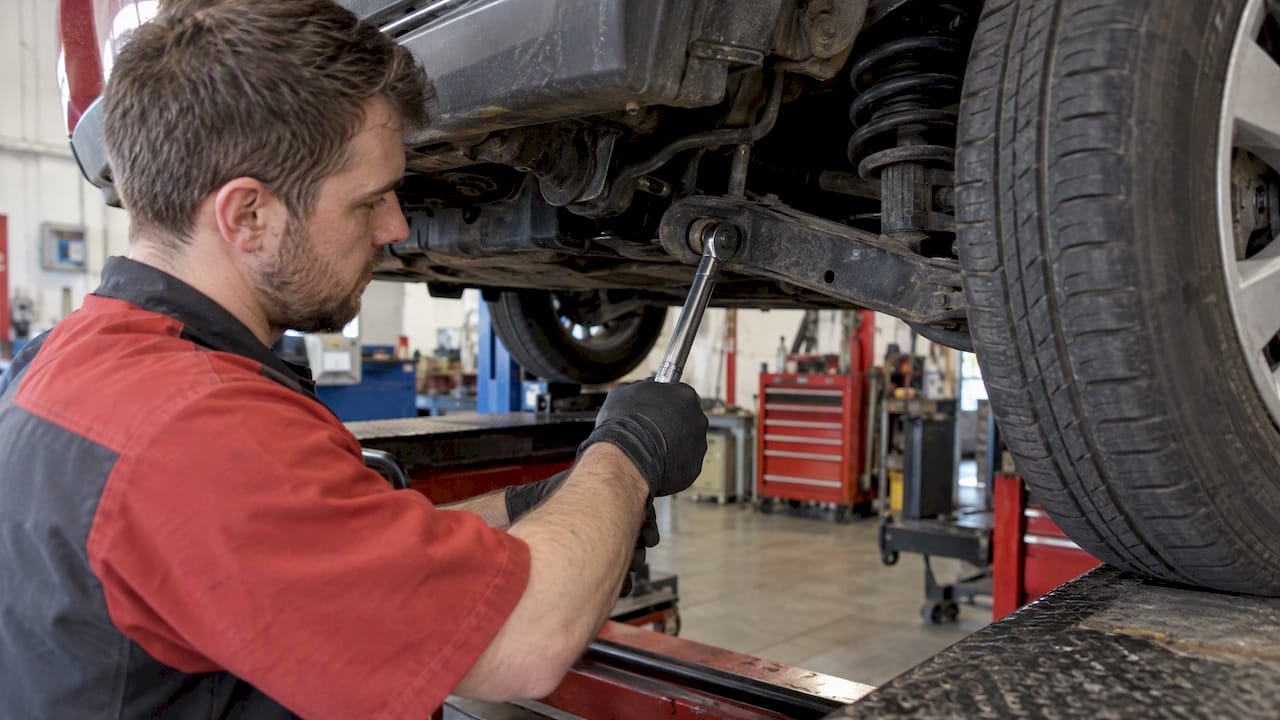
If you want to see how we handle the job, our page on control arm replacement in Lynnwood explains it.
Alignment after tie rod replacement
Tie rods are the clearest case. They are the link between the steering rack and the wheel, and their length sets toe. Many technicians count the turns when removing the old tie rod and put the new one back the same number of turns. That gets the wheel close enough to drive onto the rack, not to specification. MOOG explains that counting turns is no substitute for an alignment after an outer tie rod replacement.
A tie rod maker’s installation guide puts it plainly: a replacement changes toe, and driving with an unknown toe setting wears the tires and can trigger a stability warning. The same guide adds a useful diagnostic point. If the adjuster runs out of travel before toe reaches spec, the part is probably a mismatch or a defect. It should be exchanged, not forced.
Toe is also the angle that chews tires fastest. A car with bad toe can wear the edges of a tire noticeably within a few hundred miles. Our guide to tread patterns that reveal uneven tire wear shows what to look for.
Why a car that drives straight can still be out of spec
The most common reason people skip the alignment is that the car feels fine. Practitioners flag this as a dangerous assumption: a vehicle can track straight while its angles are far outside specification, quietly damaging tires and suspension parts. The steering wheel can be centered while the wheels point in slightly different directions.
Two more reasons a “perfect” part swap still needs the rack:
- New parts are tighter than old ones. Replacing a worn component with a new OEM part often changes the alignment, because the original had years of wear and deflection built in. Restoring factory handling means measuring again.
- The consequences are real. I-CAR documents a 2022 Porsche recall of 1,241 vehicles in which a suspension remedy had left out a rear axle alignment, with premature tire wear and reduced traction cited as the safety risk. If a manufacturer’s own repair procedure can be wrong without the alignment step, a driveway repair certainly can.
If the car already pulls, read why your car pulls to one side first. A pull after a repair can mean an alignment issue, but also a bad tire or a sticking brake.
Before or after? Timing it right
After. Always after the last part that touches geometry is installed and the car is at rest on its wheels. An alignment done before the repair measures the old, worn geometry and is wasted money.
A practical order:
- Finish every suspension and steering repair first. If you are planning struts and tie rods, do both before aligning. Doing struts later means a second alignment.
- Let the suspension settle. Roll the car on the ground and, ideally, drive a short distance so the bushings and springs take their position. Your shop will usually handle this.
- Replace worn tires if needed first. Aligning a car on tires that are already worn unevenly can hide or distort the readings. Check the 2/32 inch tread rule before you book.
- Get a printout. A proper alignment gives you before and after numbers for each wheel. Keep them with your repair records.
One more point: an alignment check and an alignment adjustment are different. Practitioners describe the check as a diagnostic step, which can reveal bent components or frame damage that must be repaired before adjustment is even possible. If a shop tells you the car cannot be aligned, ask for the measurements that show why.
Newer cars: driver-assist sensors need attention too
If your car has lane-keeping assist, automatic emergency braking or adaptive cruise control, the alignment is only half the job. The steering angle sensor has to learn the new straight-ahead position. Without that, stability control and lane-keep systems can be confused because the sensor no longer matches the car’s straight-ahead path, which usually means a scan tool or alignment machine recalibration.
Cameras and radar can also need recalibration. One 2026 price guide warns that vehicles with these systems may need cameras and sensors recalibrated after an alignment. RepairPal notes that this can add $100 to $300 on top of the base alignment price, and it is rarely included.
Ask two questions before you book: does my car have these systems, and will the quote include recalibration if it needs it? European and hybrid models in particular tend to be sensor-heavy. Air suspension adds its own wrinkle, since alignment depends on ride height. If you drive a car with it, these owner checks for air suspension leaks are worth running before the car goes on the rack.
What a wheel alignment costs in 2026
RepairPal puts the national range for a professional four-wheel alignment at roughly $80 to $273, depending on provider, vehicle and location. Chain stores sit at the low end for a one-time service and lifetime packages are around $200. Independent shops with technician time and a printout tend to land higher.
What moves the price:
- Front-only versus four-wheel. Most modern cars need all four wheels measured, even if only the front has adjusters.
- Adjustability. Cars that need aftermarket camber or caster parts cost more.
- Sensor recalibration. The $100 to $300 add-on above.
- Seized hardware. Rusted adjusters on older cars add labor. Salted winter roads and wet Puget Sound weather make this common.
If you are buying the repair and the alignment together, ask for one written quote. If your tires or AWD drivetrain are also in play, it is worth reading how tire matching and inspection checks affect AWD maintenance costs, because mismatched tires and bad alignment compound each other.
Our view: plan the alignment before the first bolt comes off
The most expensive alignment is the one that gets done twice, or never. Here is how we think about it at Tom’s B & M Auto, where we have been family-owned and operated in Lynnwood since 1985.
When a suspension job comes in, the alignment is part of the plan, not an afterthought. Our ASE-certified technicians inspect the car, we share the findings from the digital inspection, and we quote the work upfront so you know what the repair and its follow-up will cost before anything starts. If a part we install turns out to be a mismatch, the adjuster tells us right away and we exchange it.
Three habits we think every owner should adopt:
- Never judge alignment by feel. Ask for the numbers.
- Bundle repairs. If struts, tie rods and a control arm are all due, do them in one visit and align once.
- Watch the tires. Uneven wear is the earliest and cheapest warning. Catching it at 4/32 inch costs a repair. Catching it at 2/32 inch costs a repair and tires.
Our work carries a 24-month/24,000-mile warranty, so we care that the car leaves right and stays right. If you are not sure how the alignment fits with your repair, ask us when you book and we will walk you through it.
— Shingi
Suspension repair in Lynnwood and nearby
If your car is pulling, clunking or wearing tires unevenly, we can inspect the suspension and steering, tell you what needs replacing and quote it upfront. We work on all makes, including Toyota, Honda, Subaru, domestic, European and hybrid vehicles, and same-day appointments are often available. Start with our suspension and repair services, or read our squeaky suspension checklist to see what to look for before you call. We also serve Alderwood Manor and nearby areas.
FAQ
Do I need an alignment after suspension work?
Usually, yes. Any repair to a part that sets toe, camber or caster, including tie rods, control arms, struts and ball joints, changes your angles. Plain shocks and sway bar links often do not, but a check on the rack is the only way to be sure.
Should I align before or after replacing suspension parts?
After. An alignment before the repair only measures worn parts and will be undone as soon as the new ones go in. Finish all geometry-related repairs first, then align once.
How soon should I get the alignment?
As soon as the repair is complete, ideally the same day or before you rack up significant mileage. Driving on bad toe wears tires quickly, and a new part’s unknown toe setting can also trigger stability warnings.
How much does an alignment cost?
A national average range is roughly $80 to $273 for a four-wheel alignment, according to RepairPal. Add $100 to $300 if your car’s driver-assist sensors need recalibration. Get a written quote that says what is included.
Can I align a car with worn suspension parts?
Not reliably. Worn ball joints, bushings or tie rod ends let the wheel move while it is measured and after it leaves the shop, so the numbers will not hold. Repair the worn parts first, then align.
Sources
- I-CAR: when a wheel alignment is needed
- RepairPal: wheel alignment cost estimate
- SuspensionHQ: alignment after suspension work
- Strutmasters: alignment and suspension repairs
- MOOG: why an alignment is needed after an outer tie rod replacement
- Bosch: chassis components installation instructions
- Bonpora: tie rod installation guide
- SwedeSpeed: alignment after control arm replacement
- Car Service Land: wheel alignment in 2026
Recommended
- Squeaky Suspension: Quick Checks Before Clunks Signal Trouble
- How to Diagnose Suspension Noise Before It Gets Worse
- Why Your Car Pulls to One Side: Causes and Fixes
Leave a Reply