

Hybrid Inverter Coolant: What It Is and When to Change It
Hybrid inverter coolant is the fluid in a separate, sealed cooling loop that keeps your hybrid’s power electronics from overheating. It is not the same job as your engine’s coolant, and on many vehicles it is not interchangeable with whatever jug of antifreeze is on the shelf. Use the exact fluid your owner’s manual names, check the level at least once a year, and have a qualified shop handle any drain and refill, because that loop sits right next to high-voltage parts.
This guide explains what the inverter does, why it needs its own coolant, what to put in it, how often it is due, and what a proper service involves.
TL;DR
- Your hybrid has an inverter cooling loop that is separate from the engine’s loop on most vehicles. It carries its own reservoir, pump and radiator section.
- Inverter coolant is not the same as generic antifreeze for every make. Follow the fluid specification in your owner’s manual, not the color of the bottle.
- Intervals vary a lot by manufacturer. Some call for a check once a year, others for replacement around 10 years or 120,000 to 200,000 miles. Your maintenance schedule is the authority.
- Opening a hybrid cooling system near orange high-voltage cables carries real risk. Leave the drain and refill to a trained technician.
- A “Refill inverter coolant” warning, a boiling reservoir or a hybrid system fault light means stop driving and get it checked.
Table of Contents
- What the inverter does and why it runs hot
- Inverter coolant vs. engine antifreeze
- Which coolant does your hybrid need?
- How often to check and replace it
- Signs the inverter cooling loop needs attention
- Why this is not a driveway job
- What a proper hybrid cooling system service involves
- Where inverter coolant fits in overall hybrid costs
- Our perspective: what we see in the bay
- Have us look at your hybrid’s cooling system
- FAQ
- Sources
What the inverter does and why it runs hot
The inverter converts high-voltage DC electricity from the hybrid battery into the AC power that drives the electric motor or motors. According to one manufacturer’s maintenance documentation, the inverter coolant is its own service item, listed apart from the engine coolant. That is a clue about how seriously engineers treat it.
Moving that much power creates heat. The electronics inside the inverter are sensitive to temperature, so a dedicated loop pulls heat out of the inverter (and on many designs the motor-generator) and sheds it through a radiator. On some Toyota hybrids the arrangement is quite literal: the Prius uses an independent cooling system with its own radiator and water pump, running at a lower temperature than the engine loop.
If that loop loses coolant or the pump fails, the inverter can overheat. The car may then cut power, set a warning, or stop letting you drive in electric mode. Repairs to inverter assemblies are expensive, which is why the cheap maintenance matters.
Inverter coolant vs. engine antifreeze
People search “is inverter coolant antifreeze?” and get conflicting answers because both are true in different ways. Inverter coolant is usually an ethylene glycol-based antifreeze mixed with water, so it looks like antifreeze. But the fluid has a second job that engine coolant does not: it must not become a path for electricity.
Department of Energy material on thermal control describes the integration of motor and power electronics with their thermal systems as a critical engineering problem. Engine cooling is about temperature and corrosion. Inverter cooling adds electrical isolation, which means low conductivity. Contaminants, wrong additives or a wrong mix can raise conductivity and corrode the aluminum heat sink passages.
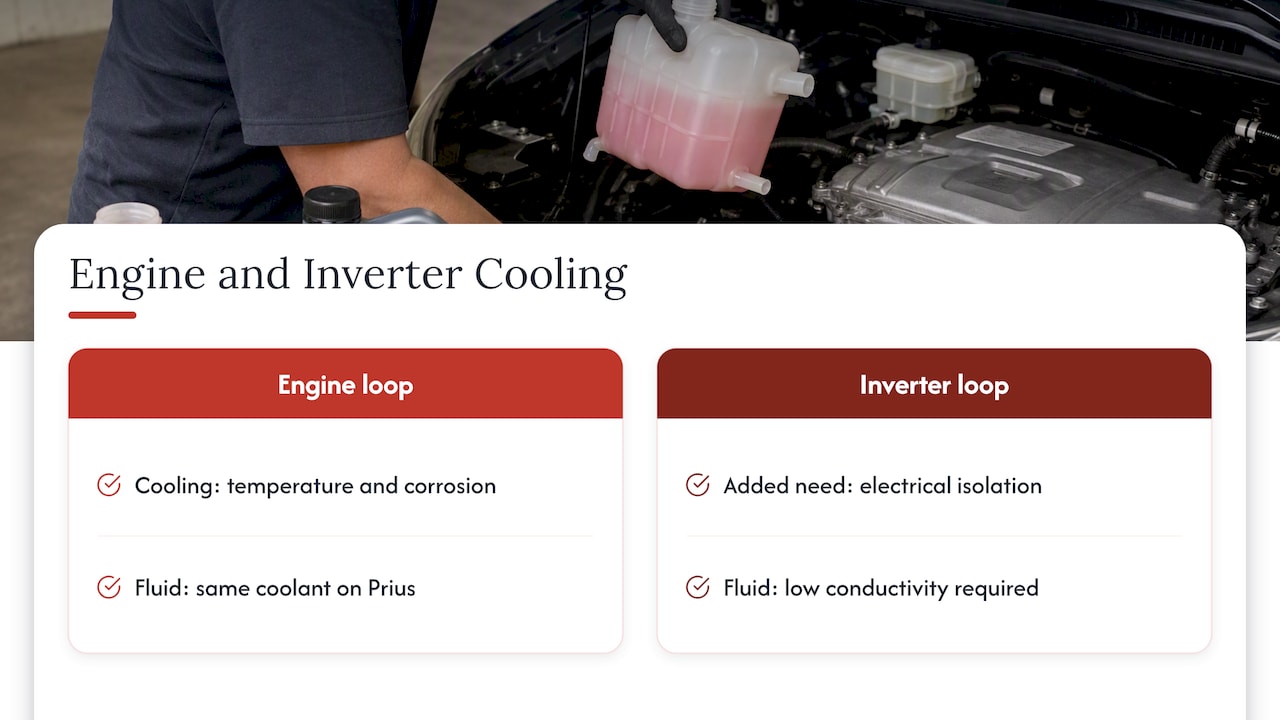
Some manufacturers go further. One automaker’s guidance notes that inverter systems often call for specific, non-conductive coolant, and that the wrong fluid can cause malfunctions and warranty problems. Others, including Toyota on the Prius, specify the same long-life coolant for both loops. So the honest answer is: it depends on the vehicle, and the manual decides.
Why “just top it off with any pink or green” goes wrong
A popular question on owner forums is whether a common off-the-shelf antifreeze can go into the inverter reservoir. Sometimes the answer is yes, if it matches the factory specification exactly. Often it is no, for these reasons:
- Chemistry mismatch. Different coolant technologies (organic acid, hybrid organic, silicate-based) use different corrosion inhibitors. Mixing them can cause gelling or deposits in narrow passages.
- Color is not a standard. Pink, red, blue and yellow coolants exist from many makers with different chemistry. Color alone tells you nothing.
- Concentration matters. Some products are sold full strength and need distilled water. Others are premixed. Adding tap water introduces minerals that raise conductivity.
- Warranty. Using a fluid that does not meet the stated specification can give a manufacturer grounds to deny a claim on the related parts.
Which coolant does your hybrid need?
Check these places, in this order:
- Owner’s manual, capacity and specification section. It names the fluid by specification or part number.
- The reservoir cap and label. Many hybrids print a warning and the coolant type under the hood.
- Maintenance schedule. It often lists inverter coolant separately from engine coolant, with its own interval.
- The dealer parts desk or a hybrid-experienced shop. Give them the VIN, not just the model name.
Here is what the sources we reviewed show, to illustrate how much this varies:
| Vehicle family | What the source says | Where to confirm |
|---|---|---|
| Toyota Prius, 2nd generation | Factory filled with Toyota Super Long Life Coolant, which is premixed; the same page says the older Long Life Coolant should not go in this generation | Prius inverter cooling reference |
| Kia hybrid system | Reservoir holds year-round antifreeze coolant filled at the factory; check protection and level at least once a year | Kia owner’s manual |
| Infiniti Q50 Hybrid (Canadian schedule) | Standard conditions: replace at 200,000 km or 180 months | Infiniti maintenance schedule |
Notice that none of these says the same thing. That is the point: your car’s own documentation is the only reliable answer.
How often to check and replace it
Two habits cover most owners.
Check yearly. The Kia manual above tells owners to check antifreeze protection and coolant level at least once a year. A good time is before winter, when freeze protection matters in the Pacific Northwest and a weak mix is easiest to catch.
Replace by the schedule. Replacement intervals on hybrids are long, but they are not infinite. Infiniti’s schedule for the Q50 Hybrid lists 200,000 km or 180 months under standard driving, with an earlier interval for severe use. Other makers differ. If your car is older or used for stop-and-go commuting, towing or heavy heat, lean toward the shorter end, and ask a technician to test the coolant condition rather than guess.
A long interval does not mean the fluid stays perfect. Corrosion inhibitors deplete with age, and a loop that has been low or contaminated needs attention sooner than the calendar says.
Signs the inverter cooling loop needs attention
- A dashboard message to refill inverter coolant. Hyundai’s Tucson Hybrid manual, for one, shows a warning that appears when the inverter coolant is nearly empty.
- A reservoir level that keeps dropping with no puddle under the car. Our guide on coolant loss with no visible leak explains why pressure testing finds what your eyes cannot.
- A whining or silent electric pump. The inverter pump is usually electric and quiet, and a failing one can cause overheating without any obvious noise.
- Reduced power, a hybrid system warning light, or the car refusing to go into ready mode in hot weather.
- Discolored, cloudy or oily coolant in the reservoir.
- Coolant smell near the front of the car after a drive.
If you see a hybrid system warning together with a hot smell or visible steam, pull over safely and call for help. Do not keep driving to see whether it clears.
Why this is not a driveway job
Some owners do replace inverter coolant themselves. On certain older Priuses, forum posters describe it as a gravity drain and refill. We understand the temptation, but we are cautious about recommending it, for three reasons.
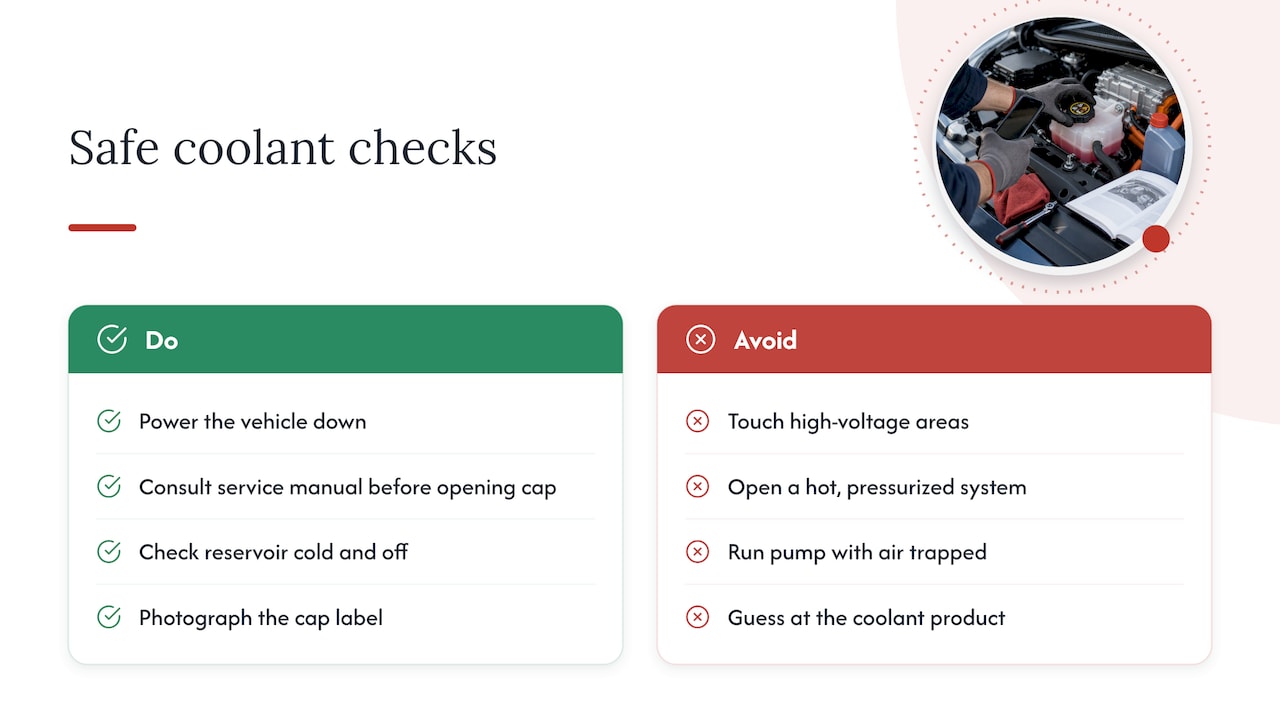
High voltage is in the neighborhood. Hybrid cooling systems have high-voltage components, often marked with orange cables and connectors, near the cooling path. The Kia manual says to consult the service manual for the exact procedure before opening the cap, power the vehicle down, and avoid contact with high-voltage areas. Pressure can also build in a hot system.
Air in the loop is costly. An electric pump can run dry if air is trapped. Many models need a specific bleed procedure, sometimes using a scan tool to run the pump, so the system is purged correctly.
Wrong fluid is easy to buy. Between look-alike bottles and premixed versus concentrate products, the chance of a mistake is real, and the damage shows up months later.
If you are comfortable with basic maintenance, you can still do the safe parts: look at the reservoir level with the car cold and off, note the color, and photograph the cap label. Then bring that information to a shop.
What a proper hybrid cooling system service involves
When readers ask about “hybrid cooling system service,” they usually mean the whole picture, not only a drain and fill. A thorough visit covers:
- Checking for stored codes and pump operation with a scan tool, since the inverter pump is electronically controlled.
- Inspecting the inverter radiator section, hoses, clamps and reservoir for seepage, cracks and debris blocking airflow.
- Testing the coolant’s condition and freeze protection, and confirming the fluid matches the specification.
- Draining and refilling with the correct coolant, following the model-specific procedure for bleeding air.
- Pressure testing if the level has been dropping.
- Checking the engine loop and the cabin heater circuit at the same visit, since they are often serviced together. Our explainer on what engine coolant does and why your car needs it covers that side.
The Department of Energy notes that future designs may merge the inverter and engine loops by using coolant tolerant of higher temperatures, though most systems stay independent today. So do not assume your car, or a friend’s, follows the same layout. Ask which loop you are looking at.
Where inverter coolant fits in overall hybrid costs
Hybrids often cost less to maintain in some areas, such as brake wear, and ask for attention in others, such as cooling and battery care. If you are weighing ownership costs, our breakdown of the three maintenance buckets that decide hybrid versus gas costs is a good place to start, and common hybrid service needs lists what to expect as mileage builds. For a broader, non-technical comparison of hybrid and electric ownership, this hybrid versus electric cars guide is a readable overview, though it is written for the Irish market. Cooling systems also matter for the high-voltage pack, which we cover in our hybrid battery service guide.
Our perspective: what we see in the bay
We have worked on cars in Lynnwood since 1985, and hybrids now come through our doors every week. The pattern is consistent: the inverter loop gets forgotten. Owners follow oil changes faithfully, because the sticker on the windshield reminds them, and then the cooling loop, which has no sticker, sits for a decade.
What we tell customers is simple. Treat the inverter coolant as its own line item on the maintenance schedule. Do not assume the engine coolant service covers it, because on many cars it is a different reservoir, a different pump and sometimes a different fluid. Ask the shop to show you which cap they are opening and which product is going in.
We also do not like guesses. If a hybrid is losing coolant, we want a pressure test and a scan of the pump before anyone sells you a part. And we would rather tell you a fluid is still good than replace it early. Our technicians are ASE-certified, we work on all makes including hybrid and European vehicles, and every repair comes with a 24-month / 24,000-mile warranty.
— Shingi
Have us look at your hybrid’s cooling system
If your hybrid is due for a coolant check, shows a warning, or you simply do not know when the inverter loop was last serviced, bring it to Tom’s B & M Auto in Lynnwood. We offer a cooling system flush and hybrid service for all makes, with upfront pricing and, often, same-day appointments. While the car is in, many owners also schedule an oil change, from $100, or a 30k, 60k, 90k service so everything is done in one visit. Military members, seniors and first responders can ask about our discounts.
FAQ
Is inverter coolant the same as antifreeze?
Not always. Both are usually glycol-based and look similar, but inverter coolant must also keep electrical conductivity low, and some makers require a specific non-conductive or silicate-free formula. Other makers, such as Toyota on the Prius, use the same long-life coolant in both loops. Match the specification in your manual.
What type of coolant does a Toyota Prius need?
According to one Prius reference, second-generation cars were filled at the factory with Toyota Super Long Life Coolant, a premixed product. Later models can differ, so confirm with your manual or VIN before buying anything.
How often should hybrid inverter coolant be changed?
It depends on the maker. One manufacturer’s schedule lists 200,000 km or 180 months under standard conditions, and another says to check the level and protection at least yearly. Follow your own maintenance schedule, and shorten it for heavy heat or stop-and-go use.
Can I top off the inverter reservoir myself?
You can look at the level with the car off and cold. Adding fluid is riskier: the wrong product can damage the loop, and the system sits near high-voltage parts. If the level is low, have a technician find out why before adding anything.
Sources
- Kia owner’s manual, engine coolant and inverter coolant
- Infiniti Q50 inverter coolant service and maintenance guide
- U.S. Department of Energy, thermal control and system integration
- Prius inverter cooling, Automotive Tech Info
- Hyundai Tucson Hybrid 2022 owner’s manual
Recommended
- What Is Engine Coolant and Why Your Car Needs It
- Hybrid Battery Service Explained: 2026 Owner’s Guide
- Coolant Loss With No Leak? Pressure Tests and Safe Home Checks
- Common Hybrid Vehicle Service Needs: 2026 Owner’s Guide
Leave a Reply